
Attached files
| file | filename |
|---|---|
| EX-32 - Yongye International, Inc. | v162701_ex32.htm |
| EX-31.2 - Yongye International, Inc. | v162701_ex31-2.htm |
| EX-31.1 - Yongye International, Inc. | v162701_ex31-1.htm |
UNITED
STATES
SECURITIES
AND EXCHANGE COMMISSION
Washington,
D.C. 20549
FORM
10-K/A
(Amendment
No. 1)
|
x
|
ANNUAL REPORT PURSUANT TO SECTION
13 OR 15(d) OF THE
|
SECURITIES
EXCHANGE ACT OF 1934
For
the fiscal year ended December 31, 2008
OR
|
¨
|
TRANSITION REPORT PURSUANT TO SECTION 13 OR 15(d)
OF THE
|
SECURITIES
EXCHANGE ACT OF 1934
For
the transition period from _____ to __________
COMMISSION
FILE NO. 333-143314
YONGYE
INTERNATIONAL, INC.
(Exact
name of registrant as specified in its charter)
|
NEVADA
|
20-8051010
|
|
(State
or other jurisdiction of
incorporation
or organization)
|
(I.R.S.
Employer Identification No.)
|
6th Floor, Suite 608, Xue Yuan
International Tower,
No.
1 Zhichun Road, Haidian District, Beijing, PRC
(Address
of principal executive offices)
+86
10 8232 8866
(Issuer’s
telephone number, including area code)
Securities
Registered Pursuant to Section 12(b) of the Act: Common Stock, par value $.001
per share
Securities
Registered Pursuant to Section 12(g) of the Act: None.
Indicate
by check mark if the registrant is a well-known seasoned issuer, as defined in
Rule 405 of the Securities Act.
Yes ¨ No
x
Check
whether the issuer is not required to file reports pursuant to Section 13 or
15(d) of the Exchange Act.
Yes ¨ No
x
Check
whether the issuer (1) filed all reports required to be filed by Section 13 or
15(d) of the Exchange Act during the past 12 months (or for such shorter period
that the registrant was required to file such reports); and (2) has been subject
to such filing requirements for the past 90 days.
Yes x
No ¨
Indicate
by check mark if disclosure of delinquent filers pursuant to Item 405 of
Regulation S-K is not contained herein, and will not be contained, to the best
of registrant’s knowledge, in definitive proxy or information statements
incorporated by reference in Part III of this Form 10-K or any amendment to this
Form 10K. ¨
Indicate
by check mark whether the registrant is a large accelerated filer, an
accelerated filer, or a non-accelerated filer. See definition of “accelerated
filer” and “large accelerated filer” in Rule 12b-2 of the Exchange
Act.
Large
Accelerated Filer ¨ Accelerated
Filer ¨ Non-Accelerated
Filer ¨
Smaller Reporting Company x
Indicate
by check mark whether the registrant is a shell company (as defined in Rule
12b-2 of the Exchange Act).
Yes ¨ No
x
The
aggregate market value of the 20,000,374 voting and non-voting common equity
stock held by non-affiliates of the Registrant was approximately $70,001,309 the
last business day of the Registrant’s most recently completed second fiscal
quarter, based on the last sale price of the registrant’s common stock on the
most recent date on which a trade in such stock took place prior
thereto.
There
were a total of 32,790,327 shares of the registrant’s Common Stock, par value
$0.001 per share, outstanding as of September 9, 2009.
DOCUMENTS
INCORPORATED BY REFERENCE
None.
EXPLANATORY
NOTE
We are
filing this Annual Report on Form 10-K/A (the “Amendment”) to amend Part I, Item
1, Financial Statements and Item 2, Management’s Discussion and Analysis of
Financial Condition and Results of Operations, in the original Annual Report on
Form 10-K, filed with the Securities and Exchange Commission (“SEC”). This
Amendment has been filed to correct an error in the manner in which we
calculated the number of shares outstanding in determining earnings per share,
and another error in which we should have reclassified warrants issued as a
derivative liability, and the financial statements contained herein are being
restated accordingly. In addition, certain revisions are being made to the
disclosures included in our Annual Report on Form 10-K for the year ended
December 31, 2008 initially filed with the Securities and Exchange Commission
(the “Commission”) on March 24, 2009 in response to the Commission’s comment
letter dated September 1, 2009.
TABLE
OF CONTENTS
|
PART
II
|
|||
|
ITEM
1
|
Business
|
1
|
|
|
ITEM
1A
|
Risk
Factors
|
8
|
|
|
ITEM
7
|
Management’s
Discussion and Analysis of Financial Condition and Results of
Operations
|
14
|
|
|
ITEM
8
|
Financial
Statements and Supplementary Data
|
24
|
|
|
ITEM
10
|
Directors,
Executive Officers and Corporate Governance
|
24
|
|
|
ITEM
11
|
Executive
Compensation
|
26
|
|
|
ITEM
12
|
Security
Ownership of Certain Beneficial Owners and Management and Related
Stockholder Matters
|
27
|
|
|
ITEM
13
|
Certain
Relationships and Related Transactions, and Director
Independence
|
29
|
|
|
Index
to Consolidated Financial Statements
|
31
|
||
|
Consolidated
Financial Statements
|
|||
i
ITEM
1 Business
Business
Overview
We are
engaged in the research, development and sales of fulvic acid based liquid and
powder nutrient compounds for plant and animal feed used in the agriculture
industry. Fulvic acid is produced by the decomposition of plant material
over a period of time and acts as a transport agent, which helps cells absorb
essential minerals and elements for growth. Based on our internal data and
research, we believe our proprietary technology for fulvic acid extraction
creates some of the purest and most effective fulvic acid base on the market in
China today. We have found that our fulvic acid has a very light weight
molecular composition, which we believe improves the overall permeability of
cell walls and allows more complete transport of nutrients across plant
membranes, effectively strengthening the overall health of plants.
Additionally, the Inner Mongolia Autonomous Region Scientific and Technology
Bureau (SEAL), on December 6, 2008, thoroughly reviewed the scientific and
economic data provided by the company and reached the opinion that information
provided by the project is complete; the data is detailed and reliable,
consistent with the identification requirements supports China’s agricultural
production development, the product has a wide range of efficacy, thereof
promoting plant growth, enhancing plant resistance, increasing production,
improving quality, increasing the utilization of fertilizer and etc. Large scale
experimentation has proven that the product can increase overall crop yield by
10-20%, and for vegetables, 15-30%, with the significant improvement of the
agricultural products quality, and outstanding economic and social benefits, the
project has obvious innovations in humic acid extraction process and of the
product preparation in selection and application in oxidants, composite
precipitators, complexing agent, distributed agent and additives.
Industry
and Market Overview
We
believe that in order to understand our business, it is important to understand
China’s economy. China has grown from a largely semi-subsistence economy to an
urban economy in recent years. The population shift to the first and
second tier cities (large populations with well developed infrastructure) such
as Beijing, Shanghai, Xian & Chengdu is already well documented and now
smaller cities such as Hohhot, Kunming and Linyi, with over 1 million people
each, are developing larger populations as well. The middle class is growing and
consumers are demanding better quality agricultural products and research
suggests that as income increases, as with other countries globally, consumers
begin to increase consumption of meat, fruit, vegetables, poultry and dairy
products (Economic Research Service/USDA, 2000). The agricultural industry
in China is expected to grow to keep up with this domestic demand, but added to
this is also a global demand for China’s agriculture products. This
increased demand is creating much volatility in the supply chain due to currency
fluctuations, logistics issues, pricing changes and market risk and we believe
farmers are at the crux of both a source of and solution to crop and animal
production issues China faces today. This is where we believe our products
can help to fulfill market need.
Currently,
crop production in China is limited to only 1.827 billion mu (121.8 million
hectares or approximately 301 million acres) of arable farm land, which is only
about 14% of all of China’s land (China, National Bureau of Statistics, 2008).
One principle to ensure food security is the “bottom line”: 1.8 billion mu (120
million hectares) of farmland which is (0.09 hectares) per capita, about a third
of the global average. In 1996, China had 1.951 billion mu (130.07 million
hectares), or 1.59 mu (0.11 hectares) per person — a loss of 6.4 percent of the
arable land in 11 years mainly to urbanization. China approves about 4 million
mu (266,667 hectares or 658,667 acres) for construction each year which impacts
about 2.82 million mu (188,000 hectares) of farmland. Currently about 70% of new
construction in second and third tier cities encroaches on farmland. China’s
urban population was about 43.9 percent in 2006 and continues to grow with
projections of 70 percent by 2050. China reported 7,438 square km of urban area
in 1981 and 32,521 square km in 2005, a 340-percent increase in 25
years.
China has
the world’s largest population, which it sustains on a very low amount of arable
land on a per capita basis, approximately 0.09 hectare (according to a story
appearing in China Daily on October 3, 2008). This is approximately 50% of that
present in the United States (Source: US Census Bureau, www.census.gov). This
high population density in China requires that each hectare of land feed an
average of 10 people compared to the world average of 4.4 people, which means
farm land is being used at close to capacity levels just for domestic production
levels. Another problem is desertification, the transformation of arable or
habitable land to desert due to changes in climate. Desertification claimed
1,200 square miles of land in 2007, or 120,000 hectares. This is a major
improvement from losses in the 1990’s which reached 10,000 square miles per
annum. According to an estimate by Interfax China, if unabated, the shortage
could reach 6.67 million hectares by 2020.
This
combination of limited arable land and a large and growing population has
created a significant need to increase the output of crops per hectare in China
using agricultural inputs as the main technology. In China, the average grain
yield per acre grew 98 percent between 1980 and 2005, while total fertilizer use
increased 416 percent from 9.1M tons to 47M tons. Much of the excess, however,
is lost to the environment, degrading both air and water quality, with 70% of
the nutrients being lost due to poor crop management (China Agriculture
Statistical Year Book, 1980-2005). The last five years, beginning with 2005,
have seen year on year increases in crop production which hasn’t been seen since
economic reforms began in the late 1970s (USDA Foreign Agriculture Service). We
believe exports and domestic consumption will continue to pressure crop
production upwards, so, given the limited amount of arable land, further growth
in farming capacity is likely to come from continued reliance on agricultural
input technologies.
This is a
common occurrence in most developing nations and has prompted the Food and
Agriculture Organization of the United Nations to implement an on-going, high
priority initiative to increase farmer education proper plant nutrient
management. The key point is that the UN is encouraging farmers to increase
nutrients to the plant without increasing the amount of fertilizer used. In case
of farmer education, the FAO says that the majority of the world’s farmers are
females and they tend to continue cultivating in traditional ways. They need to
be educated about the modern methods and the governments should take initiatives
for this. Overall, we believe that this supports not only our plant nutrient
approach, but also our educational approach to selling our product, which is
helping farmers to increase yields via overall education and proper use of input
products.
Also,
with the growth of the economy has come growth in consumers’ demand for a wider
choice of food options. One key area of growth is the demand for dairy
products. The Chinese Government has now attached great importance to the
development of this industry and it is now growing after being dormant for many
years. However, average yield per cow is only about 2,000kg, indicating
relatively low productivity. One major reason for this low production is
mastitis, which is an inflammation of the teats which slows down milk
production. This is an industry wide problem where 35-40 cows out of 100 have
some form of mastitis, which is typically treated with antibiotics.
With this
backdrop, we began selling our plant and animal nutrient products to help
farmers increase their farming output. In crop production, we believe that our
product assists farmers in generating higher yields from their crops and our
first line of animal product for dairy cows assists with the reduction of
mastitis to increase milk production.
Our
Domestic Market
The
amount of land used for agriculture in China is declining because of urban
encroachment and increasing non-agricultural use of land, and a large number of
farmers have moved to cities for higher paying jobs. China is going through
rapid urbanization, creating pressure to use arable land for development and
industrial purposes. Arable land is also being lost because of pollution
(especially by heavy metals), uncontrolled erosion, overuse of chemical
fertilizers and desertification. At the end of 2007, China had a total of 122
million hectares of arable farmland, which is expected to decrease to about 97
million hectares by 2015 (China National Grain and Oil Information
Center).
1

As the
overall economy grows, consumer demand for better quality food products is also
growing. Over 60% of the nation’s population is comprised of low income, rural
farmers (Asian Development Bank). The government has made raising the level of
rural income, especially in Western China, a top economic and social goal.
The government expects annual rural income to grow between 5% and 10% through
2010. With increased income among a large portion of the population, demand for
better food products, including organic “Green Food,” is expected to grow. The
need to use land efficiently has led to a genuine need to improve productivity.
China’s increasingly affluent urban centers and rising concerns about food
quality and safety have led to greater demand for organic plant and animal
nutrients (Demand for Food Quantity and Quality in China, USDA/ERS, January
2007).
Barely
meeting domestic demand for agricultural products, food security has become a
national priority in China (as noted in China’s Food and Agriculture: Issues for
the 21st Century, ERS/USDA). China is self-sufficient in its ability to raise
most of its staple crops, which is a part of food security, but increasingly
dependent on imports of some agricultural products, such as soybeans, to meet
rising domestic demand. This was after China’s agricultural output increased 19%
in the period 1988 to 2004 from 394,080,000 tons to 469,469,000 tons (China’s
Hunger: The Consequences of a Rising Demand for Food and Energy).
We
estimate, by the end of 2008, the overall fertilizer market generated over $50
billion in sales in China and has grown about 30% a year from 2005 to 2009.
Demand for organic plant fertilizers and nutrients is expected to grow with
increasing concern over food quality and environmental issues. Over reliance on
chemical fertilizers has led to soil degradation and water pollution, raising
the importance of alternative means of increasing productivity. The government
plans to spend approximately $169 billion, 1.6% of GDP, between 2006 and 2010 on
environmental objectives (OECD, 2006). In 2007, China spent about $5.9 billion
on direct subsidies for grain production and the purchase of agricultural
materials, up 63% from 2006. The government is planning on additional farm
subsidies, land reform initiatives, and elimination of certain agricultural
taxes and is promoting the production of organically grown products by setting
new standards.
Domestic
competition for plant nutrients typically comes from companies in the
traditional fertilizer industry, though the plant nutrient market does not
directly compete with traditional fertilizer products. China’s fertilizer
industry is highly fragmented, with over 2,800 fertilizer products registered
with the government in 2007 (according to the PRC Ministry of Agriculture).
Yongye competes against 164 other fulvic acid fertilizer products (Chinese
Fertilizer Net), however, we believe that only four other similarly enhanced
fulvic acid based products are truly competitors. We have found that most of the
products provided by local fertilizer companies are low quality, liquid compound
fertilizers, many of which are not licensed for sale. We believe these products
do not provide plants with a full range of nutrients and international producers
have higher quality offerings, but are comparatively expensive. Yongye’s animal
nutrient product, which we believe helps to reduce the onset of mastitis,
competes against medicines with antibiotic properties, which are usually used to
treat livestock after the onset of infection. The Company’s nutrient product for
dairy cows underwent internal research and market testing, which substantiated
its beliefs that it improved milk production and helped dairy cows avoid a
number of diseases including mastitis. Thus, we believe that the use of our
animal nutrient product may promote health and decrease the need for expensive
medicines in dairy cows.
The
Market for Plant Nutrients
China
Market
|
•
|
The
overall fertilizer market is estimated to be a $50B industry in China –
estimated to grow about 30% a year from 2005 to
2009
|
|
•
|
China
has about 1.81B Mu of arable land – we believe all cash and row crops
benefit from the use of Yongye’s “Shengmingsu”™
product
|
|
•
|
China
purchased 63% more agricultural materials in 2007 than 2006 - the market
is growing rapidly
|
Yongye’s Market: Ten
Provinces
|
•
|
Yongye
grew about 265% in 2008 as compared with its predecessor company in 2007
and expects to grow an additional 70-75% in
2009
|
|
•
|
Our
estimates show that nutrient products are applied to about 6% of all
arable land
|
|
Yongye International, Inc. and
Subsidiaries
|
The Predecessor
Inner Mongolia Yongye
|
|||||||||||||||||
|
YEAR ENDED DECEMBER 31, 2008
|
YEAR ENDED DECEMBER 31, 2007
|
|||||||||||||||||
|
Largest Customers
|
Amount of Sales
|
% Total
Sales
|
Largest Customers
|
Amount of Sales
|
% Total
Sales
|
|||||||||||||
|
Hebei
|
$ | 20,541,267 | 43 | % |
Xinjiang
|
$ | 3,853,891 | 29 | % | |||||||||
|
Xinjiang
|
$ | 6,886,624 | 14 | % |
Beijing
|
$ | 2,980,234 | 23 | % | |||||||||
|
Gansu
|
$ | 6,291,070 | 13 | % |
Hebei
|
$ | 1,976,680 | 15 | % | |||||||||
|
Inner
Mongolia
|
$ | 5,663,011 | 12 | % |
Dalian
|
$ | 1,216,097 | 9 | % | |||||||||
|
Shandong
|
$ | 4,727,842 | 10 | % |
Jiangsu
|
$ | 740,251 | 6 | % | |||||||||
|
Total
|
$ | 44,109,813 | 92 | % |
Total
|
$ | 10,767,153 | 82 | % | |||||||||
Competitive
Advantages
We
believe that we have the following four competitive advantages:
|
1.
|
Unique
formula for both plants and animals. Our patented plant product mixture
process and patent pending animal product mixture process are for the
invention of specific formulas used in these base products. We are the
first company to patent such formulas in our industry and we plan to
continue to improve and diversify them based on customer
need.
|
|
2.
|
Recognized
and certified product offerings. We believe we are well recognized in our
markets because we work with government authorities to establish the
strength of our product and company and we work with farmers in creating
loyalty via our sales and support process. We also make sure our products
are certified by all appropriate authorities starting with the Ministry of
Agriculture which allows domestic manufacturing and sales of the product.
We are also ISO 9001 certified.
|
2
|
3.
|
Provide
direct technical and support services to farmers who purchase products. We
work to create strong customer loyalty by supporting farmers from product
trials through initial purchase and finally into large quantity purchases.
We educate farmers in yield production techniques and show them how our
products are part of this process. We also show them how our product works
by setting up trials in specific areas and helping them use the product
throughout the season as well.
|
|
4.
|
Cost
effective extraction of fulvic acid on an industry scale. We believe our
extraction process is unique in our industry in that it allows us to
create a product which has been found to be more bioactive than other
fulvic acid mixtures on the market. We believe that we not only
create a better fulvic acid base for our products, but do it in a cost
effective manner. We believe this allows us to create a better
product at a competitive price.
|
We
believe that our strategic growth plan for 2009 capitalizes on the following
market conditions to build long term profitability:
|
•
|
In
October 2008, we began a restructuring process to acquire the
predecessor’s existing building and equipment for the 2000 tonnes per
annum (“TPA”) facility and 120 Mu of land which will house the entire
10,000 TPA facility. This effort will not be completed until approximately
October 4, 2009.
|
|
•
|
Completed
construction of a new 8,000 Tonnes Per Annum (TPA) processing facility in
October 2008, which increased the production to 10,000 tonnes per
annum.
|
|
•
|
Employing
strategic television and print advertising to support sales throughout
2008 and 2009. For example, we launched an infomercial campaign on local
channels to educate farmers and to help them alter usage
patterns.
|
|
•
|
Developing
customized and enhanced plant products targeting specific crops with the
intent to increase yields and market
position.
|
|
•
|
Increasing
our line of animal product offerings to capture a wider market – we hope
revenue from these products has the effect of reducing the seasonal sales
swings in slower quarters.
|
|
•
|
Building
our revenue base via increased sales coverage in current provinces and
increased market penetration through additional support staff
coverage.
|
Our
Corporate History and Background
We were
incorporated in the State of Nevada on December 12, 2006 under the corporate
name “Golden Tan, Inc.” At that time we were engaged in the business of
offering sunless tanning services and selling tanning lotions. In 2008, we
began to pursue an acquisition strategy, whereby we sought to acquire an
undervalued business with a history of operating revenues in markets that
provide room for growth.
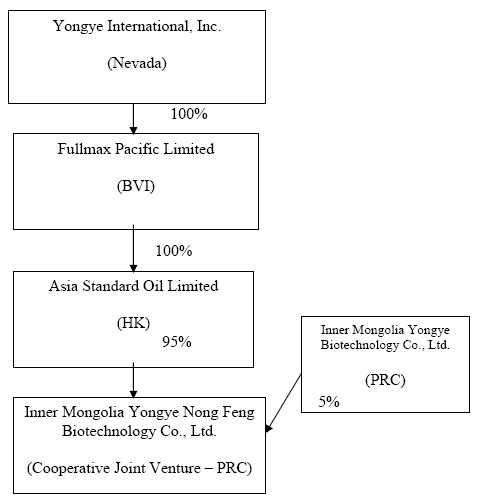
The
following chart reflects our current organizational structure as of the date
hereof:
Yongye
International Organizational Structure
On April
17, 2008, we entered into a Share Exchange Agreement (the “Exchange Agreement”)
with Fullmax Pacific Limited, a company organized under the laws of the British
Virgin Islands (“Fullmax”), the
shareholders of Fullmax (the “Shareholders”), who
together owned shares constituting 100% of the issued and outstanding ordinary
shares of Fullmax (the “Fullmax Shares”), and
our principal shareholder (the “Principal
Shareholder”). Pursuant to the terms of the Exchange Agreement, the
Shareholders transferred to us all of the Fullmax Shares in exchange for the
issuance of 11,444,755 (the “Shares”) shares of
our Common Stock (the “Share Exchange”). As
a result of the Share Exchange, Fullmax became our wholly owned subsidiary and
at that time, the Shareholders acquired approximately 84.7% of our issued and
outstanding Common Stock. As a result of the Share Exchange, we are now
engaged in the sales of fulvic acid based plant and animal nutrients in
China.
In
November 2007, Asia Standard Oil Limited, a Hong Kong company that is the wholly
owned subsidiary of Fullmax (“Asia Standard”),
entered into a Sino-foreign cooperative joint venture agreement with Inner
Mongolia Yongye (“CJV
Agreement”), a PRC company that has been in the business of researching,
producing and selling its own proprietary plant and animal nutrient products
since 2003 (“Inner
Mongolia Yongye”). Asia Standard and Inner Mongolia Yongye formed
Yongye Nongfeng Biotechnology Co., Ltd., a new cooperative joint venture under
PRC law (the “CJV” or “Yongye Nongfeng
Biotechnology”) in January 2008. Yongye Nongfeng Biotechnology was
incorporated and approved by the Inner Mongolia Department of Commerce and the
Inner Mongolia Administration for Industry and Commerce on January 4,
2008. Under the CJV Agreement, being its capital contribution obligation,
Inner Mongolia Yongye shall assign (i) its intellectual property rights,
registered trademark and patents; (ii) assist the CJV to recruit the whole
management team; (iii) assist the CJV to handle various governmental approval
and filing matters; (iv) arrange the office and manufacturing sites for the CJV;
and (v) assist the CJV to take care of foreign employees. As a separate
matter, Inner Mongolia Yongye shall assign its customers and sales contracts to
the CJV. In addition, the CJV has an option to purchase the manufacturing plant
of Inner Mongolia Yongye in two years. The CJV has a ten-year term commencing
from January 2008, subject to extension and early termination. The CJV agreement
is essentially a joint venture agreement that governs the division of profits
between the parties and generally provides for how the CJV should be managed and
governed, subject to applicable PRC law. The CJV agreement may be amended
or supplemented by mutual agreement of the parties. The CJV agreement may
be terminated upon unanimous consent of the board of directors of the CJV,
subject to governmental approval. PRC law mandates the dissolution of a
contractual joint venture, subject to governmental approval, in certain cases:
(i) the term of cooperation expires; (ii) the cooperative enterprise is unable
to continue operation due to the occurrence of heavy losses or grievous injury
caused by force majeure; (iii) the cooperative enterprise is unable to continue
operation because one or several partners fail to implement the obligations
stipulated in the cooperative enterprise contract and the articles of
association; (iv) an occurrence of other causes for dissolution as set forth in
the cooperative enterprise contract and the articles of association; and (v) the
cooperative enterprise violates laws and administrative regulations, and is
ordered to be closed by law. Any rights of Inner Mongolia Yongye to
terminate the CJV agreement would be limited to (iii) in the preceding sentence,
subject to governmental approval; in the event of (ii) or (iv) in the preceding
sentence, the board of directors of the CJV must make such determination,
subject to governmental approval.
3
We
operate our businesses in China solely through Yongye Nongfeng Biotechnology,
which is 99.5% owned by Asia Standard and 0.5% owned by Inner Mongolia Yongye as
stipulated in the CJV contract. Such percentages reflect the equity ownership
assuming the total amount of registered capital has been fully paid, which is
$21,000,000, of which $20,900,000 shall be contributed by Asia Standard Oil
Limited, and $100,000 shall be contributed by Inner Mongolia Yongye.
Because ASO only paid $16,778,741 in the year ended 2008 and Inner Mongolia
Yongye fully paid the $100,000, based upon the amount of registered capital that
has been paid to date the percentages are 99.4% and 0.6%, respectively as of
December 31, 2008. As agreed by Inner Mongolia Yongye separately, the former
primary contract manufacturer of Shengmingsu products for Yongye Nongfeng
Biotechnology, it shall assign its management and administrative team,
manufacturing employees, customers, and sales contracts to Yongye Nongfeng
Biotechnology.
As part
of the September Financing, we began a restructuring process which required us
to purchase the land, buildings and equipment which comprised the 10,000 TPA
capacity completed in October 2008. We began this process by purchasing the
predecessor’s 2000TPA equipment in October 2008, but in order to complete the
process we needed to own the fertilizer license issued by the PRC Ministry of
Agriculture. The fertilizer license, previously issued to Inner Mongolia Yongye,
was issued in the name of Yongye Nongfeng Biotechnology (the “License”) on June
1, 2009, which now permits Yongye Nongfeng Biotechnology to manufacture its own
finished products. Now that the License has been received, we intend to
acquire the remaining land and assets related to the manufacture of finished
products from Inner Mongolia Yongye (the “CJV Restructuring”). The total
liability incurred for payments to the Predecessor company is limited to USD$6M
and thus far USD$.95M has been paid to the predecessor company.
Our
Principal Products and Services
The base
of our product is our own proprietary fulvic acid compound, which is extracted
from humic acid. Fulvic acid is a complex, acidic, biochemical polymer which can
either be produced naturally by the decomposition of plant material over a long
period of time or via a manufacturing process. Fulvic acid binds itself to
cellulose fibers and strengthens the cell walls of plants and animals and acts
as a transport agent helping cells absorb the essential minerals and elements
for growth. Fulvic acid usually carries 70 or more minerals and trace elements
as part of its molecular complexes. These are in ideal natural form to be
absorbed by plants and interact with living cells. Plants readily absorb high
amounts of fulvic acid, and more readily maintain the minerals and trace
elements brought in by fulvic acid. Fulvic Acid creates bioactivity in plant
cells and makes them healthier. Our proprietary process extracts fulvic acid
from humic acid and creates the base fulvic acid compound used in both our plant
(liquid form) and animal nutrient (powder form) products. We have determined
that this process will remain a trade secret due to its importance in the
creation of our final product. If we were to patent this process, we would
necessarily have to publicly disclose certain information as part of the patent
application, and thus lose our competitive advantage we believe we currently
have.
We
believe, and our research has shown, Fulvic Acid (FA) has the following key
attributes when used in the agricultural industry for both plants and
animals:
|
•
|
Dissolves
and then absorbs minerals into
itself;
|
|
•
|
Polymer
properties protect vitamins and minerals during uptake or
digestion;
|
|
•
|
Contains
many essential nutrients for health and
growth;
|
|
•
|
Works
especially well in adverse
conditions;
|
|
•
|
Increases
natural strength and ability of cells to fight off sickness and
disease;
|
|
•
|
Scavenges
free radicals and removes toxins such as heavy metals and
pollutants;
|
|
•
|
Increases
oxygen intake into the cells; and
|
|
•
|
Maximizes
enzyme development which results in better uptake or
digestion.
|
The
principal raw material used in creating fulvic acid is Humic Acid (HA). Humic
Acid is naturally occurring organic soil matter or “humic substance” which is
mined from Leonardite Coal. Humic Acid exhibits a high cation exchange capacity
(CEC) or in other words makes it easier for soil nutrient particles to move
within the soil, and thus to be taken in by plants. Humic Acid also increases
the nutrient intake ability of plants through “chelation”. Normally, trace
elements are positively charged while the pores or openings on the roots and
leaves of plants are negatively charged which restricts the transfer of minerals
because of the mismatched charges. However, with the addition of a chelate,
Humic Acid, the minerals are encapsulated in the chelate and the positive charge
changes into a net negative or neutral charge, which allows the element to pass
through the pore and into the plant. Also, we have believe that the regular use
of HA organic liquid compound fertilizer can enable fertilizer, insecticide,
herbicide and water use to be reduced. We believe this can be supportive to the
environment since it may prevent contamination of water sources caused by
runoff.
Product Functions and
Results: Plant Line
Our plant
products are sold by the 100 ml bottle and in cases of 100 bottles each. The
average farmer in China has a cultivated land area of 2-4 Mu and this requires
about 6-12 bottles of product which is sprayed on every 15 days over a 45 day
growing period. We believe that if the farmer uses our product correctly, he can
decrease the use of fertilizers to normal levels and decrease overall usage of
pesticides and herbicides which may reduce their overall input costs. Internal
studies show that, depending upon the crop, the farmer will see increases in
yields and value in the market place which should increase overall income. Each
crop varies in response to the product, but we believe farmers may be expected
to experience increases on par with the following results under the proper
fertilizer and water conditions:
|
Crop
|
Yield
|
|
|
Capsicum
(green pepper)
|
increases
yield by up to 22.7%
|
|
|
Carrot:
|
increases
yield by up to 26.5%
|
|
|
Celery:
|
increases
yield by up to 26.3%
|
|
|
Cucumbers:
|
increases
yield to 21.7%, and the leaves are greener, the plants are higher by
3.0cm, and earlier to market by 11 days
|
|
|
Grapes:
|
increases
weight of individual grape 0.4g, 18.2%, increases sugar content
37.5%
|
|
|
Potatoes:
|
increases
yield up to 17.3%, and the leaves are thicker and they bloom 7 to 10 days
earlier
|
|
|
Watermelon:
|
increases
yield by up to 16.9%, increases sugar content 0.8%-1.8%
|
|
|
Wheat:
|
increases
yield up to 10.7%
|
Product Functions and
Results: Animal Line
Currently,
our animal product line is specifically targeted at dairy cows, although we plan
to develop products customized for other animals in the future. We believe
that our animal products will help increase the capacity of the dairy supply
chain by increasing the health of the dairy cows and reducing their problems
with mastitis. We use our base of fulvic acid and add the Chinese herbs Matrine
& Oxymatrine. Matrine and Oxymatrine are non-steroidal analgesics which are
anti-inflammatory in nature and are administered in treatment of mild to severe
pain or treatment of inflammatory states. They also have a variety of biological
activities.
4
In
general, our internal studies show that the financial impact for farmers from
using our product has been an annual net profit increase per cow due to an
increase in production, and if used for treatment of mastitis, a decrease in the
costs associated with the purchase of additional products to reduce bacterial
inflammation, which could also be expected to increase annual net profit.
We sell our product in 300g packets that are bundled into ten (10) 20g bags. A
typical regime of use would be one cow taking 1.5g daily over a 100 day period
of time.
New
Products for 2009
In 2008,
we did not roll out any customized products within our two product lines because
the market demand for our universal product for plants and for animals was
sufficient to gain market share and drive revenue. However, for 2009, we will
continue to look at opportunities to develop market driven additions to our
product lines as demand exists.
Plant
Products
Currently,
we use a universal product which can be applied to all types of crops, but will
increase our product offerings to the following:
Corn, La
Jiao Pepper, Wheat, Rice, Cucumber, Tomato, Cotton, Potato, Sunflower, Grapes,
Tropical Fruits and Flowers.
When we
introduce these products into the market place, we plan to charge a small
percentage more than we do for the universal product, which should increase our
revenue by a small amount. This will not replace our universally applied product
as we will leave it in the market as well. We also expect to increase the price
as market forces demand.
Animal
Product
After
successful sales in our test market, we will continue to offer our Dairy Cow
products, but expect to increase sales of the product due to targeted marketing
in selected provinces. We are also working on the introduction of products for
pigs, chickens and sheep.
Our
Contract Manufacturing Outsourced Process
We
believe that our competitive advantage begins with our core intellectual
property (“IP”)
and cost effective production capability, which is attributed to our IP and
manufacturing process we are acquiring from our contract manufacturer, Inner
Mongolia Yongye. The former chief scientist of Inner Mongolia Yongye
worked specifically on the Shengmingsu line of products for the first five years
of development and has over 40 years of experience in the industry. This has led
to two invention patents applied for by Inner Mongolia Yongye (the “Predecessor
Company”), which are used in the manufacturing process. Currently, one of
the two patent applications has been granted (plant patent) and is in the name
of the CJV while the other one is still pending (animal patent). The pending
patent’s transfer to the CJV has been approved and when issued, it will be
issued in the name of Yongye Nongfeng Biotechnology Co., Ltd. These
invention patents cover the formulation and stabilization of our unique plant
and animal nutrient products. Our products are approved and certified by
the PRC Ministry of Agriculture.
The
production process and IP we are acquiring from Inner Mongolia Yongye is
scientifically designed to ensure that the end product takes advantage of the
Intellectual Property and our vertical integration of our main raw materials
provider to ensure constantly high quality product. Inner Mongolia Yongye is ISO
9001:2000 (quality control certified (July 2007)), a Hohhot Industry and
Commerce Bureau AAA trusted company (awarded July 2007) and a Greenfood
certified (August 2008) production facility. The production facility is housed
in a 2,000 sq. meter building which is adjacent to a 4,000 sq meter building
used for heating and water filtration. The actual production process for Fulvic
Acid is the key intellectual property component. This process, generally
described, is as follows:
|
•
|
Humic
Acid is mixed with water and sodium hydroxide to form a
solution.
|
|
•
|
The
Humic Acid is precipitated as a solid while maintaining the solubilized
Fulvic Acid in solution.
|
|
•
|
The
solid Humic Acid and the solubilized Fulvic acid are
separated.
|
|
•
|
The
Fulvic Acid Compound is then mixed with special nutrients for its plant
and animal product lines.
|
|
•
|
The
animal product is turned into a
powder.
|
|
•
|
Other
customization is completed as required by
customers.
|
Our
products are packaged in bottles, bags and boxes. Each type of packaging
material, along with packaging labels, is purchased from three to four
manufacturers. These materials are readily available in the market. The products
are then assembled and packaged in Inner Mongolia and shipped to distributors
and retailers.
Manufacturing Outsourcing
Contract (10,000 Tonnes Per Annum Capacity)
From
January 2008 until March 2009, Yongye Nongfeng Biotechnology had an outsourcing
contract with Inner Mongolia Yongye for the production of our finished nutrient
product. From January 2008 until September 2008, the manufacturer was running at
2,000TPA capacity, but after constructing a new 8,000TPA facility, capacity was
increased to 10,000TPA. All employees have been transferred to Yongye
Nongfeng. The contract between the two companies had the following
stipulations:
|
•
|
Yongye
Nongfeng Biotechnology has negotiated a flat fee arrangement with Inner
Mongolia Yongye of RMB 350 per unit for our plant product and RMB 120 per
unit for our animal product. The term for this agreement is five (5) years
with quarterly options to renew based on general prevailing conditions at
the time.
|
|
•
|
Yongye
Nongfeng Biotechnology will work towards purchasing the existing site
and/or expanding to new production lines in the future. We will also work
towards building other equipment manufacturer (“OEM”) relationships with
other manufacturers in a way which will give us avenues for additional
capacity while also protecting our
IP.
|
|
•
|
Yongye
Nongfeng Biotechnology will have the option to purchase all the equipment,
facilities and land use right of Inner Mongolia Yongye during the first
two (2) years of the agreement, at the minimum purchase price permitted by
the Chinese government or a book
price.
|
|
•
|
The
amount of rent to be paid during the term of the agreement depends on the
amount of space used by Yongye Nongfeng Biotechnology, with the fee
equaling RMB 2 per square meter per
day.
|
|
•
|
We
were granted favorable tax benefits by the local tax authority because we
are designated a high technology company and are located in an economic
development zone in Hohhot city. This applies to the tax rate we incur for
revenue, profit and VAT and is granted on a year-by-year
basis.
|
Our
Marketing and Sales Support
Our sales
staff is trained to work with the distributor network, retail stores and farmers
to ensure that our customers receive the right product and after-sales
support. They share their knowledge by walking through farming
communities, organizing training courses, inviting local agricultural experts
and university professors to speak on proper agricultural techniques as well as
the use of our product. The Predecessor Company ended 2007 with marketing and
sales staff of 91, which included temporary staff, and at December 31, 2008 had
65 full-time staff. We expect that we will grow in 2009 to meet demand and
support the sales of the product to our distributors. Our management in Beijing
works with this staff to coordinate all marketing and sales
activities.
In the
past we have grown via market trials and word of mouth, but in 2008 we
introduced many larger market media programs. We work with our independent
distributors to coordinate television advertisements on local channels and
arrange other mass media events. We will continue to use conferences and
seminars, newspaper ads and pamphlets to get customer recognition and product
branding. Our staff emphasizes the technological components of our products to
help end users understand the differences in products available and how to use
them. Word-of-mouth advertising and sample trials of new products in new areas
are essential.
One new
strategy will include an infomercial campaign to promote and educate farmers on
benefits of Yongye’s nutrient products and provide in-store training for farmers
on the use of the products. In 2009, we began running this on CCTV, which is the
agricultural channel in China. In this way, we hope to increase the
predictability of operational and sales performance for both the franchisee and
the farmer.
5
Our
Distribution & Sales Network
Our
Distributor Network channel is comprised by provincial or regional agents who
purchase our products and sell them through a chain of local agents whose
terminal sales point is a retail store or large farm. As of March 31, 2009 there
were approximately 3,500 retail stores selling Shengmingsu products. This group
of stores is comprised of pre-existing, independently owned agricultural product
stores, which sell our product to local farmers. As of March 31, 2009, there
were 2,000 such stores in the Yongye Branded Store network and 1,500 stores
which are in a trials basis to become a branded store.
This
network of retail stores create a “community-direct” model through which our
distributors sell our product. In these stores, Yongye products are featured and
prominently displayed. We believe these stores have a local feel and have long
time recognition in the community as the “trusted” local agricultural product
expert. Before a distributor decides to bring a store into his segment of the
Branded Store network, he may require it to go through a trials process whereby
the owner works with him to reach specific performance goals. After branding,
each store has the opportunity to sell a nationally distributed product which
attracts attention to the store.
While we
generally encourage distributors to model each branded store after our own
national model, he ultimately has the control over the final implementation of
the branding along with the store owner. Store owners receive a proven product,
training and promotional assistance. Some stores are supplied with a computer
that has educational and promotional programs used to help farmers understand
the benefits of using Yongye products. The goal being to encourage farmers
to make Yongye products a greater part of their annual planning process while
building brand awareness.
Raw
Materials and Our Principal Suppliers
The humic
acid we use comes from lignite coal which is mined in Inner Mongolia and it can
be purchased at normal market rates on a per ton basis. Humic Acid is mined from
lignite or Leonardite coal. Leonardite is defined as highly oxidized low grade
lignite that contains a relatively high concentration of the smaller molecular
units (fulvic acids (FA)). China has approximately 12% of the world’s lignite
reserves according to the survey of energy resources published by the World
Energy Council.
We
believe we are able to produce a high quality fulvic acid base product by
controlling the input of humic acid from direct, contracted suppliers.
Currently, they have four principal suppliers which are all in Hohhot City: Heng
Ya Trading Company, Bo Yi Ze Trading Company, Feng Li Trading Company and
Sinochem. Their main supplier has dedicated one production line to us and has
based their production design on our specific technical requirements. This line
produces much of the humic acid we need, but only constitutes about 40% of their
capacity. The other suppliers take up slack in supply when needed.
In
addition to humic acid, we also utilize up to 18 different components in our
production process, all of which can be readily obtained from numerous sources
in local markets and require no special purchase requirements.
Competition
The
Chinese fertilizer industry is highly fragmented. By 2007, there were over 2,000
fertilizer products in the government’s registry. We compete more specifically
with producers of fulvic acid products and there are 164 of these in the
registry (Source: Chinese Fertilizer Net). Of these 164, we believe that only
four other products are similar to ours in the type of raw materials
added. The top three producers of these products based on revenue
generated in 2007 were:
|
1.
|
Dry
Dragon – USD $16M. Based in Xinjiang and in business for 15
years.
|
|
2.
|
Penshibao
– USD $13.5M. Based in Guangxi. Founded in
1985.
|
|
3.
|
Inner
Mongolia Yongye – USD $13.1M.
|
Competitive
Advantages
We
believe that we have the following four competitive advantages:
|
1.
|
Unique
formula for both plants and animals. Our pending patents, as listed below,
are for the invention of the specific formulas for our base plant and
animal products. We will continue to improve and diversify them based on
customer need.
|
|
2.
|
Recognized
and certified product offerings. We believe we are well recognized in our
markets because we work with government authorities to establish the
strength of our product and company and we work with farmers in creating
loyalty via our sales and support process. This leads to high recognition.
We also make sure our products are certified in all the appropriate
ways.
|
|
3.
|
Provide
direct technical and support services to farmers who purchase products. We
work to create strong customer loyalty by supporting farmers from product
trials through initial purchase and finally into large quantity purchases.
We will educate farmers in yield production techniques and how our
products are part of this process. We will then show them how our product
works and even set up trials in specific areas. We will then help them use
the product throughout the season as
well.
|
|
4.
|
Cost
effective extraction of fulvic acid on an industry scale. We believe
our extraction process is unique in our industry in that it allows us to
create a product which has been found to be more bioactive than other
fulvic acid mixtures on the market. We believe that we not only
create a better fulvic acid base for our products, but do it in a cost
effective manner. We believe this allows us to create a better
product at a competitive price.
|
Employees
The past
few years have seen tremendous growth in the company and our employee base has
also scaled with the business model. In focusing on our distribution base rather
than on direct sales to farmers, we have decreased the number of temporary
employees which are reflected in the 2007 numbers, and have hired full time
sales professionals who work directly with distributors and branded stores. Here
are our 2006, 2007 and 2008 numbers broken out between Yongye Nongfeng
Biotechnology Co., Ltd. (YNFB), and its contracted manufacturing company Inner
Mongolia Yongye (YBL):
|
Category
|
2006
YBL
|
2007
YBL
|
2008
YNFB
|
||||||
|
Admin
|
20
|
31
|
88
|
||||||
|
Manufacturing
|
24
|
60
|
0
|
||||||
|
Research
& Development
|
11
|
15
|
0
|
||||||
|
Sales
& Support
|
17
|
91
|
65
|
||||||
|
Total
|
72
|
197
|
153
|
As of
December 31, 2008, all employees, including manufacturing staff, have signed
contracts with Yongye Nongfeng Biotechnology Company, Ltd. and work exclusively
for us. The manufacturing and R&D staff will be transferred over in 2009 as
part of the restructuring process. None of our employees are under collective
bargaining agreements. We believe that we maintain a satisfactory working
relationship with our employees and we have not experienced any significant
labor disputes or any difficulty in recruiting staff for our
operations.
Research
and Development
The
product development life cycle is an important part of the way we do business.
We bring new products to market in the following way: market research, funding
approval, R&D on product, trials, approvals, model for marketing and market
entry. The typical process may take up to three years depending upon the
governmental approval process.
6
Intellectual
Property
Inner
Mongolia Yongye, the predecessor company, has carried on independent research
for many years in the area of biochemistry including humic acid and fulvic acid
research, development and industrialization. This research was transferred to
Yongye Nongfeng as part of the CJV agreement and is the intellectual property we
currently use. Inner Mongolia Yongye filed two invention patent applications
with the State of Intellectual Property Office of the PRC with the application
numbers 200610131953.7 and 200510118240.2. Currently, one of the two patent
applications has been granted (plant patent) and is in the name of the CJV while
the other one is still pending (animal patent). The pending patent’s transfer to
the CJV has been approved and when issued, it will be issued in the name of
Yongye Nongfeng Biotechnology Co., Ltd. We also filed two trademark registration
applications with the Trademark Bureau of the State Administration of Industry
and Commerce of the PRC.
Our
invention patents cover the mixture of both the base formulas for the plant and
animal nutrient products and we will work to ensure that this mixture process is
consistently carried out while also protecting our Intellectual Property.
The Inner Mongolia Science & Technology Department has tested and compared
our fulvic acid product with other fulvic acid products and found that it has a
lighter weight and higher bio-activity than the other products it tested. Our
extraction process for fulvic acid remains a trade secret and is protected by a
non-compete contract with Professor Gao Jing.
In
addition to trademark and patent protection law in China, we also rely on
contractual confidentiality and non-compete provisions to protect our
intellectual property rights and brand. We also take the further steps of
limiting the number of people involved in the production process and, when
taking in raw materials and preparing them for mixture, we refer to each
ingredient by a number rather than its name.
Governmental
Regulation
Our
products and services are subject to regulation by central and provincial
governmental agencies in the PRC. Business and company registrations, along with
the products, are certified on a regular basis and must be in compliance with
the laws and regulations of the PRC and provincial and local governments and
industry agencies, which are controlled and monitored through the issuance of
licenses. Our licenses include:
Operating
license
Our
operating license enables us to undertake research and development, sales and
services of humic acid liquid fertilizer, sales of pesticides, and export and
import of products, technology and equipment. The registration No. is
150000400000679, and it is valid until February 2010. Once the term has expired,
the license is renewable for a five-year term. The license is in the name
of the CJV.
Green Food
Certified
All of
our fertilizer products are certified by the PRC government as green products
for growing Grade AA “Green” foods which means they contain little or no
chemical materials and can be used to grow organic foods. This is given by the
China Green Food Research Center which has been researching organic food issues
since 1992 and is part of the PRC Ministry of Agriculture. Our certificate is
valid from August 2007 to August 2010 and requires an annual inspection, which
we passed in 2008.
Fertilizer
Registration
Fertilizer
registration is required for the production of liquid fertilizer and issued by
the Ministry of Agriculture of the PRC. Our registration number is Agriculture
Fertilizer No. 2630 (2008).
Environmental
Laws
We are in
compliance in all material respects with the numerous laws, regulations, rules,
specifications and permits, approvals and registrations relating to human health
and safety and the environment except where noncompliance would not have a
material adverse effect on our business, financial condition and results of
operations. We make capital expenditures from time to time to stay in
compliance with applicable laws and regulations, though the cost in not directly
passed on to our customers as we do not use cost-based pricing.
Executive
Office
Our
principal executive offices are located on the 6th Floor, Suite 608, at Xue Yuan
International Tower, No. 1 Zhichun Road, Haidian District, Beijing, PRC. Our
telephone number at that address is 86 -10-8232-8866 x8880. Our corporate
website is www.yongyebiotech.com. Information contained on or accessed through
our website is not intended to constitute and shall not be deemed to constitute
part of this registration statement on Form S - 1.
Legal
Proceedings
We are
not a party to any material legal proceedings nor are we aware of any
circumstance that may reasonably lead a third party to initiate legal
proceedings against us.
Property
Our
principal executive offices are located at 6th floor, Xue Yuan International
Tower, No. 1 Zhichun Road, Haidian District, Beijing PRC and the telephone
number is 86-10-8232-8866 x8880. The office space is approximately 1,000 square
meters in area. Inner Mongolia Yongye’s main production facility is in the
High Tech Economic Development Zone in Hohhot City in Inner
Mongolia.
There is
no private ownership of land in China. All land ownership is held by the
government of the PRC, its agencies and collectives. Land use rights can be
transferred upon approval by the land administrative authorities of the PRC
(State Land Administration Bureau) upon payment of the required land transfer
fee. Inner Mongolia Yongye owns the land use rights for the land on which its
manufacturing facility is situated, which have a term of 50 years from
2003.
7
ITEM
1A Risk Factors
An
investment in our Common Stock is speculative and involves a high degree of risk
and uncertainty. You should carefully consider the risks described below,
together with the other information contained in this prospectus, including the
consolidated financial statements and notes thereto, before deciding to invest
in our Common Stock. Additional risks not presently known to us or that we
presently consider immaterial may also adversely affect our Company. If any of
the following risks occur, our business, financial condition and results of
operations and the value of our Common Stock could be materially and adversely
affected.
Risks
Related to Our Business
The
CJV is still in the process of transitioning its business operations from our
predecessor company.
We
established the Cooperative Joint Venture, Yongye Nongfeng Biotechnology, on
January 4, 2008, with the intention and ultimate goal of carrying out the
business of marketing and distributing our fulvic acid plant and animal nutrient
products. We have transitioned all personnel, services, and control issues for
the distribution and sales operations from our predecessor company Inner
Mongolia Yongye (which currently, under contract, has a 0.5% ownership interest
in the Cooperative Joint Venture and is under the control of Mr. Zishen Wu), to
the Cooperative Joint Venture (Mr. Wu is also the CEO of the Cooperative Joint
Venture). All personnel, services, and control issues relating to the
manufacturing operations - from procurement of raw materials to final
production, have also been transferred to Yongye Nongfeng from the predecessor
company, which was our primary contract manufacturing company for acquiring
finished goods for all of 2008 and the first three quarters of 2009. This was
implemented as part of the restructuring plan agreed upon in the September 2008
financing. We began transitioning the manufacturing entity to the CJV starting
with the valuation of the Predecessor’s 2,000TPA equipment in October 2008,
continued with the issuance of the fertilizer license into the name of the CJV
on June 1, 2009 by the Ministry of Agriculture, and will be completed with the
transfer of the title for the land and remaining buildings, which we anticipate
will occur by October 11, 2009. The total liability incurred for payments to the
predecessor company is limited to USD$6M and thus far USD$.95M has been paid to
the predecessor company.
We have
complied with all of the stipulations in the supplemental agreement related to
the transition of the business. The IP related transfer for the plant product
has been officially completed with the patent being granted to the predecessor
company and then transferred into the name of the CJV. However, the patent for
the animal product has not been granted though the transfer agent has approved
the transfer of the patent into the name of the CJV once it has been
granted.
To the
extent that the current corporate structure is ineffective in facilitating our
business operations as contemplated, we may decide to unwind or modify the
current Cooperative Joint Venture in favor of a more efficient corporate
structure, which may include formation of a wholly owned foreign entity. This
may be accomplished without seeking approval from investors in the
financing.
Currently,
all of the distributorship agreements are in the name of Yongye Nongfeng,
however, there are no formal agreements between Yongye Nongfeng and the branded
stores. The limited operating history and the early stage of development of the
Cooperative Joint Venture make it difficult to evaluate its business and future
prospects. Although the “Predecessor” company, Inner Mongolia Yongye’s revenues
have risen quickly and has transferred the same agreements to the CJV, we cannot
assure you that the Cooperative Joint Venture will continue to maintain such
profitability or that it will not incur net losses in the future. We expect that
our operating expenses will increase as we expand. Any significant failure to
realize anticipated revenue growth could result in operating
losses.
Our
reliance upon our contract manufacturer for finished goods may hinder our
ability to be profitable.
We are
dependent upon our relationship with our contract manufacturer, Inner Mongolia
Yongye, which provides us with 100% of their production of goods up until the
time that all the manufacturing assets are transferred to the CJV. The CJV has
the opportunity to purchase from other suppliers, but Inner Mongolia Yongye is
required to sell us 100% of their production and they supplied us with
approximately 100% of our finished goods in 2008. Should they be unable to
procure sufficient amounts of their raw materials, they may be unable to meet
all of our demand. Or, if they have production restrictions and cannot perform
their obligations as agreed, we may be unable to specifically enforce our
agreements and will need to find other suppliers. If they are unable to obtain
adequate quantities of humid acid at economically viable prices, our business
could be unprofitable and investors may lose their entire investment in
us.
Failure
to manage our recent dramatic growth could strain our management, operational
and other resources, which could materially and adversely affect our business
and prospects.
We have
been expanding our operations dramatically and plan to continue to expand
rapidly. To meet the demand of our customers, we must continue to expand our
distribution network in terms of numbers and locations. The continued growth of
our business has resulted in, and will continue to result in, substantial demand
on our management, operational and other resources. In particular, the
management of our growth will require, among other things:
|
•
|
increased
sales and sales support activities;
|
|
•
|
improved
administrative and operational
systems;
|
|
•
|
stringent
cost controls and sufficient working
capital;
|
|
•
|
strengthening
of financial and management controls;
and
|
|
•
|
hiring
and training of new personnel.
|
As we
continue this effort, we may incur substantial costs and expend substantial
resources. We may not be able to manage our current or future operations
effectively and efficiently or compete effectively in new markets we enter. If
we are not able to manage our growth successfully, our business and prospects
would be materially and adversely affected.
We
rely on contractual arrangement with Inner Mongolia Yongye for our China
operations, which may not be as stable and effective in providing operational
control as direct ownership.
We rely
on the CJV Agreement with Inner Mongolia Yongye to operate our business. Under
the current CJV agreement, as a legal matter, if Inner Mongolia Yongye exercises
its contractual rights to terminate the CJV agreement, we would have no rights
to prevent such an event from occurring. In addition, if Inner Mongolia Yongye
fails to perform its obligations under the CJV agreement, we may have to incur
substantial costs and resources to enforce such arrangements, and rely on legal
remedies under PRC laws, including seeking specific performance or injunctive
relief, and claiming damages, which we cannot assure you would be effective.
Accordingly, it may be difficult for us to change our corporate structure or to
bring claims against Inner Mongolia Yongye if it does not perform its
obligations under its contracts with us.
The CJV
agreement is governed by PRC laws and provides for the resolution of disputes
through either arbitration or litigation in the PRC. Accordingly, this agreement
would be interpreted in accordance with PRC laws and any disputes would be
resolved in accordance with PRC legal procedures. The legal environment in the
PRC is not as developed as in other jurisdictions, such as the United States. As
a result, uncertainties in the PRC legal system could limit our ability to
enforce these contractual arrangements. In the event we are unable to enforce
these contractual arrangements, we may not be able to exert effective control
over our operating entities, and our ability to conduct our business may be
negatively affected.
Inner
Mongolia Yongye’s reliance upon third-party suppliers for raw materials may
hinder our ability to be profitable.
Inner
Mongolia Yongye, or the CJV once the restructuring process is complete, is
dependent upon its relationships with third parties for its supply of humic
acid. Inner Mongolia Yongye has three major suppliers of humic acid, which
provided approximately 100% of its raw material feedstock in 2007, and 100% in
2008. Should any of these suppliers terminate their supply relationships, Inner
Mongolia Yongye, or the CJV once the restructuring is complete, may be unable to
procure sufficient amounts of humic acid to meet the demand and our
profitability may be limited. In addition, these suppliers may not perform their
obligations as agreed, and it may not be possible to specifically enforce the
related agreements. If Inner Mongolia Yongye, or the CJV once the restructuring
is complete, is unable to obtain adequate quantities of humid acid at
economically viable prices, our business could become unprofitable and investors
may lose their entire investment in us.
8
Adverse
weather conditions could reduce demand for fertilizer products.
The
demand for our nutrient products fluctuates significantly with weather
conditions, which may delay the application of the fertilizer or render it
unnecessary at all. If any natural disasters, such as flood, drought, hail,
tornado or earthquake, occur, demands for our products will be
reduced.
Our
business will suffer if Inner Mongolia Yongye loses its land use
rights.
There is
no private ownership of land in China and all land ownership is held by the
government of the PRC, its agencies and collectives. Land use rights can be
obtained from the government for a period up to 70 years, and are typically
renewable. Land use rights can be transferred upon approval by the land
administrative authorities of the PRC (State Land Administration Bureau) upon
payment of the required land transfer fee. Inner Mongolia Yongye has received
the necessary land use right certificate for its primary operating facilities,
but we can give no assurance that these land use rights will be renewed on
favorable terms or renewed at all. If Inner Mongolia Yongye, or the CJV once the
restructuring is complete, loses its land right certificates we may lose access
to production facilities that may be difficult or impossible to replace. Should
we, or the CJV once the restructuring is complete, have to relocate, the
workforce may be unable or unwilling to work in the new location and operations
will be disrupted during the relocation. The relocation or loss of facilities
could cause us, or the CJV, to lose sales and/or increase costs of production,
which will negatively impact our financial results.
Our
business will be harmed if our major distributors reduce their orders or
discontinue doing business with us.
For the
year ended December 31, 2008, we sold our products primarily through 5 major
distributors in our top 4 provinces. These five major customers accounted for
92% (and one major customer accounted for 43%) of our net revenue for the year
ended December 31, 2008. These five major customers accounted for 82% (and the
same one major customer accounted for 29%) of the predecessor’s net revenue for
the year ended December 31, 2007. Although we believe that our
relationship with these distributors is good, we have no long-term supply
agreements with them and any or all of them could termination their relationship
with us in favor of competitors with increased productions capabilities or
offering lower prices or other favorable terms. If some or all of these
distributors reduce their orders or discontinue doing business with us, we could
have difficulties finding new distributors to distribute our products and our
revenues and net income could in turn decline considerably. Our reliance on
these major distributors could also affect our bargaining power in getting
favorable prices for our products. In addition, untimely payment and/or failure
to pay by these major distributors would negatively affect our cash
flow.
If
we cannot renew our fertilizer registration certificate, which expires in one
year, we will be unable to sell some of our products which will cause our sales
revenues to significantly decrease.
All
fertilizers produced in China must be registered with the PRC Ministry of
Agriculture. No fertilizer can be manufactured without such registration. Inner
Mongolia Yongye has obtained a Fertilizer Registration Certificate from the PRC
Ministry of Agriculture. Such certificate was issued in February 2008 and was
reissued in June 2009 in the name of the CJV. The certificate has a 5-year
life span that includes annual renewals through 2010. Then, if all conditions
remain satisfied, it will be issued as a permanent license from 2010 with no
further annual renewals needed.
Our
belief is that the PRC Ministry of Agriculture generally will grant an
application for renewal in the absence of illegal activity by the applicant.
However, there is no guarantee that the PRC Ministry of Agriculture will grant
renewal of our Fertilizer Registration Certificate. If we cannot obtain the
necessary renewal, we will not be able to manufacture and sell our fertilizer
products in China which will cause the termination of our commercial
operations.
Key
employees are essential to growing our business.
Mr.
Zishen Wu is essential to our ability to continue to grow our business. Mr.
Zishen Wu has established relationships within the industries in which we
operate. If Mr. Wu or other members of our senior management were to leave
us, our growth strategy might be hindered, which could limit our ability to
increase revenue. In addition, we face competition for attracting skilled
personnel. If we fail to attract and retain qualified personnel to meet current
and future needs, this could slow our ability to grow our business, which could
result in a decrease in market share.
We will
continue to encounter risks and difficulties in implementing our business model,
including potential failure to:
|
•
|
increase
awareness of our products, protect our reputation and develop customer
loyalty;
|
|
•
|
manage
our expanding operations and service
offerings;
|
|
•
|
maintain
adequate control of our expenses;
and
|
|
•
|
anticipate
and adapt to changing conditions in the markets in which we operate as
well as the impact of any changes in government regulation, mergers and
acquisitions involving our competitors, technological developments and
other significant competitive and market
dynamics.
|
If we are
not successful in addressing any or all of these risks, our business may be
materially and adversely affected.
The
markets in which we operate are highly competitive and fragmented and we may not
be able to maintain market share.
We
operate in highly competitive markets and expect competition to persist and
intensify in the future. Our competitors are mainly domestic leaders in the
fertilizer markets in China. We face the risk that new competitors with greater
resources than us will enter our markets.
If
we need additional financing, we may not be available to find such financing on
satisfactory terms or at all.
Our
capital requirements may be accelerated as a result of many factors, including
timing of development activities, underestimates of budget items, unanticipated
expenses or capital expenditures, future product opportunities with
collaborators, future licensing opportunities and future business combinations.
Consequently, we may need to seek additional debt or equity financing, which may
not be available on favorable terms, if at all, and which may be dilutive to our
stockholders.
We may
seek to raise additional capital through public or private equity offerings,
debt financings or additional corporate collaboration and licensing
arrangements. To the extent we raise additional capital by issuing equity
securities, our stockholders may experience dilution. To the extent that we
raise additional capital by issuing debt securities, we may incur substantial
interest obligations, may be required to pledge assets as security for the debt
and may be constrained by restrictive financial and/or operational covenants.
Debt financing would also be superior to our stockholders’ interest in
bankruptcy or liquidation. To the extent we raise additional funds through
collaboration and licensing arrangements, it may be necessary to relinquish some
rights to our technologies or product candidates, or grant licenses on
unfavorable terms.
Financial
damages may be imposed on us if we are unable to retain certain “financial
professionals” as required by the securities purchase agreements.
The April
Purchase Agreement and September Purchase Agreement obligate us to hire a chief
financial officer who has experience as a senior financial officer of a United
States public reporting company and who is (i) fluent in English, (ii) residing
or will reside, upon employment by us, in Asia, and (iii) familiar with GAAP and
auditing procedures and compliance for the United States public companies and to
enter into an employment agreement with such professional for a term of no less
than two years. Although we have hired Mr. Sam (Yue) Yu as the chief
financial officer in accordance with the preceding obligations, if we fail to
continue comply with the above obligations regarding such financial
professional, we may incur financial damages in the amount of 1% of the proceeds
of the financing, monthly, up to an aggregate amount of 6% of the amount of the
financing.
The
imposition of such financial damages would require the use of capital that we
had planned to use, and may require, in connection with our
business.
If
we fail to adequately protect or enforce our intellectual property rights, or to
secure rights to patents and trademarks of others, the value of our intellectual
property rights could diminish.
Our
success, competitive position and future revenues will depend in part on our
ability to obtain and maintain patent protection for our products, methods,
processes and other technologies, to preserve our trade secrets, to prevent
third parties from infringing on our proprietary rights and to operate without
infringing the proprietary rights of third parties.
To date,
we have received one patent for our plant product and have one patent pending
for our animal product with the State Intellectual Property Office of the
PRC. We also have two trademark registration applications to the Trademark
Bureau of State Administration of Industry and Commerce of the PRC. However, we
cannot predict the degree and range of protection patents and trademarks will
afford us against competitors. Third parties may find ways to invalidate or
otherwise circumvent our proprietary technology and trademark. Third parties may
attempt to obtain patents claiming aspects similar to our patent and trademark
applications. If we need to initiate litigation or administrative proceedings,
such actions may be costly whether we win or lose.
9
Our
success also depends on the skills, knowledge and experience of our scientific
and technical personnel, consultants, advisors, licensors and contractors. To
help protect our proprietary know-how and inventions for which patents may be
unobtainable or difficult to obtain, we rely on trade secret protection and
confidentiality agreements. If any of our intellectual property is disclosed,
our value would be significantly impaired, and our business and competitive
position would suffer.
If
we infringe the rights of third parties, we could be prevented from selling
products, forced to pay damages and compelled to defend against
litigation.
If our
products, formula, methods, processes and other technologies infringe
proprietary rights of other parties, we could incur substantial costs, and may
have to obtain licenses (which may not be available on commercially reasonable
terms, if at all), redesign our products or processes, stop using the subject
matter claimed in the asserted patents, pay damages, or defend litigation or
administrative proceedings, which may be costly whether it wins or loses. All of
the above could result in a substantial diversion of valuable management
resources.
We
believe we have taken reasonable steps, including comprehensive internal and
external prior patent searches, to ensure we have freedom to operate and that
our development and commercialization efforts can be carried out as planned
without infringing others’ proprietary rights. However, we cannot guarantee that
no third-party patent has been filed or will be filed that may contain subject
matter of relevance to our development, causing a third-party patent holder to
claim infringement. Resolving such issues has traditionally resulted, and could
in our case result, in lengthy and costly legal proceedings, the outcome of
which cannot be predicted accurately.
We
have never paid cash dividends and are not likely to do so in the foreseeable
future.
We have
never declared or paid any cash dividends on our Common Stock. We currently
intend to retain any future earnings for use in the operation and expansion of
our business. We do not expect to pay any cash dividends in the foreseeable
future but will review this policy as circumstances dictate.
If
we are unable to establish appropriate internal financial reporting controls and
procedures, it could cause us to fail to meet our reporting obligations, result
in the restatement of our financial statements, harm our operating results,
subject us to regulatory scrutiny and sanction, cause investors to lose
confidence in our reported financial information and have a negative effect on
the market price for shares of our Common Stock.
Effective
internal controls are necessary for us to provide reliable financial reports and
effectively prevent fraud. We maintain a system of internal control over
financial reporting, which is defined as a process designed by, or under the
supervision of, our principal executive officer and principal financial officer,
or persons performing similar functions, and effected by our board of directors,
management and other personnel, to provide reasonable assurance regarding the
reliability of financial reporting and the preparation of financial statements
for external purposes in accordance with generally accepted accounting
principles.
As a
public company, we have significant additional requirements for enhanced
financial reporting and internal controls. We are required to document and test
our internal control procedures in order to satisfy the requirements of Section
404 of the Sarbanes-Oxley Act of 2002, which requires annual management
assessments of the effectiveness of our internal controls over financial
reporting and, beginning with our next annual report, a report by our
independent registered public accounting firm addressing these assessments. The
process of designing and implementing effective internal controls is a
continuous effort that requires us to anticipate and react to changes in our
business and the economic and regulatory environments and to expend significant
resources to maintain a system of internal controls that is adequate to satisfy
our reporting obligations as a public company. We cannot assure you that
we will not, in the future, identify areas requiring improvement in our internal
control over financial reporting. We cannot assure you that the measures we will
take to remediate any areas in need of improvement will be successful or that we
will implement and maintain adequate controls over our financial processes and
reporting in the future as we continue our growth. If we are unable to establish
appropriate internal financial reporting controls and procedures, it could cause
us to fail to meet our reporting obligations, result in the restatement of our
financial statements, harm our operating results, subject us to regulatory
scrutiny and sanction, cause investors to lose confidence in our reported
financial information and have a negative effect on the market price for shares
of our Common Stock.
Lack
of experience as officers of publicly traded companies of our management team
may hinder our ability to comply with Sarbanes-Oxley Act.
It may be
time consuming, difficult and costly for us to develop and implement the
internal controls and reporting procedures required by the Sarbanes-Oxley Act of
2002. We may need to hire additional financial reporting, internal controls and
other finance staff in order to develop and implement appropriate internal
controls and reporting procedures. If we are unable to comply with the
Sarbanes-Oxley Act’s internal controls requirements, we may not be able to
obtain the independent auditor certifications that Sarbanes-Oxley Act requires
publicly traded companies to obtain.
We
have incurred increased costs as a result of being a public
company.
As a
public company, we have incurred significant legal, accounting and other
expenses that we did not incur as a private company. In addition, the
Sarbanes-Oxley Act of 2002, as well as new rules subsequently implemented by the
SEC, has required changes in corporate governance practices of public companies.
We expect these new rules and regulations to increase our legal, accounting and
financial compliance costs and to make certain corporate activities more
time-consuming and costly. In addition, we will incur additional costs
associated with our public company reporting requirements. We are currently
evaluating and monitoring developments with respect to these new rules, and we
cannot predict or estimate the amount of additional costs we may incur or the
timing of such costs.
Risks
Associated With Doing Business In China
There are
substantial risks associated with doing business in China, as set forth in the
following risk factors.
Our
operations and assets in China are subject to significant political and economic
uncertainties.
Changes
in PRC laws and regulations, or their interpretation, or the imposition of
confiscatory taxation, restrictions on currency conversion, imports and sources
of supply, devaluations of currency or the nationalization or other
expropriation of private enterprises could have a material adverse effect on our
business, results of operations and financial condition. Under our current
leadership, the Chinese government has been pursuing economic reform policies
that encourage private economic activity and greater economic decentralization.
There is no assurance, however, that the Chinese government will continue to
pursue these policies, or that it will not significantly alter these policies
from time to time without notice.
We
derive a substantial portion of our sales from China.
Substantially
all of our sales are generated from China. We anticipate that sales of our
products in China will continue to represent a substantial proportion of our
total sales in the near future. Any significant decline in the condition of the
PRC economy could adversely affect consumer demand of our products, among other
things, which in turn would have a material adverse effect on our business and
financial condition.
Currency
fluctuations and restrictions on currency exchange may adversely affect our
business, including limiting our ability to convert Chinese renminbi into
foreign currencies and, if Chinese renminbi were to decline in value, reducing
our revenue in U.S. dollar terms.
Our
reporting currency is the U.S. dollar and our operations in China use their
local currency as their functional currencies. Substantially all of our revenue
and expenses are in Chinese renminbi. We are subject to the effects of exchange
rate fluctuations with respect to any of these currencies. For example, the
value of the renminbi depends to a large extent on Chinese government policies
and China’s domestic and international economic and political developments, as
well as supply and demand in the local market. Since 1994, the official exchange
rate for the conversion of renminbi to the U.S. dollar had generally been stable
and the renminbi had appreciated slightly against the U.S. dollar. However, on
July 21, 2005, the Chinese government changed its policy of pegging the value of
Chinese renminbi to the U.S. dollar. Under the new policy, Chinese renminbi may
fluctuate within a narrow and managed band against a basket of certain foreign
currencies. This change in policy has resulted in an approximately 21.3%
appreciation of the Renminbi against the U.S. dollar between July 21, 2005 and
December 31, 2008.
It is
possible that the Chinese government could adopt a more flexible currency
policy, which could result in more significant fluctuation of Chinese renminbi
against the U.S. dollar. We can offer no assurance that Chinese renminbi will be
stable against the U.S. dollar or any other foreign currency.
10
The
income statements appearing elsewhere herein are translated into U.S. dollars at
the average exchange rates in each applicable period. To the extent the U.S.
dollar strengthens against foreign currencies, the translation of these foreign
currencies denominated transactions will result in reduced revenue, operating
expenses and net income for our international operations. Similarly, to the
extent the U.S. dollar weakens against foreign currencies, the translation of
these foreign currency denominated transactions will result in increased
revenue, operating expenses and net income for our international operations. We
are also exposed to foreign exchange rate fluctuations as we convert the
financial statements of Fullmax Ltd and Asia Standard Oil, Ltd into U.S. dollars
in consolidation. If there is a change in foreign currency exchange rates, the
conversion of the foreign subsidiaries’ financial statements into U.S. dollars
will lead to a translation gain or loss which is recorded as a component of
other comprehensive income. In addition, we may have certain assets and
liabilities that are denominated in currencies other than the relevant entity’s
functional currency. Changes in the functional currency value of these assets
and liabilities create fluctuations that will lead to a transaction gain or
loss. We have not entered into agreements or purchased instruments to hedge our
exchange rate risks, although we may do so in the future. The availability and
effectiveness of any hedging transaction may be limited and we may not be able
to successfully hedge our exchange rate risks.
Although
Chinese governmental policies were introduced in 1996 to allow the
convertibility of Chinese renminbi into foreign currency for current account
items, conversion of Chinese renminbi into foreign exchange for capital items,
such as foreign direct investment, loans or securities, requires the approval of
the State Administration of Foreign Exchange, or SAFE, which is under the
authority of the People’s Bank of China. These approvals, however, do not
guarantee the availability of foreign currency conversion. We cannot be sure
that we will be able to obtain all required conversion approvals for our
operations or that Chinese regulatory authorities will not impose greater
restrictions on the convertibility of Chinese renminbi in the future. Because a
significant amount of our future revenue may be in the form of Chinese renminbi,
our inability to obtain the requisite approvals or any future restrictions on
currency exchanges could limit our ability to utilize revenue generated in
Chinese renminbi to fund our business activities outside of China, or to repay
foreign currency obligations, including our debt obligations, which would have a
material adverse effect on our financial condition and results of
operations.
We
may have limited legal recourse under PRC law if disputes arise under our
contracts with third parties.
The
Chinese government has enacted some laws and regulations dealing with matters
such as corporate organization and governance, foreign investment, commerce,
taxation and trade. However, their experience in implementing, interpreting and
enforcing these laws and regulations is limited, and our ability to enforce
commercial claims or to resolve commercial disputes is unpredictable. If our new
business ventures are unsuccessful, or other adverse circumstances arise from
these transactions, we face the risk that the parties to these ventures may seek
ways to terminate the transactions, or, may hinder or prevent us from accessing
important information regarding the financial and business operations of these
acquired companies. The resolution of these matters may be subject to the
exercise of considerable discretion by agencies of the Chinese government, and
forces unrelated to the legal merits of a particular matter or dispute may
influence their determination. Any rights we may have to specific performance,
or to seek an injunction under PRC law, in either of these cases, are severely
limited, and without a means of recourse by virtue of the Chinese legal system,
we may be unable to prevent these situations from occurring. The occurrence of
any such events could have a material adverse effect on our business, financial
condition and results of operations.
We
must comply with the Foreign Corrupt Practices Act.
We are
required to comply with the United States Foreign Corrupt Practices Act, which
prohibits U.S. companies from engaging in bribery or other prohibited payments
to foreign officials for the purpose of obtaining or retaining business. Foreign
companies, including some of our competitors, are not subject to these
prohibitions. Corruption, extortion, bribery, pay-offs, theft and other
fraudulent practices occur from time-to-time in mainland China. If our
competitors engage in these practices, they may receive preferential treatment
from personnel of some companies, giving our competitors an advantage in
securing business or from government officials who might give them priority in
obtaining new licenses, which would put us at a disadvantage. Although we inform
our personnel that such practices are illegal, we cannot assure you that our
employees or other agents will not engage in such conduct for which we might be
held responsible. If our employees or other agents are found to have engaged in
such practices, we could suffer severe penalties.
We
may not be guaranteed of a continuance to receive the preferential tax treatment
we currently enjoy under PRC law, and dividends paid to us from our operations
in China may become subject to income tax under PRC law.
The rate
of income tax on companies in China may vary depending on the availability of
preferential tax treatment or subsidies based on their industry or
location. The PRC government promulgated on March 16, 2007 the new
Enterprise Income Tax Law that was effective as of January 1, 2008. Pursuant to
the new law, the enterprise income tax of 25% shall be applied to any
enterprise. While the Company was approved by the local tax authority in April
2008 to pay revenue tax at a rate of 1.25% of gross revenue rather than on 25%
of net income as defined by PRC accounting principles, and to receive a tax
rebate of 31.2% on all income taxes paid prior to this approval. We would
have had to pay $3,571,000 in income tax under the regular tax rate, which would
have been an additional $2,707,000 over the actual amount we paid for
2008. We do not know how long this will continue or if any new law may
change the preferential treatment granted to us. We also do not know if we will
continue to receive the rebate after the approval date. This preferential tax
treatment is reviewed and granted each year by local tax authorities.
Any loss or substantial reduction of the tax benefits enjoyed by us would
reduce our net profit.
Changes
in foreign exchange regulations in the PRC may affect our ability to pay
dividends in foreign currency or conduct other foreign exchange
business.
The
Renminbi is not currently a freely convertible currency, and the restrictions on
currency exchanges may limit our ability to use revenues generated in RMB to
fund our business activities outside the PRC or to make dividends or other
payments in United States dollars. The PRC government strictly regulates
conversion of RMB into foreign currencies. Over the years, foreign exchange
regulations in the PRC have significantly reduced the government’s control over
routine foreign exchange transactions under current accounts. In the PRC, the
State Administration for Foreign Exchange, or the SAFE, regulates the conversion
of the RMB into foreign currencies. Pursuant to applicable PRC laws and
regulations, foreign invested enterprises incorporated in the PRC are required
to apply for “Foreign Exchange Registration Certificates.” Currently, conversion
within the scope of the “current account” (e.g. remittance of foreign currencies
for payment of dividends, etc.) can be effected without requiring the approval
of SAFE. However, conversion of currency in the “capital account” (e.g. for
capital items such as direct investments, loans, securities, etc.) still
requires the approval of SAFE. In addition, on October 21, 2005, SAFE issued the
Notice on Issues Relating to the Administration of Foreign Exchange in
Fundraising and Reverse Investment Activities of Domestic Residents Conducted
via Offshore Special Purpose Companies (“Notice 75”), which became effective as
of November 1, 2005. Notice 75 replaced the two rules issued by SAFE in January
and April 2005. According to Notice 75:
|
•
|
prior
to establishing or assuming control of an offshore company for the purpose
of obtaining overseas equity financing with assets or equity interests in
an onshore enterprise in the PRC, each PRC resident, whether a natural or
legal person, must complete the overseas investment foreign exchange
registration procedures with the relevant local SAFE
branch;
|
|
•
|
an
amendment to the registration with the local SAFE branch is required to be
filed by any PRC resident that directly or indirectly holds interests in
that offshore company upon either (1) the injection of equity interests or
assets of an onshore enterprise to the offshore company, or (2) the
completion of any overseas fund raising by such offshore company;
and
|
|
•
|
an
amendment to the registration with the local SAFE branch is also required
to be filed by such PRC resident when there is any material change in the
capital of the offshore company that does not involve any return
investment, such as (1) an increase or decrease in its capital, (2) a
transfer or swap of shares, (3) a merger or division, (4) a long term
equity or debt investment, or (5) the creation of any security
interests.
|
Moreover,
Notice 75 applies retroactively. As a result, PRC residents who have established
or acquired control of offshore companies that have made onshore investments in
the PRC in the past are required to complete the relevant overseas investment
foreign exchange registration procedures by March 31, 2006. Under the relevant
rules, failure to comply with the registration procedures set forth in Notice 75
may result in restrictions being imposed on the foreign exchange activities of
the relevant onshore company, including the payment of dividends and other
distributions to its offshore parent or affiliate and the capital inflow from
the offshore entity, and may also subject relevant PRC residents to penalties
under PRC foreign exchange administration regulations.
In
addition, SAFE issued updated internal implementing rules (“Implementing Rules”)
in relation to Notice 75. The Implementing Rules were promulgated and became
effective on May 29, 2007. Such Implementing Rules provide more detailed
provisions and requirements regarding the overseas investment foreign exchange
registration procedures. However, even after the promulgation of Implementing
Rules there still exist uncertainties regarding the SAFE registration for PRC
residents’ interests in overseas companies. It remains uncertain whether PRC
residents shall go through the overseas investment foreign exchange registration
procedures under Notice 75 or Implementing Rules, who may indirectly hold our
shares through the participation and exercise of incentive stock options granted
to our members of our management by Full Alliance.
11
As a
result, we cannot predict how they will affect our business operations following
a business combination. For example, our ability to conduct foreign exchange
activities following a business combination, such as remittance of dividends and
foreign-currency-denominated borrowings, may be subject to compliance with the
SAFE registration requirements by such PRC residents, over whom we have no
control. In addition, we cannot assure you that such PRC residents will be able
to complete the necessary approval and registration procedures required by the
SAFE regulations. We will require all our shareholders, following a business
combination, who are PRC residents to comply with any SAFE registration
requirements, if required by Notice 75, Implementing Rules or other applicable
PRC laws and regulations, although we have no control over either our
shareholders or the outcome of such registration procedures. Such uncertainties
may restrict our ability to implement our business combination strategy and
adversely affect our business and prospects following a business
combination.
Recent
PRC regulations relating to mergers and acquisitions of domestic enterprises by
foreign investors may increase the administrative burden we face and create
regulatory uncertainties.
On
September 8, 2006, six PRC regulatory agencies, namely, the PRC Ministry of
Commerce, or MOFCOM, the State Assets Supervision and Administration Commission,
or SASAC, the State Administration for Taxation, the State Administration for
Industry and Commerce, the China Securities Regulatory Commission, or CSRC, and
the State Administration of Foreign Exchange, or SAFE, jointly adopted the
Regulations on Mergers and Acquisitions of Domestic Enterprises by Foreign
Investors, or New M&A Rule, which became effective on September 8, 2006. The
New M&A Rule purports, among other things, to require offshore special
purpose vehicles, or SPVs, formed for overseas listing purposes through
acquisitions of PRC domestic companies and controlled by PRC companies or
individuals, to obtain the approval of the CSRC prior to publicly listing their
securities on an overseas stock exchange.
On
September 21, 2006, pursuant to the New M&A Rule and other PRC laws and
regulations, the CSRC, in its official website, promulgated relevant guidance
with respect to the issues of listing and trading of domestic enterprises’
securities on overseas stock exchanges (the “Administrative Permits”), including
a list of application materials with respect to the listing on overseas stock
exchanges by SPVs.
Based on
our understanding of current PRC Laws, we are not sure whether the New M&A
Rule would require us or our entities in China to obtain the CSRC approval in
connection with the transaction contemplated by the Exchange Agreement in
connection with the share exchange.
Further,
if the PRC government finds that we or our management members did not obtain the
CSRC approval, which CSRC may think we should have obtained before our executing
the Exchange Agreement, we could be subject to severe penalties. The New M&A
Rule does not stipulate the specific penalty terms, so we are not able to
predict what penalties we may face, and how such penalties will affect our
business operations or future strategy.
The
Chinese government exerts substantial influence over the manner in which we must
conduct our business activities.
China
only recently has permitted provincial and local economic autonomy and private
economic activities, and, as a result, we are dependent on our relationship with
the local government in the province in which we operate our business. Chinese
government has exercised and continues to exercise substantial control over
virtually every sector of the Chinese economy through regulation and state
ownership. Our ability to operate in China may be harmed by changes in its laws
and regulations, including those relating to taxation, environmental
regulations, land use rights, property and other matters. We believe that our
operations in China are in material compliance with all applicable legal and
regulatory requirements. However, the central or local governments of these
jurisdictions may impose new, stricter regulations or interpretations of
existing regulations that would require additional expenditures and efforts on
our part to ensure our compliance with such regulations or interpretations.
Accordingly, government actions in the future, including any decision not to
continue to support recent economic reforms and to return to a more centrally
planned economy or regional or local variations in the implementation of
economic policies, could have a significant effect on economic conditions in
China or particular regions thereof, and could require us to divest ourselves of
any interest we then hold in Chinese properties.
Future
inflation in China may inhibit our activity to conduct business in
China.
In recent
years, the Chinese economy has experienced periods of rapid expansion and high
rates of inflation. During the past ten years, the rate of inflation in China
has been as high as 20.7% and as low as (2.2)%. These factors have led to the
adoption by Chinese government, from time to time, of various corrective
measures designed to restrict the availability of credit or regulate growth and
contain inflation. While inflation has been more moderate since 1995, high
inflation may in the future cause Chinese government to impose controls on
credit and/or prices, or to take other action, which could inhibit economic
activity in China, and thereby harm the market for our products.
Government
regulations on environmental matters in China may adversely impact on our
business.
Our
manufacturing operations are subject to numerous laws, regulations, rules and
specifications relating to human health and safety and the environment. These
laws and regulations address and regulate, among other matters, wastewater
discharge, air quality and the generation, handling, storage, treatment,
disposal and transportation of solid and hazardous wastes and releases of
hazardous substances into the environment. In addition, third parties and
governmental agencies in some cases have the power under such laws and
regulations to require remediation of environmental conditions and, in the case
of governmental agencies, to impose fines and penalties. We make capital
expenditures from time to time to stay in compliance with applicable laws and
regulations.
We have
obtained all permits and approvals and filed all registrations required for the
conduct of our business, except where the failure to obtain any permit or
approval or file any registration would not have a material adverse effect on
our business, financial condition and results of operations. We are in
compliance in all material respects with the numerous laws, regulations, rules,
specifications and permits, approvals and registrations relating to human health
and safety and the environment except where noncompliance would not have a
material adverse effect on our business, financial condition and results of
operations.
The PRC
governmental authorities have not revealed any material environmental liability
that would have a material adverse effect on us. We have not been notified by
any governmental authority of any continuing noncompliance, liability or other
claim in connection with any of our properties or business operations, nor are
we aware of any other material environmental condition with respect to any of
our properties or arising out of our business operations at any other location.
However, in connection with the ownership and operation of our properties
(including locations to which we may have sent waste in the past) and the
conduct of our business, we potentially may be liable for damages or cleanup,
investigation or remediation costs.
No
assurance can be given that all potential environmental liabilities have been
identified or properly quantified or that any prior owner, operator, or tenant
has not created an environmental condition unknown to us. Moreover, no assurance
can be given that (i) future laws, ordinances or regulations will not impose any
material environmental liability or (ii) the current environmental condition of
the properties will not be affected by the condition of land or operations in
the vicinity of the properties (such as the presence of underground storage
tanks), or by third parties unrelated to us. State and local environmental
regulatory requirements change often.
It is
possible that compliance with a new regulatory requirement could impose
significant compliance costs on us. Such costs could have a material adverse
effect on our business, financial condition and results of
operations.
We
may have difficulty managing the risk associated with doing business in the
Chinese agriculture sector.
In
general, the agriculture sector in China is affected by a series of factors both
natural, economic and social such as climate, market, technology regulation, and
globalization, which makes risk management difficult. Agriculture in China faces
similar risks as do other countries, however, these can either be mitigated or
exacerbated due to governmental intervention through policy promulgation and
implementation either in the agriculture sector itself or sectors which provide
critical inputs to agriculture such as energy or outputs such as transportation.
While not an exhaustive list, the following factors could significantly affect
our ability to do business:
|
•
|
Food,
feed, and energy demand including liquid fuels and crude
oil
|
|
•
|
Agricultural,
financial stimulus, energy & renewable energy, and trade
policies
|
12
|
•
|
Input
and output pricing due to market factors and regulatory
policies
|
|
•
|
Production
and crop progress due to adverse weather conditions, equipment deliveries,
and water and irrigation conditions
|
|
•
|
Infrastructure
conditions and policies
|
Currently,
the Company does not hold and does not intend to purchase insurance policies to
protect revenue in the case that the above conditions cause loss of
revenue.
We
may have difficulty establishing adequate management, legal and financial
controls in the PRC.
The PRC
historically has been deficient in Western style management and financial
reporting concepts and practices, as well as in modern banking, computer and
other control systems. We may have difficulty in hiring and retaining a
sufficient number of qualified employees to work in the PRC. As a result of
these factors, we may experience difficulty in establishing management, legal
and financial controls, collecting financial data and preparing financial
statements, books of account and corporate records and instituting business
practices that meet Western standards. We may have difficulty establishing
adequate management, legal and financial controls in the PRC.
We
face risks related to health epidemics and other outbreaks.
Our
business could be adversely affected by the effects of avian flu, severe acute
respiratory syndrome, or SARS, or another epidemic or outbreak. From 2005 to
2007, there have been reports on the occurrences of avian flu in various parts
of China and elsewhere in Asia, including a few confirmed human cases and
deaths. Any prolonged recurrence of avian flu, SARS or other adverse public
health developments in China may have a material adverse effect on our business
operations. Our operations may be impacted by a number of health-related
factors, including, among other things, quarantines or closures of our factories
and the facilities of our supplier and customers which could severely disrupt
our operations, and a general slowdown in the Chinese economy. Any of the
foregoing events or other unforeseen consequences of public health problems
could adversely affect our business and results of operations. We have not
adopted any written preventive measures or contingency plans to combat any
future outbreak of avian flu, SARS or any other epidemic.
Risks
Related to the Common Stock
The
market price of our Common Stock may be volatile.
The
market price of our Common Stock has been and will likely continue to be highly
volatile, as is the stock market in general. Some of the factors that may
materially affect the market price of our Common Stock are beyond our control,
such as changes in financial estimates by industry and securities analysts,
conditions or trends in the industry in which we operate or sales of our Common
Stock. These factors may materially adversely affect the market price of our
Common Stock, regardless of our performance. In addition, the public stock
markets have experienced extreme price and trading volume volatility. This
volatility has significantly affected the market prices of securities of many
companies for reasons frequently unrelated to the operating performance of the
specific companies. These broad market fluctuations may adversely affect the
market price of our Common Stock.
13
ITEM
7 Management’s
Discussion and Analysis of Financial Condition and Results of Operations
Except
for the historical information contained herein, the matters discussed in this
“Management’s Discussion and Analysis of Financial Condition and Results of
Operations,” and elsewhere in this report are forward-looking statements that
involve risks and uncertainties. The factors listed in the section captioned
“Risk Factors,” as well as any cautionary language in this report, provided
examples of risks, uncertainties and events that may cause our actual results to
differ materially
from those projected. Except as may be required by law, we undertake no
obligation to update any forward-looking statement to reflect events after the
date of this prospectus.
Restatement
of Financial Statements
Due to
the complexities of placing the April 2008 Escrow Shares and September 2008
Escrow Shares into escrow and subsequently accounting for the performance
measures and potential transfer of such shares, the company believed and
accounted for such shares as contingently issuable shares for purposes of
calculating earnings per share and excluded such outstanding escrowed shares
from the calculation of the weighted average number of common shares
outstanding.
However, after further examination subsequent
to the original filing of our Form 10-K for the year ended December 31, 2008,
it was determined that since the April 2008 Escrow Shares and September
2008 Escrow Shares are neither contingently cancellable nor contingently
returnable to the Company, the shares should have been included in the
denominator in computing the Company’s basic and diluted net income per
share.
In
connection with the April Offering and September Offering in 2008, the Company
issued the “April Warrants” and “September Warrants” to certain investors
and Roth Capital Partners, LLC (“Roth”) (See Financial Statements Note 12).
According to the terms of these warrants, the Company could be required to pay
cash to the warrant holders under certain events that are not within the control
of the Company. Specifically, upon the occurrence of certain “fundamental
transactions” as defined, the warrant holders (but not the shareholders of the
Company’s common stock) are entitled to receive cash equal to the value of the
warrants to be determined based on an option pricing model and certain specified
assumptions set forth in the warrant agreement. In accordance with
Emerging Issues Task Force Issue (EITF) No. 00-19, Accounting
for Derivative Financial Instruments Indexed to, and Potentially Settled in, a
Company’s Own Stock, such potential cash payments that are not within the
Company’s control would preclude equity classification and therefore the
warrants should have been classified as a liability and adjusted to fair value
through earnings at each reporting dates starting from the issuance
date.
As of
December 31, 2008, a liability of $2,107,931 representing the fair value of the
April Warrants and the September Warrants should have been recorded and the
retained earnings should have been increased by $2,118,797 representing the net
decrease in fair value of these warrants through December 31, 2008 from their
respective dates of issuance. These fair value adjustments should have been
recorded through earnings for the respective periods. Refer to Note 1(C) to the
accompanying consolidated financial statements for details.
Overview
We are
engaged in the development and distribution of fulvic acid based liquid and
powder nutrient compounds used in the agriculture industry. Our headquarters is
in Beijing, China and additional administrative offices and our manufacturing
unit are located in Hohhot, Inner Mongolia, China. Currently, we sell two lines
of products, both based on our fulvic acid compound base: a plant nutrition
liquid compound and animal nutrition powder which is a food additive. Our
products start with our proprietary fulvic acid base which is extracted from
humic acid, and to which we add other natural substances to customize the base
for use in our plant and animal product lines. Based on our internal data and
research, we believe our proprietary technology for fulvic acid extraction
creates some of the purest and most effective fulvic acid base on the market in
China today. We have found that our fulvic acid has a very light weight
molecular composition, which we believe improves the overall permeability of
cell walls and allows more complete transport of nutrients across plant
membranes, effectively strengthening the overall health of plants. We believe
our proprietary process for extracting fulvic acid from humic acid and our
patented process for mixing our plant nutrient and patent pending process for
mixing our animal nutrient are key differentiators in the market and may help
us provide a
high quality product that we can control from procurement of raw materials to
final production, which we also believe may help our products to provide
reliable and predictable results from season to season.
We are headquartered in
Beijing, China and Inner Mongolia Yongye’s manufacturing plant is located in the
Inner Mongolia province of China. Currently, we sell two lines of product based
on our fulvic acid base: plant nutrition liquid compound and animal nutrition
food additive. Our products start with our fulvic Acid base then, in addition,
we add other natural substances to customize the base for use in our plant or
animal lines of products. Our plant products are intended to add naturally
occurring macro and micro nutrients such as nitrogen, phosphorus, potassium,
boron and zinc. Our animal product adds natural herbs which we believe may help
to reduce bacterial inflammation (mastitis) in cows. It also
assists many animals
to digest food more completely and thus we believe that our animal products may
help animals who use them to be healthier.
Our
predecessor company, Inner Mongolia Yongye, began recording sales of its first
plant product in 2005 and by 2007 marketed and sold both plant product in 10
provinces and animal product in 2 provinces. In 2008, we sold approximately
5,100 tons of plant product (427,200 units), which represented 93% of revenue at
USD $44.8M. We also sold approximately 6 tons of our animal product
(approximately 98,000 units). This represented 7% of revenue at USD
$3.25M. In its highly concentrated form, based on internal sales data and
readily available government data, our plant product was sprayed on
approximately 2% of all available arable land in our 10 provinces and in our
largest province, Xinjiang, it was applied to 5% of the land available for
cultivation. Yongye’s top 3 provinces by revenue for 2008 represented 70% of
sales and were Hebei at $20,541,267 (43%), Xinjiang at $6,886,634 (14%) and
Gansu at $6,291,070 (13%). By the end of 2008, our manufacturing partner’s
capacity enabled us to produce approximately 10,000 ton per annum of Shengmingsu
product. These facilities run at almost full capacity to meet peak season
demands and store inventory for next year. On average, our Shengmingsu products
sell for approximately $10,000 per ton.
Recent
Development
The
financial statements we are reporting for 2007 are for our predecessor company,
Inner Mongolia Yongye, which has now transferred all 2008 and 2009 sales
contracts and income, intellectual property and patents, and personnel,
exclusive of manufacturing and R&D personnel, into the name of
Yongye Nongfeng Biotechnology (“Yongye Nongfeng”), the new Cooperative
Joint Venture. After this transfer, Inner Mongolia Yongye became the primary
contract manufacturing company for the new Cooperative Joint Venture and
provided product at a cost plus price for the entire year of 2008. Inner
Mongolia Yongye also kept the existing assets and long-term liabilities on its
balance sheet.
14
Factors
affecting our operating results
Demand
for our products
One major
tenet of the PRC government’s 11th Five-Year National Economic and Social Plan
(the “NESDP”) (2006-2010) is the focus towards developing China’s western
region. This is one of the top-five economic priorities of the nation. The goal
is to increase rural income growth which will in turn increase demand for more
food and agriculture products. Currently, a large majority of our products are
sold in this western region and this government focus will increase our
opportunity to sell more plant and animal nutrients to farmers who have to keep
up with the demand for higher quantity and higher quality of
products.
According
to the Asian Development Bank statistics, well over 60% of the nation’s 1.3
billion total population is comprised of low-income, rural farmers. According to
the 11th Five-Year NESDP (2006-2010), raising the level of rural income is a top
economic and social goal for the country. Many government initiatives, including
removal of certain agricultural and local product taxes, have been implemented
to spur rural income development. The government expects annual rural income to
grow between 5% and 10% through 2010 (Xinhua, October 12, 2008). Additionally,
according to the National Population and Family Planning Commission, China's
population will reach 1.5 billion by 2030. Therefore, the country has the
challenge of producing approximately 100 million more tons of crops needed to
feed the additional 200 million people. This put pressure on the agricultural
system to increase production capacity.
Supply of
Finished Goods
Currently,
we purchase our finished goods from our main supplier, Inner Mongolia Yongye and
then sell it through our distribution system. In order to generate greater
profit margins, we set out to control our cost of goods sold and have put into
place a fixed rate contract with our main supplier and this will extend over the
next five years. Each quarter we will go through a review process with our
supplier to adjust the fixed rate for the next quarter. We did not receive any
rate increases in 2008.
Earthquake
in Sichuan
The
earthquake in Sichuan was a devastating event in the recent history of China.
While the impact was felt all the way to Beijing, the disruption of business and
the ensuing relief efforts were largely contained to the province itself and
mainly to the areas nearest the epicenter. Because of this, the impact to our
business was minimal. China’s Agriculture Minister Sun Zhengcai said in an
interview with Xinhua that agriculture production would not be widely changed
due to the earthquake in Sichuan primarily because the local output of the
impacted area was quite small. He also mentioned that harvesting had been
stepped up to ensure food security nationwide.
Seasonality
We
typically face the seasonal demand patterns similar to other companies in our
sector. In general, the first and fourth quarters are typically our slowest
quarters and in 2008 we brought in approximately 20% and 6% of sales in these
quarters. The second and third quarters drive the bulk of our overall sales with
36% and 38% respectively of the year’s net sales. Our Shengmingsu plant line
faces the most seasonality of our two product lines with our Shengmingsu for
animals experiencing less fluctuation during the year as a result of seasonal
buying patterns. This year, while we did experience fluctuations by quarter of
our animal line, we believe that this
was due more in part to fluctuations in our sales and marketing efforts than due
to seasonal buying patterns. We do not expect to face this type of revenue
fluctuation for our animal product, which doesn’t typically experience the same
seasonal tapering that our plant product faces.
Agriculture
Sector
Agriculture
continues to be a heavily invested sector in China. Brand name investors
continue to invest into China’s agriculture space because they have confidence
in China’s long term outlook. The market volume for agriculture products is
large, both for domestic sales and export and there is no set threshold for
foreign investment into the sector as opposed to other industries, such as
energy, finance, mining, and telecommunications. This is driven by the growing
demand for higher quality food products domestically and international reliance
on food products from China. Currently, China is the world’s biggest grower and
consumer of grains and yet must boost crop yields by at least 1 percent a year
to ensure the country has enough food to feed its 1.3 billion people, according
to the Minister of Agriculture, Sun Zhengcai (China Economic Net, July 21,
2008).
Additional
policy changes are expected to include protecting farmland and working to
increase rural incomes to retain farming interest with the goal being to
maintain self-sufficiency in food production by improving yields based on stable
farmland. This extended to ensuring crop production for 2009 by targeting idle
farmland to grow new crops.
New Land
Reform Policy
Farmland
in China is owned by the local government, but given to local farmers under 30
year use contracts. With the allure of higher incomes and better living
conditions in the city, farmers have abandoned the land and no others farmers
have stepped in to bring it back into production. This has created a shortage of
productive agricultural land. The government has acknowledged this issue and
recently enacted a new land use reform policy which liberalizes the exchange of
land among the nation’s farmers. This creates a new model for China’s 730
million farmers with the idea being to create more stable farmland by shifting
the country away from the single household farm plot model to the amalgamation
of larger-scale operations which should be more productive due to technology and
economies of scale. Farmers will be able to transfer their land-use rights to
others through a new market system for rural land-use rights. This will ensure
national food security through increasing the supply of agricultural
products.
15
Drought
In the
last six months of 2008, it was widely reported that China faced substantial
drought conditions in important agricultural areas (as noted by The Economist in
its “China’s Dry Patch” article dated February 6, 2009). This led many to the
conclusion that this weather condition would have an overall negative impact on
China’s annual agricultural output for 2008 and potentially for 2009 which would
then have an impact on our company’s revenue. At the time, we did not believe
this to be the case and set out to corroborate this with related government
agencies, our sales and support staff, distributors, and branded store network
owners in our provincial locations. We then gathered localized information about
ways the drought might impact our distributors, their customers and our end
users and found that they believed it would not create an impact on their sales
and thus on our revenue for 2008. We also do not believe it will impact our
sales activities in 2009 at this point in time.
In the
ensuing months after the initial reports, there were several key events which
occurred to mitigate some of the impact of the drought conditions faced by the
farmers such as additional governmental spending on increased efforts to
irrigate land using other water sources and additional rainfall which fell on
once drought impacted areas in northern China as reported in Xinhua on February
9, 2008. The State Flood Control and Drought Relief Headquarters reported that
there was a reduction of farmland affected because of these key events (Xinhua
February 9, 2009). The government has also begun their stimulus injections into
the agriculture community to help ward off the affects of any drought induced
financial hardships (as reported in USA Today, February 8, 2009).
Additionally,
we believe that several market conditions also bode well for us in the sales of
our plant product during this time. Overall, the drought has impacted northern
China and primarily large field crop growers such as wheat, corn and soy bean.
Currently, our distributors concentrate on selling to farmers who grow economic
crops such as tomatoes, celery, turnips, and carrots though in Xinjiang province
our product is used on larger farms where field crops are grown such as Lajiao
peppers. Additionally, in all drought situations, we believe that the drought
resistant nature of our plant product will actually benefit crops because of the
increased water retention characteristics of our product. Internal research has
shown that fulvic acid has the ability to strengthen plant cells and root
systems which then allows plants to retain water more effectively and use it
more efficiently, which we believe may, along with other mitigating factors
discussed above, help us ward off the impact of the 2008 fall and winter
droughts on our sales in our current market area.
FINANCIAL
HIGHLIGHTS
Yongye
International, Inc. and Subsidiaries
CONSOLIDATED
STATEMENTS OF INCOME AND COMPREHENSIVE INCOME
|
Yongye International, Inc.
|
||||||||
|
and Subsidiaries
|
The Predecessor
|
|||||||
|
(f/k/a Yongye Biotechnology
International. Inc.)
|
Inner Mongolia Yongye
|
|||||||
|
FOR YEAR ENDED
|
FOR YEAR ENDED
|
|||||||
|
DECEMBER 31, 2008
|
DECEMBER 31, 2007
|
|||||||
|
(Restated
– Financial Statement Note 1(C))
|
||||||||
|
SALES
|
$ | 48,092,271 | $ | 13,137,406 | ||||
|
COST
OF SALES
|
23,165,684 | 7,274,710 | ||||||
|
GROSS
PROFIT
|
24,926,587 | 5,862,696 | ||||||
|
SELLING
EXPENSES
|
8,665,755 | 449,168 | ||||||
|
GENERAL
AND ADMINISTRATIVE EXPENSES
|
2,573,017 | 476,828 | ||||||
|
INCOME
FROM OPERATIONS
|
13,687,815 | 4,936,700 | ||||||
|
OTHER
INCOME/(EXPENSES)
|
||||||||
|
Interest
expenses
|
(3,135 | ) | (212,239 | ) | ||||
|
Other
expenses
|
(526,039 | ) | (365,907 | ) | ||||
|
Change
in fair value of derivative liabilities
|
2,118,797 | - | ||||||
|
TOTAL
OTHER INCOME, NET
|
1,589,623 | (578,146 | ) | |||||
|
INCOME
BEFORE PROVISION FOR INCOME TAXES
|
15,277,438 | 4,358,554 | ||||||
|
PROVISION
FOR INCOME TAXES
|
864,292 | - | ||||||
|
NET
INCOME
|
14,413,146 | 4,358,554 | ||||||
|
LESS:
NET INCOME ATTRIBUTABLE TO THE NONCONTROLLING INTEREST
|
1,102,388 | - | ||||||
|
NET
INCOME ATTRIBUTABLE TO YONGYE INTERNATIONAL, INC.
|
13,310,758 | 4,358,554 | ||||||
|
Foreign
Currency Translation Adjustment
|
331,100 | 723,298 | ||||||
|
COMPREHENSIVE
INCOME
|
$ | 14,744,246 | $ | 5,081,952 | ||||
|
LESS:
COMPREHENSIVE INCOME ATTRIBUTABLE TO THE NONCONTROLLING
INTEREST
|
1,104,044 | - | ||||||
|
COMPREHENSIVE
INCOME ATTRIBUTABLE TO YONGYE BIOTECHNOLOGY INTERNATIONAL,
INC.
|
13,640,202 | 5,081,952 | ||||||
|
Net
income per share:
|
||||||||
|
Basic
|
$ | 0.68 | $ | N/A | ||||
|
Diluted
|
$ | 0.56 | $ | N/A | ||||
|
Weighted
average shares used in computation:
|
||||||||
|
Basic
|
19,599,054 | N/A | ||||||
|
Diluted
|
20,106,433 | N/A | ||||||
16
RESULTS
OF OPERATIONS
Fiscal
year ended December 31, 2008 compared with Fiscal year ended December 31,
2007
Our
business for the year ended December 31, 2008 exceeded previous estimates and
grew at a rate of 266% in net sales or a $34.9M increase over the same period in
2007. This demonstrated our ability to scale our distribution and sales
mechanisms and drive robust revenue based on our new business model throughout
the full year of 2008. This was primarily driven by higher volumes shipped
through the first three quarters with the fourth quarter being the slowest due
to seasonality. Numerous factors contributed to our strong growth: strong market
demand, continued cost containment and steady pricing model, government policy
support, industry growth, and sales and marketing leadership in our
markets.
We
believe that presenting a comparison of the results of our operations to our
predecessor helps to provide a meaningful understanding of the underlying
business since it enables a comparison of operations periodically. However, due
to the transition from the predecessor to the Company that resulted in
differences between our current operating model and our predecessor’s, the
comparison of our information with the historical information of our predecessor
might not be sufficient to be indicative of our future financial position,
results of operations or cash flows. In particular, certain assets and
liabilities of our predecessor differ significantly from our assets and
liabilities.
The
approximate 1,125 retail stores selling Shengmingsu products have been assembled
into a network of stores through the work of our distributors. These stores have
typically been in existence for many years and sell many other agriculture
products including competitive products and we do not receive payment from the
owner and they do not pay Yongye Nongfeng any fees or distribute any profits to
us. Each distributor works to source successful, independently owned
agricultural product stores to bring them into their segment of the branded
store network. Our distributors work with the store owner to feature Yongye
products in a prominent fashion and will also display brochures and
advertisements for our products. Some stores will feature a computer which runs
our current infomercials. Before the store is brought into the Branded Store
network, it may be selling Yongye products as a “non-branded” store as arranged
with our distributors. To become a “branded store” the distributor may require
the store to go through a trials process to ensure the store reaches certain
performance standards set by the distributor and the distributor will alone
determine whether or not the store is considered a branded store. While we work
with all of our distributors to standardize this model so that a minimum level
of similarity is replicated across all the branded stores, it is implemented by
the distributor.
The
following table shows, for the periods indicated, information derived from our
consolidated statements of income.
|
Predecessor
|
||||||||||||
|
Yongye
|
Inner Mongolia
|
|||||||||||
|
International, Inc.
|
Yongye
|
|||||||||||
|
YEAR 2008
|
YEAR 2007
|
Increase/ (decrease)
|
||||||||||
|
(Restated – Financial
|
(Restated – Financial
|
|||||||||||
|
Statement Note 1(C))
|
–Statement Note 1(C))
|
|||||||||||
|
Net
Sales
|
$ | 48,092,271 | $ | 13,137,406 | 266 | % | ||||||
|
Gross
Profit
|
$ | 24,926,587 | $ | 5,862,696 | 325 | % | ||||||
|
Operating
Income
|
$ | 13,687,815 | $ | 4,936,700 | 177 | % | ||||||
|
Net
Income
|
$ | 13,310,758 | $ | 4,358,554 | 205 | % | ||||||
|
Gross
Margins
|
52 | % | 45 | % | 7 | % | ||||||
|
Net
Margins
|
28 | % | 33 | % | (5 | )% | ||||||
|
EPS-
Basic
|
$ | 0.68 | N/A | N/A | ||||||||
|
EPS-
Diluted
|
$ | 0.56 | N/A | N/A | ||||||||
Our
financial position at December 31, 2008 and December 31, 2007:
|
Predecessor
|
||||||||||||
|
Yongye
|
Inner
Mongolia
|
|||||||||||
|
International,
Inc.
|
Yongye
|
Increase
/(decrease)
|
||||||||||
|
YEAR
2008
|
YEAR
2007
|
|||||||||||
|
Cash
|
$ | 4,477,477 | $ | 376,002 | 1091 | % | ||||||
|
Accounts
Receivable, net
|
$ | 2,748,042 | $ | 1,630,609 | 69 | % | ||||||
|
PP&E,
net
|
$ | 5,368,074 | $ | 2,486,487 | 116 | % | ||||||
|
Total
assets
|
$ | 34,504,261 | $ | 23,131,656 | 49 | % | ||||||
|
Short
term liability
|
$ | 5,601,842 | $ | 10,208,031 | (45 | )% | ||||||
|
Long
term debt
|
$ | 397,773 | $ | 12,153 | 3,173 | % | ||||||
|
Total
stockholders’ equity
|
$ | 27,300,603 | $ | 12,911,472 | 111 | % | ||||||
17
We
increased our cash position to $4,477,477 at December 31, 2008 from $376,002 at
December 31, 2007, which is an overall increase of $4,101,475, or
1091%.
This was primarily due to increased collections of accounts receivable and the
April and September financings. Accounts receivable increased by 69% to
$2,748,042 as of December 31, 2008 from $1,630,609 as of December 31, 2007 due
to increased growth in sales for the year. Property, plant and equipment
increased to $5,368,074 at December 31, 2008 from $2,486,487 at December 31,
2007, which was a 116% increase and was largely due to the addition of the
8,000TPA facility in the third quarter. Additionally, shareholders’ equity
increased by $14,389,131 to $27,300,603 as of December 31, 2008, which is an
overall 111% increase compared to $12,911,472 on December 31, 2007, and was due
primarily to the influx of our two financing transactions on April 17, 2008 and
September 5, 2008 and net income for the year.
Net
Sales
|
Yongye
|
Predecessor
|
|||||||||||
|
International,
Inc.
|
Inner Mongolia Yongye
|
Increase/(decrease)
|
||||||||||
|
YEAR
2008
|
YEAR
2007
|
|||||||||||
|
Sales
|
$ | 48,092,271 | $ | 13,137,406 | 266 | % | ||||||
|
Gross
Profit
|
$ | 24,926,587 | $ | 5,862,696 | 325 | % | ||||||
|
Gross
Margin
|
52 | % | 45 | % | 7 | % | ||||||
Sales
revenue for the year ended December 31, 2008 was $48,092,271, an increase of
$34,954,865 or 266%, compared with the corresponding period in 2007. This
increase was the result of an increase in sales volume due to rapid expansion of
our sales network and an increased footprint in each community via our branded
stores.
Gross
profit for the year ended December 31, 2008 was $24,926,587, and represented 52%
of sales. This was an increase of $19,063,891, or 325%, when compared with
$5,862,696 in the corresponding period in 2007. However, when compared as a
percentage of revenues, Gross Profit Margin increased 7% from 45% to 52% from
2007 to 2008. The overall increase in margin was largely due to the economies of
scale experienced by our contract manufacturer which were then passed along to
Yongye Nongfeng in the form of lower unit costs.
The
number of independently owned stores brought into our branded store network grew
to 1,125 in the period ended December 31, 2008 from 200 in the same period ended
December 31, 2007 which was an increase of 463%. This was due in large part to
continued growth of the network throughout 2008 and the conversion of many
non-branded stores into branded stores.
Additionally,
Yongye Nongfeng was not required to pay VAT for the plant products sold, which
increased its gross sales in 2008, whereas Inner Mongolia Yongye paid VAT for
all products sold in 2007, which led to an approximate 4% decrease in gross
sales. Once the product is recognized by the tax bureau as belonging in the
agricultural fertilizer category, it is exempted from VAT taxation for all its
future sales. Under the PRC taxation law, our product is categorized as an
agricultural fertilizer and as such is exempted from VAT taxation. Our plant
product was recognized by the tax bureau as agricultural fertilizer in 2008, so
Yongye Nongfeng did not pay VAT for it. We expect this trend will continue as
long as Yongye sells plant products.
|
Predecessor
|
||||||||||||
|
Yongye
|
Inner Mongolia
|
Increase /
|
||||||||||
|
International, Inc.
|
Yongye
|
(decrease)
|
||||||||||
|
YEAR 2008
|
YEAR 2007
|
|||||||||||
|
Branded
Stores
|
775 | 200 | 288 | % | ||||||||
|
Branded
Stores in Trials
|
350 | 0 | N/A | |||||||||
|
Totals
|
1,125 | 200 | 463 | % | ||||||||
Our
number of branded stores grew to 1,125 in the period ended December 31, 2008
from 200 in the same period ended December 31, 2007 which was an increase of
463%
18
Sales by
Product Line
|
Yongye
|
Predecessor
|
|||||||||||||||||||||||
|
International,
Inc.
|
Inner
Mongolia Yongye
|
|||||||||||||||||||||||
|
Units
|
YEAR
2008
|
%
of Total
|
Units
|
YEAR
2007
|
% of Total
|
|||||||||||||||||||
|
Shipped
|
Total
sales
|
Sales
|
Shipped
|
Total
sales
|
Sales
|
|||||||||||||||||||
|
Plant
|
427,196 | 44,842,062 | 93 | % | 107,269 | 11,147,125 | 85 | % | ||||||||||||||||
|
Animals
|
98,058 | 3,250,209 | 7 | % | 55,305 | 1,990,282 | 15 | % | ||||||||||||||||
|
Total
|
525,254 | 48,092,271 | 100 | % | 162,574 | 13,137,407 | 100 | % | ||||||||||||||||
Sales of
plant product increased 298% to 427,196 units for the year ended December 31,
2008 from 107,269 units in the same period ended December 31, 2007.
Sales of
animal product increased 77% to 98,058 units for the year ended December 31,
2008 from 55,305 units in the same period ended December 31, 2007.
Customers
|
Yongye
|
Predecessor
|
|||||||||||||||
|
International,
Inc.
|
Inner
Mongolia Yongye
|
|||||||||||||||
|
YEAR
2008
|
YEAR
2007
|
|||||||||||||||
|
%
of Sales
|
Sales
|
%
of Sales
|
Sales
|
|||||||||||||
|
5
Major Customers
|
92 | % $ | 44,109,813 | 83 | % $ | 10,924,986 | ||||||||||
|
3
Major Customers
|
70 | % $ | 33,718,961 | 67 | %$ | 8,810,806 | ||||||||||
|
1
Major Customer
|
43 | % $ | 20,541,267 | 29 | %$ | 3,853,891 | ||||||||||
Five
major customers accounted for 92% and one major customer accounted for 43% of
the Company’s net revenue for the twelve months period ended December 31, 2008.
Five major customers accounted for 83% and one major customer accounted for 29%
of the Predecessor’s net revenue for the twelve months period ended December 31,
2007. The Company and the Predecessor’s total sales to five major customers were
$44,109,813 and $10,924,986, for the twelve months period ended December 31,
2008 and 2007, respectively.
Cost
of Goods Sold
|
Predecessor
|
||||||||||||
|
Yongye
|
Inner
Mongolia
|
Increase
|
||||||||||
|
International,
Inc.
|
Yongye
|
/(decrease)
|
||||||||||
|
YEAR
2008
|
YEAR
2007
|
|||||||||||
|
Cost
of Sales
|
$ | 23,165,684 | $ | 7,274,710 | 218 | % | ||||||
|
Percentage
of Sales
|
48 | % | 55 | % | (7 | )% | ||||||
Cost of
goods sold for the year ended December 31, 2008 was $23,165,684 which is 48% of
revenues. This is an increase of $15,890,974 over the previous period which
represents a 218% increase overall. However, as a percent of revenue, this
represented an overall decrease of 7% when compared with the corresponding
period in 2007 which was 55%. The overall decrease in cost of goods sold as a
percentage was primarily due to the significant increase of sales and the fixed
costs allocated to each unit of product throughout the twelve months ended
December 31, 2008.
The major
reason for the drop in cost by percentage is the change in business models
between the two periods of 2008 and 2007. In year 2007, Inner Mongolia Yongye
simply bought raw materials and produced them into finished goods at relatively
small levels of production. This led to lower margins due to lower economies of
scale and lower volume discounts on raw materials.
19
However,
in 2008, Inner Mongolia Yongye became a contract manufacturer to Yongye Nongfeng
which purchased 100% of the finished goods produced and did so at approximately
223% increase over 2007 with 525,254 units being sold in 2008 as opposed to
162,574 units in 2007. Based on this projected high volume of purchases, Inner
Mongolia Yongye offered Yongye Nongfeng a fixed rate contract for finished goods
for 2008. This helped Inner Mongolia Yongye reduce its fixed costs allocated to
each unit of product which increased its overall margins and this was passed on
to Yongye Nongfeng via the fixed rate contract. This helped increase the margin
to 52%.
Selling,
General & Administrative Expenses
|
Predecessor
|
||||||||||||
|
Yongye
|
Inner
Mongolia
|
Increase
/
|
||||||||||
|
International,
Inc.
|
Yongye
|
(decrease)
|
||||||||||
|
|
YEAR
2008
|
YEAR
2007
|
||||||||||
|
Selling,
General and Administrative
|
$ | 11,238,772 | $ | 925,996 | 1114 | % | ||||||
|
Percentage
of Sales
|
23 | % | 7 | % | 16 | % | ||||||
Selling,
general and administrative (“SG&A”) expenses for the year ended December 31,
2008 was $11,238,772, an overall increase of $10,312,776 or 1114% when compared
with the corresponding period in 2007. However, while we increased revenues by
266%, we only increased spending on SG&A by 16% as a percentage of revenue.
The increase in SG&A expenses was primarily due to increased sales
activities in a larger number of provinces as we sold product in an 5 additional
provinces as of the year ended December 31, 2008 as compared to the year ended
December 31, 2007; we had increased staffing at the administrative level as we
employed an additional 57 administrative staff than during the year ended
December 31, 2007; we experienced increased executive salaries in the amount of
$369,370 over the year ended December 31, 2007; advertising activities increased
in the amount of $5,093,703 over the year ended December 31, 2007; increase of
branded stores set-up cost of $1,113,146 as we added a new advertising and
distribution model in the current year; increase of freight expense of $765,392
due to increased sales; increase of legal, audit and other
professional fees of $793,102 due to the cost of being a public company; and we
provided an allowance for doubtful accounts of $305,338 during the year ended
December 31, 2008, while no such allowance was provided for the year ended
December 31, 2007. Other increased expenses included office expense, rental and
travel expenses, etc due to our business expansion.
Gain
on change in fair value of derivative liabilities
The
Company has accounted for warrants issued to investors and Roth in April
Offering and September Offering in year 2008 as liability measured at fair
value. The change in their fair value during the year ended December 31,
2008 added to Consolidated Statement of Income of a gain of $2,118,797. No
such gain was recognized for the year ended December 31, 2007, as the
Predecessor Company did not issue any such security during the year 2007. In
addition, the gain recognized for the year ended December 31, 2008 was due
to the significant decrease of our stock price at December 31, 2008 ($1.60)
compared to that at issuance date April 17, 2008 ($2.22) and September 5, 2008
($3.75).
Enterprise
Income Taxes
The
Company did not carry on any business and did not maintain any branch office in
the United States during the years ended December 31, 2008 and 2007 and does not
intend to repatriate any earnings from the Chinese operations. Therefore, no
provision for withholding or U.S. federal income taxes or tax benefits on the
undistributed earnings and/or losses of the Company has been made.
The
predecessor is located in the economic development area in Inner Mongolia
Autonomous Region; the predecessor is exempt from income tax according to the
tax law in China.
For the
year ended December 31, 2008, the Company’s income tax expense was $864,292 and
income taxes payable was $219,366 as of December 31, 2008 as compared to $0 and
$0 for the same period in 2007.
The
Company’s Cooperative Joint Venture subsidiary, Yongye Nongfeng is subject to
PRC Enterprise Income Tax at a rate of 25% of net income from its foundation on
January 4, 2008 to March 31, 2008, and 1.25% of gross revenue since April 1,
2008. The difference in tax rates occurred because, while the CJV was
entitled to the “Check and Ratify” taxation method rate, and did apply for it,
the CJV did not receive approval for such rate until the second quarter of 2008.
Under the PRC taxation system, the enterprise income taxation is conducted on a
quarter by quarter basis and, therefore, we were subject to the rate of 25% of
net income for the full first quarter of 2008 and computed the tax at 1.25% of
gross revenue for the remaining three quarters of 2008.
Net
Income
|
Yongye
|
Predecessor
|
Increase / | ||||||||||
|
International
Inc
|
Inner
Mongolia Yongye
|
(decrease)
|
||||||||||
|
|
YEAR
2008
|
YEAR
2007
|
||||||||||
|
(Restated
–Financial Statements Note 1(C))
|
||||||||||||
|
Net
Income
|
$ | 13,310,758 | $ | 4,358,554 | 205 | % | ||||||
|
Net
Margins
|
28
|
% |
33
|
% |
(5
|
)% | ||||||
|
EPS-
Basic
|
$ | 0.68 | N/A | N/A | ||||||||
|
EPS-
Diluted
|
$ | 0.56 | N/A | N/A | ||||||||
20
Net
income for the period ended December 31, 2008 increased by $8,952,204 to
$13,310,758 from $4,358,554 in the same period ended December 31, 2007, which is
a 205% increase. However, this also represented a decrease in the overall
percentage of net income to sales by 5% going from 33% in the period ended
December 31, 2007 to 28% in December 31, 2008. This was primarily due to
increased SG&A over the period as described above.
Basic and
diluted earnings per share (EPS) for the year ended December 31, 2008, were
$0.68 and $0.56, respectively. The weighted average shares outstanding used to
calculate basic and diluted EPS for the period were 19.6 million and 20.1
million, respectively.
Foreign
Currency Translation Gains
The
reporting currency of the Company is the US dollar. We use our local currency,
Renminbi (RMB), as our functional currency. Results of operations and cash flows
are translated at average exchange rates during the period, and assets and
liabilities are translated at the unified exchange rate at the end of the
period. Translation adjustments resulting from this process are included in
accumulated other comprehensive income in the statement of shareholders’ equity.
Transaction gains and losses that arise from exchange rate fluctuations on
transactions denominated in a currency other than the functional currency are
included in the results of operations as incurred.
The value
of the USD versus the RMB continued to decline during the fourth quarter of
2008. As a result of the appreciation of the RMB, we recognized a foreign
currency translation gain of $331,100 for the year ended December 31, 2008
compared to a gain of $723,298 for the same period in 2007. Given the
uncertainty of exchange rate fluctuations, we cannot estimate the effect of
these fluctuations on our future business, product pricing, and results of
operations or financial condition. All of our revenues and expenses were
denominated in RMB Yuan. The income statement accounts were translated at 1
RMB Yuan to 0.1459
USD and balance sheet amounts were translated at 1 RMB Yuan to 0.1436
USD.
Liquidity
and Capital Resources
Inner
Mongolia Yongye, the predecessor company, has historically financed its
operations and capital expenditures principally through shareholder loans, and
bank loans. As a newly formed Cooperative Joint Venture, Yongye Nongfeng, has
used the net proceeds of both the April and September Offerings of approximately
$20 million to finance the purchase of raw materials and finished inventory from
Inner Mongolia Yongye, capital equipment and an expansion of our facilities and
production, build out of our distribution network through advertising and
marketing programs and their associated expenses, and increasing the number of
our branded stores that distributors will do once they have more product
available and more advertising coverage. We believe customers will increase,
product will be pulled through the channels and distributors will penetrate the
market with more branded stores to accommodate and spur sales
growth.
As is
customary in the industry, we provide payment terms to most of our distributors
which typically exceed the terms that we ourselves receive from our finished
goods suppliers. We typically provide 90 day terms to our provincial
level customers and ask for all others to make cash payments up front or upon
delivery. Therefore, the Company’s liquidity needs have generally
consisted of working capital necessary to finance receivables and raw material
inventory. We believe that over the next 12 months our existing cash, cash
equivalents and cash flows from operations will be sufficient to meet our
anticipated future cash needs. We may, however, require additional cash
resources due to changing business conditions or other future developments,
including any investments or acquisitions we may decide to pursue. We will
determine how to meet these specific cash flow needs as they arise. Therefore,
there can be no assurance that such additional investment will be available to
us, or if available, that it will be available on terms acceptable to us. Cash
and Cash Equivalents balance amounted to $4,477,477 and $376,002 as of December
31, 2008 and December 31, 2007, respectively
21
Financial
Cash Flow Highlights for Fiscal Years Ended
|
Yongye
Biotechnology
|
Predecessor
|
|||||||||||
|
International
Inc.
|
Inner Mongolia
Yongye
|
Increase /
(decrease)
|
||||||||||
|
YEAR 2008
|
YEAR 2007
|
|||||||||||
|
Net
cash used in operating activities
|
$
|
(8,666,893
|
)
|
$
|
(4,618,338
|
)
|
73
|
%
|
||||
|
Net
cash used in investing activities
|
$
|
(5,475,572
|
)
|
$
|
(309,221
|
)
|
1705
|
%
|
||||
|
Net
cash provided by financing activities
|
$
|
18,286,765
|
$
|
5,197,237
|
240
|
%
|
||||||
|
Effect
of exchange rate change on cash and cash equivalents
|
$
|
325,041
|
$
|
17,301
|
1814
|
%
|
||||||
|
Net
increase in cash and cash equivalents
|
$
|
4,469,341
|
$
|
286,979
|
1457
|
%
|
||||||
|
Cash
and cash equivalents at beginning of period
|
$
|
8,136
|
$
|
89,023
|
(91
|
)%
|
||||||
|
Cash
and cash equivalents at end of period
|
$
|
4,477,477
|
$
|
376,002
|
1091
|
%
|
||||||
The
Company’s working capital at December 31, 2008, increased $20,783,102 to
$23,438,892 from $2,655,790 on December 31, 2007. The increase in working
capital by 783% over the same period in 2007 resulted primarily from the April
and September financings, increased receipts of accounts receivables during the
fourth quarter, increased build up of inventory in preparation for shipments
beginning in Q1 of 2009, and the substantially different business model of
the CJV which carries very little current liabilities.
The
changes described above were generally due to the fact that our provincial level
distributors typically pay us 90 days after we ship products to them,
which is according to the terms set in the agreements with
them. Because we are constrained by the seasonal forces and the
elongated payment terms of the agriculture industry, we slowly build up accounts
receivable starting in the first quarter and more rapidly add to this throughout
the peak season of the second and third quarter. As the end of the year
approaches, we typically have had the ability to collect a great deal of our
receivables so as to start the new year with a much lower balance.
Because
of the seasonal nature of agriculture industry, the peak season for the sale of
our product is in the second and third quarters of the year. We normally build
up inventory in the first and fourth quarters to prepare for shipments to
customers as they order product for the peak selling season in the second and
third quarters. The significant increase in the balance of inventory we recently
experienced was in line with this business practice. Additionally, our contract
manufacturer brought on increased capacity from 2,000TPA to 10,000TPA in
preparation for increased sales of the product which we expect to occur. We
expect that we will maintain a similar balance in the future year
ends.
Accounts
receivable Days Sales Outstanding (“DSO”) is defined as average accounts
receivable for the period divided by net sales per day and for the fiscal year
ended December 31, 2008 decreased 12 days to 18 days at December 31, 2008 from
30 days at December 31, 2007 and Days Sales in Inventory (“DIO”) is defined as
average inventory in the period divided by the cost of sales per day
and decreased by 55 days to 242 days at December 31, 2008 from 297 days at
December 31, 2007. As is customary in China’s agriculture industry, we give
credit terms which allow our distributors to pay over a longer period of time
than is traditionally done in other industries.
For the
fiscal year ended December 31, 2008, net cash used in operating activities
increased $4,048,555 to $8,666,893 from $4,618,338 for the year ended December
31, 2007. Reductions in cash were primarily attributable to growth in the
business which required larger finished goods purchases and resulted in a large
inventory balance of $20,708,193 at the end of 2008 which is needed for peak
season sales in 2009. Also, while we significantly reduced our accounts
receivable balance from Q3 to Q4, this was still $3,053,380 by year end December
31, 2008.
For the
fiscal year ended December 31, 2008, net cash used in investing activities
increased $5,166,351 to $5,475,572 from $309,221 in the same period in 2007 and
was primarily attributable to acquisitions of plant, property and equipment of
$5,475,572.
For the
fiscal year ended December 31, 2008, gross cash from financing activities
increased $14,639,056 to $19,848,424 from $5,209,368 year ended 2007. This
resulted from our offerings received on April 17, 2008 and September 8, 2008 and
bank loans for property and equipment. This was offset by expenses incurred in
issuance of stock to shareholders of $1,461,659 resulting in net cash of
$18,286,765. Net cash from financing activities increased $ 13,089,528 to $
18,286,765 year ended 2008 from $ 5,197,237 year ended 2007.
Impact
of inflation
We are
subject to commodity price risks arising from price fluctuations in the market
prices of the raw materials. We have generally been able to pass on cost
increases through price adjustments. However, the ability to pass on these
increases depends on market conditions influenced by the overall economic
conditions in China. We manage our price risks through productivity improvements
and cost-containment measures. We do not believe that inflation risk is material
to our business or our financial position, results of operations or cash
flows.
22
Off
Balance Sheet Arrangements
We do not
have any off-balance sheet arrangements as defined by standards issued by the
Financial Accounting Standards Board, and accordingly, no such arrangements are
likely to have a current or future effect on our financial position, revenues or
expenses, results of operations, liquidity, capital expenditures or capital
resources.
Critical
Accounting Policies
The
preparation of financial statements and related disclosures in conformity with
accounting principles generally accepted in the United States requires
management to make judgments, assumptions, and estimates that affect the amounts
reported in the consolidated financial statements and accompanying notes. The
second footnote to the Company’s financial statements (Summary of Significant
Accounting Policies) describes the major accounting policies and methods used in
the preparation of the financial statements.
The
following are considered to be the Company’s crucial accounting
policies:
Revenue
recognition
The
Company’s revenue recognition policies are in compliance with Staff Accounting
Bulletin (“SAB”) 104. Sales revenue is recognized at the date of customer’s
receipt of shipment when a formal arrangement exists, the price is fixed or
determinable, the delivery is completed, no other significant obligations of the
Company exist and collectability is reasonably assured. Payments received before
all of the relevant criteria for revenue recognition are recorded as customer
deposits. Sales revenue represents the invoiced value of goods, net of
value-added tax (VAT). The Company’s plant products sold in PRC are exempted
from any VAT. Under the PRC taxation law, product which is categorized as
agricultural fertilizer is exempted from VAT taxation. Once the product is
recognized by the tax bureau as agricultural fertilizer category, it is exempted
from VAT taxation for all future sales. Our plant product was recognized by tax
bureau as agricultural fertilizer in 2008, so Yongye Nongfeng did not pay VAT
for it. The Company’s animal products sold in PRC are subject to a Chinese
value-added tax at a rate of 4% of the gross sales price in 2008 because Yongye
Nongfeng was recognized by the PRC tax bureau as a small-scale tax payer in PRC
in 2008 since it is a newly founded enterprise. This VAT cannot be offset by VAT
paid by the Company on raw materials and other materials included in the cost of
the finished product.
Use of
estimates
The
preparation of financial statements in conformity with generally accepted
accounting principles of the United States of America requires management to
make estimates and assumptions that affect the amounts reported in the financial
statements and accompanying notes. Significant accounting estimates reflected in
the Company’s financial statements include the useful lives of and impairment
for property, plant and equipment, and potential losses on uncollectible
receivables. Actual results could differ from these estimates.
We
estimate the useful lives of our property, plant and equipment (“PP&E”)
under the assumption that they are capable for use in the period commonly
observed for the similar type of PP&E, and there is no indication that
revolutionary technology will appear in the foreseeable future that would cause
them to be obsolete.
As we
discussed in the notes to financial statements, we routinely assesses the
financial strength of its customers and, based upon factors surrounding the
credit risk of our customers, establishes an allowance for uncollectible
accounts receivable. As a consequence, we believe that our accounts receivable
credit risk exposure beyond such allowances is limited. The Company recognizes
an allowance for doubtful accounts to ensure accounts receivable are not
overstated due to uncollectability and are maintained for all customers based on
a variety of factors, including the length of time the receivables are past due,
significant one-time events and historical experience. Based on the age of the
receivables, the Company reserves 10% of accounts receivable balances that have
been outstanding for more than 6 months but less than one year, 20% of accounts
receivable balances that have been outstanding between one year and two years,
50% of receivable balances that have been outstanding between two year and three
years, and 100% of receivable balances that have been outstanding for more than
three years. An additional reserve for individual accounts is recorded when the
Company becomes aware of a customer's inability to meet its financial
obligation, such as in the case of bankruptcy filings or deterioration in the
customer's operating results or financial position. If circumstances related to
customers change, estimates of the recoverability of receivables would be
further adjusted. We base the Accounts Receivable and Bad Debt Reserve policy on
the historical experience of the Predecessor company’s sale and collection rates
for the same products.
We
believe that the accounting estimates related to useful lives of PP&E and
potential losses on uncollectible receivables are “critical accounting estimate”
because: (1) It is susceptible to change from period to period because it
requires company management to make assumptions about future sales and cost of
sales over the lives of the PP&E; and (2) the impact that recognizing an
allowance for uncollectible accounts receivables would have on the assets
reported on our balance sheet as well as our net profit/loss would be material.
Management's assumptions about future sales prices and future sales volumes
require significant judgment because actual sales prices and volumes have
fluctuated in the past and are expected to continue to do so. Management has
discussed the development and selection of this critical accounting estimate
with the audit committee of our board of directors and the audit committee has
reviewed the company's disclosure relating to it in this MD&A.
Inventory
costing
Inventory
is stated at the lower of cost, which takes into account historical prices on a
continuing basis, or market. Cost is determined by the weighted average method.
Provision for diminution in value on inventories is made using specific
identification method.
23
ITEM
8 Financial Statements
and Supplementary Data
Consolidated
Financial Statements
The
information required by Item 8 appears after the signature page to this
report.
ITEM 10 Directors, Executive Officers and
Corporate Governance
Directors
and Executive Officers
Set forth
below is information regarding our current directors and executive officers as
of the date of this prospectus:
|
Name
|
Age
|
Position
|
||
|
Zishen Wu
|
41
|
Chief
Executive Officer, President and Chairman
|
||
|
Taoran
Sun
|
40
|
Vice
Chairman
|
||
|
Sam
(Yue) Yu
|
33
|
Chief
Financial Officer
|
||
|
Qiang
Zhao
|
44
|
VP
Sales and Marketing and Director
|
||
|
Larry Gilmore
|
46
|
VP
Corporate Strategy
|
||
|
Ling
Zhu
|
41
|
Secretary
and Treasurer
|
||
|
Xiaochuan
Guo
|
43
|
Independent
Director
|
||
|
Rijun
Zhang
|
46
|
Independent
Director
|
||
|
Xindan
Li
|
43
|
Independent
Director
|
||
|
Sean
Shao
|
52
|
Independent
Director
|
Zishen
Wu, Chief Executive Officer, President and Chairman
Mr. Wu
has been the CEO, President and Chairman of the Board of Directors of Yongye
Nongfeng since inception in January 2008 and Yongye International, Inc. since
April 2008. Mr. Wu was General Manager of Inner Mongolia Yongye
Biotechnology, Co., Ltd. from January 2003 to December 2007. Mr. Wu began his
career as an official at the State Planning Department in Inner Mongolia from
1984 to 1988. From 1989 to 2000, Mr. Wu was appointed to various managerial
positions from Director to Chairman of several State Owned Conglomerates in
textile, diary and agriculture industries. In 2003 Mr. Wu founded Inner Mongolia
Yongye Biotechnology Company to produce plant and animal nutrients. Mr. Wu
currently is the deputy director for the Inner Mongolia Charmer of Commerce and
a member of Executive Committee for Industry and Commerce Association in Inner
Mongolia.
Taoran
Sun, Vice Chairman
Mr. Sun
joined Yongye International, Inc. as the Vice Chairman in 2008. Mr. Sun has over
16 years experience with leading media and marketing companies in China. In
1996, Mr. Sun co-founded Blue Focus PR Consulting and has remained on the Board
of Directors and serves there currently. In 2005, Mr. Sun founded and served as
CEO and Chairman of Lakala (Beijing) Billing Service Co. Ltd., which is an
electronic payment system company. Mr. Sun received his B.A. in Economics from
Beijing University in 1991.
Sam
Yu, Chief Financial Officer
Mr. Sam
(Yue) Yu joined the Company as Chief Financial Officer on March 25,
2009. Before joining the Company, Mr. Yu provided capital market
consulting services for Chinese companies listed on NASDAQ. Prior to
that, Mr. Yu had served as Chief Operating Officer of Lionax
International Investment Holding Ltd., a Chinese company listed on NYSE
Euronext, from 2007 to 2008. Mr. Yu also previously held positions of
General Manager, Fire and Security Sector, Asia Pacific; General Manager, Suzhou
Branch; Business Development Manager; and Manager of Financial Analysis; with
Underwriters Laboratories Inc. in Asia and its Chicago headquarters from 2002 to
2007. Mr. Yu was awarded a B.S. in Accounting at the University of
International Business and Economics in China. He then earned an M.B.A. in
General Management from the Stanford Graduate School of Business.
Qiang
Zhao, VP Sales and Marketing and Director
Prior to
joining the Company as the Chief Marketing Officer and director in April 2008,
Mr. Zhao had over 16 years of marketing experiences where he worked for several
well-known, globally competitive consumer product companies as Head of
Marketing. Mr. Zhao was Senior Vice President of Marketing for Guangdong Galanz
Group, a household appliance company that manufactures a line of microwave ovens
for Hamilton Beach Brands. Prior to Galanz Group, Mr. Zhao was President of
Gracewell, one of the well-known lingerie companies in China, and Senior Vice
President of Marketing at Meijin, a well-known, domestic PDA manufacturer. Mr.
Zhao received his B.A. in Journalism from China Media University, and his MBA
from Cheung Kong Graduate School of Business. Mr. Zhao has written and published
three sales & marketing books in China and he is Senior Adviser of the
“Sales and Marketing Journal” & the “China Business News.”
Larry
Gilmore, VP Corporate Strategy
Prior to
joining the Company in April 2008, Mr. Gilmore was SVP of operations for Asia
Standard Energy from 2005 to 2007 and had the responsibility for raising private
equity for PRC small to medium enterprises and renewable energy
projects and corporate oversight on finance and accounting. Mr.
Gilmore served as a Director for Asia Standard Energy from November 2007 to
April 2008. Mr. Gilmore served as Managing Director of GC Global from 2001 to
2004 and assisted large organizations in major scale change initiatives. Prior
to this he was the Manager of Human Resources at Alcatel and Senior Consultant
at Deloitte and Touche. As a result of the resignation of Ms. Vini Dharmawan on
July 23, 2008, Mr. Gilmore was appointed by the Board of Directors to serve as
Interim Principal Financial Officer until a permanent replacement for this
position was identified. Upon the hiring of Sam Yu, Mr. Gilmore no
longer serves as the Interim Principal Financial Officer. Mr. Gilmore obtained a
B.S. in Business Administration from California State University, Sacramento in
1985 and his M.S. in International Education from University of Southern
California in 2001.
Ling
Zhu, Secretary and Treasurer
Zhu Ling
joined the Company as Secretary in August 2008 and as Treasurer in April
2009. Ms. Zhu joined Yongye Nongfeng’s Board of Directors as Director
in January 2008. Ms. Zhu currently serves as Managing Director, and as a member
of the Board of Directors, of China Consolidated Investments Limited, which she
joined in Dec. 2002. Prior of that, she worked as Marketing Director in Beijing
Lianshi Technology Co. Ltd., one Hong Kong based software development company,
from October 2001 to December 2002. From June 1999 to September 2001, Ms. Zhu
worked as Assistant General Manager at Golden Medicine Commodities Network Co.,
Ltd. She received her Master’s degree in Public Health from University of New
South Wales in 1999 and her Bachelor’s degree in Medicine from Beijing
University of Traditional Chinese Medicine in 1993.
24
Xiaochuan
Guo, Independent Director
Professor
Guo Xiaochuan joined the Company as an Independent Director in April 2008.
Professor Guo received his B.S., M.S. and PhD in management science in Fudan
University. He is currently the Dean of College of Economic & Management and
Director of MBA Center of Inner Mongolia University where he has worked since
1998. Professor Guo worked as lecturer for Inner Mongolia University from 1988
to 1992. Professor Guo was the founder of the MBA program at Inner Mongolia
University. Professor Guo serves as an Independent Director of Inner Mongolia
PingZhuang Energy Resource Co., Ltd. Professor Guo also served as an Independent
Director of Inner Mongolia Yili Industrial Group Co., Ltd from April 2002 to
December 2007. He has served as director and Independent Directors in several
enterprises, such as Inner Mongolia Shunxin Ningcheng Laojiao Co., Ltd., Inner
Mongolia Rixin Group, Rising Securities and Baotou Aluminum (Group) Co.,
Ltd.
Rijun
Zhang, Independent Director
Dr. Zhang
Rijun joined the Company as an Independent Director in April
2009. Dr. Rijun is a professor in animal nutrition and feed
biotechnology. He has served as the Director of the Laboratory of Feed
Biotechnology, State Key Lab of Animal Nutrition, College of Animal
Science and Technology at China Agricultural University since December 2004, and
the Director of the United Laboratory of Marine Biotechnology of the China
National Fisheries Group & Chinese Academy of Science since January
2001. Dr. Zhang was a research trainee from July 1987 to September
1991 and an assistant researcher from September 1991 to September 1995 at
Beijing Agricultural University. Dr. Zhang was an assistant researcher from
September 1995 to August 1996, a lecturer from September 1996 to December 1999
and an associate professor from December 1999 to November 2004, at China
Agricultural University. Dr. Zhang serves as a director on the board
of directors of each of Beijing Green Hongke Ecology Sci & Tech Co., Ltd.
and Biotechnology Research Center of Beijing AOLONGGANG. Through his work
experience Dr. Zhang engaged in the research and development of patent products
and technologies and participated in numerous academic research
projects. Dr. Zhang has been granted honors and awards including
Beijing Association of Animal and Vet Science Award and Wuhan Municipal
Government First Award of Scientific and Technological Progress. Dr.
Zhang received his Ph.D degree in 1996 and master’s degree in 1993 in Animal
Nutrition Science from Beijing Agricultural University and his bachelor’s degree
in Veterinary Medicine from Beijing Agricultural University in
1987.
Xindan
Li, Independent Director
Professor
Li Xindan joined the Company as an Independent Director in April
2009. Professor Xindan has served as the Deputy Dean of the Graduate
School of Management Science and Engineering and the Director of the Institute
of Financial Engineering at Nanjing University since January
2001. Prof. Li also serves as an independent director of Hitecker
Company Limited, Union Securities Co. and Nanjing Agriculture Commercial
Bank. From January 1997 to January 2001, Prof. Li served as the Head
of the Institute of Finance and Investment, the Deputy Department Chair and
Department Chair of the Department of Finance, at Southeast
University. Prof. Li was a lecturer from July 1988 to July 1990, an
assistant professor from July 1990 to December 1993 and an associate professor
from December 1993 to May 1999 at Southeast University. Prof. Li was
a Fulbright Visiting Professor at Yale University from September 2004 to August
2005. Through his work experience Prof. Li led research projects and
published books and papers in the economic and finance fields. Prof.
Li has been granted honors and awards including Outstanding Expert with Special
Subsidies by the State Council and New Century Outstanding Talents by the
Ministry of Education of PRC. Prof. Li received his Ph.D. degree in
Finance in 1999 and his bachelor’s degree in Management Science and his
bachelor’s degree in Economic in 1988 from Fudan University, China.
Sean
Shao, Independent Director
Mr. Sean
Shao joined the Company as an Independent Director in April 2009. Mr.
Sean Shao currently serves as the Chairman of Compensation Committee and
Director of Agria Corporation (NYSE:GRO), Chairman of Audit Committee and
Director of China Nuokang Bio-Pharmaceutical, Inc., Chairman of Audit Committee
and Director of China Biologic Products, Inc. (OTCBB:CBPO.OB), Chairman of Audit
Committee and Director of China Public Security Technology, Inc.
(NASDAQ:CPBY). Prior to that, Mr. Shao worked as the Chief Financial
Officer of Trina Solar Limited (NYSE: TSL) from September 2006 to June 2008, the
Chief Financial Officer of ChinaEdu Corporation (NASDAQ:CEDU) from September
2005 to August 2006 and the Chief Financial Officer of Watchdata Technologies
Ltd. from August 2004 to September 2005. Mr. Shao had previously
worked as Audit Senior Manager of Deloitte & Touche, Beijing and Toronto
Offices for ten years since 1994. From January 1991 to February 1994,
Mr. Shao worked as the Director of Finance and Administration of Caledonia
Marble Co., Ltd.. From April 1989 to November 1990, Mr. Shao was the
Financial Controller of T.C. Construction Co., Ltd. Mr. Shao received
his master’s degree in Health Care Administration from the University of
California at Los Angeles in 1988 and his bachelor’s degree in art from East
China Normal University in 1982. Mr. Shao is a member of the American
Institute of Certified Public Accountants.
Family
Relationships
There are
no family relationships among our directors or officers.
Section
16(A) Beneficial Ownership Reporting Compliance
Under
U.S. securities laws, directors, certain executive officers and persons holding
more than 10% of our common stock must report their initial ownership of the
common stock, and any changes in that ownership, to the SEC. The SEC has
designated specific due dates for these reports. Based solely on our review of
copies of such reports filed with the SEC and written representations of our
directors and executive offers, we believe that all persons subject to reporting
filed the required reports on time in 2008.
Code
of Ethics
Our Board
of Directors has adopted a Code of Conduct and Ethics (the “Code”) that applies
to all of our employees, officers and directors. The Code covers compliance with
law; fair and honest dealings with the company, with competitors and with
others; fair and honest disclosure to the public; and procedures for compliance
with the Code. You can obtain a copy of the Code by sending a written request to
the attention of Mr. Sam Yu, 6th Floor, Suite 608, Xue Yuan International Tower,
No. 1 Zhichun Road, Haidian District, Beijing, PRC.
Board
Composition and Meetings of the Board of Directors
The Board
of Directors is currently composed of seven members. All actions of the Board of
Directors require the approval of a majority of the directors in attendance at a
meeting at which a quorum is present. Through December 31, 2008, our Board of
Directors acted by written consent once and had not taken action at a meeting of
the Board.
It is our
policy that all members of the Board of Directors attend the Annual Meeting of
Stockholders in person, although we recognize that directors occasionally may be
unable to attend for personal or professional reasons. We generally hold a
meeting of the Board on the same date as the annual stockholder
meeting.
Audit
Committee and Audit Committee Financial Expert
Our Audit
Committee is currently composed of Messrs. Sean Shao, Li Xindan and Guo
Xiaochuan, each of whom is an “independent director” as defined by Rule
4200(a)(15) of the Marketplace Rules of The Nasdaq Stock Market,
Inc. Mr. Sean Shao acts as chairman of the Audit Committee. In
addition, the Board of Directors has determined that Mr. Sean Shao is an “audit
committee financial expert” and “independent” as defined under the relevant
rules of the SEC and Nasdaq. The Audit Committee assists the Board of Directors
in fulfilling its oversight of the quality and integrity of the Company’s
financial statements and the Company’s compliance with legal and regulatory
requirements. The Audit Committee is responsible for retaining (subject to
stockholder ratification) and, as necessary, terminating, the independent
auditors, annually reviews the qualifications, performance and independence of
the independent auditors and the audit plan, fees and audit results, and
pre-approves audit and non-audit services to be performed by the auditors and
related fees. The Audit Committee also oversees the performance of the Company’s
internal audit and compliance functions. The Chairman of the Audit Committee is
Sean Shao.
25
Compensation
Committee
The
Compensation Committee is governed by a written charter. The Compensation
Committee consists of Guo Xiaochuan, Sean Shao and Li Xindan. Compensation
decisions during the fiscal year ended December 31, 2008 were made by the full
Board of Directors. The Committee is charged with the responsibility of
reviewing and approving executive officers’ compensation. The Chairman of the
Compensation Committee is Li Xindan. Each member of the Compensation Committee
meets the independent requirements applicable to such committee under the
Marketplace Rules of The Nasdaq Stock Market, Inc. (the “Nasdaq Marketplace
Rules”).
Nominating
and Corporate Governance Committee
The
Nominating and Corporate Governance Committee consists of Li Xindan, Guo
Xiaochuan and Sean Shao. The Chairman of the Nominating and Corporate Governance
Committee is Guo Xiaochuan. To date, the Nominating and Corporate Governance
Committee have not engaged any third parties to assist them in identifying
candidates for the Board.
Independent
Directors
As a
result of the review of Nasdaq Marketplace Rules, the Board has determined that
the following directors, comprising a majority of the entire Board, are
independent: Guo Xiaochuan, Sean Shao, Li Xindan and Zhang Rijun.
Policy
Regarding Board Attendance
Our
directors are expected to attend Board meetings as frequently as necessary to
properly discharge their responsibilities and to spend the time needed to
prepare for each such meeting. Our directors are expected to attend annual
meetings of stockholders, but we do not have a formal policy requiring them to
do so.
Shareholder
Communications
The
Company has a process for shareholders who wish to communicate with the Board of
Directors. Shareholders who wish to communicate with the Board may write to it
at the Company’s address given above. These communications will be reviewed by
one or more employees of the Company designated by the Board, who will determine
whether they should be presented to the Board. The purpose of this screening is
to allow the Board to avoid having to consider irrelevant or inappropriate
communications.
ITEM
11 Executive Compensation
Background
and Compensation Philosophy
Our
Compensation Committee has not adopted or established a formal policy or
procedure for determining the amount of compensation paid to our executive
officers. No pre-established, objective performance goals or metrics have been
used by the Compensation Committee in determining the compensation of our
executive officers.
Elements
of Compensation
Some of
our executive officers receive a base salary to compensate them for services
rendered during the year. Our policy of compensating our certain executives with
a cash salary has served the Company well. Because of our history of attracting
and retaining executive talent, we do not believe it is necessary at this time
to provide our executives equity incentives, or other benefits for the Company
to continue to be successful.
Base Salary and Bonus. The
value of base salary and bonus for each our executive reflects his skill set and
the market value of that skill set in the sole discretion of the Compensation
Committee.
Equity Incentives. The Company
and its subsidiaries have not established an equity based incentive program and
have not granted stock based awards as a component of compensation. In the
future, we may make awards under an equity incentive plan pursuant to which
awards may be granted if our Compensation Committee determines that it is in the
best interest of the Company and its stockholders to do so.
Retirement Benefits. Our
executive officers are not presently entitled to company-sponsored retirement
benefits.
Perquisites. We have not
provided our executive officers with any material perquisites and other personal
benefits and, therefore, we do not view perquisites as a significant or
necessary element of our executive’s compensation.
Deferred Compensation. We do
not provide our executives the opportunity to defer receipt of annual
compensation.
Summary
Compensation Table
The
following table sets forth all cash compensation paid by the Company, as well as
certain other compensation paid or accrued, for each of the last two fiscal
years of our company to each named executive officers.
Summary
Compensation of Named Executive Officers
|
Name and
Principal
|
Fiscal
|
Salary
|
Bonus
|
Stock
Awards
|
Non-equity
Incentive Plan
Compensation
|
All Other
Compensation
|
Total
|
||||||||||||||||||
|
Position
|
Year
|
($)
|
($)
|
($)
|
($)
|
($)
|
($)
|
||||||||||||||||||
|
Zishen
Wu, Chief
|
2008
|
171,233 | 17,123 | — | — | — | 188,356 | ||||||||||||||||||
|
Executive
Officer,
|
|||||||||||||||||||||||||
|
President
and
|
2007
|
14,623 | — | — | — | — | 14,623 | ||||||||||||||||||
|
Chairman
|
|||||||||||||||||||||||||
|
Larry
Gilmore, VP
|
2008
|
62,500 | 4,566 | — | — | — | 67,066 | ||||||||||||||||||
|
Corporate
Strategy*
|
|||||||||||||||||||||||||
|
Qiang
Zhao,
|
2008
|
114,155 | 11,416 | — | — | — | 125,571 | ||||||||||||||||||
|
VP
Sales &
|
|||||||||||||||||||||||||
|
Marketing
|
2007
|
— | — | — | — | — | — | ||||||||||||||||||
* Prior
to Mr. Yu’s employment as chief financial officer, Mr.Gilmore served as our
interim chief financial officer.
26
During
each of the last two fiscal years, none of our other officers had salary and
bonus greater than $100,000. The bonuses given to the above executive officers
were discretionary and were generally linked to our business position, the
executive officer’s performance for the year and reflects the executive
officer’s skill set and the market value of that skill set. In
addition, our executive officers and/or their respective affiliates will be
reimbursed by us for any out-of-pocket expenses incurred in connection with
activities conducted on our behalf. There is no limit on the amount of these
out-of-pocket expenses and there will be no review of the reasonableness of such
expenses by anyone other than our Board of Directors, which includes persons who
may seek reimbursement, or a court of competent jurisdiction if such
reimbursement is challenged.
Director
Compensation
Our
non-independent directors are paid an annual stipend of $50,000 in monthly
installments and are also reimbursed for expenses incurred by them in connection
with attending Board of Directors’ meetings. Our Independent Directors receive
an annual stipend of $40,000 in monthly installments and are also reimbursed for
travel related fees.
The
following table sets forth all cash compensation paid by the Company, as well as
certain other compensation paid or accrued, to its directors for the fiscal year
ended December 31, 2008:
Summary
Compensation of Directors
|
Name
|
Fees Earned
or
Paid in Cash
|
Stock
Awards
|
Non-equity Incentive
Plan Compensation
|
All Other
Compensation
|
Total
|
|||||||||||||||
|
($)
|
($)
|
($)
|
($)
|
($)
|
||||||||||||||||
|
Zishen
Wu, Chief
|
43,924 | — | — | — | 43,924 | |||||||||||||||
|
Executive
Officer,
|
||||||||||||||||||||
|
President
and
|
||||||||||||||||||||
|
Chairman
|
||||||||||||||||||||
|
Toaran
Sun
|
43,924 | — | — | — | 43,924 | |||||||||||||||
|
Qiang
Zhao
|
43,924 | — | — | — | 43,924 | |||||||||||||||
|
Xiaochuan
Guo
|
14,642 | — | — | — | 14,642 | |||||||||||||||
|
Haiming
Zhang (1)
|
14,642 | — | — | — | 14,642 | |||||||||||||||
|
(1)
|
Mr.
Zhang Haiming no longer serves on the Board of
Directors.
|
Bonuses
and Deferred Compensation
We do not
have any bonus, deferred compensation or retirement plan. All decisions
regarding compensation are determined by our Compensation
Committee.
Options
and Stock Appreciation Rights
We do not
currently have a stock option or other equity incentive plan. We may adopt one
or more such programs in the future.
Employment
Contracts
We have
entered into an employment agreement with each of Wu Zishen, Qiang Zhao, Larry
Gilmore and Sam (Yue) Yu. The CJV entered into an employment contract on April
17, 2008 with Mr. Wu Zishen to employ him as its Chairman and CEO. Mr. Wu is
entitled to an annual gross salary in an amount of $205,479 including all
allowances, social insurance and housing fund. Mr. Wu is also entitled to a
stipend of $50,000 per year for board activities. He may also pay premiums for
social security insurance schemes such as pension, unemployment, medical
insurance and other social insurance coverage in accordance with relevant PRC
laws and regulations. The CJV has a right to adjust the salary and welfare
benefits of Mr. Wu appropriately based on his capability, experience, attitude,
performance, achievement, working-age and position as well as its salary and
position adjustment policies and business conditions experienced. Either party
to the agreement has a right to terminate the agreement, subject to the terms
and conditions therein.
We have
entered into a service agreement with each of our non-independent directors for
an annual stipend of $50,000 to be paid in monthly installments. We
have entered into a service agreement with each of our independent directors for
an annual stipend of $40,000 to be paid in monthly installments.
The CJV
entered into an employment contract effective as of March 25, 2009 with Mr. Sam
(Yue) Yu to employ him as its Chief Financial Officer. Mr. Yu is
entitled to an annual gross salary in an amount of $145,000 and a discretionary
bonus.
The CJV
entered into an employment contract on April 17, 2008 with Mr. Qiang Zhao to
employ him as its VP Sales & Marketing. Mr. Zhao is entitled to an annual
gross salary in an amount of $136,986 including all allowances, social insurance
and housing fund. Mr. Zhao is also entitled to a stipend of $50,000 per year for
board activities. He also pays premiums for social security insurance schemes
such as pension, unemployment, medical insurance and other social insurance
coverage in accordance with relevant PRC laws and regulations. The CJV has a
right to adjust the salary and welfare benefits of Mr. Zhao appropriately based
on his capability, experience, attitude, performance, achievement, working-age
and position as well as its salary and position adjustment policies and business
conditions experienced. Either party to the agreement has a right to terminate
the agreement, subject to the terms and conditions therein.
The CJV
entered into an employment contract on April 17, 2008 with Mr. Larry Gilmore to
employ him as its VP Corporate Strategy and was later amended to include the
role of interim Principal Financial Officer. Mr. Gilmore’ annual gross salary
for 2008 amounted to $62,500 including all allowances in accordance with
relevant PRC laws and regulations. The CJV has a right to adjust the salary and
welfare benefits of Mr. Gilmore appropriately based on his capability,
experience, attitude, performance, achievement, working-age and position as well
as its salary and position adjustment policies and business conditions
experienced. Either party to the agreement has a right to terminate the
agreement, subject to the terms and conditions therein.
Payment
of Post-Termination Compensation
The
Company does not have change-in-control agreements with any of its directors or
executive officers, and the Company is not obligated to pay severance or other
enhanced benefits to executive officers upon termination of their
employment.
ITEM 12 Security Ownership of Certain
Beneficial Owners and Management and Related Stockholder
Matters
The
following table sets forth certain information regarding beneficial ownership of
our Common Stock as of September 9, 2009 by (i) each person (or group of
affiliated persons) who is known by us to own more than five percent (5%) of the
outstanding shares of our Common Stock, (ii) each director and named executive
officer, and (iii) all of our directors and executive officers as a group. As of
September 9, 2009, we had 32,790,327 shares of Common Stock
outstanding.
Beneficial
ownership is determined in accordance with SEC rules and generally includes
voting or investment power with respect to securities. Unless otherwise noted,
the principal address of each of the stockholders, directors and officers listed
below is 6th Floor Xue Yuan International Tower, No. 1 Zhichun Road, Haidian
District, Beijing, PRC.
27
Unless
otherwise indicated, all share ownership figures include shares of our Common
Stock assumable upon securities convertible or exchangeable into shares of our
Common Stock within sixty (60) days of September 9, 2009, which are deemed
outstanding and beneficially owned by such person for purposes of computing his
or her percentage ownership, but not for purposes of computing the percentage
ownership of any other person.
|
Name and Address of Beneficial Owner
|
Amount and
Nature of
Beneficial
Ownership
|
Percentage of
Outstanding
Shares of
Common
Stock
|
||||||
|
Full
Alliance International Limited (1)
|
7,657,704
|
23.35
|
%
|
|||||
|
Knight
Bridge Group Limited (2)
|
2,861,189
|
8.73
|
%
|
|||||
|
Ardsley
Partners Fund II, LP (3)
|
2,113,683
|
6.36
|
%
|
|||||
|
Ardsley
Offshore Fund, Ltd. (3)
|
380,000
|
1.15
|
%
|
|||||
|
Ardsley
Partners Institutional Fund, LP (3)
|
1,517,500
|
4.59
|
%
|
|||||
|
1998 Hempleman
Family Trust (3)
|
406,250
|
1.24
|
%
|
|||||
|
Special
Situations Private Equity Fund, L.P. (4)
|
1,456,336
|
4.41
|
%
|
|||||
|
Special
Situations Cayman Fund, L.P. (4)
|
2,110,938
|
6.36
|
%
|
|||||
|
Special
Situations Fund III QP, LP (4)
|
974,026
|
2.97
|
%
|
|||||
|
Black
River Small Capitalization Fund Ltd. (5)
|
2,441,498
|
7.34
|
%
|
|||||
|
Black
River Commodity Select Fund Ltd. (5)
|
771,304
|
2.34
|
%
|
|||||
|
Lake
Union Capital Fund, LP(6)
|
2,000,000
|
6.10
|
%
|
|||||
|
Zishen
Wu (7)
|
—
|
—
|
||||||
|
Taoran
Sun (7)
|
—
|
—
|
||||||
|
Qiang
Zhao (7)
|
—
|
—
|
||||||
|
Sam
(Yue) Yu (7)
|
—
|
—
|
||||||
|
Larry
Gilmore (7)
|
—
|
—
|
||||||
|
Rijun
Zhang (7)
|
—
|
—
|
||||||
|
Xiaochuan
Guo (7)
|
—
|
—
|
||||||
|
Xindan
Li (7)
|
—
|
—
|
||||||
|
Sean
Shao (7)
|
—
|
—
|
||||||
|
All
Directors and Executive Officers, as a group
|
—
|
—
|
||||||
|
(1)
|
The
business address of Full Alliance International Limited is OMC Chambers,
P.O. Box 3152, Road Town, Tortola, British Virgin Islands. Full Alliance
is wholly owned by Ms. Xingmei Zhaong and such shares may be deemed to be
beneficially owned by Ms. Zhaong.
|
|
(2)
|
As
reported on the Schedule 13D filed with the Securities and Exchange
Commission (“SEC”) on June 17, 2008, the business address of Knight Bridge
Group Limited is 2021 Two Pacific Place, 88 Queensway, Hong
Kong. Knight Bridge Group Limited is controlled by Mr. Kwok
Cheuk Yuen, who may be deemed to beneficially own such
shares.
|
|
(3)
|
As
reported on Amendment No. 1 to Schedule 13G/A filed with the SEC on
February 13, 2009 (the “Schedule 13G/A”), these are all affiliated
entities with a business address c/o Ardsley Partners, 262 Harbor Drive,
4th Floor, Stamford, CT 06902; Ardsley Advisory Partners (“Ardsley”), the
Investment Manager of Ardsley Offshore Fund, Ltd. (“Ardsley Offshore”) and
the Investment Advisor of one or more managed accounts, has the power to
vote and direct the disposition of the proceeds from the sale of the
shares of common stock owned by Ardsley Offshore, and the managed
accounts, and accordingly may be deemed the direct “beneficial owner” of
such shares of common stock; Ardsley, the Investment Adviser of Ardsley
Partners Fund II, LP (“AP II”) and Ardsley Institutional Fund, LP
(“Ardsley Institutional”), shares the power to vote and direct the
disposition of the proceeds from the sale of the shares of common stock
owned by AP II and Ardsley Institutional and, accordingly, may be deemed
the direct “beneficial owner” of such shares of common stock; Ardsley
Partners I (“Ardsley Partners”), the General Partner of AP II and Ardsley
Institutional, shares the power to vote and direct the disposition of the
shares of common stock owned by AP II and Ardsley Institutional, and
accordingly, may be deemed the direct “beneficial owner” of such shares of
common stock; Mr. Hempleman is the Managing Partner of Ardsley and Ardsley
Partners and in that capacity directs their operations and therefore may
be deemed to be the indirect “beneficial owner” of the shares of common
stock owned by Ardsley Offshore, AP II, Ardsley Institutional and the
managed accounts; Mr. Hempleman disclaims beneficial ownership of all of
the shares of common stock reported in the Schedule 13G/A. The amount of
beneficial ownership set forth in the table above includes the September
Warrants. Based upon the terms of the September Warrants the holders may
not exercise the September Warrants if after giving effect to the issuance
of shares of Common Stock issuable upon exercise of any portion of the
September Warrants, on any such date the holders, together with their
affiliates, would be deemed the beneficial owner of more than 4.99% of the
then outstanding shares of our Common Stock; however, any such holder can
elect to increase or decrease the cap upon 61 days’ prior notice to us,
provided that the cap in no event exceeds
9.99%.
|
|
(4)
|
Consists
of (i) 1,229,004 shares of our common stock and 227,332 warrants to
purchase our common stock owned by Special Situations Private Equity Fund,
L.P. (“SSPS”), (ii) 1,668,750 shares of our common stock and 422,188
warrants to purchase our common stock owned by Special Situations Cayman
Fund, L.P. (“Cayman”), and (iii) 974,026 shares of our common stock owned
by Special Situations Fund III, QP, L.P. (“QP”). MGP Advisors
Limited (“MGP”) is the general partner of QP. AWM Investment
Company, Inc. (“AWM”) is the general partner of MGP, the general partner
of and investment adviser to Cayman and the investment adviser to QP and
SSPS. Austin W. Marxe (“Marxe”) and David M. Greenhouse
(“Greenhouse”) are the principal owners of MGP and AWM. Through
their control of MGP and AWM, Marxe and Greenhouse share voting and
investment control over the portfolio securities of each of SSPS, Cayman
and QP. The address of each of SSPS, Cayman and QP is 527
Madison Avenue, Suite 2600, New York, NY
10022.
|
|
(5)
|
As
reported on Amendment No. 1 to Schedule 13G filed with the SEC on February
18, 2009, the business address is c/o Black River Asset Management LLC,
12700 Whitewater Drive, Minnetonka, MN 55343-9438; the address of the
principal office of Black River Commodity Select Fund Ltd. and Black River
Small Capitalization Fund Ltd. is P.O. Box 309, Ugland House, Grand Cayman
KY1-1104, Cayman Islands; Black River Asset Management LLC has voting and
investment control over securities held by Black River Small
Capitalization Fund Ltd. and Black River Commodity Select Fund Ltd. and
may be deemed to beneficially own such shares. The calculation of the
amount of beneficial ownership as set forth in the table above includes
487,140 September Warrants with respect to Black River Small
Capitalization Fund Ltd. Based upon the terms of the September Warrants
the holders may not exercise the September Warrants if after giving effect
to the issuance of shares of Common Stock issuable upon exercise of any
portion of the September Warrants, on any such date the holders, together
with their affiliates, would be deemed the beneficial owner of more than
9.99% of the then outstanding shares of our Common Stock; however, any
such holder can elect to increase or decrease the cap upon 61 days’ prior
notice to us.
|
|
(6)
|
The
business address of Lake Union Capital Fund, LP is c/o Lake Union Capital
Management, LLC, 600 University Street, Suite 1520 Seattle, WA,
98101. As reported on Schedule 13G filed with the SEC on May
20, 2009, Michael Self , Lake Union Capital Management, LLC and Lake Union
Capital Fund, LP have shared voting and dispositive power over the shares
of common stock owned by Lake Union Capital Fund,
LP.
|
|
(7)
|
Address
of referenced person is c/o Yongye International, Inc., 6th Floor, Suite
608, Xue Yuan International Tower, No. 1 Zhichun Road, Haidian District,
Beijing, PRC.
|
Changes
in Control
There are
no arrangements known to us, including any pledge by any person of our
securities, the operation of which may at a subsequent date result in a change
in control of the Company.
28
ITEM 13 Certain Relationships and Related
Transactions, Director Independence
Based on
CJV contractual terms, Inner Mongolia Yongye is a 0.5% owner of Yongye Nongfeng
and Asia Standard Oil, Ltd. is a 99.5% owner in the CJV. However, based upon
actual capital injection into the CJV, Inner Mongolia Yongye is a 0.6% owner of
Yongye Nongfeng Biotechnology and Asia Standard Oil, Ltd. is a 99.4% owner. Mr.
Zishen Wu controls Inner Mongolia Yongye and is the CEO of Yongye Nongfeng
Biotechnology. He also sits on the boards of both companies as Chairman. During
the years ended December 31, 2008 and 2007, Inner Mongolia Yongye entered into
several intercompany loan transactions with affiliated entities, none of which
have been assumed by Yongye Nongfeng Biotechnology. In addition, in January
2008, Yongye Nongfeng Biotechnology entered into a Cooperation Agreement with
Inner Mongolia Yongye providing for the terms of contract manufacturing of
nutrient product on terms disclosed elsewhere herein. In January 2008 Inner
Mongolia Yongye and Yongye Nongfeng Biotechnology also entered into a Sales
Agreement providing for the sale of existing nutrient inventory on terms
disclosed elsewhere herein.
As of
December 31, 2008, the predecessor is Yongye Nongfeng’s only vendor that
provided $43,509,906 (100%) of the Company’s purchased finished goods for the
year ended December 31, 2008. As of December 31, 2008, due from related party is
$192,741 and represents the payment the Company made for the predecessor for its
professional fees and research & development fee. According to the contract,
the predecessor sells to Yongye Nongfeng at fixed prices of RMB 350 per case for
plant products and RMB 120 per case for animal products.
During
the year ended December 31, 2008, the Company borrowed $1,617,293 from Ms. Yin’s
(Mr. Wu’s wife) company Inner Mongolia Chilechuan Culture Development Co., Ltd.
The amounts are unsecured and non-interest bearing, and has been repaid before
December 31, 2008.
Yongye
Nongfeng and the predecessor entered lease-exchange arrangements to lease land,
buildings and equipments to each other. On June 1, 2008, a land lease agreement
was entered into in which Yongye Nongfeng would lease a land of 74,153 square
meters from the predecessor from June 1, 2008 to May 31, 2009. On September 28,
2008, a building lease agreement and an equipment lease agreement were entered
into in which the predecessor would lease a building of 3,967 square meters and
a set of equipments from Yongye Nongfeng from September 28, 2008 to September
27, 2009. The estimated value of rentals of land lease and the combination of
building and equipment lease are not materially different. Therefore, pursuant
to the agreements, both Yongye Nongfeng and the predecessor would not charge any
rental to each other for the lease.
As of
December 31, 2007, the predecessor has borrowed $2,507,371 from Mr. Zishen Wu.
These loans are short term in nature with no stated repayment term, unsecured
and non-guaranteed, and non-interest bearing. Also, at December 31, 2007 the
predecessor has $12,153 of long-term, unsecured and non-interest bearing loans
from shareholders.
Other
than the foregoing, there have been no transactions since January 1, 2007 or any
currently proposed transaction, or series of transactions, to which the Company
was or is to be a party in which the amount involved exceeds $120,000 and in
which any current or former director or officer of the Company, any 5% or
greater shareholder of the Company or any member of the immediate family of any
such persons had or will have a direct or indirect material interest other than
as disclosed below.
Policies
and Procedures for Review, Approval or Ratification of Transactions with Related
Persons
It is the
Company’s policy that the Company will not enter into transactions required to
be disclosed under item 404 of the SEC’s Regulation S-K unless the audit
committee or another independent body of the board first reviews and approves
the transactions.
Promoters
and Certain Control Persons
We did
not have any promoters at any time during the past five fiscal years. Except as
set forth in our discussion above, none of our directors, director nominees or
executive officers has been involved in any transactions with us or any of our
directors, executive officers, affiliates or associates which are required to be
disclosed pursuant to the rules and regulations of the SEC.
29
SIGNATURES
Pursuant
to the requirements of Section 13 or 15(d) of the Securities Exchange Act, the
Registrant has duly caused this Report to be signed on its behalf by the
undersigned thereunto duly authorized.
|
Date:
October 19, 2009
|
By:
|
/s/ Zishen Wu
|
|
|
Name:
Zishen
Wu
|
|||
|
Title:
Chief Executive Officer
|
30
YONGYE
INTERNATIONAL, INC.
AND
SUBSIDIARIES
CONTENTS
|
PAGE
|
F-1
|
REPORTS
OF INDEPENDENT REGISTERED PUBLIC ACCOUNTING FIRMS.
|
|||
|
PAGE
|
F-3
|
CONSOLIDATED
BALANCE SHEETS.
|
|||
|
PAGE
|
F-4
|
CONSOLIDATED STATEMENTS OF INCOME
AND COMPREHENSIVE INCOME.
|
|||
|
PAGE
|
F-5
|
CONSOLIDATED STATEMENT OF CHANGES
IN STOCKHOLDERS’ EQUITY.
|
|||
|
PAGE
|
F-7
|
CONSOLIDATED
STATEMENTS OF CASH FLOWS.
|
|||
|
PAGES
|
|
F-8
- F-22
|
|
NOTES
TO CONSOLIDATED FINANCIAL STATEMENTS.
|
31
REPORT
OF INDEPENDENT REGISTERED PUBLIC ACCOUNTING FIRM
To the
Board of Directors and Stockholders of Yongye Biotechnology International,
Inc.
We have
audited the accompanying consolidated balance sheet of Yongye Biotechnology
International, Inc. and Subsidiaries as of December 31, 2008 and the related
consolidated statements of income and comprehensive income, changes in
stockholders' equity, and cash flows for the year then ended. These consolidated
financial statements are the responsibility of the Company's management. Our
responsibility is to express an opinion on these consolidated financial
statements based on our audit.
We
conducted our audit in accordance with the standards of the Public Company
Accounting Oversight Board (United States). Those standards require that we plan
and perform the audit to obtain reasonable assurance about whether the financial
statements are free of material misstatement. The Company is not required to
have, nor were we engaged to perform, an audit of its internal control over
financial reporting. Our audit included consideration of internal control over
financial reporting as a basis for designing audit procedures that are
appropriate in the circumstances, but not for the purpose of expressing an
opinion on the effectiveness of the Company's internal control over financial
reporting. Accordingly, we express no such opinion. An audit includes examining,
on a test basis, evidence supporting the amounts and disclosures in the
financial statements. An audit also includes assessing the accounting principles
used and significant estimates made by management, as well as evaluating the
overall financial statement presentation. We believe that our audit provides a
reasonable basis for our opinion.
In our
opinion, the consolidated financial statements referred to above present fairly,
in all material respects, the financial position of Yongye Biotechnology
International, Inc. and Subsidiaries as of December 31, 2008 and the results of
their operations and their cash flows for the year then ended in conformity with
United States generally accepted accounting principles.
MSPC
Certified
Public Accountants and Advisors, P.C.
New York,
New York
March 19,
2009, except for Note 1(c), as to which the date is October 16,
2009
F-1
Report
of Independent Registered Public Accounting Firm
To the
Board of Directors
Yongye
Biotechnology Co.
We have
audited the accompanying balance sheet of Yongye Biotechnology Co. as of
December 31, 2007, and the related statements of operations and comprehensive
income, stockholders’ equity, and cash flows for the year then ended. These
financial statements are the responsibility of the Company's management. Our
responsibility is to express an opinion on these financial statements based on
our audits.
We
conducted our audit in accordance with auditing standards of the Public Company
Accounting Oversight Board (United States). Those standards require that we plan
and perform the audit to obtain reasonable assurance about whether the financial
statements are free of material misstatement. The Company is not required to
have, nor were we engaged to perform, an audit of its internal control over
financial reporting. Our audit included consideration of internal control over
financial reporting as a basis for designing audit procedures that are
appropriate in the circumstances, but not for the purpose of expressing an
opinion on the effectiveness of the Company’s internal control over financial
reporting. Accordingly, we express no such opinion. An audit also includes
examining, on a test basis, evidence supporting the amounts and disclosures in
the financial statements, assessing the accounting principles used and
significant estimates made by management, as well as evaluating the overall
financial statement presentation. We believe that our audit provides a
reasonable basis for our opinion.
In our
opinion, the financial statements referred to above present fairly, in all
material respects, the financial position of Yongye Biotechnology Co. as of
December 31, 2007, and the results of their operations and cash flows for the
year then ended in conformity with accounting principles generally accepted in
the United States of America.
PATRIZIO
& ZHAO, LLC
Parsippany,
New Jersey
January
25, 2008
F-2
YONGYE
INTERNATIONAL, INC. AND SUBSIDIARIES
CONSOLIDATED
BALANCE SHEETS
|
Yongye
International, Inc.
|
|
|||||||
|
and
Subsidiaries
|
|
|||||||
|
(f/k/a
Yongye
|
||||||||
|
Biotechnology
|
The
predecessor
|
|||||||
|
International,
Inc.)
|
Inner
Mongolia Yongye
|
|||||||
|
DECEMBER
31, 2008
|
DECEMBER
31, 2007
|
|||||||
|
CURRENT
ASSETS
|
||||||||
|
Cash
and cash equivalents
|
$ | 4,477,477 | $ | 376,002 | ||||
|
Accounts
receivable, net
|
2,748,042 | 1,630,609 | ||||||
|
Inventories
|
20,708,193 | 9,851,788 | ||||||
|
Advance
payments
|
44,051 | — | ||||||
|
Due
from related party
|
192,741 | — | ||||||
|
Due
from affiliates
|
— | 978,384 | ||||||
|
Prepaid
expenses
|
189,478 | — | ||||||
|
Other
receivables
|
680,752 | 27,038 | ||||||
|
Total
Current Assets
|
29,040,734 | 12,863,821 | ||||||
|
PROPERTY
AND EQUIPMENT, NET
|
5,368,074 | 2,486,487 | ||||||
|
INTANGIBLE
ASSETS, NET
|
95,453 | 3,665,584 | ||||||
|
LONG-TERM
INVESTMENTS
|
— | 4,115,764 | ||||||
|
TOTAL
ASSETS
|
$ | 34,504,261 | $ | 23,131,656 | ||||
|
CURRENT
LIABILITIES
|
||||||||
|
Short-term
bank loans
|
$ | — | $ | 5,484,000 | ||||
|
Accounts
payable and accrued expenses
|
630,619 | 1,271,852 | ||||||
|
Due
to shareholders
|
— | 2,507,371 | ||||||
|
Taxes
payable
|
366,981 | 893,892 | ||||||
|
Advance
from customers
|
1,869,400 | — | ||||||
|
Other
payables
|
626,911 | 50,916 | ||||||
|
Derivative
liabilities – fair value of warrants
|
2,107,931 | — | ||||||
|
Total
Current Liabilities
|
5,601,842 | 10,208,031 | ||||||
|
LONG-TERM
LOANS
|
397,773 | 12,153 | ||||||
|
STOCKHOLDERS'
EQUITY
|
||||||||
|
Capital
stock: par value $.001; 75,000,000 shares authorized; 26,760,258
shares issued and outstanding at December
31, 2008
|
26,760 | — | ||||||
|
Capital
contribution
|
— | 7,260,000 | ||||||
|
Additional
paid-in capital- Common stock
|
13,633,604 | — | ||||||
|
Retained
earnings
|
12,102,882 | 4,024,111 | ||||||
|
Statutory
reserve
|
1,207,912 | 480,629 | ||||||
|
Accumulated
other comprehensive income
|
329,445 | 1,146,732 | ||||||
|
Total
Equity of the Company’s Shareholders
|
27,300,603 | 12,911,472 | ||||||
|
Noncontrolling
interest
|
1,204,043 | — | ||||||
|
Total
Equity
|
28,504,646 | 12,911,472 | ||||||
|
TOTAL
LIABILITIES AND STOCKHOLDERS' EQUITY
|
$ | 34,504,261 | $ | 23,131,656 | ||||
The
accompanying notes are an integral part of these consolidated financial
statements.
F-3
YONGYE
INTERNATIONAL, INC. AND SUBSIDIARIES
CONSOLIDATED
STATEMENTS OF INCOME AND COMPREHENSIVE INCOME
|
Yongye International, Inc.
|
||||||||
|
and Subsidiaries
|
|
|||||||
|
(f/k/a Yongye Biotechnology
International. Inc.)
|
The Predecessor
Inner Mongolia Yongye
|
|||||||
|
FOR YEAR ENDED
|
FOR YEAR ENDED
|
|||||||
|
DECEMBER 31, 2008
|
DECEMBER 31, 2007
|
|||||||
|
(Restated
- Note 1(C))
|
||||||||
|
SALES
|
$ | 48,092,271 | $ | 13,137,406 | ||||
|
COST OF
SALES
|
23,165,684 | 7,274,710 | ||||||
|
GROSS
PROFIT
|
24,926,587 | 5,862,696 | ||||||
|
SELLING
EXPENSES
|
8,665,755 | 449,168 | ||||||
|
GENERAL
AND ADMINISTRATIVE EXPENSES
|
2,573,017 | 476,828 | ||||||
|
INCOME
FROM OPERATIONS
|
13,687,815 | 4,936,700 | ||||||
|
OTHER
INCOME/(EXPENSES)
|
||||||||
|
Interest
expenses
|
(3,135 | ) | (212,239 | ) | ||||
|
Other
expenses
|
(526,039 | ) | (365,907 | ) | ||||
|
Change
in fair value of derivative liabilities
|
2,118,797 | — | ||||||
|
TOTAL
OTHER INCOME, NET
|
1,589,623 | (578,146 | ) | |||||
|
INCOME
BEFORE PROVISION FOR INCOME TAXES
|
15,277,438 | 4,358,554 | ||||||
|
PROVISION
FOR INCOME TAXES
|
864,292 | — | ||||||
|
NET
INCOME
|
14,413,146 | 4,358,554 | ||||||
|
LESS:
NET INCOME ATTRIBUTABLE TO THE NONCONTROLLING INTEREST
|
1,102,388 | — | ||||||
|
NET
INCOME ATTRIBUTABLE TO YONGYE INTERNATIONAL, INC.
|
13,310,758 | 4,358,554 | ||||||
|
Foreign
Currency Translation Adjustment
|
331,100 | 723,298 | ||||||
|
COMPREHENSIVE
INCOME
|
$ | 14,744,246 | $ | 5,081,852 | ||||
|
LESS:
COMPREHENSIVE INCOME ATTRIBUTABLE TO THE NONCONTROLLING
INTERST
|
1,104,043 | — | ||||||
|
COMPREHENSIVE
INCOME ATTRIBUTABLE TO YONGYE BIOTECHNOLOGY INTERNATIONAL,
INC.
|
13,640,203 | 5,081,952 | ||||||
|
Net
income per share:
|
||||||||
|
Basic
|
$ | 0.68 | $ | 0.38 | ||||
|
Diluted
|
$ | 0.56 | $ | 0.38 | ||||
|
Weighted
average shares used in computation:
|
||||||||
|
Basic
|
19,599,054 | 11,444,775 | ||||||
|
Diluted
|
20,106,433 | 11,444,775 | ||||||
The
accompanying notes are an integral part of these consolidated financial
statements.
F-4
YONGYE
INTERNATIONAL, INC. AND SUBSIDIARIES
STATEMENTS
OF CHANGES IN STOCKHOLDERS' EQUITY
FOR
THE YEAR ENDED DECEMBER 31, 2008
|
Shares
of
Common Stock |
Common
Stock Amount |
Additional
Paid-in Capital |
Accumulated
other Comprehensive Income |
Statutory
Reserve |
Retained
Earnings (Deficits) |
||||||||||||||||||
|
Note
|
|||||||||||||||||||||||
|
Balance
at January 1, 2008
|
4,960,000 | $ | 4,960 | $ | (6,860 | ) | $ | — | $ |
—
|
$ | — | |||||||||||
|
McElroy
shares cancelled
|
(2,900,000 | ) | (2,900 | ) | 2,900 | — |
—
|
— | |||||||||||||||
|
Stock
issued for Fullmax merger
|
11,444,755 | 11,445 | (11,445 | ) | — |
—
|
36 | ||||||||||||||||
|
Stock
issued for cash April 17, 2008 (Restated)
|
6,495,619 | 6,495 | 6,763,803 | — |
—
|
— | |||||||||||||||||
|
Stock
issued for cash September 8, 2008 (Restated)
|
6,073,006 | 6,073 | 4,277,905 | — |
—
|
— | |||||||||||||||||
|
Warrants
exercise Sep 11, 2008 (Restated)
|
686,878 | 687 | 2,607,301 | — |
—
|
— | |||||||||||||||||
|
Net
income (Restated)
|
— | — | — | — |
—
|
13,310,758 | |||||||||||||||||
| Transfer to statutory reserve | — | — | — | — |
1,207,912
|
— | |||||||||||||||||
|
Foreign
Currency translation Adjustment
|
— | — | — | 329,445 |
—
|
— | |||||||||||||||||
|
Comprehensive
income (Restated)
|
|||||||||||||||||||||||
|
Balance
at December 31, 2008 (Restated)
|
26,760,258 | $ | 26,760 | $ | 13,633,604 | $ | 329,445 | $ |
1,207,912
|
$ | 13,310,794 | ||||||||||||
F-5
|
Comprehensive Income
|
||||||||||||||||||||||||
|
Note
|
Noncontrolling
Interest
|
Total
|
Attributable
to Yongye
International,
Inc.
Shareholders
|
Attributable to
Noncontrolling
Interests
|
Total
|
|||||||||||||||||||
|
Balance
at January 1, 2008
|
— | $ | (1,900 | ) | ||||||||||||||||||||
|
McElroy
shares cancelled
|
— | — | ||||||||||||||||||||||
|
Stock
issued for Fullmax merger
|
100,000 | 100,036 | ||||||||||||||||||||||
|
Stock
issued for cash April 17, 2008 (Restated)
|
1
|
— | 6,770,298 | |||||||||||||||||||||
|
Stock
issued for cash September 8,2008 (Restated)
|
1
|
— | 4,283,978 | |||||||||||||||||||||
|
Warrants
exercise Sep 11, 2008 (Restated)
|
1(C)
|
— | 2,607,988 | |||||||||||||||||||||
|
Net
income (Restated)
|
1(C)
|
1,102,388 | 14,413,146 | $ | 13,310,758 | $ | 1,102,388 | $ | 14,413,146 | |||||||||||||||
| Transfer to stautory reserve | — | — | — | — | ||||||||||||||||||||
|
Foreign
Currency translation Adjustment
|
1,655 | 331,101 | 329,445 | 1,655 | 331,101 | |||||||||||||||||||
|
Comprehensive
income (Restated)
|
1(C)
|
— | $ | 13,640,203 | $ | 1,104,043 | $ | 14,744,247 | ||||||||||||||||
|
Balance
at December 31, 2008 (Restated)
|
1(C)
|
1,204,043 | $ | 28,504,646 | ||||||||||||||||||||
THE
PREDECESSOR
INNER
MONGOLIA YONGYE, CO.
STATEMENT
OF CHANGES IN STOCKHOLDERS' EQUITY
FOR THE
YEAR ENDED DECEMBER 31, 2007
|
Capital
Contribution
|
Retained
Earnings
(Deficits)
|
Statutory
Reserve
|
Accumulated
other
Comprehensive
Income
|
Total
Equity
|
||||||||||||||||
|
Balance
at December 31, 2006
|
$
|
7,260,000
|
$
|
101,412
|
$
|
44,774
|
$
|
423,434
|
$
|
7,829,620
|
||||||||||
|
Net
income
|
—
|
4,358,554
|
—
|
—
|
4,358,554
|
|||||||||||||||
|
Statutory
reserve
|
—
|
(435,855
|
)
|
435,855
|
—
|
—
|
||||||||||||||
|
Other
comprehensive income
|
—
|
—
|
—
|
723,298
|
723,298
|
|||||||||||||||
|
Balance
at December 31, 2007
|
$
|
7,260,000
|
$
|
4,024,111
|
$
|
480,629
|
$
|
1,146,732
|
$
|
12,911,472
|
||||||||||
The
accompanying notes are an integral part of these consolidated financial
statements.
F-6
YONGYE
INTERNATIONAL, INC. AND SUBSIDIARIES
CONSOLIDATED
STATEMENTS OF CASH FLOWS
|
Yongye
|
|
|||||||
|
International,
Inc.
|
||||||||
|
And
Subsidiaries
|
|
|||||||
|
(f/k/a
Yongye
|
||||||||
|
Biotechnology
|
The
Predecessor
|
|||||||
|
International, Inc.)
|
Inner Mongolia Yongye
|
|||||||
|
FOR
YEAR ENDED
|
FOR
YEAR ENDED
|
|||||||
|
DECEMBER
31, 2008
|
DECEMBER 31, 2007
|
|||||||
|
CASH
FLOWS FROM OPERATING ACTIVITIES
|
||||||||
|
Net
income
|
$ | 14,413,146 | $ | 4,358,554 | ||||
|
Adjustments
to reconcile net income to net cash used in operating
activities
|
||||||||
|
Depreciation
and amortization
|
118,104 | 212,423 | ||||||
|
Provision
for bad debts
|
305,338 | 31,907 | ||||||
|
Change
in fair value of derivative liabilities
|
(2,118,797 | ) | — | |||||
|
Loss
on disposal of fixed assets
|
— | 149,853 | ||||||
|
Changes
in assets and liabilities:
|
||||||||
|
Accounts
receivable
|
(3,053,380 | ) | (1,124,042 | ) | ||||
|
Inventories
|
(20,708,193 | ) | (7,814,789 | ) | ||||
|
Advanced
payments
|
(44,051 | ) | 93,091 | |||||
|
Due
from related party
|
(192,741 | ) | — | |||||
|
Due
from related affiliates
|
— | (267,345 | ) | |||||
|
Prepaid
expense
|
(189,478 | ) | 5,741 | |||||
|
Other
receivables, net
|
(680,752 | ) | 66,926 | |||||
|
Accounts
payable and accrued expenses
|
630,619 | 1,068,613 | ||||||
|
Taxes
payable
|
366,981 | 835,137 | ||||||
|
Advance
from customers
|
1,869,400 | — | ||||||
|
Other
payables
|
616,911
|
(2,234,407
|
) | |||||
|
Net
Cash Used in Operating Activities
|
(8,666,893 | ) | (4,618,338 | ) | ||||
|
CASH
FLOWS FROM INVESTING ACTIVITIES
|
||||||||
|
Acquisition
of property and equipment
|
(5,475,572 | ) | (308,312 | ) | ||||
|
Additions
to intangible assets
|
— | (909 | ) | |||||
|
Net
Cash Used in Investing Activities
|
(5,475,572 | ) | (309,221 | ) | ||||
|
CASH
FLOWS FROM FINANCING ACTIVITIES
|
||||||||
|
Proceeds
from bank loans
|
397,773 | 4,345,110 | ||||||
|
Proceeds
from shares issued
|
19,350,651 | — | ||||||
|
Proceeds
from shareholder loans
|
— | 864,258 | ||||||
|
Repayment
of long-term loans
|
— | (12,131 | ) | |||||
|
Payment
for stock issuance costs
|
(1,461,659
|
) |
—
|
|||||
|
Net
Cash Provided by Financing Activities
|
18,286,765 | 5,197,237 | ||||||
|
EFFECT
OF FOREIGN CURRENCY TRANSLATION ON CASH
|
325,041 |
17,301
|
||||||
|
NET
INCREASE IN CASH AND CASH EQUIVALENTS
|
4,469,341 | 286,979 | ||||||
|
CASH
AND CASH EQUIVALENTS - BEGINNING
|
8,136 | 89,023 | ||||||
|
CASH
AND CASH EQUIVALENTS - ENDING
|
$ | 4,477,477 | $ | 376,002 | ||||
|
Supplemental
cash flow information:
|
||||||||
|
Cash
paid for income taxes
|
648,331 | — | ||||||
|
Cash
paid for interest expense payment
|
11,301 | 212,239 | ||||||
|
Noncash
investing and financing activities:
|
||||||||
|
The
minority shareholder of one of our subsidiaries contributed a patent
valued at $100,000 to the subsidiary.
|
||||||||
The
accompanying notes are an integral part of these consolidated financial
statements.
F-7
YONGYE
BIOTECHNOLOGY INTERNATIONAL, INC. AND SUBSIDIARIES
NOTES TO
CONSOLIDATED FINANCIAL STATEMENTS
DECEMBER
31, 2008
NOTE 1
-ORGANIZATION AND DESCRIPTION OF BUSINESS
A.
Organization
Yongye
International, Inc. (the “Company”, formerly known as “Golden Tan, Inc.” or
“Yongye Biotechnology International, Inc.”) was incorporated in the State of
Nevada on December 12, 2006. On April 17, 2008, the Company entered into a share
exchange agreement (the “Exchange Agreement”) with Fullmax Pacific Limited, a
privately held investment holding company organized on May 23, 2007 under the
laws of the British Virgin Islands (“Fullmax”) and the shareholders of Fullmax
(the “ Fullmax Shareholders”), who collectively owned all the issued and
outstanding ordinary shares of Fullmax. Pursuant to the terms of the Exchange
Agreement, the Fullmax Shareholders transferred to the Company all of their
shares in exchange for 11,444,755 (the “Shares”) shares of the Company’s common
shares (the “Share Exchange”). As a result of the Share Exchange, Fullmax became
a wholly-owned subsidiary of the Company and the Fullmax Shareholders received
approximately 84.7% of the Company’s issued and outstanding common shares.
Immediately prior to the date of the Share Exchange, the Company was a publicly
listed shell entity with no operations and had a nominal amount of cash and,
Fullmax, through its wholly-owned subsidiary, Asia Standard Oil Limited (“ASO”)
and indirect subsidiary, Yongye Nongfeng Biotechnology (“Yongye Nongfeng”), was
engaged in the sale of fulvic acid based liquid and powder nutrient compounds
for plant and animal feed used in the agriculture industry. The Share Exchange
was accounted for as a reverse recapitalization, equivalent to the issuance of
stock by Fullmax for the net monetary assets of the Company accompanied by a
recapitalization.
In
November 2007, ASO a Hong Kong investment holding company, entered into a
Sino-Foreign cooperative joint venture contract (“Contract”) with Inner Mongolia
Yongye Biotechnology Co., Ltd. (“Inner Mongolia Yongye”) to form a cooperative
joint venture, Yongye Nongfeng Biotechnology Co. Ltd (“Yongye Nongfeng”),
pursuant to which, Inner Mongolia Yongye and ASO is to own 10% and 90% of the
equity interests in Yongye Nongfeng, respectively. Inner Mongolia Yongye was
formed on September 16, 2003 in the People’s Republic of China (the “PRC”). Mr.
Zishen Wu, Chief Executive Officer, President and Chairman of the Company, owns
a controlling 91.67% of the equity interest in Inner Mongolia Yongye. Inner
Mongolia Yongye’s primary business is the research, manufacturing, and sale of
biochemical products for use in plants and animal growth. Inner
Mongolia Yongye is located in the City of Hohhot, Inner Mongolia Autonomous
Region PRC.
On
January 4, 2008, the incorporation and establishment of Yongye Nongfeng was
approved by the Inner Mongolia Department of Commerce and the Inner Mongolia
Administration for Industry and Commerce. The scope of business of Yongye
Nongfeng is the distribution and sale of products of Inner Mongolia
Yongye. The period of the cooperative joint venture is ten years and
may be extended by a written application submitted to the relevant government
authority for approval no less than six months prior to the expiration of the
cooperative joint venture. Prior to the legal establishment of Yongye Nongfeng,
both Fullmax and ASO were non substantive holding companies with no assets and
operations and were primarily designed and used as legal vehicles to facilitate
foreign participation in the business conducted by Inner Mongolia
Yongye.
In May
2008, upon the agreement among Inner Mongolia Yongye, ASO and Yongye Nongfeng,
the ownership of Yongye Nongfeng was revised, pursuant to which Inner Mongolia
Yongye and ASO became 0.5% and 99.5% equity interest owner of Yongye Nongfeng,
respectively. ASO did not fully inject its share of the capital into Yongye
Nongfeng until May 31, 2009. Based upon actual capital injection into Yongye
Nongfeng, Inner Mongolia Yongye and ASO were 0.6% and 99.4% owner of Yongye
Nongfeng as of December 31, 2008.
The
Company, through its primary operating subsidiary, Yongye Nongfeng, is engaged
in the sale of fulvic acid based liquid and powder nutrient compounds used in
the agriculture industry in the PRC. In January 2008, upon receiving
governmental approval of the establishment of Yongye Nongfeng, the management of
Yongye Nongfeng anticipated that Yongye Nongfeng would not be able to obtain the
fertilizer licensee in the near future, and therefore, Yongye Nongfeng entered
into an agreement ( the “Agreement”) with Inner Mongolia Yongye, pursuant to
which Yongye Nongfeng agreed to purchase finished goods products that are to be
manufactured by Inner Mongolia Yongye at a fixed price of RMB 350 per case for
fulvic acid plant based products and RMB 120 per case for fulvic acid animal
based products . The term of the Agreement is for the period from
January 15, 2008 to January 14, 2013. Pursuant to the Agreement, the Company can
terminate this by giving one month notice to Inner Mongolia Yongye. The Company
will terminate the Agreement after obtaining the fertilizer license referred to
in the following paragraph.
Yongye
Nongfeng and Inner Mongolia Yongye also entered into certain lease-exchange
arrangements related to land-use rights, buildings and equipment. (See Note
18).
F-8
B. Shares
Issued and Registration Matters
Concurrent
with the Share Exchange, we entered into a securities purchase agreement (the
“April Purchase Agreement”) with certain investors (the “April Investors”) for
the sale in a private placement of an aggregate of 6,495,619 shares of our
Common Stock (the “April Investor Shares”), and 1,623,905 warrants to purchase
1,623,905 shares of Common Stock (the “April Warrants”) for aggregate gross
proceeds equal to $10,000,651 (the “April Offering”). The warrants
issued have a 5 years exercise period with an exercise price of $1.848. There
were another 649,562 warrants issued to Roth Capital Partners, LLC (“Roth”)
as the “Placement Agent” and these were issued with the same exercise price and
term as the April Warrants. Expenses of the April Offering were
$1,162,022 allocated as follows: fees for the issuance of stock of $806,159 as a
reduction of Additional Paid In Capital on the December 31, 2008 Consolidated
Balance Sheet and $355,863 as an expense on the Consolidated Statement of Income
and Comprehensive Income for the year ended December 31, 2008.
In
connection with the April Offering, we also entered into a registration rights
agreement (the “April Registration Rights Agreement”) with the April Investors,
in which we agreed to file a registration statement (the “April Registration
Statement”) with the Securities and Exchange Commission (the “SEC”) to register
for resale the April Investor Shares and the shares underlying the April
Warrants, within 45 calendar days of the closing date of the April Offering, and
use our best efforts to have the registration statement declared effective
within 150 calendar days of the closing date of the April Offering. We filed the
April Registration Statement on Form S-1 on May 15, 2008.
In
connection with the April Offering, we also entered into an escrow agreement
with ROTH Capital Partners, LLC, a representative of the Investors (“Roth”),
Tri-State Title & Escrow LLC (the “Escrow Agent”) and Full Alliance
International Limited (The “Full Alliance”), one of the Shareholders (the “April
Escrow Agreement”), pursuant to which 2,000,000 of the Shares (the “April Escrow
Shares”) were delivered to the Escrow Agent. The Escrow Shares are being held as
security for the achievement of $10,263,919 after tax net income (“ATNI”) for
the year ending December 31, 2008 (the 2008 “Net Income Threshold”). If we
achieve the Net Income Threshold, the Escrow Shares will be released back to
Full Alliance. If the Net Income Threshold is not achieved, the Escrow Shares
will be distributed pro-rata to the April Investors. As of the filing of this
Form 10-K, the ATNI threshold has been achieved.
On
September 5, 2008, we entered into a securities purchase agreement (the
“September Purchase Agreement”), with certain Qualified Institutional Buyers
(the “September Investors”), for the sale in a private placement of an aggregate
of 6,073,006 shares of our Common Stock (the “September Investor Shares”), and
the issuance of 1,518,253 warrants (the “September Warrants”), for aggregate
gross proceeds equal to approximately $9,350,000 (the “September Offering”).
Expenses of the September Offering were $995,500.
In
connection with the September Offering, we also entered into a registration
rights agreement (the “ September Registration Rights Agreement”) with the
September Investors, in which we agreed to file a registration statement (the “
September Registration Statement”) with the SEC to register for resale the
September Investor Shares and the shares underlying the September Warrants, on
or prior to 45 calendar days after the closing date of the September Offering,
and use our best efforts to have the September Registration Statement declared
effective within 150 calendar days of the closing date of the September
Offering. We registered the September Investor Shares and the shares underlying
the September Warrants in the April Registration Statement by using a “piggy
back” registration process. We requested that the SEC accelerate the
effectiveness of our S-1 Registration Statement on September 8, 2008 which was
declared effective on September 11, 2008.
In
connection with the September Offering, we entered into an escrow agreement with
Roth, the Escrow Agent and Full Alliance (the “September Escrow Agreement”),
pursuant to which 4,000,000 of the Shares issued to Full Alliance in the Share
Exchange (the “September Escrow Shares”) were delivered to the Escrow Agent. Of
the September Escrow Shares, 2,000,000 shares (the “Make Good Escrow Shares”)
are being held as security for the achievement of 2008 and 2009 Make Good ATNI
in the following manner. If the Company achieves (i) the 2008 Net Income
Threshold, and (ii) fully diluted earnings per share reported in the 2008 Annual
Report on Form 10-K filed with the SEC (the “2008 Annual Report”), of no less
than $0.42 (the “2008 Guaranteed EPS”), then the provisions described in the
following paragraph apply with respect to the achievement of 2009 net income and
fully diluted earnings per share targets and the Make Good Escrow Shares will be
retained in escrow for the achievement of certain net income and fully diluted
earnings per share targets for the year ending December 31, 2009. If the Company
does not achieve the Make Good ATNI, the Make Good Shares will be released
pro-rata to the September Offering investors.
In the
event that (i) the 2009 After Tax Net Income equals or exceeds $12,649,248 and
is less than $15,811,560, or (ii) the fully diluted earnings per share reported
in the 2009 Annual Report on Form 10-K filed with the SEC (the “2009 Annual
Report”), equals or exceeds $0.42 and is less than $0.53, then Make Good Shares
equal to the product of (i)(A) $15,811,560 minus the 2009 After Tax Net Income,
divided by (B) $15,811,560, and (ii) the Make Good Escrow Shares, shall be
transferred to the September Investors on a pro-rata basis, and the remaining
Make Good Shares shall be returned to Full Alliance.
The
remaining 2,000,000 escrow shares are being held as security for the timely
issuance of Yongye Biotechnology’s (the “Predecessor”) fertilizer License into
the name of Yongye Nongfeng Biotechnology Co. and completion of the CJV
Restructuring as defined below (the “Restructuring Make Good Shares”). This
license is issued by the Ministry of Agriculture and gives the owner the right
to manufacturer and sell fertilizer products domestically. In the event that (1)
the License has not been issued to Yongye Nongfeng Biotechnology by June 30,
2009, or such later date as agreed to by us and the September Investors holding
a majority of the September Investor Shares at such time (the “License Grant
Date”), or (2) the License has been issued by the License Grant Date, but the
CJV Restructuring is not completed by the Restructuring Completion Date, the
Restructuring Make Good Shares shall be transferred in accordance with the
September Escrow Agreement to the September Investors on a pro-rata basis for no
consideration other than their respective investment amounts paid to us at the
closing of September Offering. The “Restructuring Completion Date” shall be the
date that is 132 calendar days after the License Grant Date. If the License is
issued by the License Grant Date and the CJV Restructuring is completed by the
Restructuring Completion Date, the Restructuring Make Good Shares shall be
returned to Full Alliance.
As part
of the above private financing, the Company agreed to begin a restructuring
process whereby our Cooperative Joint Venture ("CJV") subsidiary, Yongye
Nongfeng Biotechnology Co. ("Yongye Nongfeng"), will acquire all of the land
rights, buildings, equipment and permits that currently belong to our
Predecessor and manufacturing partner Inner Mongolia Yongye. This will enable
Yongye Nongfeng to centralize and manage the Company’s product research and
development, manufacturing and distribution and result in a more tightly
integrated business model with greater control over our product quality and
intellectual property. The full restructuring process should be completed by
approximately September 2009. We will begin by purchasing the production
equipment used in the existing 2,000 Tonnes Per Annum (TPA) production facility,
which was purchased from the Inner Mongolia Yongye pursuant to an Asset Transfer
Agreement on October 31, 2008. The total liability incurred for payments to the
Predecessor company is limited to $6M and $.95M has been paid to the predecessor
company.
F-9
C.
Restatement of Financial Statements
Subsequent
to the preparation of the Company’s consolidated financial statements as of
and for the year ended December 31, 2008, management identified an error in the
Company’s basic and diluted net income per share presented in its previously
issued consolidated financial statements. The Company has incorrectly
accounted for the April Escrow Shares and September Escrow Shares (See Note 12)
as contingently issuable shares for purposes of calculating earnings per
share and excluded such outstanding shares that were placed in escrow from the
calculation of the weighted average number of common shares outstanding.
It was determined that since April Escrow Shares and September Escrow Shares are
neither contingently cancellable nor contingently returnable to the
Company, the shares should have been included in the denominator in computing
the Company’s basic and diluted net income per share.
In
connection with the April Offering and September Offering in 2008 (see Note12),
the Company issued the “April Warrants” and “September Warrants” to certain
investors and Roth Capital Partners, LLC (“Roth”). According to the terms of
these warrants, the Company could be required to pay cash to the warrant holders
under certain events that are not within the control of the Company.
Specifically, upon the occurrence of certain “fundamental transactions” as
defined, the warrant holders (but not the shareholders of the Company’s common
stock) are entitled to receive cash equal to the value of the warrants to be
determined based on an option pricing model and certain specified assumptions
set forth in the warrant agreement. In accordance with Emerging Issues Task
Force Issue (EITF) No. 00-19, Accounting for Derivative Financial Instruments
Indexed to, and Potentially Settled in, a Company’s Own Stock, such
potential cash payments that are not within the Company’s control would
preclude equity classification and therefore the warrants should have been
classified as a liability and adjusted to fair value through earnings at each
reporting date starting from the issuance date.
As a
result, the amounts of $1,731,567 and $3,150,375 should have been recognized as
derivative liabilities with fair value at issuance April 17, 2008 and September
5, 2008, respectively. The decrease in fair value of the warrants of $2,118,797
should have been recorded as a gain to earnings for the year ended December 31,
2008. In addition, since the Roth Warrants issued by the Company in April and
September 2008 (see Note 12) also contains the “Fundamental Transactions”, such
warrants should have been accounted for as a liability with changes in fair
value also reported in earnings. Roth exercised these warrant during the year
ended December, 31, 2008 (see Note 12). Accordingly, the increase in fair value
of the Roth April and September Warrants from issuance date to the exercise date
of should have been recorded as a charge to earnings for the year ended December
31, 2008. These restatement adjustments had no impact on the Company’s
previously reported income tax amounts because the profit or loss associated
with these warrants for financial reporting purposes, as described herein, are
not expected to result in future income tax consequences.
The
following table presents the effect of correcting this error on the consolidated
financial statements for the year ended December 31, 2008. As the correcting
adjustments had no impact on the amounts previously reported for the Company’s
operating, investing or financing cash flows, the adjustments to the components
of consolidated cash flow statement to reconcile net income to net cash used by
operating activities are not presented.
CONSOLIDATED
BALANCE SHEET
|
December
31, 2008
|
||||||||
|
As
Previously Reported
|
As
Restated
|
|||||||
|
Derivative
liabilities
|
— | 2,107,931 | ||||||
|
Total
current liabilities
|
3,493,911 | 5,601,842 | ||||||
|
Additional
paid-in capital- Common stock
|
13,976,900 | 13,633,604 | ||||||
|
Additional
paid-in capital- Warrants
|
3,883,432 | — | ||||||
|
Retained
earnings
|
9,984,085 | 12,102,882 | ||||||
|
Total
Stockholders' Equity
|
29,410,189 | 27,300,603 | ||||||
|
Total
Equity
|
30,612,577 | 28,504,646 | ||||||
F-10
CONSOLIDATED
STATEMENTS OF INCOME AND COMPREHENSIVE INCOME
|
Year
ended December 31, 2008
|
||||||||
|
As
Previously
|
As
Restated
|
|||||||
|
Change
in fair value of derivative liabilities
|
$ | — | 2,118,797 | |||||
|
Total
other expenses, net
|
(529,174 | ) | 1,589,623 | |||||
|
Income
before provisions for income taxes and noncontrolling
interest
|
13,158,641 | 15,277,438 | ||||||
|
Net
income
|
12,294,349 | 14,413,146 | ||||||
|
Net
income attributable to Yongye Biotechnology International, Inc.
.
|
11,191,961 | 13,310,758 | ||||||
|
Comprehensive
income
|
11,523,061 | 14,744,246 | ||||||
|
Net
income per ordinary share-basic
|
$ | 0.66 | $ | 0.68 | ||||
|
Net
income per ordinary share-diluted
|
$ | 0.64 | $ | 0.56 | ||||
|
Weighted
average ordinary shares outstanding
|
16,937,852 | 19,599,054 | ||||||
|
Weighted
average ordinary shares outstanding used in computing diluted
net
|
17,546,796 | 20,106,433 | ||||||
CONSOLIDATED
STATEMENTS OF CASH FLOWS
|
Year
ended
December
31, 2008
|
||||||||
|
As
Previously
Reported
|
As
Restated
|
|||||||
|
NET
INCOME
|
11,191,961 | 13,310,758 | ||||||
|
Change
in fair value of derivative liabilities
|
— | (2,118,797 | ) | |||||
F-11
NOTE 2
-SUMMARY OF SIGNIFICANT ACCOUNTING POLICIES
PRINCIPLES
OF CONSOLIDATION AND BASIS OF PRESENTATION
The
accompanying consolidated financial statements of the Company have been prepared
in accordance with generally accepted accounting principles in the United States
of America (“GAAP”) and include the financial statements of the Company and its
majority-owned subsidiaries. All significant intercompany transactions and
balances are eliminated on consolidation.
USE OF
ESTIMATES
The
preparation of financial statements in conformity with GAAP requires management
to make estimates and assumptions that affect the reported amounts of assets,
liabilities, revenues, expenses, and related disclosures at the date of the
financial statements and during the reporting period. Actual results could
differ from those estimates.
CASH AND
CASH EQUIVALENTS
In
accordance with Statement of Financial Accounting Standards ("SFAS") No. 95,
“Statement of Cash Flows,” the Company and the Predecessor considers all highly
liquid instruments with original maturities of three months or less to be cash
and cash equivalents.
ACCOUNTS
RECEIVABLE AND BAD DEBT RESERVE
The
Company performs certain credit evaluation procedures and does not require
collateral for financial instruments subject to credit risk. The Company
believes that credit risk is limited because the Company routinely assesses the
financial strength of its customers and, based upon factors surrounding the
credit risk of its customers, establishes an allowance for uncollectible
accounts receivable. As a consequence, the Company believes that its accounts
receivable credit risk exposure beyond such allowances is limited. The Company
recognizes an allowance for doubtful accounts to ensure accounts receivable are
not overstated due to uncollectability and are maintained for all customers
based on a variety of factors, including the length of time the receivables are
past due, significant one-time events and historical experience. Based on the
age of the receivables, the Company reserves 10% of accounts receivable balances
that have been outstanding for more than 6 months but less than one year, 20% of
accounts receivable balances that have been outstanding between one year and two
years, 50% of receivable balances that have been outstanding between two year
and three years, and 100% of receivable balances that have been outstanding for
more than three years. An additional reserve for individual accounts is recorded
when the Company becomes aware of a customer’s inability to meet its financial
obligation, such as in the case of bankruptcy filings or deterioration in the
customer’s operating results or financial position. If circumstances related to
customers change, estimates of the recoverability of receivables would be
further adjusted . An allowance for doubtful accounts of $305,338 was provided
as of December 31, 2008.
Our
normal credit terms to our provincial distributors are typically 90 days,
while we ask our other customers to pay either up front or upon receipt. We
based the CJV’s Accounts Receivable and Bad Debt Reserve policy on the
historical experience of the Predecessor company’s sale and collection rates for
the same products.
INVENTORY
Inventory
is stated at the lower of weighted average cost, which takes into account
historical prices on a continuing basis, or market. Cost is determined by the
weighted average method. Provision for diminution in value on inventories is
made using specific identification method.
F-12
PROPERTY
AND EQUIPMENT
Property
and equipment other than leasehold improvements are stated at cost and
depreciated using the straight-line method over the estimated useful lives of
the assets. Leasehold improvements are stated at cost and depreciated using the
straight-line method over the estimated useful life or lease period, whichever
is shorter. Estimated useful lives are as follows:
Estimated
Useful Life
|
Yongye
International, Inc.
|
|
|
Buildings
and structures
|
30
years
|
|
Office
equipment and furniture
|
5
years
|
|
Machinery
and equipment
|
10
years
|
|
Vehicles
|
10
years
|
|
Software
|
10
years
|
|
Leasehold
improvements
|
3
years
|
|
The
Predecessor- Inner Mongolia Yongye
|
|
|
Buildings
|
50
years
|
|
Machinery
and equipment
|
10-20
years
|
|
Transportation
equipment
|
10
years
|
REVENUE
RECOGNITION
Our
distributors are classified as our customers. Revenue from product sales is
recognized when title has been transferred, which is generally at the time of
customer’s receipt of product, the risks and rewards of ownership have been
transferred to the customer, the fee is fixed and determinable, and the
collection of the related receivable is probable. The Company reports revenue
net of value added taxes if applicable.
If the
product is has expired or the package is broken at the time of receipt, the
distributor has the right to exchange it for a new product with intact package;
and distributors do not have the right to return unused, intact product to us
after it has been delivered.
ADVERTISING
COSTS
Advertising
costs are expensed as incurred. Advertising costs for the years ended December
31, 2008 and 2007 were $5,109,502 and $15,800, respectively.
IMPAIRMENT
OF LONG-LIVED ASSETS
The
Company follows SFAS No. 144, “Accounting for the Impairment or Disposal of
Long-Lived Assets” (“SFAS 144”), which addresses financial accounting and
reporting for the impairment or disposal of long-lived assets. Per SFAS 144, the
Company is required to periodically evaluate the carrying value of longlived
assets and to record an impairment loss when indicators of impairment are
present and the undiscounted cash flows estimated to be generated by those
assets are less than the asset’s carrying amounts.
In that
event, a loss is recognized based on the amount by which the carrying amount
exceeds the fair market value of the long-lived assets. Loss on long-lived
assets to be disposed of is determined in a similar manner, except that fair
market values are reduced for the cost of disposal. Based on its review, the
Company and the Predecessor concluded that as of December 31, 2008 and 2007
there were no significant impairments of their long-lived assets.
INCOME
TAXES
Deferred
income taxes are computed using the asset and liability method, such that
deferred tax assets and liabilities are recognized for the expected future tax
consequences of temporary differences between financial reporting amounts and
the tax basis of existing assets and liabilities based on currently enacted tax
laws and tax rates in effect in the People’s Republic of China for the periods
in which the differences are expected to reverse. Income tax expense is the tax
payable for the period plus the change during the period in deferred income
taxes.
A
valuation allowance is provided when it is more likely than not that some
portion or all of the deferred tax assets will not be realized. No material
differences were noted between the book and tax bases of the Company and the
Predecessor’s assets and liabilities, respectively, therefore, there are no
deferred tax assets or liabilities as of December 31, 2008 and 2007. Yongye
Nongfeng is subject to PRC Enterprise Income Tax at a rate of 25% of net income
from its foundation on January 4, 2008 to March 31, 2008, and 1.25% of gross
revenue since April 1, 2008. Since the Predecessor is located in the economic
development area in Inner Mongolia Autonomous Region, the Predecessor is exempt
from income tax according to the tax law in China. .
F-13
FOREIGN
CURRENCY TRANSLATION AND TRANSACTIONS
The
financial position and results of operations of the Company’s Chinese
subsidiaries are determined using the local currency (Chinese Yuan) as the
functional currency, while the reporting currency is the US dollar. Assets and
liabilities of the subsidiaries are translated at the prevailing exchange rate
in effect at each period end. Contributed capital accounts are translated using
the historical rate of exchange when capital is injected. Income statement
accounts are translated at the average rate of exchange during the period.
Translation adjustments arising from the use of different exchange rates from
period to period are included in the cumulative translation adjustment account
in shareholders’ equity. Gains and losses resulting from foreign currency
transactions denominated in other than the functional currency are included in
operations as incurred. Such gains and losses were immaterial for the years
ended December 31, 2008 and 2007.
The PRC
government imposes significant exchange restrictions on fund transfers out of
the PRC that are not related to business operations. These restrictions have not
had a material impact on the Company because it has not engaged in any
significant transactions that are subject to the restrictions.
FAIR
VALUE OF FINANCIAL INSTRUMENTS
The
Company follows Statement of Financial Accounting Standards ("SFAS") 157, Fair
Value Measurements. SFAS 157 clarifies the definition of fair value, prescribes
methods for measuring fair value, and establishes a fair value hierarchy to
classify the inputs used in measuring fair value as follows:
Level 1 -
Inputs are unadjusted quoted prices in active markets for identical assets or
liabilities available at the measurement date.
Level 2 -
Inputs are unadjusted quoted prices for similar assets and liabilities in active
markets, quoted prices for identical or similar assets and liabilities in
markets that are not active, inputs other than quoted prices that are
observable, and inputs derived from or corroborated by observable market
data.
Level 3 -
Inputs are unobservable inputs which reflect the reporting entity's own
assumptions on what assumptions the market participants would use in pricing the
asset or liability based on the best available information.
The
carrying amounts of cash and cash equivalents, term deposits, trade receivables,
and accounts payable approximate their fair value due to the short-term nature
of these instruments. The Company uses level 2 inputs to value its derivative
liablities.
NET
INCOME PER SHARE
Basic net
income per share is computed by dividing net income attributable to common
shareholders by the weighted average number of common shares outstanding during
the period. Diluted net income per share reflects the potential dilution that
would occur upon the exercise of outstanding warrants. Common share equivalents
are excluded from the computation of the diluted net income per share in periods
when their effect would be anti-dilutive.
RECENTLY
ISSUED ACCOUNTING PRONOUNCEMENTS
In February 2008, the Financial
Accounting Standards Board ("FASB") issued FASB Staff Position FAS 157-2,
"Effective Date of FASB Statement No. 157" ("FSP FAS 157-2"), which delays the
effective date of SFAS 157 for all nonrecurring fair value measurements of
nonfinancial assets and liabilities until fiscal years beginning after November
15, 2008. The Company has elected to defer the adoption of the nonrecurring fair
value measurement disclosures of nonfinancial assets and liabilities. The
adoption of FSP FAS 157-2 is not expected to have a material impact on the
Company's results of operations, cash flows or financial
positions.
In
February 2007, the FASB issued Statement No. 159, “The Fair Value Option for
Financial Assets and Financial Liabilities” (FAS 159). The statement,
which is
expected to expand fair value measurement, permits entities to choose to measure
many financial instruments and certain others items at fair value.
FAS 159 is effective for the Company beginning in the first quarter of 2009.
This pronouncement should not have a material impact on the Company’s financial
statements.
F-14
In March
2008, the FASB issued SFAS No. 161, “Disclosures about Derivative Instruments
and Hedging Activities” (FAS 161). The new standard is intended to improve
financial reporting about derivative instruments and hedging activities by
requiring enhanced disclosures to enable investors to better understand their
effects on an entity’s financial position, financial performance, and cash
flows. It is effective for financial statements issued for fiscal years and
interim periods beginning after November 15, 2008, with early application
encouraged. The Company does not expect the adoption of FAS 161 to have a
material impact on its financial statements.
NOTE 3
-ACCOUNTS RECEIVABLE
Net
accounts receivable at December 31, 2008 and December 31, 2007 consisted of the
following:
|
Yongye International,
Inc. and
Subsidiaries
|
The Predecessor
|
|||||||
|
(f/k/a Yongye
Biotechnology
|
Inner Mongolia
Yongye
|
|||||||
|
International, Inc.)
DECEMBER 31, 2008
|
DECEMBER
31, 2007
|
|||||||
|
Account
receivable
|
$
|
3,053,380
|
$
|
1,677,078
|
||||
|
Less:
allowance for doubtful accounts
|
(305,338
|
)
|
(46,469
|
)
|
||||
|
Total
|
$
|
2,748,042
|
$
|
1,630,609
|
||||
|
Yongye International, Inc. and Subsidiaries
|
||||||||||||||||
|
(f/k/a Yongye Biotechnology International, Inc.)
|
||||||||||||||||
|
Year ended December 31, 2008
|
||||||||||||||||
|
Balance at beginning
of period
|
Additions
|
Reversal
|
Balance at end
of period
|
|||||||||||||
|
Allowance
for doubtful accounts
|
— | $ | 305,338 | — | $ | 305,338 | ||||||||||
A bad
debt provision of $305,338 was provided for the year ended December 31, 2008. No
bad debt expense provision was required for the three months ended March 31,
2008.
NOTE
4-INVENTORIES
Inventories
at December 31, 2008 and 2007 consisted of the following:
|
Yongye
|
The
Predecessor
|
|||||||
|
International,
Inc. and Subsidiaries
|
Inner
Mongolia Yongye
|
|||||||
|
DECEMBER
31, 2008
|
DECEMBER
31, 2007
|
|||||||
|
Raw
materials
|
$ | — | $ | 384,361 | ||||
|
Packing
supplies
|
— | 195,127 | ||||||
|
Work-in
process
|
— | 4,969,350 | ||||||
|
Finished
goods
|
20,664,930 | 4,302,950 | ||||||
|
Consumables
|
43,263 | — | ||||||
|
Total
|
$ | 20,708,193 | $ | 9,851,788 | ||||
NOTE
5-DUE FROM AFFILIATES
The
balance due from the Predecessor’s affiliated entity, Huimin Biotechnology Co.,
Ltd., at December 31, 2007 was $978,384. The balance had no stated terms for
repayment and was not interest-bearing.
F-15
NOTE
6-PROPERTY AND EQUIPMENT
Property
and equipment at December 31, 2008 and 2007 consisted of the
following:
|
Yongye
Biotechnology
|
The
Predecessor
|
|||||||
|
International,
Inc. and Subsidiaries
|
Inner
Mongolia Yongye
|
|||||||
|
DECEMBER
31, 2008
|
DECEMBER
31, 2007
|
|||||||
|
Buildings
and structures
|
$ | 3,656,992 | $ | 1,560,251 | ||||
|
Manufacturing
equipment
|
673,480 | 788,641 | ||||||
|
Office
equipment and furniture
|
85,087 | 33,724 | ||||||
|
Vehicles
|
824,013 | 419,529 | ||||||
|
Software
|
17,156 | — | ||||||
|
Leasehold
improvement
|
218,844 | — | ||||||
|
Construction-in-process
|
— | 1,797 | ||||||
| 5,475,572 | 2,803,942 | |||||||
|
Less:
Accumulated depreciation
|
107,498 | 317,455 | ||||||
|
Total
|
$ | 5,368,074 | $ | 2,486,487 | ||||
Depreciation
expense for the years ended December 31, 2008 and 2007 was $107,498 and
$125,931, respectively.
Among the
vehicles, 11 cars in the amount of $692,982 were pledged for the long-term banks
loans of $438,563 which were received for purchasing those cars (see Note
11).
NOTE 7-
INTANGIBLE ASSETS
Net
intangible assets at December 31, 2008 and 2007 were as follows:
|
Yongye Biotechnology
|
||||||||
|
|
International, Inc. and
Subsidiaries
|
The Predecessor
Inner Mongolia Yongye
|
||||||
|
|
DECEMBER 31, 2008
|
DECEMBER
31, 2007
|
||||||
|
Rights
to use land
|
$
|
—
|
$
|
4,028,099
|
||||
|
Patent
|
106,059
|
—
|
||||||
|
106,059
|
4,028,099
|
|||||||
|
Less:
accumulated amortization
|
10,606
|
362,515
|
||||||
|
Total
|
$
|
95,453
|
$
|
3,665,584
|
||||
Product
patent was acquired by the Company in March 2008 with an estimated useful life
of 10 years. It is amortized using the straight-line method over its useful life
commencing on April 1, 2008. The predecessor’s rights to use land are also
amortized using the straight-line method over its useful life of 50 years.
Amortization expense for the years ended December 31, 2008 and 2007 amounted to
$10,606 and $86,492, respectively. The estimated aggregate amortization expense
for each of the five succeeding fiscal years is $10,606.
NOTE 8 -
LONG-TERM INVESTMENTS
Long-term
investments of the Predecessor as of December 31, 2007 consist of medicinal
plants and trees which the Predecessor purchased in conjunction with the right
to use land. These medicinal plants and trees are to be used for human medical
treatments and the Predecessor intends to sell them in future years as they
mature.
NOTE 9 -
SHORT-TERM BANK LOANS
On March
27, 2007, the Predecessor obtained a loan in the amount of $5,484,000 from Inner
Mongolia Agriculture Development Bank, of which the principal is to be paid in
full by March 26, 2008. The interest is to be calculated using an annual fixed
interest rate of 6.39% and paid monthly. The loan is secured by the
Predecessor’s property and equipment.
NOTE10 -
DUE TO SHAREHOLDERS
As of
December 31, 2007, the Predecessor has $2,507,371 in loans from shareholders.
These loans are short-term in nature, unsecured and non-interest bearing.
NOTE 11 -
LONG-TERM LOANS
From
August to December 2008, the Company financed the purchase of 11 cars by with
bank loans of $438,563. The Company pledged those 11 cars with an initial value
of $692,982 to the loans. The loans all have 3-year terms and are paid in
monthly installments. Interest on the loans is range from 5.45% to 14.54%
annually. These loans were obtained by individuals who are employees of the
Company on behalf of the Company. The Company and the individuals entered into
agreements of trust whereby the Company is entitled to the cars and is
responsible for payments on the loans. Under the loan agreements, the Company
must make specified payments monthly. The aggregate amount of such required
payments at December 31, 2008 is as follows:
F-16
|
2009
|
$ | 167,652 | ||
|
2010
|
167,652 | |||
|
2011
|
119,758 | |||
|
Total
|
455,062 | |||
|
Less:
Amount representing interest
|
(57,289 | ) | ||
|
Total
at present value
|
$ | 397,773 |
The
Company's total payments under the agreement were $47,151 which included
interest expenses $11,301 during the year ended December 31, 2008. As of
December 31, 2007 the Predecessor has $12,153 of long-term, unsecured and
non-interest bearing loans from shareholders.
NOTE 12 -
CAPITAL STOCK
Capital
stock
Concurrent
with the “Share Exchange”, the Company entered into a securities purchase
agreement on April 17, 2008 with certain investors (the “ April Investors”) for
the sale in a private placement of an aggregate of 6,495,619 shares of the
Company’s common stock, par value $0.001 per share (the “ April Investor
Shares”) for aggregate gross proceeds equal to $10,000,651 (the “April
Offering”).
On
September 5, 2008, the Company entered into a securities purchase agreement,
with certain investors (the “September Investors ”), for the sale in a private
placement of an aggregate of 6,073,006 shares of the Company’s common
stock, par value $0.001 per share (the “September Investor Shares”) for
aggregate gross proceeds equal to approximately $9,350,000 (the “September
Offering”).
Warrants
Concurrent
with the “April Investor Shares”, the Company issued 1,623,905 warrants to
purchase 1,623,905 shares of the Company’s common stock (the “April Warrants”)
to the “April Investors”. The warrants issued have a 5 years exercise period
with an exercise price of $1.848. In addition, 649,562 warrants were issued to
Roth Capital Partners, LLC (“Roth”) as the placement agent with terms and
exercise price identical to the warrants issued to the April
Investors.
Concurrent
with the “September Investor Shares”, the Company issued 1,518,253 warrants to
purchase 1,518,253 shares of the Company’s common stock (the “September
Warrants”) to the “September Investors”. The warrants issued have a 5 years
exercise period with an exercise price of $1.848. In addition, 607,301 warrants
were issued to Roth as the placement agent with terms and exercise price
identical to the warrants issued to the September Investors.
On
September 12, 2008 Roth Capital executed an irrevocable cashless exercise of its
warrants and was issued 686,878 shares of common stock of the Company pursuant
to the April 17, 2008 and September 5, 2008 warrants issued to Roth as placement
agent. In exchange for the issuance of 354,987 shares, Roth surrendered 649,562
warrants received in the April Offering; and in exchange for the issuance of
331,891 shares, Roth surrendered 607,301 warrants received in the September
Offering.
At
December 31, 2008, there are 3,142,158 warrants outstanding with a weighted
average exercise price of $1.848. Of this total, 1,623,905 expire in
April 2013, 1,518,253 expire in September 2013.
Pursuant
to these warrant agreements, in the event of a “Fundamental Transaction” that is
(1) an all cash transaction, (2) a “Rule 13e-3 transaction” as defined in Rule
13e-3 under the Exchange Act, or (3) a Fundamental Transaction involving a
person or entity not traded on a national securities exchange, the Nasdaq Global
Select Market, the Nasdaq Global Market, or the Nasdaq Capital Market, the
Company or any successor entity shall pay at the warrants holders’ option,
exercisable at any time concurrently with or within 30 days after the
consummation of the Fundamental Transaction, an amount of cash equal to the
value of this Warrant .
As of
December 31, 2008 the fair value of all of our outstanding derivative
liability warrants were $2,107,931. The change in their fair values during the
year ended December 31, 2008 of $2,774,011 in fair value is reported as a
non-cash gain in our condensed consolidated statement of income and
comprehensive income. The increase in fair value of the Roth April and September
Warrants from issuance date to the exercise date of $655,214 has been recorded
as a charge to earnings for the year ended December 31, 2008.
The
estimated fair values of the Company’s Investor Warrants and Roth Warrants were
determined at December 31, 2008 using Binominal Option Pricing Model
with Level 2 inputs.
F-17
The
following table sets forth, by level within the fair value hierarchy, the
Company’s financial liabilities that were accounted for at fair value as of
December 31, 2008.
|
Fair Value Measurements Using:
|
||||||||||||||||
|
Total
|
Quoted Prices in
Active Markets for
Identical Financial
Assets and Liabilities
|
Significant Other
Observable Inputs
|
Significant
Unobservable Inputs
|
|||||||||||||
|
December 31, 2008
|
Level 1
|
Level 2
|
Level 3
|
|||||||||||||
|
Liabilities
at fair value:
|
||||||||||||||||
|
Derivative
liabilities—warrants
|
2,107,931 | — | 2,107,931 | — | ||||||||||||
|
Net
Liabilities
|
$ | 2,107,931 | $ | — | $ | 2,107,931 | $ | — | ||||||||
The fair
values of the warrants granted are as follows:
|
Fair
value of Warrant per share (US$) at:
|
2008
April Warrants
|
2008
September
Warrants
|
||||||
|
April
17, 2008
|
1.07
|
N/A
|
||||||
|
September
5, 2008
|
N/A
|
2.08
|
||||||
|
December
31, 2008
|
$ |
0.66
|
$ |
0.68
|
||||
The fair
values of the warrants as of December 31, 2008 were determined based on the
Binominal option pricing model, using the following assumptions:
|
April Offering
|
September
Offering
|
|||||||
|
Expected
volatility
|
59.5 | % | 58.5 | % | ||||
|
Expected
dividends yield
|
0 | % | 0 | % | ||||
|
Expected
time to maturity
|
4.30
years
|
4.69
years
|
||||||
|
Risk-free
interest rate per annum
|
1.411 | % | 1.411 | % | ||||
|
Fair
value of underlying Common Shares (per share)
|
1.60 | 1.60 | ||||||
|
Exercise
multiple
|
2.4 | 2.4 | ||||||
Escrow
shares
In
connection with the April Offering, the Company entered into an escrow agreement
with Roth as a representative of the April Investors, Tri-State Title &
Escrow LLC (the “Escrow Agent”) and Full Alliance , one of the
Company’s shareholders (the “April Escrow Agreement”), pursuant to which
2,000,000 shares of the Company held by Full Alliance (the “April Escrow
Shares”) were delivered to the Escrow Agent. The Escrow Shares were held for the
Company’s achievement of $10,263,919 after tax net income (“ATNI”) for the year
ended December 31, 2008 (the “2008 Net Income Threshold”). As reported in the
Company’s 2008 Form 10-K, the ATNI threshold has been achieved.
In
connection with the September Offering, the Company entered into an escrow
agreement with Roth, the Escrow Agent and Full Alliance (the “September Escrow
Agreement”), pursuant to which 4,000,000 shares of the Company issued to Full
Alliance in the Share Exchange (the “September Escrow Shares”) were delivered to
the Escrow Agent. Of the September Escrow Shares, 2,000,000
shares (the “Make Good Escrow Shares”) are being held for
the Company’s achievement of 2008 and 2009 financial targets described
below:
““
If the
Company achieves (i) the 2008 Net Income Threshold, and (ii) fully
diluted earnings per share reported in the Company’s 2008 Annual Report on
Form 10-K filed with the SEC (the “2008 Annual Report”) of no less than $0.42
(the “2008 Guaranteed EPS”), then the provisions described in the following
sentence apply with respect to the achievement of 2009 net income and fully
diluted earnings per share targets and the Make Good Escrow Shares will be
retained in escrow for the achievement of certain net income and fully diluted
earnings per share targets for the year ending December 31, 2009. In the event
that (i) the 2009 ATNI is less than $12,649,248, or the fully diluted earnings
per share reported in 2009 Annual Report on Form 10-K filed with the SEC (the
“2009 Annual Report”) is less than $0.42, all of the 2,000,000 Make Good Escrow
Shares shall be distributed to the September Investors on a pro-rata basis, (ii)
the 2009 ATNI equals or exceeds $12,649,248 and is less than $15,811,560, or the
fully diluted earnings per share reported in the 2009 Annual Report, equals or
exceeds $0.42 and is less than $0.53, then the Make Good Shares equal to the
product of (i)(A) $15,811,560 minus the 2009 ATNI, divided by (B)
$15,811,560, and (ii) the Make Good Escrow Shares, shall be transferred to the
September Investors on a pro-rata basis, and the remaining share shall be
returned to Full Alliance, (iii) the 2009 ATNI exceeds $15,811,560, the
2,000,000 Make Good Escrow Shares will be released back to Full
Alliance.
If the
Company does not achieve (i) the 2008 Net Income Threshold, or (ii) 2008
Guaranteed EPS, the Make Good Escrow Shares will be released pro-rata to the
September Offering investors.
The
remaining 2,000,000 escrow shares are being held for the timely approval
obtained from Ministry of Agriculture of Inner Mongolia in relation to the
transfer of fertilizer license to Yongye Nongfeng from Inner Mongolia Yongye and
completion of Yongye Nongfeng’s restructuring (the “Restructuring Make Good
Shares”). The fertilizer license is issued by the Ministry of Agriculture and
provides the holder the right to manufacture and sell fertilizer products in the
PRC. The Company is undergoing a restructuring process under which
the Company will purchase the land, buildings and equipment which comprised of
the 10,000 tonnes per annum capacity of the fulvic acid based products (“Yongye
Nongfeng Restructuring”).
F-18
In the
event that (1) the fertilizer license has not been issued to Yongye Nongfeng by
June 30, 2009, or such later date as agreed to by the Company and the September
Investors holding a majority of the September Investor Shares at such time (the
“License Grant Date”), or (2) the fertilizer license has been issued by the
License Grant Date, but the Yongye Nongfeng Restructuring is not completed by
the Restructuring Completion Date, the Restructuring Make Good Shares shall be
transferred in accordance with the September Escrow Agreement to the September
Investors on a pro-rata basis for no consideration. The “Restructuring
Completion Date” shall be the date that is 132 calendar days after the License
Grant Date.
The
purpose of the April Escrow Arrangement and September Escrow Arrangement was an
inducement made to facilitate the respective offerings, and not part of a
compensatory arrangement to management. The escrow shares will not be released
or cancelled due to the discontinued employment of any management of the
Company.
NOTE 13 -
NONCONTROLLING INTEREST
The
Company’s main operating subsidiary, Yongye Nongfeng, is a Cooperative Joint
Venture by ASO and the Predecessor, Inner Mongolia Yongye. During the year ended
December 31, 2008, the Predecessor invested $100,000 in Yongye Nongfeng by
contributing a patent and ASO made 4 cash investments totaling $
16,778,771.
NOTE 14 -
STATUTORY COMMON WELFARE FUND
As
stipulated by the PRC, net income after taxation can only be distributed as
dividends after appropriation has been made for the following:
|
(i)
|
Making
up cumulative prior years’ losses, if any;
|
|
(ii)
|
Allocations
to the “Statutory surplus reserve” of at least 10% of income after tax, as
determined under PRC accounting rules and regulations, until the fund
amounts to 50% of the company’s registered capital;
|
|
(iii)
|
Allocation
of 5-10% of income after tax, as determined under PRC accounting rules and
regulations, to the company’s “Statutory common welfare fund”, which is
established for the purpose of providing employee facilities and other
collective benefits to the company’s employees. Chinese companies invested
by companies registered outside mainland China, including joint ventures,
are exempted from contributing to this fund;
|
|
(iv)
|
Allocations
to the discretionary surplus reserve, if approved in the shareholders’
annual general meeting.
|
The
predecessor did not provide a reserve for the welfare fund for the year ended
December 31, 2007. The Company provided $1,207,912 to the statutory surplus
reserve for the year ended December 31, 2008.
NOTE 15 -
EMPLOYEE BENEFIT PLANS
The
employees of the Company who are domiciled in the PRC receive coverage under a
comprehensive benefit plan as required by the local social security governing
bureau. The calculation for contribution by eligible employees is based on 20%
of the base salary. The contribution paid by the Company on behalf of their
employees for this defined benefit plan was $31,053 for the year ended December
31, 2008. The Predecessor was not obliged to pay any contribution for the year
ended December 31, 2007.
In
addition, the Company is required to contribute a portion of the employees base
salary for those employees domiciled in Beijing in the following manner-
approximately 10% for medical benefits, 1.5% for unemployment benefits and 1.3%
for workers compensation. Contributions for the employees located in Inner
Mongolia for these benefits is not required for the year ended December 31,
2008. The PRC government is directly responsible for the payments of the
benefits to these employees. The amounts contributed by the Company were $19,651
for the year ended December 31, 2008. The Predecessor was not obliged to pay any
contribution for the year ended December 31, 2007.
F-19
NOTE 16 –
INCOME TAXES
A
reconciliation between taxes computed at the United States statutory rate of 34%
and the Company’s and the Predecessor’s effective tax rate is as
follows:
|
Yongye Biotechnology
|
||||||||
|
International, Inc. and
Subsidiaries
|
The Predecessor
Inner Mongolia Yongye
|
|||||||
|
DECEMBER 31, 2008
|
DECEMBER 31, 2007
|
|||||||
|
Income
before income taxes
|
$ | 15,277,438 | $ | 4,358,554 | ||||
|
Income
tax on pretax income at statutory rate
|
5,194,329 | 1,481,908 | ||||||
|
Effect
of different tax rates of subsidiary operating in other
jurisdictions
|
(4,330,037 | ) | — | |||||
|
Tax
exemption
|
— | (1,481,908 | ) | |||||
|
Income
tax at effective rate
|
$ | 864,292 | $ | — | ||||
NOTE 17 –
LEASE COMMITMENTS
The
Company has entered into a building lease for our Beijing office. The lease for
Beijing office is from January 1, 2008 to December 31, 2010. The lease
expense for Beijing office was $227,606 for the year ended December 31, 2008.
Future minimum lease payments under non-cancellable operating lease agreements
at December 31, 2008 were as follows:
|
December
31, 2009
|
$ | 222,969 | ||
|
December
31, 2010
|
231,194 | |||
|
Total
|
$ | 454,163 |
NOTE 18 –
RELATED PARTY TRANSACTIONS AND BALANCES
As of
December 31, 2008, the Predecessor is a 0.6% shareholder of the Company’s main
operating subsidiary, Yongye Nongfeng, and is Yongye Nongfeng’s only vendor,
providing $43,509,906 (100%) of the Company’s
purchased finished goods for the year ended December 31, 2008. According to the
contract, the Predecessor sells to Yongye Nongfeng at fixed prices of RMB 350
per case for plant products and RMB 120 per case for animal
products.
As of
December 31, 2008, due to the Predecessor is $46,739 and represents the payable
generated in purchasing inventory from the Predecessor; due from related party
is $192,741 and represents the payment the Company made for the Predecessor for
its professional fees and research & development fee. The amounts are
unsecured and non-interest bearing, and has no defined payment
terms.
During
the year ended December 31, 2008, the Company borrowed $1,617,293 from Ms. Yin’s
(Mr. Wu’s wife) company, Inner Mongolia Chilechuan Culture Development Co., Ltd.
The amounts were unsecured and non-interest bearing, and were repaid before
December 31, 2008.
Yongye
Nongfeng and Inner Mongolia Yongye entered into two lease-exchange arrangements
related to the land-use right, buildings and equipment of the 2,000TPA and
8,000TPA facilities. On June 1, 2008, Yongye Nongfeng entered into a land lease
agreement to lease 74,153 square meters of land from Inner Mongolia Yongye for a
term beginning June 1, 2008 and ending May 31, 2009. On September 28, 2008,
Inner Mongolia Yongye entered into a building lease agreement with Yongye
Nongfeng to lease a building of 3,967 square meters and the 8,000 TPA production
equipment for a term beginning September 28, 2008 and ending September 27, 2009.
The estimated value of rentals of land lease and the combination of buildings
and equipment were not materially different. Therefore, pursuant to the
agreements, both Yongye Nongfeng and the Inner Mongolia Yongye did not charge
lease fees to each other. Additionally, the rental income to be received by the
Company and the rental expense to be paid are not material to the Company’s 2008
results of operations and therefore have not been included.
F-20
As of
December 31, 2007, the Predecessor has borrowed $2,507,371 from stockholders.
These loans are short term in nature, unsecured and non-interest bearing. Also,
at December 31, 2007 the Predecessor has $12,153 of long-term, unsecured and
non-interest bearing loans from shareholders.
NOTE
19-NET INCOME PER SHARE
The
following table sets forth the computation of basic and diluted income per share
for the periods indicated:
|
Yongye
Biotechnology
|
||||
|
International,
Inc.
|
||||
|
and
Subsidiaries
|
||||
|
FOR
YEAR ENDED
|
||||
|
DECEMBER
31, 2008
|
||||
|
(Restated
– Note 1(C))
|
||||
|
Numerator
used in basic net income per share:
|
||||
|
Net
income attributable to Yongye International, Inc.
|
$ | 13,310,758 | ||
|
Change
in fair value of derivative liabilities
|
(2,118,797 | ) | ||
|
Numerator
used in diluted net income per share
|
11,191,961 | |||
|
Shares
(denominator):
|
||||
|
Weighted
average ordinary shares outstanding
|
19,599,054 | |||
|
Plus:
weighted average incremental shares from assumed exercise of
warrants
|
507,379 | |||
|
Weighted
average ordinary shares outstanding used in computing
diluted net income per ordinary share
|
20,106,433 | |||
|
Net
income per ordinary share-basic
|
$ | 0.68 | ||
|
Net
income per ordinary share-diluted
|
$ | 0.56 | ||
NOTE 20
-CONCENTRATIONS AND CREDIT RISKS
At
December 31, 2008 and 2007, the Company and the Predecessor have a credit risk
exposure of uninsured cash in banks of approximately $4,477,500 and $376,000,
respectively. Neither the Company nor the Predecessor requires
collateral or other securities to support financial instruments that are subject
to credit risk.
Five
major customers accounted for 92% and one major customer accounted for 43% of
the Company’s net revenue for the year ended December 31, 2008. Five major
customers accounted for 82% and one major customer accounted for 29% of the
Predecessor’s net revenue for the year ended December 31, 2007. The Company and
the Predecessor’s total sales to five major customers were $44,109,813 and
$10,767,153 for the years ended December 31, 2008 and 2007,
respectively.
|
Yongye Biotechnology
International, Inc. and
Subsidiaries
|
The Predecessor
Inner Mongolia Yongye
|
|||||||||||||||||
|
YEAR ENDED DECEMBER 31, 2008
|
YEAR ENDED DECEMBER 31, 2007
|
|||||||||||||||||
|
Largest Customers
|
Amount of Sales
|
% Total
Sales
|
Largest Customers
|
Amount of Sales
|
% Total
Sales
|
|||||||||||||
|
Hebei
|
$ | 20,541,267 | 43 | % |
Xinjiang
|
$ | 3,853,891 | 29 | % | |||||||||
|
Xinjiang
|
$ | 6,886,624 | 14 | % |
Beijing
|
$ | 2,980,234 | 23 | % | |||||||||
|
Gansu
|
$ | 6,291,070 | 13 | % |
Hebei
|
$ | 1,976,680 | 15 | % | |||||||||
|
Inner
Mongolia
|
$ | 5,663,011 | 12 | % |
Dalian
|
$ | 1,216,097 | 9 | % | |||||||||
|
Shandong
|
$ | 4,727,842 | 10 | % |
Jiangsu
|
$ | 740,251 | 6 | % | |||||||||
|
Total
|
$ | 44,109,813 | 92 | % |
Total
|
$ | 10,767,153 | 82 | % | |||||||||
F-21
The
Predecessor is the Company’s only vender who provided 100% of the Company
purchased finished goods for the year ended December 31, 2008 in the amount of
$43,509,906. The Predecessor had four major vendors who provided 73% of its raw
materials for the year ended December 31, 2007. Total purchases from these
vendors were $11,088,687 for the year ended December 31, 2007.
The
Company and the Predecessor’s operations are carried out in the PRC.
Accordingly, the Company and the Predecessor’s business, financial condition and
results of operations may be influenced by the political, economic and legal
environments in the PRC as well as by the general state of the PRC’s economy.
The business may be influenced by changes in governmental policies with respect
to laws and regulations, anti-inflationary measures, currency conversion and
remittance abroad, and rates and methods of taxation, among other
things.
NOTE 21
– SUBSEQUENT EVENTS
On
October 29, 2008 on behalf of Yongye Nongfeng, Jones Lange LaSalle, an
internationally recognized valuation company, completed the valuation of the
2,000TPA equipment owned by the predecessor company, Inner Mongolia Yongye
Biotechnology in order to acquire it as required by the September financing. The
purchase contract between the two companies allowed for payment 10 days
subsequent to the “Completion Date” and the “Completion Date” was specified as
two (2) months after the effective date of this Agreement or based upon normal
performance of such conditions; the last date for satisfaction of all such
conditions shall be the Completion Date. The satisfaction date for
this was March 12, 2009 and the payment for the assets was made on that date. As
such, on March 12, 2009 RMB 6,439,000 (USD $939,849), which fairly represented
the market value of the machinery and equipment, was paid to Inner Mongolia
Yongye Biotechnology by Yongye Nongfeng.
F-22