
Attached files
| file | filename |
|---|---|
| EX-23.2 - EX-23.2 - First Wind Holdings Inc. | a2195887zex-23_2.htm |
| EX-16.1 - EX-16.1 - First Wind Holdings Inc. | a2195887zex-16_1.htm |
| EX-24.1 - EX-24.1 - First Wind Holdings Inc. | a2195887zex-24_1.htm |
| EX-23.1 - EX-23.1 - First Wind Holdings Inc. | a2195887zex-23_1.htm |
Use these links to rapidly review the document
TABLE OF CONTENTS
INDEX TO CONSOLIDATED FINANCIAL STATEMENTS
As filed with the Securities and Exchange Commission on December 22, 2009
Registration No. 333-152671
UNITED STATES
SECURITIES AND EXCHANGE COMMISSION
Washington, D.C. 20549
Amendment No. 2
to
FORM S-1
REGISTRATION STATEMENT
UNDER
THE SECURITIES ACT OF 1933
First Wind Holdings Inc.
(Exact Name of Registrant as Specified in Its Charter)
| Delaware (State or Other Jurisdiction of Incorporation or Organization) |
4911 (Primary Standard Industrial Classification Code Number) |
26-2583290 (I.R.S. Employer Identification Number) |
179 Lincoln Street, Suite 500
Boston, MA 02111
617-960-2888
(Address, Including Zip Code, and Telephone Number, Including Area Code, of Registrant's Principal Executive Offices)
Paul Gaynor
Chief Executive Officer
First Wind Holdings Inc.
179 Lincoln Street, Suite 500
Boston, MA 02111
617-960-2888
(Name, Address, Including Zip Code, and Telephone Number, Including Area Code, of Agent For Service)
Copies to:
| Paul H. Wilson, Jr. Executive Vice President, General Counsel and Secretary First Wind Holdings Inc. 179 Lincoln Street, Suite 500 Boston, MA 02111 617-960-2888 |
Richard J. Sandler Joseph A. Hall Davis Polk & Wardwell LLP 450 Lexington Avenue New York, NY 10017 212-450-4000 |
Dennis M. Myers, P.C. Elisabeth M. Martin Kirkland & Ellis LLP 300 North LaSalle Chicago, IL 60654 312-862-2000 |
Approximate date of commencement of proposed sale to the public:
As soon as practicable after this Registration Statement is declared effective.
If any securities being registered on this form are to be offered on a delayed or continuous basis pursuant to Rule 415 under the Securities Act of 1933, as amended (the "Securities Act"), check the following box. o
If this form is filed to register additional securities for an offering pursuant to Rule 462(b) under the Securities Act, check the following box and list the Securities Act registration statement number of the earlier effective registration statement for the same offering. o
If this form is a post-effective amendment filed pursuant to Rule 462(c) under the Securities Act, check the following box and list the Securities Act registration statement number of the earlier effective registration statement for the same offering. o
If this form is a post-effective amendment filed pursuant to Rule 462(d) under the Securities Act, check the following box and list the Securities Act registration statement number of the earlier effective registration statement for the same offering. o
Indicate by check mark whether the registrant is a large accelerated filer, an accelerated filer, a non-accelerated filer, or a smaller reporting company. See definitions of "large accelerated filer," "accelerated filer," and "smaller reporting company" in Rule 12b 2 of the Exchange Act. (Check one):
| Large accelerated filer o | Accelerated filer o | Non-accelerated filer ý (Do not check if a smaller reporting company) |
Smaller reporting company o |
The registrant hereby amends this registration statement on such date or dates as may be necessary to delay its effective date until the registrant shall file a further amendment which specifically states that this registration statement shall thereafter become effective in accordance with Section 8(a) of the Securities Act or until this registration statement shall become effective on such date as the Commission, acting pursuant to said Section 8(a), may determine.
The information in this prospectus is not complete and may be changed. We may not sell these securities until the registration statement relating to this prospectus filed with the Securities and Exchange Commission is declared effective. This prospectus is not an offer to sell these securities and it is not soliciting an offer to buy these securities in any jurisdiction where the offer or sale is not permitted.
SUBJECT TO COMPLETION, DATED DECEMBER 22, 2009
Shares
First Wind Holdings Inc.
Class A Common Stock
We are offering shares of our Class A common stock and we intend to use the net proceeds of this offering to fund capital expenditures and for general corporate purposes.
We will be a holding company and our sole asset will be approximately % of the Series A Units of First Wind Holdings, LLC. Concurrently with the completion of this offering, we will issue and shares of Class A and Class B common stock, respectively, to the continuing members of First Wind Holdings, LLC.
Before this offering there has been no public market for our Class A common stock. The initial public offering price of our Class A common stock is expected to be between $ and $ per share. We have applied to list our Class A common stock on the Nasdaq Global Market under the symbol "WIND."
The underwriters have an option to purchase up to additional shares from us to cover over-allotments, if any.
Investing in our Class A common stock involves risks. See "Risk Factors" beginning on page 16.
|
||||||
| |
Price to Public |
Underwriting Discounts and Commissions |
Proceeds to First Wind Holdings Inc. |
|||
|---|---|---|---|---|---|---|
Per share |
$ | $ | $ | |||
Total |
$ | $ | $ | |||
|
||||||
Delivery of the shares of Class A common stock will be made on or about .
Neither the Securities and Exchange Commission nor any state securities commission has approved or disapproved of these securities or determined if this prospectus is truthful or complete. Any representation to the contrary is a criminal offense.
The date of this prospectus is .
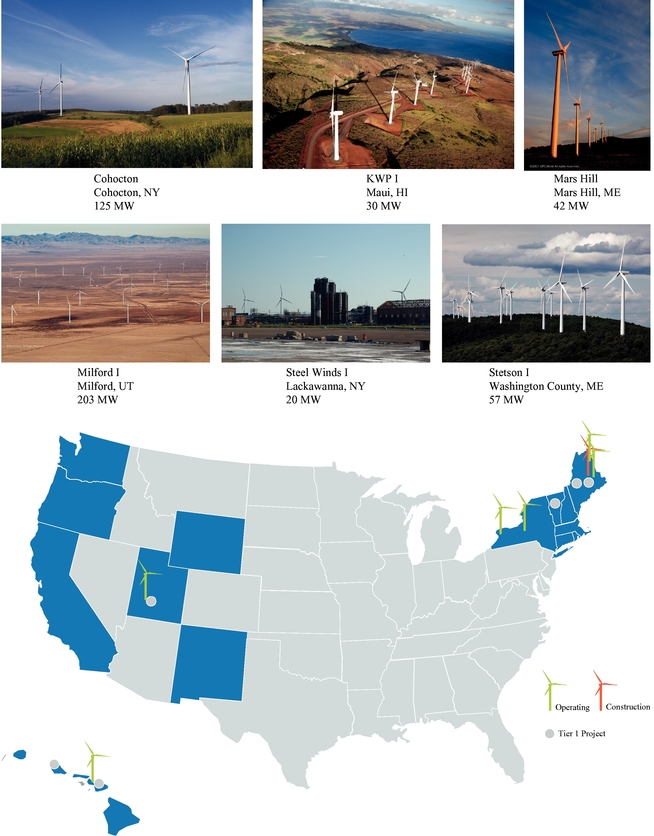
Highlighted areas represent states in which First Wind has projects in operation, under construction or in various stages of development. Green turbines represent operating projects, red turbines represent projects under construction, and the grey circles indicate the approximate locations of our Tier 1 development projects. See "Business—How We Classify Our Projects."
You should rely only on the information contained in this prospectus. We have not, and the underwriters have not, authorized anyone to provide you with different information. We are not making an offer to sell these securities in any state where an offer or sale is not permitted. You should not assume that the information appearing in this prospectus is accurate as of any date other than the respective dates as of which the information is given.
The service marks for our company name, "FIRST WIND", and our trademark "CLEAN ENERGY. MADE HERE." are the property of First Wind Holdings, LLC. All other trademarks and service marks appearing in this prospectus are the property of their respective holders. All rights reserved.
In this prospectus, unless the context otherwise requires, we refer to (i) First Wind Holdings Inc. and its subsidiaries, including First Wind Holdings, LLC, after giving effect to the reorganization described herein, as "First Wind," "we," "us," "our" or the "company"; (ii) entities in the D. E. Shaw group as "the D. E. Shaw group;" (iii) Madison Dearborn Capital Partners IV, L.P., as "Madison Dearborn;" and (iv) the D. E. Shaw group and Madison Dearborn collectively as "our Sponsors." We use the following electrical power abbreviations throughout this prospectus: "kW" means kilowatt, or 1,000 watts of electrical power; "MW" means megawatt, or 1,000 kW of electrical power; "GW" means
i
gigawatt, or 1,000 MW of electrical power; and "kWh," "MWh" and "GWh" mean an hour during which 1 kW, MW or GW, as applicable, of electrical power has been continuously produced. Capacity refers to rated capacity. References in this prospectus to "RECs" mean renewable energy certificates or other renewable energy attributes, as the context requires. Unless otherwise indicated, the financial information in this prospectus represents the historical financial information of First Wind Holdings, LLC.
ii
This summary highlights selected information from this prospectus but does not contain all information that you should consider before investing in our Class A common stock. You should read this entire prospectus carefully, including the information under "Risk Factors" beginning on page 16, and the consolidated financial statements included elsewhere in this prospectus.
We are an independent wind energy company focused solely on the development, financing, construction, ownership and operation of utility-scale wind energy projects in the United States. Our projects are located in the Northeastern and Western regions of the continental United States and in Hawaii. We have focused on these markets because we believe they provide the potential for future growth and investment returns at the higher end of the range available for wind projects. These markets are characterized by relatively high electricity prices, a shortage of renewable energy and sites with good wind resources that can be built in a cost effective manner. Moreover, we have focused our efforts on projects and regions with significant expansion opportunities, often enabled by transmission solutions that we have developed.
As of November 30, 2009, we operated six projects with combined rated capacity of 477 MW, and we owned two lines that connect projects to the electricity grid (generator leads) with transmission capacity of approximately 1,200 MW. In 2009, we doubled the number of projects in our operating fleet, adding three new projects with an aggregate capacity of 385 MW. Two of these projects, Milford I, which sells power into Southern California, and Stetson I, which sells power in New England, include wholly-owned generator leads we built in anticipation of expanding these projects.
We manage our business with a team of professionals with experience in all aspects of wind energy development, financing, construction and operations. We have a track record of selecting projects from our development pipeline and converting them into operating projects that we believe will meet our financial return requirements. By the end of 2010, we expect to have seven additional projects with 293 MW of capacity operating or under construction, one of which is already under construction. We target having approximately 1,000 MW of projects operating or under construction by the end of 2011. Thereafter, we target adding approximately 300 to 400 MW of operating/under-construction capacity each year to achieve our goal of having an operating/under-construction fleet in excess of 2,000 MW by the end of 2014. Expansions of current operating and under-construction projects make up approximately 51% (measured by capacity) of our targeted 2010-2011 projects. See "Business—Our Development Process" and "Business—Our Portfolio of Wind Energy Projects."
We believe our development pipeline of over 4,000 MW should enable us to meet our 2014 goal of having an operating/under-construction fleet of 2,000 MW. We have land rights for 85% of our development pipeline and meteorological data for nearly 90% of our development pipeline, in most cases covering at least three years. We have also conducted preliminary environmental screening for all of our projects. We are unlikely to complete all of the projects in our current development pipeline, while some of the projects we are likely to develop in the future are not in our current pipeline. Our ability to complete our projects and achieve anticipated generation capacities is subject to numerous risks and uncertainties as described under "Risk Factors."
Wind energy project returns depend mainly on the following factors: energy prices, transmission costs, wind resources, turbine costs, construction costs, financing cost and availability and government incentives. In applying our strategy, we take into account the combination of all of these factors and focus on margins, return on invested capital and value creation as opposed solely to project size. Some of our projects, while having high construction costs, still offer attractive returns because of favorable wind resources or energy prices. Additionally, in many cases, smaller, more profitable projects can create as much absolute value as do larger, lower-returning projects. We assess the profitability of each
1
project by evaluating its net present value. We also evaluate a project on the basis of its Project EBITDA, as described under "Management's Discussion and Analysis of Financial Condition and Results of Operations—How We Measure Our Performance" as compared with the project's development and construction costs.
We closely manage our commodity-price risk and generally construct wind energy projects only if we have put in place some form of a fixed-price, long-term power purchase agreement (PPA) and/or financial hedge. Approximately 85% of the estimated revenues through 2011 from our current operating projects are hedged. We plan to hedge approximately 90% of the estimated revenues for 2011 for the seven projects we plan to have under construction in 2010. See "Business—Revenues; Hedging Activities."
The United States is one of the largest and fastest growing wind energy markets. In 2008, the United States surpassed Germany as the world's largest market for wind energy, as cumulative installed capacity increased approximately 51% and accounted for 42% of all new energy supply in the United States, according to the American Wind Energy Association (AWEA). Moreover, our markets are among the highest growth U.S. markets due to demand driven by state-mandated renewable portfolio standards (RPS), premium electricity pricing, a shortage of renewable energy and strong wind resources. States in our markets in the Northeast, West and Hawaii have RPS legislation that calls for approximately 70 GW of installed renewable energy capacity to be built by 2020.
Achievements
We have achieved a number of milestones, including:
- •
- Northeast. We completed two of the largest utility-scale wind energy projects in New
England (Stetson I and Mars Hill in Maine) and obtained the first permit for a utility-scale wind energy project in Vermont since 1996. We have started construction of our Stetson II project, for
which we entered into a long-term PPA with Harvard University to provide 10% of its local electricity needs. This makes Harvard the largest academic institutional buyer of wind power in
the Northeast. See "Business—Our Regions—Northeast."
- •
- West. We entered into a long-term PPA with the Southern California Public
Power Authority (SCPPA) to supply 20 years of power to the cities of Los Angeles, Burbank and Pasadena from Milford I, our 203 MW wind energy project in Utah. This project includes a 1,000 MW
generator lead providing transmission to the electricity grid. Milford I commenced commercial operations in November 2009. Milford I is the first wind energy project to receive a grant of a right of
way permit under the Bureau of Land Management's new programmatic environmental impact statement for wind energy development. See "Business—Our Regions—West."
- •
- Hawaii. We successfully completed and are operating our Kaheawa Wind Power I
(KWP I) project in Maui, the largest wind energy project in Hawaii. See "Business—Our Regions—Hawaii."
- •
- Financing and U.S. Treasury Grants. Beginning in the fourth quarter of 2008, in the midst of very difficult financial and credit markets, we refinanced or raised approximately $1.9 billion for our company and projects in 16 refinancing and new capital-raising activities. These activities included project debt financings, tax equity financings, intermediate holding company financings, government grants and Sponsor equity contributions. In September 2009, we were among the first recipients of cash grants from the U.S. Treasury under Section 1603 of the American Recovery and Reinvestment Act of 2009 (ARRA), when we received approximately $115 million for our Cohocton and Stetson I projects. See "Industry—Drivers of U.S. Wind Energy Growth—State and Federal Government Incentives—American Recovery and Reinvestment Act of 2009 (ARRA)."
2
Revenues, Financing and Government Programs
We generate revenues from the sale of electricity and the sale of RECs from our operating projects:
- •
- Electricity
sales. We typically sell the power generated by our projects (sometimes bundled with RECs) either pursuant to PPAs with local utilities
or power companies or directly into the local power grid at market prices. Our PPAs have terms ranging from three to 20 years with fixed prices, market prices or a combination of fixed and
market prices. We also seek to hedge a significant portion of the market component of our power sales revenue with financial swaps. See "Management's Discussion and Analysis of Financial Condition and
Results of Operations—Factors Affecting Our Results of Operations, Financial Condition and Cash Flows—Power Purchase Agreements and Financial Hedging."
- •
- REC sales. The RECs associated with renewable electricity generation can be "unbundled" and sold as a separate attribute. In some states, we sell RECs to entities that must either purchase or generate specific quantities of RECs to comply with state or municipal RPS programs. Currently, 25 states and the District of Columbia have adopted RPS programs that operate in tandem with a credit trading system in which generators sell RECs for renewable power they generate in excess of state-mandated requirements.
We have generated substantial net losses and negative operating cash flows since our inception. See "Risk Factors—Risks Related to Our Business and the Wind Industry—We have generated substantial net losses and negative operating cash flows since our inception and expect to continue to do so as we develop and construct new wind energy projects."
We finance our projects with various sources of funds, depending on a project's stage of development and other factors. We use equity, turbine supply loans, construction loans, non-recourse project financings, tax equity financings, term loans and, recently, grants from the U.S. Treasury under the ARRA.
We benefit from U.S. government programs established to stimulate the economy and increase domestic investment in the wind energy industry. In February 2009, the ARRA went into effect and extended the federal production tax credit (PTC) for renewable energy generators until the end of 2012. In the past, we have monetized PTCs through tax equity financings as part of our project financing strategy. In these transactions, we receive up-front payments, and our tax equity investors receive substantially all of the production tax credits and taxable income or loss generated by the project and a portion of the operating cash flows, until they achieve their targeted investment returns and return of capital, which we typically expect to occur in ten years.
The ARRA also made an investment tax credit (ITC) available to wind energy projects in lieu of PTCs. Project owners can for the first time receive the cash equivalent of the ITC in the form of a grant paid by the U.S. Treasury representing 30% of ITC-eligible costs of building a wind energy project, namely, the costs of constructing energy-producing assets. In September 2009, two of our projects were among the first recipients of such cash grants, receiving approximately $115 million. We intend to apply for, and expect to receive, cash grants for our Milford I project, our Stetson II project and the other projects we begin to construct in 2010. We have also applied for other federal government incentives, including loan guarantees from the Department of Energy. See "Industry—Drivers of U.S. Wind Energy Growth—State and Federal Government Incentives—American Recovery and Reinvestment Act of 2009 (ARRA)."
3
Strategy
Wind energy project returns depend mainly on the following factors:
- •
- Energy price. The realized price of energy, including
power, REC sales and capacity payments and the effect of cash settlements from related hedging activities.
- •
- Wind. The quality of the wind resources and the resulting
energy production, otherwise known as the net capacity factor (NCF). NCF is a measure of a turbine's production compared with the amount of power the turbine could have produced running at full
capacity for a particular period of time.
- •
- Construction costs. The fully loaded installed costs of
the project, including turbines, transmission, balance-of-plant, interest during construction, financing costs and fees and development expenses.
- •
- Financing. The financeability of and cost of capital to
construct the project.
- •
- Government incentives. PTC, ITC, government grants and other incentives.
Our business strategy is to build a diverse portfolio of operating projects and development opportunities. We seek opportunities where, if we are able to execute successfully, we will be able to generate attractive returns for our stockholders.
- •
- Develop our existing pipeline of projects and expand existing operating
projects. We have identified and are developing a broad pipeline of projects in our markets, including expanding our operating projects in existing locations. We believe
expansion projects have lower execution risks than other projects. We target having approximately 1,000 MW of projects operating or under construction by the end of 2011. Thereafter, we target adding
approximately 300 to 400 MW of operating/under-construction capacity each year to achieve our goal of having an operating/under-construction fleet in excess of 2,000 MW by the end of 2014. Expansions
of current operating and under-construction projects make up approximately 51% (measured by capacity) of our targeted 2010-2011 projects.
- •
- Continue to identify and create a new pipeline of diverse development project opportunities in
financially attractive markets. Our markets are undergoing significant growth, which we expect to continue, reaching 70 GW of RPS-driven demand by 2020. Our team of
developers focuses our prospecting and development efforts on identifying new opportunities and acquiring existing wind energy assets that we believe will meet our financial return requirements in
these markets.
- •
- Implement transmission solutions to support development
opportunities. We develop, build, own and operate generator leads connecting our projects to third-party electricity networks. We have
built two generator leads that provide us with significant opportunities for future development: the Stetson generator lead, which has approximately 140 MW of capacity available for our future
expansion projects, and the Milford generator lead, which has approximately 750 MW of capacity available for future expansion projects. In 2010, we plan to build expansion projects using both the
Stetson and Milford leads, leaving 700 MW of additional capacity on these lines. Our generator lead assets and capabilities enable us to develop projects in areas that would otherwise present
significant transmission challenges.
- •
- Focus on construction and operational control. We oversee the construction and operation of our projects. We believe having control of our projects enhances our credibility, allows us to make rapid decisions and strengthens our relationships with landowners, local communities, regulators and other stakeholders. For construction projects, we manage and mitigate budget and schedule risks through arrangements with contractors that have significant experience constructing wind
4
- •
- Obtain stable revenues from our operating
fleet. We manage exposure to market prices for electricity through long-term PPAs and hedging. We also seek to maximize the
value of the RECs we generate by selling our electricity into markets that have higher RPS requirements and strong markets for RECs. We believe that stabilizing our revenue stream benefits us, our
lenders and tax equity investors, and enhances our ability to obtain long-term, non-recourse financing for our projects on attractive terms.
- •
- Develop substantial local presence and community stakeholder involvement in our
markets. We establish a local presence from a project's early stage through the operating stage to work cooperatively with the communities where our projects are located to
more fully understand each community's unique issues and concerns. We believe this helps us to better assess the feasibility of projects and enhances our ability to complete and operate them
successfully.
- •
- Access financing to grow our portfolio. Our business is capital intensive and requires ongoing access to debt and equity capital markets to build our projects. We believe we demonstrated our capacity to do this during the difficult financial market conditions in 2008 and 2009.
energy projects. We also work closely with the manufacturers of our turbines with the goal of enhancing the operating performance of our fleet.
Competitive Strengths
We intend to use the following strengths to capitalize on what we believe to be significant opportunities for growth in the U.S. wind energy industry in general and in our markets in particular:
- •
- Track record in developing complex wind energy
projects. Our experienced management team has a track record of developing complex projects in each of our three markets. Our project
development strategy sometimes includes the construction of generator leads as in the case of Stetson I and Milford I, or the structuring and negotiation of creative financing and risk
management solutions as in our PPA with SCPPA for Milford I. In certain cases, as in KWP I, we took over projects from other developers who were unable to complete them.
- •
- Ability to finance multiple projects across our
portfolio. Wind energy project development and construction are capital intensive and require access to a relatively constant stream of
financing. As a result, our ability to access capital markets efficiently and effectively is crucial to our growth. The recent worldwide financial and credit crisis has reduced the availability of
liquidity and credit. However, during the difficult market conditions that began in the fall of 2008 and have persisted through 2009, we refinanced or raised approximately $1.9 billion for our
company and projects in 16 refinancing and new capital-raising activities. These activities included project debt financings, tax equity financings, intermediate holding company financings,
government grants and Sponsor equity contributions. We expect to fund the development of our projects with a combination of cash flows from operations, debt financings, tax equity financings,
government grants and capital markets transactions such as this offering. See "Business—Project Financing."
- •
- Established platform in attractive markets with significant growth
opportunities. We have a portfolio of projects in the Northeast, West and Hawaii where we believe we can generate attractive investment
returns. These markets are characterized by high electricity prices, a shortage of renewable energy and sites with good wind resources that can be built on cost-effectively. Many of our
projects have significant expansion opportunities, which in some cases will enable us to use our existing generator leads. Expansions of our current operating and under-construction projects make up
approximately 51% (measured by capacity) of our targeted 2010-2011 projects.
- •
- Well positioned for future turbine orders with few turbine commitments. We have secured sufficient turbines to execute our 2010 project plan. Because we believe the turbine market is currently
5
- •
- Experienced management team that owns significant equity in the company. Our management team is experienced in all aspects of the wind energy business. Over the past two years, we have added several key personnel to our team, primarily in the areas of construction, operations and finance. We believe we can achieve our operating/under-construction fleet goal of over 2,000 MW by the end of 2014 without significant additions to headcount and overhead costs related to non-operating activities. In addition, members of our senior management team have a meaningful equity stake in our company.
over-supplied, we have not entered into firm commitments to purchase turbines for projects in our development pipeline after 2010. Instead, we have agreements in place that give us the right, but not the obligation, to purchase additional turbines after 2010, allowing us to cancel our turbine orders with the forfeiture of deposits. We believe this gives us flexibility to acquire turbines at attractive prices and on favorable terms.
Market Opportunity
According to AWEA, wind energy capacity in the United States grew at a CAGR of 33% from 2000 through 2008. The Energy Information Administration (EIA) also indicates that wind energy was the fastest growing source of new electricity supply in the U.S. electrical generation market from 2000 through 2008. This growth reached a record high during 2008, when the cumulative installed wind capacity in the United States increased 51% from 16.8 GW to 25.4 GW and new wind energy capacity made up approximately 42% of total new electricity supply in the United States, according to AWEA.
Despite its significant growth in the United States, wind energy accounted for only 1.3% of total U.S. electricity production in 2008 according to the EIA. The EIA predicts that wind energy will account for only 2.5% of total U.S. electricity production in 2030. This represents a small portion compared with the percentage of electricity produced in 2008 by wind energy in Denmark, Spain and Germany—approximately 18%, 11% and 8%, respectively. EER forecasts that installed wind energy capacity in the United States will grow at a CAGR of 22.6% from 2008 through 2013. In certain U.S. markets, state-mandated RPS and similar voluntary programs, among other factors, have strengthened the demand for renewable energy.
We believe wind energy growth in the United States is being driven primarily by:
- •
- decreasing costs in the U.S. wind industry supply chain and continued improvements in wind technologies;
- •
- public concern about environmental issues, including climate change;
- •
- favorable federal and state policies regarding climate change and renewable energy, exemplified by state RPS programs and
the ARRA, that support the development of renewable energy;
- •
- increasing obstacles for the construction of conventional power plants; and
- •
- public concern over continued U.S. dependence on foreign energy imports.
Risk Factors
Our business is subject to numerous risks and uncertainties, including those relating to our ability to build our projects and convert our development pipeline into operating projects; our substantial net losses and negative operating cash flows; government policies supporting renewable energy development; our dependence on suitable wind conditions; the need for ongoing access to capital to support our growth; and the potential for mechanical breakdowns. You should carefully consider all of the information in this prospectus and, in particular, the information under "Risk Factors," prior to making an investment in our Class A common stock.
6
Class A Common Stock and Class B Common Stock
After completion of this offering, our outstanding capital stock will consist of Class A common stock and Class B common stock. Investors in this offering will hold shares of Class A common stock. See "Description of Capital Stock."
The Reorganization and Our Holding Company Structure
First Wind Holdings Inc. was formed in contemplation of this offering and, upon its completion, all of our business and operations will continue to be conducted through First Wind Holdings, LLC, which owns all of our interests in our operating subsidiaries. Prior to this offering, First Wind Holdings Inc. did not engage in any activities, except in preparation for this offering. After the completion of this offering and the reorganization described under "The Reorganization and Our Holding Company Structure," we will be a holding company and the sole managing member of First Wind Holdings, LLC. Our only business and material asset will be our managing member interest in First Wind Holdings, LLC. We will own approximately % of the economic interest in First Wind Holdings, LLC (assuming no exercise of the underwriters' over-allotment option) and entities in the D. E. Shaw group and Madison Dearborn Capital Partners IV, L.P., our Sponsors, will collectively own the balance. Our only source of cash flow from operations will be distributions from First Wind Holdings, LLC. See "The Reorganization and Our Holding Company Structure."
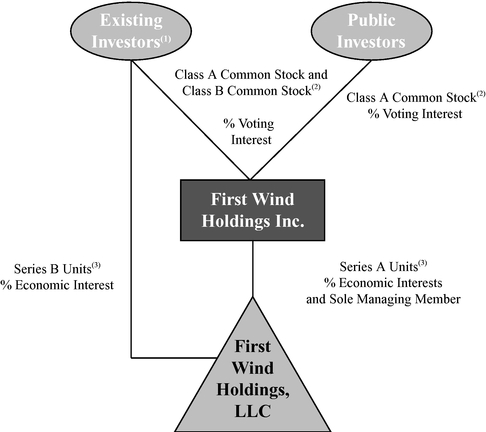
The diagram below illustrates our holding company structure and anticipated ownership immediately after completion of the reorganization and this offering (assuming no exercise of the underwriters' over-allotment option).
- (1)
- The members of First Wind Holdings, LLC, other than us, will consist of our Sponsors and certain of our employees and current investors in First Wind Holdings, LLC.
7
- (2)
- Each
share of Class A common stock and Class B common stock is entitled to one vote per share. The Class A common stockholders will
have the right to receive all distributions made on account of our capital stock, except for the right of the Class B common stockholders to receive their $0.0001 per share par value pari passu
upon liquidation, dissolution or winding up. Certain entities in the D. E. Shaw group have elected to receive Class A common stock in lieu of receiving Series B Units (and
the corresponding shares of Class B common stock). As a result, the D. E. Shaw group will hold Series B Units, Class A common stock and Class B common stock.
- (3)
- Series A Units and Series B Units will have the same economic rights.
Corporate Information
We began developing wind energy projects in North America in 2002. First Wind Holdings Inc. was incorporated in Delaware in May 2008. Our principal executive offices are located at 179 Lincoln Street, Suite 500, Boston, Massachusetts 02111, and our telephone number is (617) 960-2888. Our website is www.firstwind.com. The information contained on or accessible through our website is not part of this prospectus and you should not consider it in making an investment decision.
8
Class A common stock offered by us |
shares. | |
Class A common stock to be outstanding after this offering |
shares (assuming no exercise of the underwriters' over-allotment option). |
|
Class B common stock to be outstanding after this offering |
shares. Shares of our Class B common stock will be issued in connection with, and in equal proportion to, issuances of Series B Units of First Wind Holdings, LLC. When a Series B Unit is exchanged for a share of our Class A common stock or forfeited, the corresponding share of our Class B common stock will automatically be redeemed by us. See "The Reorganization and Our Holding Company Structure." |
|
Underwriters' over-allotment option |
shares. |
|
Use of proceeds |
We expect to receive net proceeds from the sale of Class A common stock offered hereby, after deducting estimated underwriting discounts and commissions and estimated offering expenses, of approximately $ million, based on an assumed offering price of $ per share (the midpoint of the range set forth on the cover of this prospectus). We intend to use such net proceeds to fund a portion of our capital expenditures for 2010–2013 and for general corporate purposes. |
|
Voting rights |
Each share of our Class A common stock and Class B common stock will entitle its holder to one vote on all matters to be voted on by stockholders. Holders of Class A common stock and Class B common stock will vote together as a single class on all matters presented to stockholders for their vote or approval, except as otherwise required by law. After completion of this offering, our Sponsors will own % of our outstanding Class A common stock and Class B common stock on a combined basis ( % if the underwriters exercise their over-allotment option in full) and will have effective control over the outcome of votes on all matters requiring approval by our stockholders. |
|
Exchange of Series B Units |
Each fully-vested Series B Unit of First Wind Holdings, LLC, together with a corresponding share of our Class B common stock, will be exchangeable for one share of Class A common stock as described under "The Reorganization and Our Holding Company Structure—Amended and Restated Limited Liability Company Agreement of First Wind Holdings, LLC." |
|
Dividend policy |
We do not anticipate paying dividends. See "Dividend Policy." |
|
Risk factors |
For a discussion of factors you should consider before making an investment, see "Risk Factors." |
|
Proposed Nasdaq Global Market symbol |
"WIND" |
9
The number of shares to be outstanding after completion of this offering is based on shares of Class A common stock outstanding as of after giving effect to the reorganization described under "The Reorganization and Our Holding Company Structure." The number of shares to be outstanding after this offering excludes additional shares of Class A common stock reserved for issuance under our long-term incentive plan.
Unless we specifically state otherwise, the information in this prospectus assumes:
- •
- the implementation of the reorganization described in "The Reorganization and Our Holding Company Structure;" and
- •
- no exercise of the underwriters' over-allotment option.
10
Summary Financial and Operating Data
The following tables present summary consolidated financial data as of and for the dates and periods indicated below. The summary consolidated statement of operations data for the years ended December 31, 2006, 2007 and 2008 and the summary consolidated balance sheet data as of December 31, 2007 and 2008 are derived from our audited consolidated financial statements included elsewhere in this prospectus. The summary consolidated statement of operations data for the nine months ended September 30, 2008 and 2009 and the summary consolidated balance sheet data as of September 30, 2009 are derived from our unaudited interim consolidated financial statements included elsewhere in this prospectus. The unaudited interim period financial information, in the opinion of management, includes all adjustments, which are normal and recurring in nature, necessary for the fair presentation of the periods shown.
The summary unaudited pro forma consolidated financial data for the year ended December 31, 2008 and for the nine months ended September 30, 2009 have been prepared to give pro forma effect to all of the reorganization transactions described in "The Reorganization and Our Holding Company Structure" and this offering as if they had been completed as of January 1, 2008 with respect to the unaudited consolidated pro forma statement of operations and as of September 30, 2009 with respect to the unaudited pro forma consolidated balance sheet data. These data are subject and give effect to the assumptions and adjustments described in the notes accompanying the unaudited pro forma financial statements included elsewhere in this prospectus. The summary unaudited pro forma financial data are presented for informational purposes only and should not be considered indicative of actual results of operations that would have been achieved had the reorganization transactions and this offering been consummated on the dates indicated, and do not purport to be indicative of statements of financial condition data or results of operations as of any future date or for any future period. Pro forma net loss per share is based on the weighted average common shares outstanding.
The summary consolidated financial data set forth below should be read in conjunction with the "Unaudited Pro Forma Financial Information," "Selected Historical Financial and Operating Data," "Management's Discussion and Analysis of Financial Condition and Results of Operations" and the
11
consolidated financial statements and related notes included elsewhere in this prospectus. Our historical results may not be indicative of the operating results to be expected in any future period.
| |
First Wind Holdings, LLC |
First Wind Holdings Inc. |
First Wind Holdings, LLC |
First Wind Holdings Inc. |
|||||||||||||||||||
|---|---|---|---|---|---|---|---|---|---|---|---|---|---|---|---|---|---|---|---|---|---|---|---|
| |
2006 | 2007 | 2008 | Pro Forma | 2008 | 2009 | Pro Forma | ||||||||||||||||
| |
|
|
|
(unaudited) |
(unaudited) |
(unaudited) |
(unaudited) |
||||||||||||||||
| |
(in thousands, except unit/share data and other operating data) |
||||||||||||||||||||||
Statement of Operations Data: |
|||||||||||||||||||||||
Revenues: |
|||||||||||||||||||||||
Revenues |
$ | 7,063 | $ | 23,817 | $ | 28,790 | $ | $ | 21,712 | $ | 30,468 | $ | |||||||||||
Risk management activities related to operating projects |
8,848 | (11,471 | ) | 10,688 | (6,180 | ) | 27,580 | ||||||||||||||||
Total revenues |
15,911 | 12,346 | 39,478 | 15,532 | 58,048 | ||||||||||||||||||
Cost of revenues: |
|||||||||||||||||||||||
Wind energy project operating expenses |
1,339 | 9,175 | 10,613 | 6,592 | 13,269 | ||||||||||||||||||
Depreciation and amortization of operating assets |
1,945 | 8,800 | 10,611 | 6,978 | 23,445 | ||||||||||||||||||
Total cost of revenues |
3,284 | 17,975 | 21,224 | 13,570 | 36,714 | ||||||||||||||||||
Gross income (loss) |
12,627 | (5,629 | ) | 18,254 | 1,962 | 21,334 | |||||||||||||||||
Other operating expenses: |
|||||||||||||||||||||||
Project development |
16,028 | 25,861 | 35,855 | 19,348 | 32,694 | ||||||||||||||||||
General and administrative |
6,598 | 13,308 | 44,358 | 28,856 | 28,599 | ||||||||||||||||||
Depreciation and amortization |
294 | 1,215 | 2,325 | 1,712 | 2,443 | ||||||||||||||||||
Total other operating expenses |
22,920 | 40,384 | 82,538 | 49,916 | 63,736 | ||||||||||||||||||
Loss from operations |
(10,293 | ) | (46,013 | ) | (64,284 | ) | (47,954 | ) | (42,402 | ) | |||||||||||||
Risk management activities related to non-operating projects |
$ | (13,131 | ) | $ | (21,141 | ) | $ | 42,138 | $ | $ | 12,369 | $ | — | $ | |||||||||
Net loss attributable per common unit (basic and diluted) |
$ | (0.24 | ) | $ | (0.36 | ) | $ | (0.05 | ) | $ | $ | (0.15 | ) | $ | (0.06 | ) | $ | ||||||
Weighted average number of common units (basic and diluted) |
107,712,405 | 189,161,855 | 278,266,400 | 226,161,565 | 649,648,023 | ||||||||||||||||||
Pro forma net loss per share—basic and diluted(1) |
|||||||||||||||||||||||
Shares used in computing pro forma net loss per share—basic and diluted |
|||||||||||||||||||||||
Other Financial Data: |
|||||||||||||||||||||||
Net cash provided by (used in): |
|||||||||||||||||||||||
Operating activities |
$ | (31,799 | ) | $ | (26,370 | ) | $ | (41,589 | ) | $ | (15,894 | ) | $ | (39,742 | ) | ||||||||
Investing activities |
(311,281 | ) | (334,007 | ) | (477,268 | ) | (351,067 | ) | (326,440 | ) | |||||||||||||
Financing activities |
346,500 | 358,107 | 556,059 | 367,500 | 374,012 | ||||||||||||||||||
Selected Operating Data |
|||||||||||||||||||||||
Nameplate capacity (end of period) |
30 MW | 92 MW | 92 MW | 92 MW | 274 MW | ||||||||||||||||||
Megawatt hours generated |
56,629 | 239,940 | 275,024 | 194,718 | 437,143 | ||||||||||||||||||
Average realized energy price ($/MWh)(2) |
$ | 108 | $ | 93 | $ | 85 | $ | 84 | $ | 77 | |||||||||||||
Project EBITDA(3) |
$ | 4,802 | $ | 15,433 | $ | 16,052 | $ | 11,392 | $ | 26,826 | |||||||||||||
- (1)
- The basic net loss attributable per common unit for each of the annual periods ended December 31, 2006, 2007 and 2008 and the nine-month periods ended September 30, 2008 and 2009 has been presented for informational and historical purposes only. After completion of this offering, as a result of the reorganization events that have taken place or that will take place immediately prior to completion of the offering as described in "The Reorganization and Our Holding Company Structure," the shares used in computing net earnings or loss per share will bear no relationship to these historical common units.
12
- (2)
- Average
realized energy price per MWh of energy generated is a metric that allows us to compare revenues from period to period, or on a project by project
basis, regardless of whether the revenues are generated under a fixed-price PPA, from sales at market prices with a financial swap, or a combination of the two. Although average realized energy price
is based, in part, on revenues recognized under accounting principles generally accepted in the United States (GAAP), this metric does not represent revenue per unit of production on a GAAP basis. We
adjust GAAP revenues used to compute this metric in two respects:
- •
- Under GAAP, recognition of revenues from the sale of New England RECs is delayed due
to regulations that limit their transfer to the buyer to quarterly trading windows that open two quarters subsequent to generation. To match New England REC revenue to the period in which the related
power was generated, in calculating this metric, we add New England REC revenues attributable to generation during a period but not yet recognized under GAAP, and subtract New England REC revenue
recognized under GAAP in the period but generated in a prior period.
- •
- In addition, in order to focus this metric on realized energy prices, we exclude the effects of mark-to-market adjustments on financial swaps and certain transmission costs incurred to secure RECs.
Average realized energy price changes over time due to several factors. Historically, the most significant factor has been the growth of our business and the corresponding change in pricing mix. Each project has a different pricing profile, including varying levels of hedging in relation to electricity generation, and in certain cases, short periods of unhedged exposure to market price fluctuations as hedging agreements are put in place.
The table below shows the calculation of our average realized energy price for the periods presented:
| |
Year Ended December 31, | Nine Months Ended September 30, |
||||||||||||||||
|---|---|---|---|---|---|---|---|---|---|---|---|---|---|---|---|---|---|---|
| |
2006 | 2007 | 2008 | 2008 | 2009 | |||||||||||||
Numerator (in thousands) |
||||||||||||||||||
Total revenue |
$ | 15,911 | $ | 12,346 | $ | 39,478 | $ | 15,532 | $ | 58,048 | ||||||||
Add (subtract): |
||||||||||||||||||
New England REC timing(a) |
— | 2,461 | 1,947 | 248 | 1,239 | |||||||||||||
Transmission costs |
— | (2,268 | ) | (3,316 | ) | (1,555 | ) | (2,387 | ) | |||||||||
Mark-to-market adjustment(b) |
(9,770 | ) | 9,801 | (14,760 | ) | 2,204 | (23,339 | ) | ||||||||||
|
$ | 6,141 | $ | 22,340 | $ | 23,349 | $ | 16,424 | $ | 33,561 | ||||||||
Denominator (MWh) |
||||||||||||||||||
Total energy production |
56,629 | 239,940 | 275,024 | 194,718 | 437,143 | |||||||||||||
Average realized energy price ($/MWh) |
||||||||||||||||||
(numerator/denominator) |
$108 | $93 | $85 | $84 | $77 | |||||||||||||
- (a)
- New England REC timing represents the difference between: (i) New England RECs generated in earlier periods that qualified for GAAP revenue recognition in the applicable period and (ii) New England RECs generated in the applicable period and sold to a creditworthy counterparty under a firm sales contract where revenue is deferred under GAAP until the applicable quarterly trading window occurs. The gross amounts of such New England RECs are as follows:
| |
Year Ended December 31, | Nine Months Ended September 30, |
||||||||||||||||
|---|---|---|---|---|---|---|---|---|---|---|---|---|---|---|---|---|---|---|
| |
2006 | 2007 | 2008 | 2008 | 2009 | |||||||||||||
| |
(in thousands) |
|||||||||||||||||
New England REC |
||||||||||||||||||
Included in revenues |
$ |
(17 |
) |
$ |
(2,364 |
) |
$ |
(5,274 |
) |
$ |
(3,936 |
) |
$ |
(7,937 |
) |
|||
Generated during the period |
17 | 4,825 | 7,221 | 4,184 | 9,176 | |||||||||||||
|
$ | — | $ | 2,461 | $ | 1,947 | $ | 248 | $ | 1,239 | ||||||||
- (b)
- The
mark-to-market adjustment for September 30, 2009, includes the effect of a cash settlement of a financial hedge for $4,147 in addition to market
adjustments of $19,192.
- (3)
- We evaluate the performance of our operating projects on the basis of their Project EBITDA, which is a non-GAAP financial measure. We use Project EBITDA to assess the performance of our operating projects because we believe it is a measure that allows us to: (i) more accurately evaluate the operating performance of our projects based on the energy generated during each period (through the treatment of mark-to-market adjustments and New England REC timing, for which the GAAP accounting treatment does not correspond to the energy generated during the period) and (ii) assess the
13
ability of our projects to support debt and/or tax equity financing (through the exclusion of depreciation and amortization that is not indicative of capital costs that would be expected over the term of the financing). Our ability to raise debt and/or tax equity financing for our projects is a key requirement of our development plan as described in "—Factors Affecting Our Results of Operations, Financial Condition and Cash Flows—Financing Requirements." We believe it is important for investors to understand the factors that we focus on in managing the business, and therefore we believe Project EBITDA is useful for investors to understand. In addition, as long as investors consider Project EBITDA in combination with the most directly comparable GAAP measure, gross income (loss), we believe it is useful for investors to have information about our operating performance on a period-by-period basis, without giving effect to GAAP requirements that require the recognition of income or expense that does not correspond to actual energy production in a given period, and we believe it is useful for investors to consider a measure that does not include project-related depreciation and amortization. Because lenders and providers of tax equity financing frequently disregard the non-cash charges and GAAP timing differences noted above when determining the financeability of a project, we believe that presenting information in this manner can help give investors an understanding of our ability to secure financing for our projects. Project EBITDA can be reconciled to gross income (loss), which we believe to be the most directly comparable financial measure calculated and presented in accordance with GAAP, as follows (in thousands):
| |
Year Ended December 31, | Nine Months Ended September 30, |
|||||||||||||||||
|---|---|---|---|---|---|---|---|---|---|---|---|---|---|---|---|---|---|---|---|
| |
2006 | 2007 | 2008 | 2008 | 2009 | ||||||||||||||
Gross income (loss) |
$ | 12,627 | $ | (5,629 | ) | $ | 18,254 | $ | 1,962 | $ | 21,334 | ||||||||
Add (subtract): |
|||||||||||||||||||
Depreciation and amortization of operating assets |
1,945 | 8,800 | 10,611 | 6,978 | 23,445 | ||||||||||||||
New England REC timing |
— | 2,461 | 1,947 | 248 | 1,239 | ||||||||||||||
Mark-to-market adjustments |
(9,770 | ) | 9,801 | (14,760 | ) | 2,204 | (19,192 | ) | |||||||||||
Project EBITDA |
$ | 4,802 | $ | 15,433 | $ | 16,052 | $ | 11,392 | $ | 26,826 | |||||||||
Project EBITDA does not represent funds available for our discretionary use and is not intended to represent or to be used as a substitute for gross income (loss), net income or cash flow from operations data as measured under GAAP. The items excluded from Project EBITDA are significant components of our statement of income and must be considered in performing a comprehensive assessment of our overall financial performance. Project EBITDA and the associated period-to-period trends should not be considered in isolation.
14
The following table presents summary consolidated balance sheet data as of the dates indicated:
- •
- on an actual basis;
- •
- on a pro forma basis as of September 30, 2009 to give effect to all of the reorganization transactions described in
"The Reorganization and Our Holding Company Structure"; and
- •
- on a pro forma as adjusted basis as of September 30, 2009 to give further effect to our sale of shares of common stock in this offering at an assumed initial public offering price of $ per share, the midpoint of the range set forth on the cover of this prospectus, after deducting estimated underwriting discounts and commissions and estimated offering expenses.
| |
First Wind Holdings, LLC | |
|
|||||||||||||||||
|---|---|---|---|---|---|---|---|---|---|---|---|---|---|---|---|---|---|---|---|---|
| |
As of December 31, | First Wind Holdings Inc. | ||||||||||||||||||
| |
2006 | 2007 | 2008 | As of September 30, 2009 |
Pro Forma As of September 30, 2009 |
Pro Forma As Adjusted September 30, 2009 |
||||||||||||||
| |
|
|
|
(unaudited) |
(unaudited) |
|
||||||||||||||
| |
(in thousands) |
|||||||||||||||||||
Balance Sheet Data: |
||||||||||||||||||||
Property, plant and equipment, net |
$ | 81,452 | $ | 192,076 | $ | 187,316 | $ | 478,166 | $ | $ | ||||||||||
Construction in progress |
85,153 | 346,320 | 571,586 | 910,563 | ||||||||||||||||
Total assets |
372,500 | 770,666 | 1,311,591 | 1,736,390 | ||||||||||||||||
Long-term debt, including debt with maturities less than one year |
257,884 | 465,449 | 532,441 | 854,378 | ||||||||||||||||
Members' capital/ stockholders' equity |
88,519 | 147,876 | 653,092 | 769,661 | ||||||||||||||||
- Note:
- Pro forma basic and diluted net loss per share was computed by dividing the pro forma net loss attributable to our Class A common stockholders by the shares of Class A common stock that we will issue and sell in this offering, plus shares issued in connection with our initial capitalization, assuming that these shares of Class A common stock were outstanding for the entirety of each of the historical periods presented on a pro forma basis. No pro forma effect was given to the future potential exchanges of the Series B Units (and the equal number of shares of our Class B common stock) of our subsidiary, First Wind Holdings, LLC, that will be outstanding immediately after the completion of this offering and the reorganization transactions for an equal number of shares of our Class A common stock because the issuance of shares of Class A common stock upon these exchanges would not be dilutive.
15
You should consider carefully each of the risks described below, together with all of the other information contained in this prospectus, before deciding to invest in our Class A common stock. If any of the following risks materializes, our business, financial condition and results of operations may be materially adversely affected. In that event, the trading price of our Class A common stock could decline, and you could lose some or all of your investment.
The risks described in this prospectus are those that we believe are material, but they are not the only risks and uncertainties that we face. Additional risk factors not currently known or which are currently believed to be immaterial may also have a material adverse effect on our business, financial condition and results of operations, or result in other events that could lead to a decline in the value of our Class A common stock. This prospectus also contains forward-looking statements that involve risks and uncertainties. Actual results could differ materially from those anticipated in these forward-looking statements as a result of various factors, including the risks described below and elsewhere in this prospectus. See "Cautionary Statement Regarding Forward-Looking Statements."
Risks Related to Our Business and the Wind Energy Industry
If we cannot continue to build our pipeline of projects under development and turn them into operating projects, our business will not grow and we may have significant write-offs.
We may be unable to meet our target of having in excess of 2,000 MW of operating/under-construction capacity by 2014, because we will need to add new projects to our pipeline on an ongoing basis. In addition, we may have difficulty in converting our development pipeline into operating projects or may be unable to find suitable projects to add to our pipeline. These circumstances could prevent those projects from commencing operations or from meeting our original expectations about how much energy they will generate or the returns they will achieve. Since completing the projects in our development pipeline as anticipated or at all involves numerous risks and uncertainties, some projects in our portfolio will not progress to construction or may be substantially delayed. From time to time we have abandoned projects on which we had started development work, or re-categorized projects to a less advanced stage than we had previously assigned them, representing in the aggregate approximately 103 MW of potential capacity. This resulted in $3.5 million and $3.1 million of write-offs in 2008 and 2009, respectively. Abandonment or re-categorization of our projects may make it difficult for us to achieve our operating capacity goals by our target dates. As we increase our development activities and the number of projects in our pipeline, such discontinuations and re-categorizations and the corresponding write-offs may increase. In addition, those projects that are constructed and begin operations may not meet our return expectations due to schedule delays, cost overruns or revenue shortfalls or they may not generate the capacity that we anticipate or result in receipt of revenue in the originally anticipated time period or at all. An inability to maintain our development pipeline or to convert those projects into financially successful operating projects would have a material adverse effect on our business, financial condition and results of operations.
We have generated substantial net losses and negative operating cash flows since our inception and expect to continue to do so as we develop and construct new wind energy projects.
We have generated substantial net losses and negative operating cash flows from operating activities since our operations commenced. We had accumulated losses of approximately $171.9 million from our inception through September 30, 2009. For the year ended December 31, 2008 and the nine months ended September 30, 2009, we generated net losses of $26.2 million and $47.3 million, respectively. In addition, our operating activities used cash of $41.6 million and $39.7 million for the year ended December 31, 2008 and the nine months ended September 30, 2009, respectively.
We expect that our net losses will continue and our cash used in operating activities will grow during the next several years, as compared with prior periods, as we increase our development activities
16
and construct additional wind energy projects. Wind energy projects in development typically incur operating losses prior to commercial operation at which point the projects begin to generate positive operating cash flow. We also expect to incur additional costs, contributing to our losses and operating uses of cash, as we incur the incremental costs of operating as a public company. Our costs may also increase due to such factors as higher than anticipated financing and other costs; non-performance by third-party suppliers or subcontractors; increases in the costs of labor or materials; and major incidents or catastrophic events. If any of those factors occurs, our losses could increase significantly and the value of our common stock could decline. As a result, our net losses and accumulated deficit could increase significantly.
We depend on federal, state and local government support for renewable energy, especially wind projects.
We depend on government policies that support renewable energy and enhance the economic feasibility of developing wind energy projects. The federal government and several of the states in which we operate or into which we sell power provide incentives that support the sale of energy from renewable sources, such as wind.
The Internal Revenue Code provides a production tax credit (PTC) for each kWh of energy generated by an eligible resource. Under current law, an eligible wind facility placed in service prior to the end of 2012 may claim the PTC. The PTC is a credit claimed against the income of the owner of the eligible project.
PTC eligible projects are also eligible for an investment tax credit (ITC) of 30% of the eligible cost-basis, which is in lieu of the PTC. The same placed-in-service deadline of December 31, 2012 applies for purposes of the ITC. The ITC is a credit claimed against the income of the owner of the eligible project.
The American Recovery and Reinvestment Act of 2009 (ARRA) created a grant administered by the U.S. Treasury that provides for a cash payment of the amount an eligible project otherwise would be able to claim under the ITC. In addition, there are various programs for loan guarantees. See "Industry—Drivers of U.S. Wind Energy Growth—State and Federal Government Incentives."
In addition to federal incentives, we rely on state incentives that support the sale of energy generated from renewable sources, including state adopted renewable portfolio standards (RPS) programs. Such programs generally require that electricity supply companies include a specified percentage of renewable energy in the electricity resources serving a state or purchase credits demonstrating the generation of such electricity by another source. However, the legislation creating such RPS requirements usually grants the relevant state public utility commission the ability to reduce electric supply companies' obligations to meet the RPS requirements in certain circumstances. If the RPS requirements are reduced or eliminated, this could result in our receiving lower prices for our power and in a reduction in the value of our RECs, which could have a material adverse effect on us. See "Industry—Drivers of U.S. Wind Energy Growth—State and Federal Government Incentives."
We depend on these programs to finance the projects in our development pipeline. If any of these incentives are adversely amended, eliminated, not extended beyond their current expiration dates, or if funding for these incentives is reduced, it would have a material adverse effect on our financing. The delay or failure by federal departments to administer these programs in a timely and efficient manner could have a material adverse effect on our financing.
While certain federal, state and local programs and policies promote renewable energy and additional legislation is regularly being considered that would enhance the demand for renewable energy, policies may be adversely modified, legislation may not pass or may be amended and governmental support of renewable energy development, particularly wind energy, may not continue or may be reduced. If governmental authorities do not continue supporting, or reduce their support for, the development of wind energy projects, our revenues may be adversely affected, our economic return
17
on certain projects may be reduced, our financing costs may increase, it may become more difficult to obtain financing, and our business and prospects may otherwise be adversely affected.
Most of our revenue comes from sales of electricity and RECs, which are subject to market price fluctuations, and there is a risk of a significant, sustained decline in their market prices. Such a decline may make it more difficult to develop our projects.
We may not be able to develop our projects economically if there is a significant, sustained decline in market prices for electricity or RECs without a commensurate decline in the cost of turbines and the other capital costs of constructing wind energy projects. Electricity prices are affected by various factors and may decline for many reasons that are not within our control. Those factors include changes in the cost or availability of fuel, regulatory and governmental actions, changes in the amount of available generating capacity from both traditional and renewable sources, changes in power transmission or fuel transportation capacity, seasonality, weather conditions and changes in demand for electricity. In addition, other power generators may develop new technologies or improvements to traditional technologies to produce power that could increase the supply of electricity and cause a sustained reduction in market prices for electricity and RECs. If governmental action or conditions in the markets for electricity or RECs cause a significant, sustained decline in the market prices of electricity or those attributes, without an offsetting decline in the cost of turbines or other capital costs of wind energy projects, we may not be able to develop and construct our pipeline of development projects or achieve expected revenues, which could have a material adverse effect on our business, financial condition and results of operations.
The production of wind energy depends heavily on suitable wind conditions. If wind conditions are unfavorable, our electricity production, and therefore our revenue, may be substantially below our expectations.
The electricity produced and revenues generated by a wind energy project depends heavily on wind conditions, which are variable and difficult to predict. We base our decisions about which sites to develop in part on the findings of long-term wind and other meteorological studies conducted in the proposed area, which measure the wind's speed, prevailing direction and seasonal variations. Actual wind conditions, however, may not conform to the measured data in these studies and may be affected by variations in weather patterns, including any potential impact of climate change. Therefore, the electricity generated by our projects may not meet our anticipated production levels or the rated or nameplate capacity of the turbines located there, which could adversely affect our business, financial condition and results of operations. Projections of wind resources also rely upon assumptions about turbine placement, interference between turbines and the effects of vegetation, land use and terrain, which involve uncertainty and require us to exercise considerable judgment. We or our consultants may make mistakes in conducting these wind and other meteorological studies. Any of these factors could cause us to develop sites that have less wind potential than we expected, or to develop sites in ways that do not optimize their potential, which could cause the return on our investment in these projects to be lower than expected.
If our wind energy assessments turn out to be wrong, our business could suffer a number of material adverse consequences, including:
- •
- our energy production and sales may be significantly lower than we predict;
- •
- our hedging arrangements may be ineffective or more costly;
- •
- we may not produce sufficient energy to meet our commitments to sell RECs and, as a result, we may have to buy RECs on the
open market to cover our obligations or pay damages; and
- •
- our projects may not generate sufficient cash flow to make payments of principal and interest as they become due on our project-related debt, and we may have difficulty obtaining financing for future projects.
18
Natural events may reduce energy production below our expectations.
A natural disaster, severe weather or an accident that damages or otherwise adversely affects any of our operations could have a material adverse effect on our business, financial condition and results of operations. Lightning strikes, blade icing, earthquakes, tornados, extreme wind, severe storms, wildfires and other unfavorable weather conditions or natural disasters could damage or require us to shut down our turbines or related equipment and facilities, impeding our ability to maintain and operate our facilities and decreasing electricity production levels and our revenues. Operational problems, such as degradation of turbine components due to wear or weather or capacity limitations on the electrical transmission network, can also affect the amount of energy we are able to deliver. Any of these events, to the extent not fully covered by insurance, could have a material adverse effect on our business, financial condition and results of operations.
Operational problems may reduce energy production below our expectations.
Spare parts for wind turbines and key pieces of electrical equipment may be hard to acquire or unavailable to us. Sources for some significant spare parts and other equipment are located outside of North America. If we were to experience a shortage of or inability to acquire critical spare parts, we could incur significant delays in returning facilities to full operation. In addition, we generally do not hold spare substation main transformers. These transformers are designed specifically for each wind energy project, and the current lead time to receive an order for this type of equipment is over eight months. If we have to replace any of our substation main transformers, we could be unable to sell electricity from the affected wind energy project until a replacement is installed. That interruption to our business might not be fully covered by insurance.
One of our key turbine suppliers, Clipper Windpower Plc, has experienced certain technical issues with its wind turbine technology and may continue to experience similar issues.
Clipper, one of our two turbine suppliers in our existing operating fleet, is a new entrant into the wind turbine market. Clipper's first prototype wind turbine, the 2.5 MW Liberty, was placed in service in April 2005. We now operate 116 Liberty turbines (290 MW) and plan to install 34 Liberty turbines in 2010 (85 MW). We have entered into agreements which provide us the right but not the obligation to acquire up to 253 Liberty turbines (632 MW) for installation during 2011-2015. We deployed the first eight commercially produced Liberty turbines at our Steel Winds I project, which commenced commercial operations on June 1, 2007. Since our initial deployment, Clipper has announced and remediated three defects affecting the Liberty turbines deployed by us and other customers that resulted in prolonged downtime for turbines at various projects, including our Steel Winds I and Cohocton projects. Among issues adversely affecting Liberty turbine performance were drive trains that incorporated a supplier-related deficiency, a design deficiency resulting in separation of bonding materials in the blades of several turbines and minor defects in the blade skin resulting from a defective manufacturing process. At present, all such items affecting our installed Clipper fleet have been remediated and availability of the Liberty turbines in our fleet is within warranted levels.
The Liberty turbines, however, may not perform in accordance with Clipper's specifications for their anticipated useful life or may require additional warranty or non-warranty repairs. In addition, the initial failure of performance has adversely affected our ability to arrange and close turbine supply loans, tax equity financing transactions and construction loans involving Liberty turbines. Moreover, Clipper may not be able to fund its obligations to us and its other customers under its outstanding warranty agreements.
A failure of Clipper to produce Liberty turbines that perform within design specifications would preclude us from completing projects that could otherwise incorporate Clipper technology and likely result in our determination to elect not to purchase any or all Liberty turbines that we have the right but not the obligation to acquire from 2011 through 2015.
19
We have paid Clipper approximately $60 million of deposits and progress payments towards turbine purchases from 2011–2015 and intend to pay approximately $30 million more in deposits and progress payments through January 15, 2011. If we elect for any reason not to acquire any additional turbines from Clipper, we will forfeit the pro rata portion of these deposits and progress payments corresponding to the schedule of future turbine purchases: $38.6 million for turbines scheduled to be purchased in 2011, $17.9 million for 2012, $10.7 million for 2013, $13.4 million for 2014 and $8.9 million for 2015.
We have no commitments from turbine manufacturers other than Clipper for projects we plan to have in construction after 2010.
A portion of our revenues from the sale of RECs are not hedged, and we are exposed to volatility of commodity prices with respect to those sales.
REC prices are driven by various market forces, including electricity prices and the availability of electricity from other renewable energy sources and conventional energy sources. We are unable to hedge a portion of our revenues from RECs in certain markets where conditions limit our ability to sell forward all of our RECs. Our ability to hedge RECs generated by our Northeast projects is limited by the unbundled nature of the RECs and the relative illiquidity of this market, and revenues associated with these RECs account for a majority of the unhedged revenue stream from our existing operating fleet. We are exposed to volatility of commodity prices with respect to the portion of RECs that are unhedged, including risks resulting from volatility in commodities, changes in regulations, including state RPS targets, general economic conditions and changes in the level of renewable energy generation. We will have quarterly variations in our revenues from the sale of unhedged RECs.
We have a limited operating history and our rapid growth may make it difficult for us to manage our business efficiently.
Since we began our business in 2002 and began commercial operation of our first wind energy project in 2006, there is limited history to use to evaluate our business. You should consider our prospects in light of the risks and uncertainties growing companies encounter in rapidly evolving industries such as ours. Also, our rapid growth may make it difficult for us to manage our business efficiently, effectively manage our capital expenditures and control our costs, including general and administrative costs. These challenges could have a material adverse effect on our business, financial condition and results of operation.
We rely on a limited number of key customers.
There are a limited number of possible customers for electricity and RECs produced in a given geographic location. As a result, we do not have many choices about the buyers of our electricity, which limits our ability to negotiate the terms under which we sell electricity. Also, since we depend on sales of electricity and RECs to certain key customers, our operations are highly dependent upon these customers' fulfilling their contractual obligations under our power purchase agreements (PPAs) and other material sales contracts. For example, 48% of our revenues were generated from sales of electricity under PPAs with three customers in the nine months ended September 30, 2009. Our customers may not comply with their contractual payment obligations or may become subject to insolvency or liquidation proceedings during the term of the relevant contracts. In addition, the credit support we received from such customers to secure their payments under the PPAs may not be sufficient to cover our losses if they fail to perform. To the extent that any of our customers are, or are controlled by, governmental entities, they may also be subject to legislative or other political action that impairs their contractual performance. Failure by any key customer to meet its contractual commitments or insolvency or liquidation of our customers could have a material adverse effect on our business, financial condition and results of operations.
20
We face competition primarily from other renewable energy sources and, in particular, other wind energy companies.
We believe our primary competitors are developers and operators focused on renewable energy generation, and specifically wind energy companies. Renewable energy sources, including wind, biomass, geothermal and solar, currently benefit from various governmental incentives such as PTCs, ITCs, cash grants, loan guarantees, RPS programs and accelerated tax depreciation. Changes in any of these incentives could significantly disadvantage wind energy generators including us, compared with other renewable energy sources. Further, the energy industry is rapidly evolving and highly competitive. A reduction in demand for energy from renewable sources or our failure to identify and adapt to new technologies could have a material adverse effect on our business, financial condition and results of operations.
We compete with other wind energy companies primarily for sites with good wind resources that can be built in a cost-effective manner. We also compete for access to transmission or distribution networks. Because the wind energy industry in the United States is at an early stage, we also compete with other wind energy developers for the limited pool of personnel with requisite industry knowledge and experience. Furthermore, in recent years, there have been times of increased demand for wind turbines and their related components, causing turbine suppliers to have difficulty meeting the demand. If these conditions return in the future, turbine and other component manufacturers may give priority to other market participants, including our competitors, who may have resources greater than ours.
We compete with other renewable energy companies (and energy companies in general) for the financing needed to pursue our development plan. Once we have developed a project and put a project into operation, we may compete on price if we sell electricity into power markets at wholesale market prices. Depending on the regulatory framework and market dynamics of a region, we may also compete with other wind energy companies, as well other renewable energy generators, when we bid on or negotiate for a long-term PPA.
We also compete with traditional energy companies.
We also compete with traditional energy companies. For example, depending on the regulatory framework and market dynamics of a region, we also compete with traditional electricity producers when we bid on or negotiate for a long-term PPA. Furthermore, technological progress in traditional forms of electricity generation or the discovery of large new deposits of traditional fuels could reduce the cost of electricity generated from those sources and as a consequence reduce the demand for electricity from renewable energy sources, or render existing or future wind energy projects uncompetitive. Any of these developments could have a material adverse effect on our business, financial condition and results of operations.
The growth of our business depends on locating and obtaining control of suitable operating sites.
Wind energy projects require wind conditions that are found in limited geographic areas and, within these areas, at particular sites. These sites must also be suitable for construction of a wind energy project, including related roads and operations and maintenance facilities. Further, projects must be interconnected to electricity transmission or distribution networks. Once we have identified a suitable operating site, obtaining the requisite land rights (including access rights, setbacks and other easements) requires us to negotiate with landowners and local government officials. These negotiations can take place over a long time, are not always successful and sometimes require economic concessions not in our original plans. The property rights necessary to construct and interconnect our projects must also be insurable and otherwise satisfactory to our financing counterparties. In addition, our ability to obtain adequate property rights is subject to competition from other wind energy developers. If a competitor obtains land rights critical to our project development efforts, we could incur losses as a result of development costs for sites we do not develop, which we would have to write off. If we are
21
unable to obtain adequate property rights for a project, that project may be smaller in size or potentially unfeasible. Failure to obtain insurable property rights for a project satisfactory to our financing counterparties would preclude our ability to obtain third-party financing and could prevent ongoing development and construction of that project.
Negative public or community response to wind energy projects in general or our projects specifically can adversely affect our ability to develop our projects.
Negative public or community response to our wind energy projects can adversely affect our ability to develop, construct and operate our projects. This type of negative response can lead to legal, public relations and other challenges that impede our ability to meet our development and construction targets, achieve commercial operations for a project on schedule, address the changing needs of our projects over time and generate revenues. Some of our projects are and have been the subject of administrative and legal challenges from groups opposed to wind energy projects in general or concerned with potential environmental, health or aesthetic impacts, impacts on property values or the rewards of property ownership, or impacts on the natural beauty of public lands. We expect this type of opposition to continue, or, potentially increase, as we develop and construct our existing and future projects. An increase in opposition to our requests for permits or successful challenges or appeals to permits issued to us could materially adversely affect our development plans. If we are unable to develop, construct and operate the production capacity that we expect from our development projects in our anticipated timeframes, it could have a material adverse effect on our business, financial condition and results of operations.
We need governmental approvals and permits, including environmental approvals and permits, to construct and operate our projects. Any failure to procure and maintain necessary permits would adversely affect ongoing development, construction and continuing operation of our projects.
The design, construction and operation of wind energy projects are highly regulated and require various governmental approvals and permits, including environmental approvals and permits, and may be subject to the imposition of related conditions that vary by jurisdiction. In some cases, these approvals and permits require periodic renewal. We cannot predict whether all permits required for a given project will be granted or whether the conditions associated with the permits will be achievable. The denial of a permit essential to a project or the imposition of impractical conditions would impair our ability to develop the project. In addition, we cannot predict whether the permits will attract significant opposition or whether the permitting process will be lengthened due to complexities and appeals. Delay in the review and permitting process for a project can impair or delay our ability to develop that project or increase the cost so substantially that the project is no longer attractive to us. We have experienced delays in developing our projects due to delays in obtaining non-appealable permits and may experience delays in the future. If we were to commence construction in anticipation of obtaining the final, non-appealable permits needed for that project, we would be subject to the risk of being unable to complete the project if all the permits were not obtained. If this were to occur, we would likely lose a significant portion of our investment in the project and could incur a loss as a result. Any failure to procure and maintain necessary permits would adversely affect ongoing development, construction and continuing operation of our projects.
Our development activities and operations are subject to numerous environmental, health and safety laws and regulations.
We are subject to numerous environmental, health and safety laws and regulations in each of the jurisdictions in which we operate. These laws and regulations require us to obtain and maintain permits and approvals, undergo environmental impact assessments and review processes and implement environmental, health and safety programs and procedures to control risks associated with the siting, construction, operation and decommissioning of wind energy projects. For example, to obtain permits we could be required to undertake expensive programs to protect and maintain local endangered species. If such programs are not successful, we could be subject to penalties or to revocation of our permits. In addition, permits frequently specify permissible sound levels.
22
If we do not comply with applicable laws, regulations or permit requirements, we may be required to pay penalties or fines or curtail or cease operations of the affected projects. Violations of environmental and other laws, regulations and permit requirements, including certain violations of laws protecting migratory birds and endangered species, may also result in criminal sanctions or injunctions.
Environmental, health and safety laws, regulations and permit requirements may change or become more stringent. Any such changes could require us to incur materially higher costs than we currently have. Our costs of complying with current and future environmental, health and safety laws, regulations and permit requirements, and any liabilities, fines or other sanctions resulting from violations of them, could adversely affect our business, financial condition and results of operations.
Our ownership and operation of real property and our disposal of hazardous waste could result in our being liable for environmental issues.
Certain environmental laws impose liability on current and previous owners and operators of real property for the cost of removal or remediation of hazardous substances. These laws often impose liability even if the owner or operator did not know of, or was not responsible for, the release of such hazardous substances. They can also assess liability on persons who arrange for hazardous substances to be sent to disposal or treatment facilities when such facilities are found to be contaminated. Such persons can be responsible for cleanup costs even if they never owned or operated the contaminated facility. In addition to actions brought by governmental agencies, private plaintiffs may also bring claims arising from the presence of hazardous substances on a property or exposure to such substances. Our liabilities arising from past or future releases of, or exposure to, hazardous substances may adversely affect our business, financial condition and results of operations.
We often rely on transmission lines and other transmission facilities that are owned and operated by third parties. Where we develop our own generator leads, we are exposed to transmission facility development and curtailment risks, which may delay and increase the costs of our projects or reduce the return to us on those investments.
We often depend on electric transmission lines owned and operated by third parties to deliver the electricity we generate. Some of our projects have limited access to interconnection and transmission capacity because there are many parties seeking access to the limited capacity that is available. We may not be able to secure access to this limited interconnection or transmission capacity at reasonable prices or at all. Moreover, a failure in the operation by third parties of these transmission facilities could result in our losing revenues because such a failure could limit the amount of electricity we deliver. In addition, our production of electricity may be curtailed due to third-party transmission limitations, reducing our revenues and impairing our ability to capitalize fully on a particular project's potential. Such a failure could have a material adverse effect on our business, financial condition and results of operations.
In certain circumstances, we have developed and in the future will develop our own generator leads from our projects to available electricity transmission or distribution networks when such facilities do not already exist. In some cases, these facilities may cover significant distances. To construct such facilities, we need approvals, permits and land rights, which may be difficult or impossible to acquire or the acquisition of which may require significant expenditures. We may not be successful in these activities, and our projects that rely on such generator lead development may be delayed, have increased costs or not be feasible. Our failure in operating these generator leads could result in lost revenues because it could limit the amount of electricity we are able to deliver. In addition, we may be required by law or regulation to provide service over our facilities to third parties at regulated rates, which could constrain transmission of our power from the affected facilities, or we could be subject to additional regulatory risks associated with being considered the owner of a transmission line.
23
We may be unable to construct our wind energy projects on time, and our construction costs could increase to levels that make a project too expensive to complete or make the return on our investment in that project less than expected.
There may be delays or unexpected developments in completing our wind energy projects, which could cause the construction costs of these projects to exceed our expectations. We may suffer significant construction delays or construction cost increases as a result of a variety of factors, including:
- •
- failure to receive turbines or other critical components and equipment from third parties on schedule and according to
design specifications;
- •
- failure to complete interconnection to transmission networks;
- •
- failure to obtain all necessary rights to land access and use;
- •
- failure to receive quality and timely performance of third-party services;
- •
- failure to secure and maintain environmental and other permits or approvals;
- •
- appeals of environmental and other permits or approvals that we obtain;
- •
- failure to obtain capital to develop our pipeline;
- •
- shortage of skilled labor;
- •
- inclement weather conditions;
- •
- adverse environmental and geological conditions; and
- •
- force majeure or other events out of our control.
Any of these factors could give rise to construction delays and construction costs in excess of our expectations. This could prevent us from completing construction of a project, cause defaults under our financing agreements or under PPAs that require completion of project construction by a certain time, cause the project to be unprofitable for us, or otherwise impair our business, financial condition and results of operations.
Demand for wind turbines and related components has exceeded supply in the past and may again in the future. In that case, we may face difficulties in obtaining turbines and related components at affordable prices, in a timely manner or in sufficient quantities.
A limited number of companies build turbines with a capacity in excess of one MW. In recent years, the rapid growth in aggregate worldwide installed wind power capacity created at times a surge in the demand for wind turbines and their related components. Turbine suppliers have at times had difficulty meeting the demand, leading to significant supply backlogs, increased prices, higher up-front payments and deposits and delivery delays. These market conditions may prevail again and if they do, may result in prices that are higher than the costs we expect, less favorable payment terms or may result in insufficient available supplies to sustain our growth. Delays in the delivery of ordered turbines and components could delay the completion of our projects under development. Additionally, future price increases may make it more costly for us to acquire turbines that are not covered by our current turbine supply agreements.
We may not be able to purchase a sufficient quantity of turbines and related components to satisfy our business plans. Also, turbine and other component manufacturers may give priority to other market participants, including our competitors. To the extent that a wind turbine manufacturer becomes unable or unwilling to supply us with the turbines that we need to develop, construct and operate our projects in accordance with our development plan and budget, we may be unable to find suitable replacements.
24
If we are unable to acquire turbines to meet our development plan, it would have a material adverse effect on our business, financial condition and results of operations.
Warranties from suppliers of turbines, which protect us against turbine non-performance, may be limited by the ability of the vendor to satisfy its obligations under the warranty. In addition, the warranties have time limits and if we are not ready for turbine installation at the time we receive a turbine, that warranty protection can be lost.
When we purchase turbines, we also enter into warranty agreements with the manufacturer. However, there can be no assurance that the supplier will be able to fulfill its contractual obligations. In addition, these warranties generally expire within two to five years after the turbine delivery date or the date the turbine is commissioned. We may lose all or a portion of the benefit of a warranty if we take delivery of a turbine before we are able to deploy it, as we have in the past. If we seek warranty protection and the vendor is unable or unwilling to perform its obligations under the warranty, whether as a result of the vendor's financial condition or otherwise, or if the term of the warranty has expired, we may suffer reduced warranty availability for the affected turbines, which could have a material adverse effect on our business, financial condition and results of operations. Also, under such warranties, the warranty payments by the manufacturer are typically subject to an aggregate maximum cap that is a portion of the total purchase price of the turbines. Losses in excess of these caps may be our responsibility.
Our use and enjoyment of real property rights for our wind energy projects may be adversely affected by the rights of lienholders and leaseholders that are superior to those of the grantors of those real property rights to us.
Our wind energy projects generally are and are likely to be located on land we occupy pursuant to long-term easements and leases. The ownership interests in the land subject to these easements and leases may be subject to mortgages securing loans or other liens (such as tax liens) and other easement and lease rights of third parties (such as leases of oil or mineral rights) that were created prior to our easements and leases. As a result, our rights under these easements or leases may be subject, and subordinate, to the rights of those third parties. We perform title searches and obtain title insurance to protect ourselves against these risks. Such measures may, however, be inadequate to protect us against all risk of loss of our rights to use the land on which our projects are located, which could have a material adverse effect on our business, financial condition and results of operations.
Many of our operating projects are, and other future projects may be, subject to regulation by the Federal Energy Regulatory Commission under the Federal Power Act or other regulations that regulate the sale of electricity, which may adversely affect our business.
Some of our current operating projects are "Qualifying Facilities" that are exempt from regulation as public utilities by the Federal Energy Regulatory Commission (FERC) under the Federal Power Act (FPA). Many of our operating projects are, however, subject to rate regulation by FERC under the FPA, and certain of our under-construction and development projects may be subject to such rate regulation in the future. Our projects that are subject to rate regulation are required to obtain FERC acceptance of their rate schedules for wholesale sales of energy, capacity and ancillary services. FERC may revoke or revise an entity's authorization to make wholesale sales at market-based rates if FERC subsequently determines that such entity can exercise market power in transmission or generation, create barriers to entry or engage in abusive affiliate transactions or market manipulation. In addition, public utilities are subject to FERC reporting requirements that impose administrative burdens and that, if violated, can expose the company to civil penalties or other risks.
Any market-based rate authority that we have or will obtain will be subject to certain market behavior rules. If we are deemed to have violated these rules, we will be subject to potential
25
disgorgement of profits associated with the violation and/or suspension or revocation of our market-based rate authority, as well as potential criminal and civil penalties. If we were to lose market-based rate authority for a project, we would be required to obtain FERC's acceptance of a cost-based rate schedule and could become subject to, among other things, the burdensome accounting, record keeping and reporting requirements that are imposed on public utilities with cost-based rate schedules. This could have an adverse effect on the rates we charge for power from our projects and our cost of regulatory compliance.
Although the sale of electric energy has been to some extent deregulated, the industry is subject to increasing regulation and even possible re-regulation. Due to major regulatory restructuring initiatives at the federal and state levels, the U.S. electric industry has undergone substantial changes over the past several years. We cannot predict the future design of wholesale power markets or the ultimate effect ongoing regulatory changes will have on our business. Other proposals to re-regulate may be made and legislative or other attention to the electric power market restructuring process may delay or reverse the movement towards competitive markets. If deregulation of the electric power markets is reversed, discontinued or delayed, our business, financial condition and results of operations could be adversely affected.
Current or future litigation or administrative proceedings could have a material adverse effect on our business, financial condition and results of operations.
We have been and continue to be involved in legal proceedings, administrative proceedings, claims and other litigation that arise in the ordinary course of business. Individuals and interest groups may sue to challenge the issuance of a permit for a wind energy project or seek to enjoin construction of a wind energy project. For example, proceedings have been instituted against us challenging the issuance of some of our permits. Unfavorable outcomes or developments relating to these proceedings, such as judgments for monetary damages, injunctions or denial or revocation of permits, could have a material adverse effect on our business, financial condition and results of operations. In addition, settlement of claims could adversely affect our financial condition and results of operations. See "Business—Legal Proceedings."
We are not able to insure against all potential risks and may become subject to higher insurance premiums.
Our business is exposed to the risks inherent in the construction and operation of wind energy projects, such as breakdowns, manufacturing defects, natural disasters, terrorist attacks and sabotage. We are also exposed to environmental risks. We have insurance policies covering certain risks associated with our business. Our insurance policies do not, however, cover losses as a result of force majeure, natural disasters, terrorist attacks or sabotage, among other things. We generally do not maintain insurance for certain environmental risks, such as environmental contamination. In addition, our insurance policies are subject to annual review by our insurers and may not be renewed at all or on similar or favorable terms. A serious uninsured loss or a loss significantly exceeding the limits of our insurance policies could have a material adverse effect on our business, financial condition and results of operations.
The loss of one or more members of our senior management or key employees may adversely affect our ability to implement our strategy.
We depend on our experienced management team and the loss of one or more key executives could have a negative impact on our business. We also depend on our ability to retain and motivate key employees and attract qualified new employees. Because the wind industry is relatively new, there is a scarcity of top-quality employees with experience in the wind industry. If we lose a member of the management team or a key employee, we may not be able to replace him or her. Integrating new employees into our management team and training new employees with no prior experience in the
26
wind industry could prove disruptive to our operations, require a disproportionate amount of resources and management attention and ultimately prove unsuccessful. An inability to attract and retain sufficient technical and managerial personnel could limit or delay our development efforts, which could have a material adverse effect on our business, financial condition and results of operations.
Risks Related to Our Financial Activities
We may not be able to finance the growth of our business, including the development and construction of our wind energy projects and the growth of our organization.
We are in a capital intensive business and do not have sufficient funds or cash flow from our existing assets to finance the development or construction costs of our projects and other projected capital expenditures. Completion of our projects requires significant capital expenditures and construction costs. Recovery of the capital investment in a wind energy project generally occurs over a long period of time. As a result, we must obtain funds from equity or debt financings, including tax equity transactions, to develop and construct our existing project pipeline, to finance the acquisition of turbines, to identify and develop new projects, and to pay the general and administrative costs of operating our business. The cost of turbines represents approximately 70% of the total cost of an average wind energy project. The significant disruption in credit and capital markets generally over 2008 and 2009 has made it difficult to obtain financing on acceptable terms or, in some cases, at all. If we are unable to raise additional funds when needed, we could delay development and construction of projects, reduce the scope of projects or abandon or sell some or all of our development projects, or default on our contractual commitments to buy turbines in the future, any of which would adversely affect our business, financial condition and results of operations.
Our substantial amount of indebtedness maturing in less than one year may adversely affect our ability to operate our business, remain in compliance with debt covenants and make payments on our indebtedness.
As of September 30, 2009, we had gross outstanding indebtedness of approximately $879.7 million, which represented approximately % of our total debt and equity capitalization of $ million (after giving effect to this offering and giving effect to the pro forma as adjusted assumptions set forth under "Capitalization"), including:
- •
- $267.3 million of debt under turbine supply loans;
- •
- $181.2 million of project term debt; and
- •
- $431.2 million of other debt used to fund development, construction and general and administrative expenses.
Of this amount, $306.5 million matures prior to September 30, 2010 (after giving effect to amounts repaid or refinanced from October 1, 2009 through December 21, 2009). This amount is principally composed of $267.3 million of turbine supply loan debt due on June 30, 2010. We do not have available cash or short-term liquid investments sufficient to repay all of this indebtedness and we have not obtained commitments for refinancing all of this debt. Therefore, we may not be able to extend the maturity of this indebtedness or to otherwise successfully refinance current maturities.
The initial report of our independent registered public accounting firm, dated April 30, 2009, on the consolidated financial statements as of and for the year ended December 31, 2008, contained an explanatory paragraph regarding our ability to continue as a going concern. Since April 30, 2009, we obtained additional funding that removed the substantial doubt about whether we would continue as a going concern through December 31, 2009; however, there may be in the future circumstances that raise substantial doubt about our ability to continue as a going concern. If doubts about our ability to continue as a going concern are raised in the future notwithstanding the additional funding we obtained this year and obtain from this offering, our stock price could drop and our ability to raise additional
27
funds, to obtain credit on commercially reasonable terms or to remain in compliance with covenants that we have in place with current lenders may be adversely affected.
In addition, the assets of some of our subsidiaries collateralize their indebtedness, and in certain cases the assets of certain subsidiaries collateralize the indebtedness of other subsidiaries. This cross-collateralization means that a default by one subsidiary could trigger adverse consequences for other subsidiaries, including possible defaults under their debt agreements, which could have a material adverse effect on our business, financial condition and results of operations.
Our substantial indebtedness and its short-term tenor could have important consequences. For example, it could:
- •
- make it difficult for us to satisfy our obligations with respect to our indebtedness, and failure to comply with these
obligations could result in an event of default under those agreements, which could be difficult to cure, or result in our bankruptcy;
- •
- require us to dedicate an even greater portion of our cash flow to pay principal and interest on our debt, reducing the
funds available to us and our ability to borrow to operate and grow our business;
- •
- limit our flexibility to plan for and react to unexpected opportunities;
- •
- make us vulnerable to adverse changes in general economic, credit and capital markets, industry and competitive conditions
and adverse changes in government regulation; and
- •
- place us at a disadvantage compared with competitors with less debt.
Any of these consequences could materially and adversely affect our business, financial condition and results of operations. If we do not comply with our obligations under our debt instruments, we may be required to refinance all or part of our existing debt, borrow additional amounts or sell securities, which we may not be able to do on favorable terms, or at all. In addition, increases in interest rates and changes in debt covenants may reduce the amounts that we can borrow, reduce our net cash flow and increase the equity investment we may be required to make to complete development and construction of our projects. These increases could cause some of our projects to become economically unattractive. If we are unable to obtain additional debt or equity financing, we may have to curtail our development activities or be forced to sell assets, perhaps on unfavorable terms, which could have a material adverse effect on our business, financial condition and results of operations.
If our subsidiaries default on their obligations under their debt instruments, we may need to make payments to lenders to prevent foreclosure on the collateral securing the debt, which would cause us to lose certain of our wind energy projects.
Our subsidiaries incur various types of debt. Non-recourse debt is repayable solely from the applicable project's revenues and is secured by the project's physical assets, major contracts, cash accounts and, in many cases, our ownership interest in the project subsidiary. Limited recourse debt is debt where we have provided a limited guarantee and recourse debt is debt where we have provided a full guarantee, which means if our subsidiaries default on these obligations, we will be liable directly to those creditors, although in the case of limited recourse debt only to the extent of our limited recourse obligations. To satisfy these obligations, we may be required to use amounts distributed by our other subsidiaries as well as other sources of available cash, reducing the cash available to execute our business plan. In addition, if our subsidiaries default on their obligations under non-recourse financing agreements, we may decide to make payments to prevent the creditors of these subsidiaries from foreclosing on the relevant collateral. Such a foreclosure would result in our losing our ownership interest in the subsidiary or in some or all of its assets. The loss of our ownership interest in one or more of our subsidiaries or some or all of their assets could have a material adverse effect on our business, financial condition and results of operations.
28
Our hedging activities may not adequately manage our exposure to commodity and financial risk, may result in significant losses or require us to use cash collateral to meet margin requirements, each of which could adversely affect our results of operations and cash flow. Liquidity constraints could impair our ability to execute favorable financial hedges in the future.
Our ownership and operation of wind energy projects exposes us to volatility in market prices of electricity and RECs.
In an effort to stabilize our revenue from electricity sales, we evaluate the electricity sale options for each of our development projects, including the appropriateness of entering into a fixed price PPA or a financial swap, or both. If we sell our electricity into an independent system operator (ISO) market and there is no PPA available, we may enter into a financial swap to stabilize all or a portion of our projected revenue stream. Under the terms of our existing financial swaps, we are not obligated to physically deliver or purchase electricity. Instead, we receive payments for specified quantities of electricity based on a fixed price and are obligated to pay our counterparty the market price for the same quantities of electricity. These financial swaps cover quantities of electricity that we estimate we are highly likely to produce. As a result, gains or losses under the financial swaps are designed to be offset by decreases or increases in our revenues from spot sales of electricity in liquid ISO markets. However, the actual amount of electricity we generate from operations may be materially different from our estimates for a variety of reasons, including variable wind conditions and turbine availability. If a project does not generate the volume of electricity covered by the associated swap contract, we could incur significant losses if electricity prices in the market rise substantially above the fixed price provided for in the swap. If a project generates more electricity than is contracted in the swap, the excess production will not be hedged and the revenues we derive will be exposed to market price fluctuations.
We would also incur financial losses as a result of adverse changes in the mark-to-market values of the financial swaps or if the counterparty fails to make payments. We could also experience a reduction in operating cash flow if we are required to post margin in the form of cash collateral. We often are required to post cash collateral and issue letters of credit, which fluctuate based on changes in commodity prices, to backstop our obligations under our hedging arrangements. These actions reduce our available borrowing capacity under the credit facilities under which these letters of credit are issued. We have been and expect in the future to be required to post additional cash collateral or issue additional letters of credit if electricity and oil prices rise. We may be exposed to counterparty credit risk, and may suffer losses, if we enter into hedges with entities that are not creditworthy or we obtain credit support that is inadequate with respect to a counterparty.
We enter into PPAs when we sell our electricity into non-ISO markets or where we believe it is otherwise advisable. Under a PPA, we contract to sell all or a fixed proportion of the electricity generated by one of our projects, sometimes bundled with RECs and capacity, to a customer, often a utility. We do this to stabilize our revenues from that project. We are exposed to the risk that the customer will fail to perform under a PPA, with the result that we will have to sell our electricity at the market price, which could be disadvantageous in the case of fixed-price PPAs. We also in some instances commit to sell minimum levels of generation. If the project generates less than the committed volumes, we may be required to buy the shortfall of electricity on the open market, which could be costly, or make payments of liquidated damages.
We often seek to sell forward a portion of our RECs to fix the revenues from those attributes and hedge against future declines in prices of RECs. If our projects do not generate the amount of electricity required to earn the RECs sold forward or if for any reason the electricity we generate does not produce RECs in a particular state we may be required to make up the shortfall of RECs through purchases on the open market, which could be costly, or make payments of liquidated damages. Further, current market conditions may limit our ability to hedge sufficient volumes of our anticipated
29
RECs, leaving us exposed to the risk of falling prices for RECs. Future prices for RECs are also subject to the risk that regulatory changes will adversely affect prices.
We are subject to credit and performance risk from third parties under service and supply contracts.
We enter into contracts with vendors to supply equipment, materials and other goods and services for the development, construction and operation of wind projects as well as for other business operations. If vendors do not perform their obligations, we may have to enter into new contracts with other vendors at a higher cost or may have schedule disruptions.
We rely on tax equity financing arrangements to realize the benefits provided by PTCs and accelerated tax depreciation. These arrangements may limit the cash distributions we receive and restrict the manner in which we conduct our business.
In 2007, we entered into two tax equity financing transactions in which we received an aggregate of $146.3 million from tax equity investors in return for investments in our projects. The tax equity investors are entitled to substantially all of the applicable project's related operating cash flow from electricity sales and related hedging agreements, PTCs and taxable income or loss until they achieve their agreed rates of return, which we expect to occur in 10 years.
As a result, a tax equity financing substantially reduces the cash distributions from the applicable projects available to us for other uses, and the period during which the tax equity investors receive substantially all of the cash distributions from electricity sales and related hedging agreements may last longer than expected if our wind energy projects perform below our expectations.
Our ability to enter into tax equity arrangements in the future depends on the extension of the expiration date or renewal of the PTC, without which the market for tax equity financing would likely cease to exist. Moreover, there are a limited number of potential tax equity investors, they have limited funds and wind energy developers compete with other renewable energy developers and others for tax equity financing. In addition, conditions in financial and credit markets generally may result in the contraction of available tax equity financing. As the renewable energy industry expands, the cost of tax equity financing may increase and there may not be sufficient tax equity financing available to meet the total demand in any year. If we are unable to enter into tax equity financing agreements with attractive pricing terms or at all, we may not be able to use the tax benefits provided by PTCs and accelerated tax depreciation, which could have a material adverse effect on our business, financial condition and results of operations.
Our tax equity financing agreements provide our tax equity investors with various approval rights with respect to the applicable project or projects, including approvals of annual budgets, indebtedness, incurrence of liens, sales of assets outside the ordinary course of business and litigation settlements. These approval rights may restrict how we conduct our business.
We have had material weaknesses and significant deficiencies in our internal control over financial reporting. Any material weaknesses or significant deficiencies in our internal controls could result in a material misstatement in our financial statements as well as result in our inability to file periodic reports timely as required by federal securities laws, which could have a material adverse effect on our business and stock price.
We are required to design, implement and maintain effective controls over financial reporting. A material weakness is a deficiency, or a combination of deficiencies, in internal control over financial reporting such that there is a reasonable possibility that a material misstatement of a company's annual or interim financial statements will not be prevented or detected on a timely basis.
We have had material weaknesses in our internal control over financial reporting that related to the adequacy of our financial and accounting organization support for our financial accounting and reporting needs, including regarding the financial statements as of and for the nine months ended
30
September 30, 2009. These weaknesses mainly resulted from a lack of sufficient personnel, and contributed to significant deficiencies related to: (1) effective policies and procedures designed to ensure certain costs are capitalized in accordance with generally accepted accounting principles and captured in the appropriate accounting period; (2) an effective process to ensure the completeness of accounts payable and accrued expenses; and (3) an effective review, approval and communications process for journal entries.
While we are implementing procedures designed to remediate these weaknesses and deficiencies, we cannot be certain that we will not in the future have material weaknesses or significant deficiencies in our internal control over financial reporting, or that we will successfully remediate any we find. If, in the future, we have weaknesses or deficiencies in our internal controls, that could result in a material misstatement in our annual or interim consolidated financial statements or cause us to fail to meet our obligations to file periodic financial reports with the SEC. We also may not be able conclude on an ongoing basis that we have effective internal control over financial reporting as contemplated by Section 404 of the Sarbanes-Oxley Act of 2002 or our independent registered public accounting firm may issue an adverse opinion on the effectiveness of our internal control over financial reporting. Any of these failures could result in adverse consequences that could materially and adversely affect our business, including potential action by the SEC against us, possible defaults under our debt agreements, stockholder lawsuits, delisting of our stock and general damage to our reputation.
Risks Related to Our Structure
We are a holding company and our only material asset after completion of the reorganization and this offering will be our interest in First Wind Holdings, LLC, and accordingly we are dependent upon distributions from First Wind Holdings, LLC to pay taxes and other expenses.
We will be a holding company and will have no material assets other than our ownership of Series A Units of First Wind Holdings, LLC. We will have no independent means of generating revenue. First Wind Holdings, LLC will be treated as a partnership for U.S. federal income tax purposes and, as such, will not itself be subject to U.S. federal income tax. Instead, its taxable income will generally be allocated to its members, including us, pro rata according to the number of membership units each member owns. Accordingly, we will incur income taxes on our proportionate share of any net taxable income of First Wind Holdings, LLC and also will incur expenses related to our operations. We intend to cause First Wind Holdings, LLC to distribute cash to its members in an amount at least equal to the amount necessary to cover their tax liabilities, if any, with respect to their allocable share of the net income of First Wind Holdings, LLC. To the extent that we need funds to pay our tax or other liabilities or to fund our operations, and First Wind Holdings, LLC is restricted from making distributions to us under applicable agreements, laws or regulations or does not have sufficient cash to make these distributions, we may have to borrow funds to meet these obligations and operate our business and our liquidity and financial condition could be materially adversely affected.
We will be required to pay holders of Series B Units most of the tax benefit of any depreciation or amortization deductions we may claim as a result of the tax basis step up we receive in connection with the reorganization and future exchanges of Series B Units.
Our reorganization is expected to increase the tax basis in the tangible and intangible assets of First Wind Holdings, LLC. In addition, future exchanges of Series B Units (together with an equal number of shares of our Class B common stock) for shares of our Class A common stock are expected to result in additional increases in that tax basis. These increases in tax basis are expected to reduce the amount of tax that we would otherwise be required to pay in the future. We will be required to pay a portion of the cash savings we actually realize from such increase to holders of the Series B Units, which include our Sponsors and certain members of management pursuant to a tax receivable
31
agreement. See "The Reorganization and Our Holding Company Structure—Tax Receivable Agreement."
We intend to enter into a tax receivable agreement with certain current members of First Wind Holdings, LLC and any future holder of Series B Units, pursuant to which we will pay them % of the amount of the cash savings, if any, in U.S. federal, state and local income tax that we realize (or are deemed to realize in the case of an early termination payment by us, or a change in control, as discussed below) as a result of these increases in tax basis. The actual increase in tax basis, as well as the amount and timing of any payments under the tax receivable agreement, will vary depending upon a number of factors including the timing of exchanges, the price of our Class A common stock at the time of the exchanges, the extent to which such exchanges are taxable, the amount and timing of our income and the tax rates then applicable. We expect that, as a result of the size and increases in our share of the tax basis in the tangible and intangible assets of First Wind Holdings, LLC attributable to our interest therein, the payments that we may be required to make pursuant to the tax receivable agreement likely will be substantial. Assuming that there are no material changes in the relevant tax law, and that we earn sufficient taxable income to realize the full tax benefit of the increased depreciation and amortization of our assets, we expect that future aggregate payments under the tax receivable agreement in respect of our initial purchase of membership units of First Wind Holdings, LLC will be approximately $ million and range from approximately $ million to $ million per year over the next 15 years (or $ million and range from approximately $ million to $ million per year over the next 15 years if the underwriters exercise their over-allotment option in full). A $1.00 increase (decrease) in the assumed initial public offering price of $ per Class A share (the midpoint of the range set forth on the cover of this prospectus) would increase (decrease) the aggregate amount of future payments to holders of Series B Units in respect of the purchase by $ million (or $ million if the underwriters exercise their over-allotment option in full).
If the IRS successfully challenges the tax basis increases described above, we will not be reimbursed for any payments made under the tax receivable agreement. As a result, in certain circumstances, we could be required to make payments under the tax receivable agreement in excess of our cash tax savings.
If we are deemed to be an investment company under the Investment Company Act, our business would be subject to applicable restrictions under that Act, which could make it impracticable for us to continue our business as contemplated.
We believe our company is not an investment company under the Investment Company Act because we are the managing member of First Wind Holdings, LLC and we are primarily engaged in a non-investment company business. We intend to conduct our operations so that we will not be an investment company. However, if we are deemed an investment company, restrictions imposed by the Investment Company Act, including limitations on our capital structure and our ability to transact with affiliates, and changes in financial reporting and regulatory disclosure requirements as a result of being an investment company, could make it impractical for us to continue operating our business as contemplated.
Risks Related to this Offering and Our Class A Common Stock
We will continue to be controlled by our Sponsors after the completion of this offering, which will limit your ability to influence corporate activities and may adversely affect the market price of our Class A common stock.
Upon completion of the offering, our Sponsors will own or control outstanding common stock representing, in the aggregate, an approximately % voting interest in us, or approximately % if the underwriters exercise their over-allotment option in full. As a result of this ownership, our Sponsors will have effective control over the outcome of votes on all matters requiring
32
approval by our stockholders, including the election of directors, the adoption of amendments to our certificate of incorporation and bylaws and approval of a sale of the company and other significant corporate transactions. Our Sponsors can also take actions that have the effect of delaying or preventing a change in control of us or discouraging others from making tender offers for our shares, which could prevent stockholders from receiving a premium for their shares. These actions may be taken even if other stockholders oppose them. Concurrently with the completion of this offering, our Sponsors will enter into a stockholders' agreement pursuant to which they will vote all of the shares of Class A common stock and Class B common stock held by them together on certain matters submitted to a vote of our common stockholders.
The interests of our Sponsors may conflict with the interests of our other stockholders.
The interests of our Sponsors, or entities controlled by them, may not coincide with the interests of the holders of our Class A common stock. For example, our Sponsors could cause us to make acquisitions or engage in other transactions that increase the amount of our indebtedness or the number of outstanding shares of Class A common stock or sell revenue-generating assets. Additionally, our Sponsors are in the business of trading securities of, and/or investing in, energy companies, including wind energy producers, and related products, including derivatives, commodities and power, and may, from time to time, compete directly or indirectly with us or prevent us from taking advantage of corporate opportunities. Our Sponsors may also pursue acquisition opportunities that may be complementary to our business, and as a result, those acquisition opportunities may not be available to us.
Conflicts of interest may arise because some of our directors are representatives of our controlling stockholders.
Messrs. Aube, Eilers, Martin and Raino, who are representatives of our Sponsors, serve on our board of directors. As discussed above, our Sponsors and entities controlled by them may hold equity interests in entities that directly or indirectly compete with us, and companies in which they currently invest may begin competing with us. As a result of these relationships, when conflicts between the interests of our Sponsors, on the one hand, and the interests of our other stockholders, on the other hand, arise, these directors may not be disinterested. Although our directors and officers have a duty of loyalty to us under Delaware law and our certificate of incorporation, transactions that we enter into in which a director or officer has a conflict of interest are generally permissible so long as (1) the material facts relating to the director's or officer's relationship or interest as to the transaction are disclosed to our board of directors and a majority of our disinterested directors, or a committee consisting solely of disinterested directors, approves the transaction, (2) the material facts relating to the director's or officer's relationship or interest as to the transaction are disclosed to our stockholders and a majority of our disinterested stockholders approves the transaction or (3) the transaction is otherwise fair to us. Under our certificate of incorporation, representatives of our Sponsors are not required to offer to us any transaction opportunity of which they become aware and could take any such opportunity for themselves or offer it to other companies in which they have an investment, unless such opportunity is expressly offered to them solely in their capacity as a director of ours.
We have limited the liability of and have agreed to indemnify our Sponsors, their affiliates and their subsidiaries, as well as our directors and officers, which may result in these parties assuming greater risks.
The liability of our Sponsors, their affiliates and their subsidiaries, as well as of our directors and officers, is limited, and we have agreed to indemnify each of these parties to the fullest extent permitted by law. This may lead such parties to assume greater risks when making investment-related decisions than they otherwise would.
Under our certificate of incorporation and bylaws, the liability of our directors, officers and employees is limited. Similarly, First Wind Holdings, LLC's amended and restated limited liability
33
company agreement contains provisions limiting its managing member's, members', officers' and their respective affiliates', including our Sponsors', liability to First Wind Holdings, LLC and its unit holders. Because First Wind Holdings, LLC is a limited liability company, the exculpation and indemnification provisions in its amended and restated limited liability company agreement are not subject to the limitations set forth in the Delaware General Corporation Law with respect to the indemnification that may be provided by a Delaware corporation to its directors and officers. In addition, we have contractually agreed to indemnify our directors, officers, and their respective affiliates, including our Sponsors, to the fullest extent permitted by law. These protections may result in the indemnified parties', including our Sponsors, tolerating greater risks when making investment-related decisions than otherwise would be the case, for example when determining whether to use leverage in connection with investments. The indemnification arrangements may also give rise to legal claims for indemnification that are adverse to us and holders of our common stock.
We will be a "controlled company" within the meaning of Nasdaq rules and, as a result, will qualify for, and rely on, applicable exemptions from certain corporate governance requirements.
After completion of this offering we will be a "controlled company" under Nasdaq rules. Under these rules, a company of which more than 50% of the voting power is held by a group is a "controlled company" and may elect not to comply with certain Nasdaq corporate governance requirements, including (1) the requirement that a majority of the board of directors consist of independent directors, (2) the requirement that the nominating committee be composed entirely of independent directors, (3) the requirement that the compensation committee be composed entirely of independent directors and (4) the requirement for an annual performance evaluation of the nominating and corporate governance and compensation committees. We intend to rely on this exemption to the extent it is applicable, and therefore we will not have a majority of independent directors or nominating and compensation committees consisting entirely of independent directors. Accordingly, you will not have the same protections afforded to stockholders of companies that are not deemed "controlled companies."
The market price of our Class A common stock could decline due to the large number of shares of Class A common stock eligible for future sale upon the exchange of Series B Units.
The market price of our Class A common stock could decline as a result of sales of a large number of shares of our Class A common stock eligible for future sale upon the exchange of Series B Units (together with an equal number of shares of our Class B common stock), or the perception that such sales could occur. These sales, or the possibility that these sales may occur, also may make it more difficult for us to raise additional capital by selling equity securities in the future, at a time and price that we deem appropriate.
After completion of this offering, approximately Series B Units of First Wind Holdings, LLC will be outstanding. Subject to certain limitations, each Series B Unit, together with a share of Class B common stock, will be exchangeable for one share of Class A common stock as described under "The Reorganization and Our Holding Company Structure—Amended and Restated Limited Liability Company Agreement of First Wind Holdings, LLC." We will enter into a registration rights agreement with our current investors pursuant to which we will grant such investors registration rights with respect to shares of Class A common stock received upon exchange of Series B Units.
Requirements associated with being a public company will increase our costs significantly, as well as divert significant company resources and management attention.
Before this offering, we have not been subject to the reporting requirements of the Exchange Act or the other rules and regulations of the SEC or any stock exchange relating to publicly-held companies. We are working with our legal, independent auditing and financial advisors to identify those areas in which changes should be made to our financial and management control systems to manage
34
our growth and fulfill our obligations as a public company. These areas include corporate governance, corporate controls, internal audit, disclosure controls and procedures, financial reporting and accounting systems. We have made, and will continue to make, changes in these and other areas. However, the expenses that will be required in order to prepare adequately for being a public company could be material. Compliance with the various reporting and other requirements applicable to public companies will also require considerable management time and attention.
In addition, being a public company could make it more difficult or more costly for us to obtain certain types of insurance, including directors' and officers' liability insurance, and we may be forced to accept reduced policy limits and coverage or incur substantially higher costs to obtain the same or similar coverage.
Our certificate of incorporation, bylaws and Delaware law contain provisions that could discourage another company from acquiring us, may prevent attempts by our stockholders to replace or remove our current management and could negatively affect our stock price.
Some provisions of our certificate of incorporation, bylaws and Delaware law may have the effect of delaying, discouraging or preventing a merger or acquisition that our stockholders may consider favorable, including transactions in which stockholders may receive a premium for their shares. In addition, these provisions may frustrate or prevent any attempts by our stockholders to replace or remove our current management by making it more difficult for stockholders to replace or remove our board of directors. Our certificate of incorporation and bylaws:
- •
- authorize the issuance of "blank check" preferred stock that could be issued by our board of directors to thwart a
takeover attempt without further stockholder approval;
- •
- prohibit cumulative voting in the election of directors, which would otherwise allow holders of less than a majority of
stock to elect some directors; and
- •
- require super majority (80%) voting to effect amendments to provisions of our certificate of incorporation or bylaws regarding board composition, renouncement of business opportunities and other amendments to our certificate of incorporation or bylaws described above.
In addition, in our certificate of incorporation, we have elected not to be subject to section 203 of the Delaware General Corporation Law, which would otherwise prohibit transactions with a stockholder who owns 15% or more of our stock. As a result, we may be more susceptible to takeover offers that have not been approved by our board. These provisions could limit the price that investors are willing to pay in the future for shares of our Class A common stock. These provisions may also discourage a potential acquisition proposal or tender offer, even if the acquisition proposal or tender offer is at a premium over the then-current market price for our Class A common stock.
Our Class A common stock has not traded publicly before this offering, and we expect the price of our Class A common stock to fluctuate substantially.
There has not been a public market for our Class A common stock before this offering. A trading market for our Class A common stock may not develop or be liquid. If you purchase shares of our Class A common stock in this offering, you will pay a price that was not established in the public trading markets. The initial public offering price was determined by negotiations between the underwriters and us. You may not be able to resell your shares above the initial public offering price and may suffer a loss of some or all of your investment.
Broad market and industry factors may adversely affect the market price of our Class A common stock, regardless of our actual operating performance. Other factors that could cause fluctuations in our stock price may include, among other things, the numerous risks and uncertainties as described under "Risk Factors" and under "Cautionary Statement Regarding Forward-Looking Statements."
35
Factors over which we have little or no control may cause our operating results to vary widely from period to period, which may cause our stock price to decline.
Our operating results may fluctuate from period to period depending on several factors, including varying weather conditions; changes in regulated or market electricity prices; electricity demand, which follows broad seasonal demand patterns; changes in market prices for RECs; marking to market of our hedging arrangements and unanticipated development or construction delays. Thus, a period-to-period comparison of our operating results may not reflect long-term trends in our business and may not prove to be a relevant indicator of future earnings. These factors may harm our business, financial condition and results of operations and may cause our stock price to decline.
We currently do not intend to pay dividends on our Class A common stock. As a result, your only opportunity to achieve a return on your investment is if the price of our Class A common stock appreciates.
We currently do not expect to declare or pay dividends on our Class A common stock. Our debt agreements currently limit our ability to pay dividends on our Class A common stock, and we may also enter into other agreements in the future that prohibit or restrict our ability to declare or pay dividends on our Class A common stock. As a result, your only opportunity to achieve a return on your investment will be if the market price of our Class A common stock appreciates and you sell your shares at a profit.
You may experience dilution of your ownership interest due to the future issuance of additional shares of our Class A common stock.
We are in a capital intensive business and we do not have sufficient funds to finance the growth of our business or the construction costs of our development projects or to support our projected capital expenditures. As a result, we will require additional funds from further equity or debt financings, including tax equity financing transactions or sales of preferred shares or convertible debt to complete the development of new projects and pay the general and administrative costs of our business. We may in the future issue our previously authorized and unissued securities, resulting in the dilution of the ownership interests of purchasers of Class A common stock offered hereby. We are currently authorized to issue shares of common stock and shares of preferred stock with preferences and rights as determined by our board of directors. The potential issuance of such additional shares of common stock or preferred stock or convertible debt may create downward pressure on the trading price of our Class A common stock. We may also issue additional shares of Class A common stock or other securities that are convertible into or exercisable for Class A common stock in future public offerings or private placements for capital raising purposes or for other business purposes, potentially at an offering price or conversion price that is below the offering price for Class A common stock in this offering.
You will suffer immediate and substantial dilution in the book value per share of your Class A common stock as a result of this offering.
The initial public offering price of our Class A common stock is considerably more than the pro forma net tangible book value per share of our outstanding Class A common stock, as adjusted to reflect completion of this offering. This reduction in the book value of your equity is known as dilution. This dilution occurs in large part because our earlier investors paid substantially less than the initial public offering price when they purchased their shares. Investors purchasing Class A common stock in this offering will incur immediate dilution of $ in pro forma net tangible book value per share of Class A common stock, as adjusted to reflect completion of this offering and giving effect to the pro forma as adjusted assumptions set forth under "Capitalization."
36
CAUTIONARY STATEMENT REGARDING FORWARD-LOOKING STATEMENTS
Various statements in this prospectus, including those that express a belief, expectation or intention, as well as those that are not statements of historical fact, are forward-looking statements. The forward-looking statements may include projections and estimates concerning the timing and success of specific projects, revenues, income and capital spending. We generally identify forward-looking statements with the words "believe," "intend," "expect," "seek," "may," "should," "anticipate," "could," "estimate," "plan," "predict," "project" or their negatives, and other similar expressions. All statements we make relating to our estimated and projected earnings, margins, costs, expenditures, cash flows, growth rates and financial results or to our expectations regarding future industry trends are forward-looking statements.
These forward-looking statements are subject to risks and uncertainties that may change at any time, and, therefore, our actual results may differ materially from those that we expected. The forward-looking statements contained in this prospectus are largely based on our expectations, which reflect many estimates and assumptions made by our management. These estimates and assumptions reflect our best judgment based on currently known market conditions and other factors. Although we believe such estimates and assumptions are reasonable, we caution that it is very difficult to predict the impact of known factors and it is impossible for us to anticipate all factors that could affect our actual results. In addition, management's assumptions about future events may prove to be inaccurate. We caution all readers that the forward-looking statements contained in this prospectus are not guarantees of future performance, and we cannot assure any reader that such statements will prove correct or the forward-looking events and circumstances will occur. Actual results may differ materially from those anticipated or implied in the forward-looking statements due to the numerous risks and uncertainties as described under "Risk Factors" and elsewhere in this prospectus. All forward-looking statements are based upon information available to us on the date of this prospectus. We undertake no obligation to update or revise any forward-looking statements as a result of new information, future events or otherwise, except as otherwise required by law. These cautionary statements qualify all forward-looking statements attributable to us, or persons acting on our behalf. The risks, contingencies and uncertainties associated with our forward-looking statements relate to, among other matters, the following:
- •
- our ability to complete our wind energy projects;
- •
- fluctuations in supply, demand, prices and other conditions for electricity, other commodities and RECs;
- •
- changes in law;
- •
- public response to and changes in the local, state and federal regulatory framework affecting renewable energy projects,
including the potential expiration and extension of the PTC, ITC and the related U.S. Treasury grants;
- •
- the ability of our counterparties to satisfy their financial commitments;
- •
- the availability of financing, including tax equity financing, for our wind energy projects;
- •
- our ability to continue as a going concern;
- •
- risks associated with our hedging strategies;
- •
- our substantial short-term and long-term indebtedness;
- •
- competition from other energy developers;
- •
- development constraints, including limited geographic availability for suitable sites, obtaining permits on a timely basis and availability of interconnection;
37
- •
- the limited operating history of and technical issues experienced by one of our key turbine suppliers, Clipper;
- •
- potential environmental liabilities and the cost of compliance with applicable environmental laws and regulations;
- •
- our electrical production projections for our wind energy projects;
- •
- our ability to operate our business efficiently, manage capital expenditures and costs (including general and
administrative expenses) effectively and generate cash flow;
- •
- our ability to retain and attract senior management and key employees;
- •
- our ability to keep pace with and take advantage of new technologies;
- •
- weather conditions that may affect our electricity production;
- •
- the effects of litigation, including administrative and other proceedings or investigations relating to our wind energy
projects under development and those in operation;
- •
- conditions in energy markets as well as financial markets generally, which will be affected by interest rates, foreign
currency fluctuations and general economic conditions;
- •
- strains on our resources due to the expansion of our business;
- •
- non-payment by customers and enforcement of certain contractual provisions;
- •
- the effective life and cost of maintenance of our wind turbines and other equipment; and
- •
- other factors discussed under "Risk Factors."
38
This prospectus includes market and industry data that we have developed from independent consultant reports, publicly available information, various industry publications, other published industry sources and our internal data and estimates. Our internal data, estimates and forecasts are based upon information obtained from trade and business organizations and other contacts in the markets in which we operate and our management's understanding of industry conditions.
We estimate that the net proceeds to us from the sale of Class A common stock in this offering will be approximately $ , based on an offering price of $ per share, the midpoint of the range set forth on the cover of this prospectus, after deducting estimated underwriting discounts and commissions and estimated offering expenses.
We intend to use our net proceeds from this offering to fund a portion of our capital expenditures for 2010-2013 and for general corporate purposes.
A $1.00 increase or decrease in the assumed initial public offering price of $ would increase or decrease net proceeds to us from this offering by approximately $ million after deducting estimated underwriting discounts and commissions and estimated offering expenses.
We do not expect to declare or pay any cash or other dividends on our Class A common stock, as we intend to reinvest cash flow generated by operations in our business. Our debt agreements effectively limit our ability to pay dividends on our Class A common stock, and we may also enter into credit agreements or other arrangements in the future that prohibit or restrict our ability to declare or pay dividends on our Class A common stock. Class B common stock will not be entitled to any dividend payments.
39
The following table sets forth the consolidated capitalization of:
- •
- First Wind Holdings, LLC on an actual basis as of September 30, 2009;
- •
- First Wind Holdings Inc. on a pro forma basis as of September 30, 2009 to give effect to all of the
reorganization transactions described in "The Reorganization and Our Holding Company Structure;" and
- •
- First Wind Holdings Inc. on a pro forma as adjusted basis as of September 30, 2009 to give further effect to our sale of shares of common stock in this offering at an assumed initial public offering price of $ per share, the midpoint of the range set forth on the cover of this prospectus, after deducting estimated underwriting discounts and commissions and estimated offering expenses.
You should read this table together with the information under "Unaudited Pro Forma Financial Information," "Selected Historical Financial and Operating Data," "Management's Discussion and Analysis of Financial Condition and Results of Operations," "The Reorganization and Our Holding Company Structure," "Description of Capital Stock" and in the consolidated financial statements included elsewhere in this prospectus.
| |
As of September 30, 2009 | ||||||||||
|---|---|---|---|---|---|---|---|---|---|---|---|
| |
First Wind Holdings, LLC Actual |
First Wind Holdings Inc. Pro Forma |
First Wind Holdings Inc. Pro Forma As Adjusted(2) |
||||||||
| |
(unaudited) (in thousands, except share amounts) |
||||||||||
Long-term debt, including debt with maturities less than one year(1) |
$ | 854,378 | $ | $ | |||||||
Members' capital/stockholders' equity: |
|||||||||||
Members' capital |
853,156 | — | |||||||||
Class A common stock, $0.001 par value, no shares authorized, issued and outstanding, actual; shares authorized and shares issued and outstanding, pro forma; shares authorized and shares issued and outstanding, pro forma as adjusted |
— | ||||||||||
Class B common stock, $0.0001 par value, no shares authorized, issued and outstanding, actual; shares authorized and shares issued and outstanding pro forma; shares authorized and shares issued and outstanding, pro forma as adjusted |
— | ||||||||||
Additional paid-in capital |
— | ||||||||||
Accumulated deficit |
(171,945 | ) | |||||||||
Noncontrolling interests in subsidiaries |
88,450 | ||||||||||
Total members' capital/stockholders' equity |
769,661 | ||||||||||
Total capitalization |
$ | 1,624,039 | $ | $ | |||||||
- (1)
- Approximately
$306.5 million of our outstanding indebtedness had a maturity of less than one year as of September 30, 2009 after giving effect
to amounts repaid or refinanced after September 30, 2009.
- (2)
- A $1.00 increase (decrease) in the assumed initial public offering price of $ per share would increase (decrease) pro forma as adjusted stockholders' equity by $ million, based on the assumptions set forth above. The pro forma as adjusted information set forth above is illustrative only and upon completion of this offering will be adjusted based on the actual offering price and other terms of this offering determined at pricing.
40
At September 30, 2009 after giving effect to the reorganization described under "The Reorganization and Our Holding Company Structure," the net tangible book value per share of our Class A common stock was $ . Net tangible book value per share is determined by dividing our tangible net worth (tangible assets less total liabilities) by the total number of outstanding shares of Class A common stock. After giving effect to the sale of shares in this offering at an assumed offering price of $ per share, the midpoint of the range set forth on the cover of this prospectus, after deducting estimated underwriting discounts and commissions and estimated offering expenses, and assuming all Series B Units that will be outstanding immediately after the reorganization are, together with an equal number of shares of our Class B common stock, exchanged for an equal number of shares of Class A common stock, our net tangible book value at September 30, 2009 would have been approximately $ per share. This represents an immediate dilution of $ per share to new investors purchasing Class A common stock in this offering, resulting from the difference between the offering price and the net tangible book value after this offering. The following table illustrates the per share dilution to new investors purchasing Class A common stock in this offering:
Assumed initial public offering price per share |
$ | |||
Net tangible book value per share at September 30, 2009 |
$ | |||
Increase in net tangible book value per share attributable to new investors |
||||
As adjusted net tangible book value per share after this offering |
||||
Dilution per share to new investors |
$ | |||
The following table sets forth at September 30, 2009 after giving effect to the reorganization, the total number of shares of Class A common stock purchased from us, and the total consideration and average price per share paid by existing equity holders and by new investors purchasing Class A common stock in this offering, assuming all Series B Units that will be outstanding immediately after the completion of the reorganization are, together with an equal number of shares of Class B common stock, exchanged for an equal number of shares of Class A common stock, at an assumed initial public offering price of $ per share, the midpoint of the range set forth on the cover of this prospectus.
| |
|
|
Total Consideration |
|
||||||||||||
|---|---|---|---|---|---|---|---|---|---|---|---|---|---|---|---|---|
| |
Shares Issued | |
||||||||||||||
| |
Average Consideration Per Share |
|||||||||||||||
| |
Number | Percent | Amount | Percent | ||||||||||||
Existing stockholders |
||||||||||||||||
New investors |
||||||||||||||||
Total |
100 | % | 100 | % | ||||||||||||
If the underwriters' over-allotment option is exercised in full, the number of shares held by existing stockholders after this offering would decrease to , or %, of the total number of shares of Class A common stock outstanding immediately following this offering, and the number of shares held by new investors would increase to or approximately % of the total number of shares of Class A common stock outstanding immediately following this offering.
A $1.00 increase (decrease) in the assumed initial public offering price of $ per share would increase (decrease) total consideration paid by new investors in this offering and by all investors by $ million, and would increase (decrease) the average price per share paid by new investors by $ .
41
UNAUDITED PRO FORMA FINANCIAL INFORMATION
The following unaudited consolidated pro forma statements of operations for the year ended December 31, 2008 and the nine months ended September 30, 2009 and the unaudited pro forma consolidated balance sheet as of September 30, 2009 present our consolidated results of operations and financial position to give pro forma effect to the reorganization transactions described in "The Reorganization and Our Holding Company Structure" and the sale of shares in this offering (excluding shares issuable upon exercise of the underwriters' over-allotment option, if any) and the application of the net proceeds from this offering as if all such transactions had been completed as of January 1, 2008 with respect to the unaudited consolidated pro forma statement of operations and as of September 30, 2009 with respect to the unaudited pro forma consolidated balance sheet data. The unaudited pro forma consolidated financial statements reflect pro forma adjustments that are described in the accompanying notes and are based on available information and certain assumptions we believe are reasonable, but are subject to change. We have made, in our opinion, all adjustments that are necessary to present fairly the pro forma financial data.
The unaudited pro forma financial data are presented for informational purposes only and should not be considered indicative of actual results of operations that would have been achieved had the reorganization transactions and this offering been consummated on the dates indicated, and do not purport to be indicative of statements of financial condition or results of operations as of any future date or any future period.
42
FIRST WIND HOLDINGS INC.
Unaudited Pro Forma Consolidated Balance Sheet
As of September 30, 2009
(in thousands, except share amounts)
| |
First Wind Holdings, LLC Historical |
Reorganization Adjustments |
First Wind Holdings Inc.(1) Pro Forma |
Offering Adjustments |
First Wind Holdings Inc.(1) Pro Forma as Adjusted |
|||||||||||||
|---|---|---|---|---|---|---|---|---|---|---|---|---|---|---|---|---|---|---|
Assets |
||||||||||||||||||
Current assets: |
||||||||||||||||||
Cash and cash equivalents |
$ | 48,559 | $ | $ | $ | (4 | ) | $ | ||||||||||
Restricted cash |
144,357 | |||||||||||||||||
Accounts receivable |
2,945 | |||||||||||||||||
Prepaid expenses and other current assets |
6,010 | |||||||||||||||||
Derivative assets |
9,343 | |||||||||||||||||
Total current assets |
211,214 | |||||||||||||||||
Property, plant and equipment, net |
478,166 | |||||||||||||||||
Construction in progress |
910,563 | |||||||||||||||||
Turbine deposits |
71,573 | |||||||||||||||||
Long-term derivative assets |
37,579 | |||||||||||||||||
Other non-current assets |
19,504 | (2 | ) | |||||||||||||||
Deferred financing costs |
7,791 | |||||||||||||||||
Total assets |
$ | 1,736,390 | $ | $ | $ | $ | ||||||||||||
Liabilities and Stockholders' Equity |
||||||||||||||||||
Current liabilities: |
||||||||||||||||||
Accrued capital expenditures |
$ | 56,364 | $ | $ | $ | $ | ||||||||||||
Accounts payable and accrued expenses |
23,380 | |||||||||||||||||
Derivative liabilities |
3,294 | |||||||||||||||||
Deferred tax liability |
(3 | ) | ||||||||||||||||
Other current liabilities |
(3 | ) | ||||||||||||||||
Current portion of long-term debt |
344,206 | |||||||||||||||||
Total current liabilities |
427,244 | |||||||||||||||||
Long-term debt, net of current portion |
510,172 | |||||||||||||||||
Long-term derivative liabilities |
11,121 | |||||||||||||||||
Deferred revenue |
2,324 | |||||||||||||||||
Other liabilities |
4,656 | |||||||||||||||||
Asset retirement obligations |
11,212 | |||||||||||||||||
Total liabilities |
966,729 | |||||||||||||||||
Commitments and contingencies |
||||||||||||||||||
Members' capital/stockholders' equity: |
||||||||||||||||||
First Wind Holding, LLC members' capital |
853,156 | (2 | ) | |||||||||||||||
Class A common stock, $0.001 par value, no shares authorized, issued and outstanding, actual; shares authorized and shares issued and outstanding, as adjusted |
(2 | ) | (4 | ) | ||||||||||||||
Class B common stock, $0.0001 par value, no shares authorized, issued and outstanding, actual; shares authorized and shares issued and outstanding, as adjusted |
(3 (2 |
) ) |
||||||||||||||||
Additional paid in-capital |
(2 | ) | ||||||||||||||||
Accumulated deficit |
(171,945 | ) | ||||||||||||||||
Total First Wind Holdings members' capital/stockholders' equity |
681,211 | |||||||||||||||||
Noncontrolling interests in subsidiaries |
88,450 | |||||||||||||||||
Total members' capital/stockholders' equity |
769,661 | |||||||||||||||||
Total liabilities and members' capital/stockholders' equity |
$ | 1,736,390 | $ | $ | $ | $ | ||||||||||||
- (1)
- As a newly formed entity, First Wind Holdings Inc. will have no assets or results of operations until the completion of this offering.
43
- (2)
- Represents
adjustments to reflect noncontrolling interest resulting from the existing members' ownership interest of approximately % of the
Series B Units of First Wind Holdings, LLC. As described in "The Reorganization and Our Holding Company Structure," after this offering and the reorganization transactions that we are
undertaking in connection therewith, our only material asset will be our ownership of approximately % of the membership units of First Wind Holdings, LLC and our only business
will be to act as the sole managing member of First Wind Holdings, LLC. As such, we will operate and control all of its business and affairs and will consolidate its financial results into our
financial statements. The ownership interests of the other members of First Wind Holdings, LLC will be accounted for as a noncontrolling interest in our consolidated financial statements after
this offering. The exchange of shares of our Class B common stock (or Class A common stock, as the case may be) for membership units of First Wind Holdings, LLC as part of our
reorganization will be accounted for as a transfer of carrying value in a recapitalization without consideration.
- (3)
- Our
reorganization and the new holding company structure are expected to increase the tax basis in the tangible and intangible assets of First Wind
Holdings, LLC. The step-up in tax basis is initially depreciable and amortizable for tax purposes over a 15-year period. We will enter into a tax receivable agreement
with certain holders of Series B Units after giving effect to the reorganization and any future holder of Series B Units that will require us to pay such holders % of the
amount of cash savings, if any, in U.S. federal, state and local income tax that we actually realize (or are deemed to realize in the case of an early termination payment by us, or a change in
control, as discussed below) as a result of the increases in tax basis and of certain other tax benefits related to entering into the tax receivable agreement, including tax benefits attributable to
payments under the tax receivable agreement. The adjustments assume that there are no material changes in the relevant tax law.
- (4)
- We expect to receive net proceeds from this offering of $ million based on an aggregate underwriting discount of $ million and estimated offering expenses of $ million. We intend to use our net proceeds from this offering to fund a portion of our capital expenditures for 2010–2013 and for general corporate purposes.
44
FIRST WIND HOLDINGS INC.
Unaudited Pro Forma Consolidated Statement of Operations
Year Ended December 31, 2008
(in thousands, except share and per share amounts)
| |
First Wind Holdings, LLC Historical |
Reorganization Adjustments |
First Wind Holdings Inc.(1) Pro Forma |
Offering Adjustments |
First Wind Holdings Inc.(1) Pro Forma as Adjusted |
|||||||||||||
|---|---|---|---|---|---|---|---|---|---|---|---|---|---|---|---|---|---|---|
Statement of Operations Data: |
||||||||||||||||||
Revenues: |
||||||||||||||||||
Revenues |
$ | 28,790 | $ | $ | $ | $ | ||||||||||||
Risk management activities related to operating projects |
10,688 | |||||||||||||||||
Total revenues |
39,478 | |||||||||||||||||
Cost of revenues: |
||||||||||||||||||
Wind energy project operating expenses |
10,613 | |||||||||||||||||
Depreciation and amortization of operating assets |
10,611 | |||||||||||||||||
Total cost of revenues |
21,224 | |||||||||||||||||
Gross income (loss) |
18,254 | |||||||||||||||||
Other operating expenses: |
||||||||||||||||||
Project development |
35,855 | |||||||||||||||||
General and administrative |
44,358 | |||||||||||||||||
Depreciation and amortization |
2,325 | |||||||||||||||||
Total other operating expenses |
82,538 | |||||||||||||||||
Loss from operations |
(64,284 | ) | ||||||||||||||||
Risk management activities related to non-operating projects |
42,138 | |||||||||||||||||
Other income (expense) |
1,277 | (2) | ||||||||||||||||
Interest expense, net of capitalized interest |
(5,296 | ) | ||||||||||||||||
Net loss |
(26,165 | ) | (3) | |||||||||||||||
Less: net loss attributable to noncontrolling interest |
11,107 | (4) | ||||||||||||||||
Net loss attributable to members of First Wind Holdings, LLC |
$ | (15,058 | ) | $ | $ | $ | $ | |||||||||||
Pro forma net loss per share (basic)(5) |
||||||||||||||||||
Shares used in computing pro forma net loss per share (basic)(5)(6)(7) |
||||||||||||||||||
- (1)
- As
a newly formed entity, First Wind Holdings Inc. will have no assets or results of operations until the completion of this offering.
- (2)
- Reflects
interest accrued on cash received in this offering in exchange for the issuance of shares of Class A common stock in this offering. We
expect to receive net proceeds from this offering of $ million based on an aggregate underwriting discount of
$ million and estimated offering expenses of
$ million. We intend to use our net proceeds from this offering to fund a portion of our capital expenditures for 2010–2013 and for general corporate purposes.
- (3)
- As
described in "The Reorganization and Our Holding Company Structure," following this offering, and the reorganization transactions that we are undertaking
in connection therewith, our only material asset will be our ownership of approximately % of the membership units of First Wind Holdings, LLC and our only business will be to act
as the sole managing member of First Wind Holdings, LLC. As such, we will operate and control all of its business and affairs and will consolidate its financial results into our financial
statements. The ownership interests of the other members of First Wind Holdings, LLC will be accounted for as a noncontrolling interest in our consolidated financial statements after this
offering. Represents adjustments to reflect noncontrolling interest resulting from the existing members' ownership interest of approximately % of the Series B Units of First Wind
Holdings, LLC.
- (4)
- First Wind Holdings, LLC is currently taxed as a partnership for federal income tax purposes. Therefore, First Wind Holdings, LLC is not subject to entity-level federal income taxation, with the exception of certain subsidiaries that have elected to be treated as corporations under the Internal Revenue Code, and taxes with respect to income of First Wind Holdings, LLC are payable by First Wind Holdings, LLC's equity holders at rates applicable to them. Following this offering, and the reorganization that we are undertaking in connection therewith, earnings recorded by us will be subject to federal income taxation. Reflects provision for income taxes based on an assumed effective tax rate of %.
45
- (5)
- Basic
and diluted net income per share was computed by dividing the pro forma net income attributable to our Class A stockholders by the
shares of Class A common stock that we will issue and sell in this offering (assuming that the underwriters do not exercise their option to purchase an additional
shares of Class A common stock to cover over-allotments), plus shares issued in connection with our
initial capitalization, assuming that these
shares of Class A common stock were outstanding for the entirety of each of the historical periods presented on a pro forma basis. No pro forma effect was given to the
future
potential exchanges of the Series B Units, together with an equal number of shares of our Class B common stock, of our subsidiary, First Wind Holdings, LLC, that
will be outstanding immediately after the completion of this offering and the reorganization transactions for the equal number of shares of our Class A common stock because the issuance of
shares of Class A common stock upon these exchanges would not be dilutive.
A $1.00 increase (decrease) in the assumed initial public offering price of $ per share would increase (decrease) each of the pro forma as adjusted cash and cash equivalents and stockholders' equity by $ million, after deducting estimated underwriting discounts and commissions and estimated offering expenses. The pro forma as adjusted information discussed above is illustrative only and following completion of this offering will be adjusted based on the actual offering price and other terms of this offering determined at pricing.
- (6)
- We
made dividend distributions of $ during 2008 to noncontrolling members of First Wind Holdings, LLC. We have assumed an increase in
the number of shares that, when multiplied by the offering price, would be sufficient to replace the capital in excess of the earnings withdrawn. This pro forma adjustment resulted in an additional
shares added to the calculation of "Shares used in computing pro forma net loss per share—basic and diluted."
- (7)
- The shares used in computing pro forma net loss per share include only the number of shares for which the proceeds are being reflected in the pro forma adjustments above. The table below summarizes the corresponding number of shares, assuming an offering price of $ , issued related to each pro forma adjustment:
| |
Number of Shares | |||
|---|---|---|---|---|
Pro forma adjustment(a)—noncontrolling interest of $ |
||||
Pro forma adjustment(b)—income tax expense of $ |
||||
Pro forma adjustment(c)—dividend paid of $ |
||||
Total pro forma shares |
||||
- (a)
- See
footnote (3).
- (b)
- See
footnote (4).
- (c)
- See footnote (6).
46
FIRST WIND HOLDINGS INC.
Unaudited Pro Forma Consolidated Statement of Operations
Nine Months Ended September 30, 2009
(in thousands, except share and per share amounts)
| |
First Wind Holdings, LLC Historical |
Reorganization Adjustments |
First Wind Holdings Inc.(1) Pro Forma |
Offering Adjustments |
First Wind Holdings Inc.(1) Pro Forma as Adjusted |
||||||||||||
|---|---|---|---|---|---|---|---|---|---|---|---|---|---|---|---|---|---|
Statement of Operations Data: |
|||||||||||||||||
Revenues: |
|||||||||||||||||
Revenues |
$ | 30,468 | $ | $ | $ | $ | |||||||||||
Risk management activities related to operating projects |
27,580 | ||||||||||||||||
Total revenues |
58,048 | ||||||||||||||||
Cost of revenues: |
|||||||||||||||||
Wind energy project operating expenses |
13,269 | ||||||||||||||||
Depreciation and amortization of operating assets |
23,445 | ||||||||||||||||
Total cost of revenues |
36,714 | ||||||||||||||||
Gross income (loss) |
21,334 | ||||||||||||||||
Other operating expenses: |
|||||||||||||||||
Project development |
32,694 | ||||||||||||||||
General and administrative |
28,599 | ||||||||||||||||
Depreciation and amortization |
2,443 | ||||||||||||||||
Total other operating expenses |
63,736 | ||||||||||||||||
Loss from operations |
(42,402 | ) | |||||||||||||||
Risk management activities related to non-operating projects |
— | ||||||||||||||||
Other income (expense) |
(1,044 | ) | (2) | ||||||||||||||
Interest expense, net of capitalized interest |
(3,819 | ) | |||||||||||||||
Net loss |
(47,265 | ) | (3) | ||||||||||||||
Less: net loss attributable to noncontrolling interest |
6,771 | (4) | |||||||||||||||
Net loss attributable to members of First Wind Holdings, LLC |
$ | (40,494 | ) | $ | $ | $ | $ | ||||||||||
Pro forma net loss per share (basic)(5) |
$ | $ | |||||||||||||||
Shares used in computing pro forma net loss per share (basic)(5)(6)(7) |
|||||||||||||||||
- (1)
- As
a newly formed entity, First Wind Holdings Inc. will have no assets or results of operations until the completion of this offering.
- (2)
- We
expect to receive net proceeds from this offering of $ million based on an aggregate underwriting discount of
$ million and estimated offering expenses of $ million. We intend to use our net proceeds from
this offering to fund a portion of our capital expenditures
for 2010–2013 and for general corporate purposes.
- (3)
- As
described in "The Reorganization and Our Holding Company Structure," following this offering, and the reorganization transactions that we are undertaking
in connection therewith, our only material asset will be our ownership of approximately % of the membership units of First Wind Holdings, LLC and our only business will be to
act
as the sole managing member of First Wind Holdings, LLC. As such, we will operate and control all of its business and affairs and will consolidate its financial results into our financial
statements. The ownership interests of the other members of First Wind Holdings, LLC will be accounted for as a noncontrolling interest in our consolidated financial statements after this
offering. Represents adjustments to reflect noncontrolling interest resulting from the existing members' ownership interest of approximately % of the Series B Units of First
Wind
Holdings, LLC.
- (4)
- First Wind Holdings, LLC is currently taxed as a partnership for federal income tax purposes. Therefore, First Wind Holdings, LLC is not subject to entity-level federal income taxation, with the exception of certain subsidiaries that have elected to be treated as corporations under the Internal Revenue Code, and taxes with respect to income of First Wind Holdings, LLC are payable by First Wind Holdings, LLC's equity holders at rates applicable to them. Following this offering, and the reorganization that we are undertaking in connection therewith, earnings recorded by us will be subject to federal income taxation. Reflects provision for income taxes based on an assumed effective tax rate of %.
47
- (5)
- Basic
and diluted net income per share was computed by dividing the pro forma net income attributable to our Class A stockholders by the
shares of Class A common stock that we will issue and sell in this offering (assuming that the underwriters do not exercise their option to purchase an additional
shares of Class A common stock to cover over-allotments), plus shares issued in connection with our
initial capitalization, assuming that these
shares of Class A common stock were outstanding for the entirety of each of the historical periods presented on a pro forma basis. No pro forma effect was given to the
future
potential exchanges of the Series B Units, together with an equal number of shares of our Class B common stock, of our subsidiary, First Wind Holdings, LLC, that
will be outstanding immediately after the completion of this offering and the reorganization transactions for an equal number of shares of our Class A common stock because the issuance of
shares of Class A common stock upon these exchanges would not be dilutive.
A $1.00 increase (decrease) in the assumed initial public offering price of $ per share would increase (decrease) each of the pro forma as adjusted cash and cash equivalents and stockholders' equity by $ million, after deducting estimated underwriting discounts and commissions and estimated offering expenses. The pro forma as adjusted information discussed above is illustrative only and following completion of this offering will be adjusted based on the actual offering price and other terms of this offering determined at pricing.
- (6)
- We
made dividend distributions of $ during the nine months ended September 30, 2009 to noncontrolling members of First Wind
Holdings, LLC. We have assumed an increase in the number of shares that, when multiplied by the offering price, would be sufficient to replace the capital in excess of the earnings withdrawn.
This pro forma adjustment resulted in an additional shares added to the calculation of "Shares used in computing pro forma net loss per share—basic and diluted."
- (7)
- The shares used in computing pro forma net loss per share include only the number of shares for which the proceeds are being reflected in the pro forma adjustments above. The table below summarizes the corresponding number of shares, assuming an offering price of $ , issued related to each pro forma adjustment:
| |
Number of Shares | |
|---|---|---|
Pro forma adjustment(a)—noncontrolling interest of $ |
||
Pro forma adjustment(b)—income tax expense of $ |
||
Pro forma adjustment(c)—dividend paid of $ |
||
Total pro forma shares |
- (a)
- See
footnote (3).
- (b)
- See
footnote (4).
- (c)
- See footnote (6).
48
SELECTED HISTORICAL FINANCIAL AND OPERATING DATA
You should read the following selected consolidated financial data together with "Management's Discussion and Analysis of Financial Condition and Results of Operations" and our consolidated financial statements and notes thereto appearing elsewhere in this prospectus. The selected consolidated statement of operations data for the years ended December 31, 2006, 2007 and 2008 and the selected consolidated balance sheet data as of December 31, 2007 and 2008 are derived from our audited consolidated financial statements included elsewhere in this prospectus. The selected consolidated statement of operations data for the years ended December 31, 2004 and 2005 and the selected consolidated balance sheet data as of December 31, 2004, 2005 and 2006 are derived from our audited consolidated financial statements not included in this prospectus. The selected consolidated statement of operations data for the nine months ended September 30, 2008 and 2009 and the selected consolidated balance sheet data as of September 30, 2009 are derived from our unaudited interim consolidated financial statements included elsewhere in this prospectus. The unaudited interim period financial information, in the opinion of management, includes all adjustments, which are normal and
49
recurring in nature, necessary for the fair presentation of the periods shown. Our historical results may not be indicative of the operating results to be expected in any future periods.
| |
Year Ended December 31, | Nine Months Ended September 30, |
||||||||||||||||||||||
|---|---|---|---|---|---|---|---|---|---|---|---|---|---|---|---|---|---|---|---|---|---|---|---|---|
| |
2004 | 2005 | 2006 | 2007 | 2008 | 2008 | 2009 | |||||||||||||||||
| |
(in thousands, except unit data and operating data) |
|||||||||||||||||||||||
Statement of Operations Data: |
||||||||||||||||||||||||
Revenues: |
||||||||||||||||||||||||
Revenues |
$ | — | $ | 72 | $ | 7,063 | $ | 23,817 | $ | 28,790 | $ | 21,712 | $ | 30,468 | ||||||||||
Risk management activities related to operating projects |
— | — | 8,848 | (11,471 | ) | 10,688 | (6,180 | ) | 27,580 | |||||||||||||||
Total revenues |
— | 72 | 15,911 | 12,346 | 39,478 | 15,532 | 58,048 | |||||||||||||||||
Cost of revenues: |
||||||||||||||||||||||||
Wind energy project operating expenses |
— | — | 1,339 | 9,175 | 10,613 | 6,592 | 13,269 | |||||||||||||||||
Depreciation and amortization of operating assets |
— | — | 1,945 | 8,800 | 10,611 | 6,978 | 23,445 | |||||||||||||||||
Total cost of revenues |
— | — | 3,284 | 17,975 | 21,224 | 13,570 | 36,714 | |||||||||||||||||
Gross income (loss) |
— | 72 | 12,627 | (5,629 | ) | 18,254 | 1,962 | 21,334 | ||||||||||||||||
Other operating expenses |
||||||||||||||||||||||||
Project development |
4,369 | 6,706 | 16,028 | 25,861 | 35,855 | 19,348 | 32,694 | |||||||||||||||||
General and administrative |
— | 1,557 | 6,598 | 13,308 | 44,358 | 28,856 | 28,599 | |||||||||||||||||
Depreciation and amortization |
— | 158 | 294 | 1,215 | 2,325 | 1,712 | 2,443 | |||||||||||||||||
Total other operating expense |
4,369 | 8,421 | 22,920 | 40,384 | 82,538 | 49,916 | 63,736 | |||||||||||||||||
Loss from operations |
(4,369 | ) | (8,349 | ) | (10,293 | ) | (46,013 | ) | (64,284 | ) | (47,954 | ) | (42,402 | ) | ||||||||||
Risk management activities related to non-operating projects |
— | (6,784 | ) | (13,131 | ) | (21,141 | ) | 42,138 | 12,369 | — | ||||||||||||||
Other income (expense) |
11 | 19 | 458 | 843 | 1,277 | 1,369 | (1,044 | ) | ||||||||||||||||
Interest expense, net of capitalized interest |
(340 | ) | (2,803 | ) | (3,049 | ) | (9,585 | ) | (5,296 | ) | (4,119 | ) | (3,819 | ) | ||||||||||
Net loss |
(4,698 | ) | (17,917 | ) | (26,015 | ) | (75,896 | ) | (26,165 | ) | (38,335 | ) | (47,265 | ) | ||||||||||
Less: net loss attributable to noncontrolling interest |
— | — | — | 7,825 | 11,107 | 5,185 | 6,771 | |||||||||||||||||
Net loss attributable to members of First Wind Holdings, LLC before cumulative effect of adoption of FIN 46R |
(4,698 | ) | (17,917 | ) | (26,015 | ) | (68,071 | ) | (15,058 | ) | (33,150 | ) | (40,494 | ) | ||||||||||
Cumulative effect of adoption of FIN 46R(1) |
— | (703 | ) | — | — | — | — | — | ||||||||||||||||
Net loss attributable to members of First Wind Holdings, LLC |
$ | (4,698 | ) | $ | (18,620 | ) | $ | (26,015 | ) | $ | (68,071 | ) | $ | (15,058 | ) | $ | (33,150 | ) | $ | (40,494 | ) | |||
Net loss attributable per common unit(2) (basic and diluted) |
$ | (0.10 | ) | $ | (0.38 | ) | $ | (0.24 | ) | $ | (0.36 | ) | $ | (0.05 | ) | $ | (0.15 | ) | $ | (0.06 | ) | |||
Weighted average number of common units (basic and diluted) |
45,567,426 | 49,095,347 | 107,712,405 | 189,161,855 | 278,266,400 | 226,161,565 | 649,648,023 | |||||||||||||||||
Other Financial Data: |
||||||||||||||||||||||||
Net cash provided by (used in): |
||||||||||||||||||||||||
Operating activities |
$ | (283 | ) | $ | (3,195 | ) | $ | (31,799 | ) | $ | (26,370 | ) | $ | (41,589 | ) | (15,894 | ) | (39,742 | ) | |||||
Investing activities |
(124 | ) | (25,286 | ) | (311,281 | ) | (334,007 | ) | (477,268 | ) | (351,067 | ) | (326,440 | ) | ||||||||||
Financing activities |
980 | 30,244 | 346,500 | 358,107 | 556,059 | 367,500 | 374,012 | |||||||||||||||||
Selected Operating Data: |
||||||||||||||||||||||||
Nameplate capacity (end of period) |
— | — | 30 MW | 92 MW | 92 MW | 92 MW | 274 MW | |||||||||||||||||
Megawatt hours generated |
— | — | 56,629 | 239,940 | 275,024 | 194,718 | 437,143 | |||||||||||||||||
Average realized energy price ($/MWh)(3) |
— | — | $ | 108 | $ | 93 | $ | 85 | $ | 84 | $ | 77 | ||||||||||||
Project EBITDA(4) |
— | — | $ | 4,802 | $ | 15,433 | $ | 16,052 | $ | 11,392 | $ | 26,826 | ||||||||||||
50
| |
As of December 31, | As of September 30, |
||||||||||||||||||
|---|---|---|---|---|---|---|---|---|---|---|---|---|---|---|---|---|---|---|---|---|
| |
2004 | 2005 | 2006 | 2007 | 2008 | 2009 | ||||||||||||||
| |
(in thousands, except unit data and operating data) |
|
||||||||||||||||||
Balance Sheet Data: |
||||||||||||||||||||
Property, plant and equipment, net |
$ | 141 | $ | 484 | $ | 81,452 | $ | 192,076 | $ | 187,316 | $ | 478,166 | ||||||||
Construction in progress |
— | 29,075 | 85,153 | 346,320 | 571,586 | 910,563 | ||||||||||||||
Total assets |
763 | 37,998 | 372,500 | 770,666 | 1,311,591 | 1,736,390 | ||||||||||||||
Long-term debt, including debt with maturities less than one year |
— | 35,195 | 257,884 | 465,449 | 532,441 | 854,378 | ||||||||||||||
Members' capital (deficit) |
(6,602 | ) | (24,672 | ) | 88,519 | 147,876 | 653,092 | 769,661 | ||||||||||||
- (1)
- We
adopted FASB Interpretation No. 46(R), Consolidation of Variable Interest Entities, an interpretation of FIN 46(R) effective
December 31, 2006, and as a result of being the primary beneficiary of certain VIEs, were required to consolidate them in accordance with GAAP. FIN 46(R) defines a VIE as an entity in
which the equity investors do not have the characteristics of a controlling financial interest or do not have sufficient equity at risk for the entity to finance its activities without additional
subordinated financial support from other parties. A VIE must be consolidated only by its primary beneficiary, which is defined as the party who, along with its affiliates and agents, absorbs a
majority of the VIE's expected losses or receives a majority of the expected residual returns as a result of holding variable interests.
- (2)
- The
basic net loss attributable per common unit for each of the five year periods ended December 31, 2008 and the nine month periods ended
September 30, 2008 and 2009 has been presented for informational and historical purposes only. After completion of this offering, as a result of the reorganization events that have taken place
or that will take place immediately prior to completion of the offering as described in "The Reorganization and Our Holding Company Structure," the shares used in computing net earnings or loss per
share will bear no relationship to these historical common units.
- (3)
- Average
realized energy price per MWh of energy generated is a metric that allows us to compare revenues from period to period, or on a project by project
basis, regardless of whether the revenues are generated under a fixed-price PPA, from sales at market prices with a financial swap, or a combination of the two. Although average realized energy price
is based, in part, on revenues recognized under accounting principles generally accepted in the United States (GAAP), this metric does not represent revenue per unit of production on a GAAP basis. We
adjust GAAP revenues used to compute this metric in two respects:
- •
- Under GAAP, recognition of revenues from the sale of New England RECs is delayed due
to regulations that limit their transfer to the buyer to quarterly trading windows that open two quarters subsequent to generation. To match New England REC revenue to the period in which the related
power was generated, in calculating this metric, we add New England REC revenues attributable to generation during a period but not yet recognized under GAAP, and subtract New England REC revenue
recognized under GAAP in the period but generated in a prior period.
- •
- In addition, in order to focus this metric on realized energy prices, we exclude the effects of mark-to-market adjustments on financial swaps and certain transmission costs incurred to secure RECs.
Average realized energy price changes over time due to several factors. Historically, the most significant factor has been the growth of our business and the corresponding change in pricing mix. Each project has a different pricing profile, including varying levels of hedging in relation to electricity generation, and in certain cases, short periods of unhedged exposure to market price fluctuations as hedging agreements are put in place.
The table below shows the calculation of our average realized energy price for the periods presented:
| |
Year Ended December 31, | Nine Months Ended September 30, |
||||||||||||||||
|---|---|---|---|---|---|---|---|---|---|---|---|---|---|---|---|---|---|---|
| |
2006 | 2007 | 2008 | 2008 | 2009 | |||||||||||||
| |
(in thousands) |
|||||||||||||||||
Numerator |
||||||||||||||||||
Total revenue |
$ | 15,911 | $ | 12,346 | $ | 39,478 | $ | 15,532 | $ | 58,048 | ||||||||
Add (subtract): |
||||||||||||||||||
New England REC timing(a) |
— | 2,461 | 1,947 | 248 | 1,239 | |||||||||||||
Transmission costs |
— | (2,268 | ) | (3,316 | ) | (1,555 | ) | (2,387 | ) | |||||||||
Mark-to-market adjustment(b) |
(9,770 | ) | 9,801 | (14,760 | ) | 2,204 | (23,339 | ) | ||||||||||
|
$ | 6,141 | $ | 22,340 | $ | 23,349 | $ | 16,424 | $ | 33,561 | ||||||||
Denominator |
||||||||||||||||||
Total energy production (MWh) |
56,629 | 239,940 | 275,024 | 194,718 | 437,143 | |||||||||||||
Average realized energy price |
||||||||||||||||||
(numerator/denominator) ($/MWh) |
$108 | $93 | $85 | $84 | $77 | |||||||||||||
- (a)
- New England REC timing represents the difference between: (i) New England RECs generated in earlier periods that qualified for GAAP revenue recognition in the applicable period and (ii) New England RECs generated in the applicable
51
- period and sold to a creditworthy counterparty under a firm sales contract where revenue is deferred under GAAP until the applicable quarterly trading window occurs. The gross amounts of such New England RECs are as follows:
| |
Year Ended December 31, | Nine Months Ended September 30, |
||||||||||||||
|---|---|---|---|---|---|---|---|---|---|---|---|---|---|---|---|---|
| |
2006 | 2007 | 2008 | 2008 | 2009 | |||||||||||
| |
(dollars in thousands) |
|||||||||||||||
New England REC |
||||||||||||||||
Included in revenues |
$ |
(17 |
) |
$ |
(2,364 |
) |
$ |
(5,274 |
) |
$ |
(3,936 |
) |
$ |
(7,937 |
) |
|
Generated during the period |
17 | 4,825 | 7,221 | 4,184 | 9,176 | |||||||||||
|
$ | — | $ | 2,461 | $ | 1,947 | $ | 248 | $ | 1,239 | ||||||
- (b)
- The
mark-to-market adjustment for September 30, 2009, includes the effect of a cash settlement of a financial hedge for $4,147 in addition to market
adjustments of $19,192.
- (4)
- We evaluate the performance of our operating projects on the basis of their Project EBITDA, which is a non-GAAP financial measure. We use Project EBITDA to assess the performance of our operating projects because we believe it is a measure that allows us to: (i) more accurately evaluate the operating performance of our projects based on the energy generated during each period (through the treatment of mark-to-market adjustments and New England REC timing, for which the GAAP accounting treatment does not correspond to the energy generated during the period) and (ii) assess the ability of our projects to support debt and/or tax equity financing (through the exclusion of depreciation and amortization that is not indicative of capital costs that would be expected over the term of the financing). Our ability to raise debt and/or tax equity financing for our projects is a key requirement of our development plan as described in "—Factors Affecting Our Results of Operations, Financial Condition and Cash Flows—Financing Requirements." We believe it is important for investors to understand the factors that we focus on in managing the business, and therefore we believe Project EBITDA is useful for investors to understand. In addition, as long as investors consider Project EBITDA in combination with the most directly comparable GAAP measure, gross income (loss), we believe it is useful for investors to have information about our operating performance on a period-by-period basis, without giving effect to GAAP requirements that require the recognition of income or expense that does not correspond to actual energy production in a given period, and we believe it is useful for investors to consider a measure that does not include project-related depreciation and amortization. Because lenders and providers of tax equity financing frequently disregard the non-cash charges and GAAP timing differences noted above when determining the financeability of a project, we believe that presenting information in this manner can help give investors an understanding of our ability to secure financing for our projects. Project EBITDA can be reconciled to gross income (loss), which we believe to be the most directly comparable financial measure calculated and presented in accordance with GAAP, as follows (in thousands):
| |
Year Ended December 31, | Nine Months Ended September 30, |
|||||||||||||||||
|---|---|---|---|---|---|---|---|---|---|---|---|---|---|---|---|---|---|---|---|
| |
2006 | 2007 | 2008 | 2008 | 2009 | ||||||||||||||
Gross income (loss) |
$ | 12,627 | $ | (5,629 | ) | $ | 18,254 | $ | 1,962 | $ | 21,334 | ||||||||
Add (subtract): |
|||||||||||||||||||
Depreciation and amortization of operating assets |
1,945 | 8,800 | 10,611 | 6,978 | 23,445 | ||||||||||||||
New England REC timing |
— | 2,461 | 1,947 | 248 | 1,239 | ||||||||||||||
Mark-to-market adjustments |
(9,770 | ) | 9,801 | (14,760 | ) | 2,204 | (19,192 | ) | |||||||||||
Project EBITDA |
$ | 4,802 | $ | 15,433 | $ | 16,052 | $ | 11,392 | $ | 26,826 | |||||||||
Project EBITDA does not represent funds available for our discretionary use and is not intended to represent or to be used as a substitute for gross income (loss), net income or cash flow from operations data as measured under GAAP. The items excluded from Project EBITDA are significant components of our statement of income and must be considered in performing a comprehensive assessment of our overall financial performance. Project EBITDA and the associated period-to-period trends should not be considered in isolation.
52
MANAGEMENT'S DISCUSSION AND ANALYSIS OF
FINANCIAL CONDITION AND RESULTS OF OPERATIONS
The historical financial data discussed below reflect the historical results of operations and financial condition of First Wind Holdings, LLC and do not give effect to our reorganization. See "The Reorganization and Our Holding Company Structure" and "Unaudited Pro Forma Financial Information" for a description of our reorganization and its effect on our historical results of operations. Our consolidated financial statements and the accompanying notes beginning on page F-1 contain additional information that you should refer to when considering investing in our Class A common stock. Statements in this discussion may be forward-looking, and these forward-looking statements involve risks and uncertainties. See "Risk Factors" and "Cautionary Statement Regarding Forward-Looking Statements."
Overview
We are an independent wind energy company focused solely on the development, financing, construction, ownership and operation of utility-scale wind energy projects in the United States. Our projects are located in the Northeastern and Western regions of the continental United States and in Hawaii. We have focused on these markets because we believe they provide the potential for future growth and investment returns at the higher end of the range available for wind projects. These markets have relatively high electricity prices, a shortage of renewable energy and sites with good wind resources that can be built in a cost-effective manner. Moreover, we have focused our efforts on projects and regions with significant expansion opportunities, often enabled by transmission solutions that we have developed.
Wind energy project returns depend mainly on the following factors:
- •
- Energy price. The realized price of energy, including
power, capacity and REC sales and the effect of cash settlements from related hedging activities.
- •
- Wind. The quality of the wind resources and the resulting
energy production, otherwise known as the net capacity factor (NCF). NCF is a measure of a turbine's production over a given period of time compared to the amount of power the turbine could have
produced if it had run at full capacity for the same amount of time.
- •
- Construction costs. The fully loaded installed costs of
the project, including transmission, balance-of-plant, turbines, interest during construction, financing costs and fees and development expenses.
- •
- Financing. The financeability and cost of capital to
construct the project.
- •
- Government incentives. PTC, ITC, government grants and other government incentives.
Our strategy considers all of these factors in combination and focuses on margins, returns on invested capital and value creation as opposed solely to project size. Some of our projects, while having high construction costs, still offer attractive returns because of favorable wind resources or energy prices. Additionally, in many cases, smaller, more profitable projects can create as much value as do larger, lower-returning projects. We assess the profitability of each project by evaluating its net present value. We also evaluate a project on the basis of its Project EBITDA, as described under "—How We Measure Our Performance" as compared with the project's development and construction costs.
Recent Developments
In November 2009, we commenced commercial operations at our largest facility to date, Milford I. Located in Millard and Beaver County, Utah, Milford I's capacity is 203 MW, making it the largest renewable energy facility in Utah. Milford I consists of 97 wind turbines, including 58 Clipper Liberty 2.5 MW wind turbines and 39 GE 1.5 MW wind turbines, along with its related 88-mile, 1,000 MW
53
generator lead. It will supply 20 years of renewable energy to the cities of Los Angeles, Burbank and Pasadena under a PPA with the Southern California Public Power Authority (SCPPA). Our Milford I generator lead has approximately 750 MW of capacity available for future expansion projects, including Milford II. See "Business—Our Portfolio of Wind Energy Projects—Operating Projects."
Also in November 2009 we began construction of Stetson II, the 25 MW expansion of our Stetson I operating project in Washington County, Maine. Stetson II will consist of 17 additional GE 1.5 MW turbines, bringing to 55 the total number of turbines operating at Stetson I and II and making the combined project an 82 MW facility. Stetson II will use existing Stetson I infrastructure including its substation, interconnection, 38-mile generator lead and site personnel. Harvard University has agreed to purchase half of the energy generated by Stetson II pursuant to a long-term PPA, providing the university with 10% of its local electricity needs. The other half of Stetson II's output will be sold directly into the ISO New England (ISO-NE), the majority of which is hedged with a financial swap. See "Business—Our Portfolio of Wind Energy Projects."
In November 2009, we renegotiated our turbine supply agreements with Clipper in order to convert our firm purchase commitments into rights to purchase turbines, and we extended the delivery schedule for our existing orders. These agreements provide us with the right, but not the obligation, to acquire Clipper Liberty turbines representing 632 MW of capacity for installation over the period from 2011 to 2015. We have already paid approximately $60 million in deposits and progress payments for these turbines and intend to pay approximately $30 million more in deposits and progress payments by January 15, 2011. If we decide not to purchase any additional turbines from Clipper, we will forfeit the pro rata portion of these deposits and progress payments corresponding to the schedule of future turbine purchases: $38.6 million for turbines scheduled to be purchased in 2011, $17.9 million in 2012, $10.7 million in 2013, $13.4 million in 2014 and $8.9 million in 2015. Also in the fourth quarter, Clipper finished remediating the turbine blade problems we had at Cohocton and Steel Winds I. See "Risk Factors—Risks Related to Our Business and the Wind Energy Industry." Finally, in December 2009, Clipper announced that United Technologies Corporation had agreed to acquire a 49.5% interest in Clipper for approximately $270.0 million in a transaction that, if completed, would improve Clipper's financial condition.
Factors Affecting Our Results of Operations, Financial Condition and Cash Flows
Significant Recent Growth
Since January 1, 2006, we have significantly expanded our installed base of projects and our project development pipeline, and with them, our development capabilities and our headcount. Our rapid growth makes it difficult to compare consolidated financial results from period to period. As of November 30, 2009, we operated six projects with combined rated capacity of 477 MW, and we owned two generator leads with transmission capacity of approximately 1,200 MW. In contrast, as of December 31, 2008 and 2007 we operated three projects with combined rated capacity of 92 MW. As of November 30, 2009, we had approximately 195 employees in 10 offices in our markets, compared to 170 employees at December 31, 2008 and 85 employees at December 31, 2007.
As our business has grown, we have increased our expenditures on general and administrative functions necessary to support this growth. We believe that, apart from additional costs expected to be incurred as a public company, we have achieved sufficient general and administrative capabilities to support our future growth without requiring significant increases in expenses related to overhead.
Our results of operations have varied significantly due to variations in our project development activities, the timing of our projects, volatility in commodity prices that affect the fair value of our financial hedges and the overall increased cost of expanding our business. Additionally, we have experienced variability in 2008 and 2009 from expensing previously-capitalized development costs for projects that were discontinued after reaching the Tier 1 development stage. These write-offs in 2008
54
and the first nine months of 2009 amounted to $6.6 million in the aggregate, or approximately 10% of our development expenses during this period. Although we believe our current process for determining whether to promote projects to Tier 1 mitigates this risk, we could experience similar write-offs in the future. See "Business—How We Classify Our Projects."
Financing Requirements
Wind energy project development and construction are capital intensive. In addition to the cost of turbines, discussed below, we also incur material costs and expenses for land acquisition, feasibility studies, construction and other development costs. As a result, our ability to access capital markets efficiently and effectively is crucial to our growth strategy. The recent worldwide financial and credit crisis has reduced liquidity and the availability of credit. However, during the difficult market conditions that began in the fall of 2008 and have persisted through 2009, we refinanced or raised approximately $1.9 billion for our company and projects in 16 refinancing and new capital-raising activities. These activities included project debt financings, tax equity financings, intermediate holding company financings, government grants and Sponsor equity contributions. We expect to fund the development of our projects with a combination of cash flows from operations, debt financings, tax equity financings, government grants and capital markets transactions such as this offering. See "Business—Project Financing."
State-Level Support
Among the more significant factors driving growth in our business are state-mandated RPS and in some cases, municipal level RPS. An RPS is a program mandating that a specified percentage of electricity sales in a state or municipality come from renewable energy, including wind energy. Currently, 29 states and the District of Columbia have implemented RPS requirements, more than double the number of states with RPS requirements six years ago. For example, in the Northeast and California, two of our target markets, there are RPS targets of between 15% and 40% by 2013 to 2020 and 33% by 2020, respectively. In June 2009, Hawaii, the third region where we operate and where we have the largest utility-scale wind energy project in the state, increased its RPS target to 40% by 2030. See "Industry." To the extent states continue to strengthen their RPS requirements, our opportunities for growth will continue to increase.
Power Purchase Agreements and Financial Hedging
The market prices of electricity and RECs materially affect the economic feasibility of our development projects and our results of operations. In the past 12 months, the price of electricity in our markets has fluctuated significantly, based in part on the costs of fossil fuels. There is no clear trend in prices for electricity or RECs in our markets. To limit the impact of market price variability on our revenues, we enter into fixed-price PPAs and financial hedges covering the revenue stream from a significant portion of the electricity we produce. We also seek to maximize the value of the RECs we generate by selling forward under long-term contracts the amount of RECs we expect to produce. We believe that stabilizing our revenues in this manner benefits us, our lenders and tax equity investors and enhances our ability to obtain long-term, non-recourse financing. Approximately 85% of estimated revenues from our current operating projects are hedged through 2011. We plan to hedge approximately 90% of the estimated revenues for 2011 for the seven projects we plan to have under construction in 2010.
We believe the widespread support for renewable energy demonstrated by state RPS programs has improved our ability to negotiate and enter into long-term PPAs with utilities. We expect an increasing percentage of our electricity sales to be made pursuant to long-term PPAs. For example, Milford I, which commenced commercial operations in November 2009, has a PPA with SCPPA to supply 20 years of power to the cities of Los Angeles, Burbank and Pasadena. In connection with our Sheffield project,
55
which is in our 2010 project construction portfolio, we have fully negotiated and received approval on long-term PPAs with three Vermont utilities, Vermont Electric Cooperative, Inc., City of Burlington Electric Department and Washington Electric Cooperative. For our Stetson II project that recently began construction, we have entered into a long-term PPA with Harvard University to provide 10% of its local electricity needs. In addition, we expect to sell 100% of our energy and capacity from our Rollins project, which is also part of our 2010 project construction portfolio, to two utilities in Maine under 20-year PPAs. See "Business—Our Portfolio of Wind Energy Projects."
When we enter into financial hedges and contracts for forward sales of RECs, we base the contracted amount on estimates we believe with a high degree of certainty that we can produce; however, actual amounts may be materially different from our estimates for a variety of reasons, including variable wind conditions and turbine performance. In the event a project does not generate the amount of electricity covered by a related financial hedge, we could incur significant losses under the hedge if electricity prices were to rise substantially above the fixed prices provided for in the hedge. A shortfall in the production of RECs could require us to purchase RECs at current market prices for delivery under a forward sales contract, and the market price may be higher than the contracted price. Additionally, our hedges may result in significant volatility in our quarterly and annual financial results as we are required to mark them to market through earnings on a periodic basis.
Turbine Supply and Pricing
The majority of the total cost of a wind energy project is attributable to turbine purchases, so turbine purchases have been and will continue to be our principal capital expenditure. As a result, the price trend of turbines has a direct impact on our results of operations, and the method of financing our turbines has a direct impact on our cash flows and liquidity. Historically we have needed to secure turbine orders early in the project development lifecycle, and turbine suppliers generally required up-front payments upon execution of a turbine supply agreement with significant progress payments well in advance of turbine delivery. We used turbine supply loans to finance approximately 70 to 80% of progress payments made in advance of the actual construction period. This financing method was prevalent in part because in recent years demand for turbines often exceeded supply, a factor that also resulted in the price of turbines generally increasing between 2006 and 2008. However, an expanding turbine supply chain coupled with the global economic downturn has mitigated this trend, resulting in an over-supply of turbines globally. This has led to a significant downward trend in prices for turbines in the nine months ended September 30, 2009. We believe that as a result of these market developments, turbine supply loans will increasingly be made for, and collateralized by, individual projects. Although this may require us to make a larger amount of initial equity investment in turbines, we expect that we will have less of a need to make long-term capital commitments to turbine purchases far in advance of anticipated delivery. We have maintained the right, but not the obligation, to buy turbines from Clipper for up to 632 MW of additional deliveries between 2011 and 2015, subject to the forfeiture of up to $89.5 million in deposits and progress payments that we have made and are scheduled to make to Clipper, if we decide not to buy any additional turbines from them.
Federal Programs
We utilize federal government programs supporting renewable energy, which enhance the economic feasibility of developing our projects. The key federal programs include the ITC, grants and loan guarantees under the ARRA, the PTC and accelerated depreciation of renewable energy property. Under the ARRA, project owners can receive of a cash grant in lieu of the ITC paid by the U.S. Treasury representing 30% of the ITC-eligible costs of building wind energy producing assets. In September 2009, two of our projects were among the first recipients of such cash grants, receiving approximately $115 million. In addition to cash grants, Sections 1703 and 1705 of the ARRA establish loan guarantee programs administered by the U.S. Department of Energy. These programs call for over
56
$40 billion of federal loan guarantees to be allocated for innovative technology authorized under the Energy Policy Act of 2005 and approximately $15 billion to be made available for commercially proven technology. We intend to apply for, and expect to receive, cash grants for our Milford I project, our Stetson II project and the other projects we begin to construct in 2010. We intend also to apply for loan guarantees for some projects.
Historically, the PTC has been subject to extension on an annual basis, resulting in uncertainty that made it difficult to successfully execute qualifying development activities. However, the ARRA extended the PTC through 2012 for wind projects, making the PTC more attractive from an investment standpoint. The tax equity financing market has allowed us to monetize certain of these tax benefits that would otherwise be deferred until such time as we have taxable income. Changes in or elimination of these policies could render certain of the projects in our portfolio uneconomic, increase our financing costs or otherwise adversely affect our financing efforts, increase our equity requirements and adversely affect our growth.
Wind Variability and Seasonality
The profitability of a wind energy project is directly correlated with wind conditions at the project site. Each of our projects has a unique daily and seasonal variation in its wind resources, which will in turn affect the revenue profile of that project during the course of the year. For example, our projects in the Northeast tend to be sited in winter-peaking, storm-driven wind resources where a majority of the electricity (and therefore REC production) occurs from October through April. In Utah, the wind resource is more often summer peaking and driven by thermal conditions that result from heat generated by sunlight. In Hawaii, we experience trade winds throughout the year.
These daily and seasonal variations are carefully studied by our meteorological team to develop an annual output profile that reflects seasonal variations in cash flow that can be expected from individual projects. Our finance and commodities teams use these projections to plan and structure our hedges and financings to account for seasonal variation. Our meteorological teams are able to draw on data for nearly 90% of our project pipeline, and use this data to prepare computer models to estimate potential wind levels. For Tier 1 projects, 100% of this data is for one or more years and 92% is for at least three years, while for Tier 1 and Tier 2 projects on a combined basis, 67% of this data is for one or more years and 57% is for at least three years.
In regions with liquid power markets, the price of electricity may vary by season, depending on weather conditions that often affect system load conditions, as in the case of extreme heat or cold leading to increased use of heating, ventilation and air conditioning systems. We are able to mitigate some of the seasonal variation in pricing by hedging a portion of our output. See "—Power Purchase Agreements and Financial Hedging."
Public Company Expenses
We believe that our general and administrative expenses will increase in connection with the completion of this offering. This increase will consist of legal and accounting fees and additional expenses associated with complying with the Sarbanes-Oxley Act of 2002 and other regulations affecting publicly traded companies. We anticipate that our ongoing general and administrative expenses will also increase as a result of being a publicly traded company, in part due to the cost of filing annual and quarterly reports with the SEC, investor relations, directors' fees, directors' and officers' insurance and registrar and transfer agent fees. Our consolidated financial statements after completion of this offering will reflect the impact of these increased expenses and affect the comparability of our financial statements with periods prior to completion of this offering.
57
Effects of the Reorganization
We were formed in contemplation of this offering and upon its completion all of our business and operations will continue to be conducted through First Wind Holdings, LLC, which owns all of our interests in our operating subsidiaries. We will be the sole managing member of First Wind Holdings, LLC. All of the outstanding equity of First Wind Holdings, LLC will be either exchanged for our Class A common stock or reclassified into Series B Units of First Wind Holdings, LLC. For more information regarding our reorganization and holding company structure, see "The Reorganization and Our Holding Company Structure."
Our reorganization and the new holding company structure are expected to increase the tax basis in the tangible and intangible assets of First Wind Holdings, LLC. In addition, we expect that future exchanges of Series B Units, together with an equal number of shares of Class B common stock, for shares of our Class A common stock will result in additional increases in that tax basis. We expect that these increases in tax basis, which would not have been available but for the reorganization, will reduce the amount of tax that we would otherwise be required to pay in the future. We may be required to pay a portion of the cash savings we actually realize from such increase (or are deemed to realize in the case of an early termination payment by us, or a change in law, as discussed below) to the holders of the Series B Units, which include our Sponsors and certain members of management, pursuant to a tax receivable agreement. See "The Reorganization and Our Holding Company Structure—Tax Receivable Agreement."
First Wind Holdings, LLC is currently taxed as a partnership for federal income tax purposes. Therefore, we have not been subject to entity-level federal or state income taxation, and the members of First Wind Holdings, LLC pay taxes with respect to their allocable share of our taxable income. Following the reorganization and this offering, our earnings will be subject to federal income taxation.
Components of Revenues and Expenses
Revenues
Our total revenues are composed of energy sales, capacity sales, sales of RECs and the effects of related risk management activities, including both the cash settlement of financial swaps and adjustments to mark these swaps to market at the end of each period. When we analyze the revenues of our operating projects and the related performance of our hedging strategies, we use a metric we refer to as "average realized energy price" per MWh of energy generated.
Energy Sales
We typically sell the power generated by our projects (sometimes bundled with RECs) either pursuant to PPAs with local utilities or power companies or directly into the local power grid at market prices. Our PPAs have terms ranging from three to 20 years with fixed prices, market prices or a combination of fixed and market prices. We may also seek to hedge a significant portion of the market component of our power sales revenue with financial swaps. See "—Risk Management Activities Related to Operating Projects."
Sales of RECs
The RECs associated with renewable electricity generation can be "unbundled" and sold as a separate attribute. In some states, we sell RECs to entities that must either purchase or generate certain quantities of RECs to comply with state RPS programs. Currently, 25 states and the District of Columbia have adopted RPS programs that operate in tandem with a credit trading system in which generators sell RECs for renewable power they generate.
58
Capacity Sales
Capacity payments are made to energy generators, including wind energy projects, as an incentive to promote development and continued operational capacity sufficient to meet anticipated requirements. Market systems have been established to ensure that generators receive these payments based on their availability to generate electricity.
Risk Management Activities Related to Operating Projects
We enter into derivative contracts to hedge future electricity prices to mitigate a portion of the risk of market price fluctuations we will encounter by selling power at variable or market prices. See "—Quantitative and Qualitative Disclosure about Market Risk—Commodity Price Risk."
Average Realized Energy Price
Average realized energy price per MWh of energy generated is a metric that allows us to compare revenues from period to period, or on a project by project basis, regardless of whether the revenues are generated under a fixed-price PPA, from sales at market prices with a financial swap, or a combination of the two. Although average realized energy price is based, in part, on revenues recognized under accounting principles generally accepted in the United States (GAAP), this metric does not represent revenue per unit of production on a GAAP basis. We adjust GAAP revenues used to compute this metric in two respects:
- •
- Under GAAP, recognition of revenues from the sale of New England RECs is delayed due to regulations that limit their
transfer to the buyer to quarterly trading windows that open two quarters subsequent to generation. To match New England REC revenue to the period in which the related power was generated, in
calculating this metric, we add New England REC revenues attributable to generation during a period but not yet recognized under GAAP, and subtract New England REC revenue recognized under GAAP in the
period but generated in a prior period.
- •
- In addition, in order to focus this metric on realized energy prices, we exclude the effects of mark-to-market adjustments on financial swaps and certain transmission costs incurred to secure RECs.
Average realized energy price changes over time due to several factors. Historically, the most significant factor has been the growth of our business and the corresponding change in pricing mix. Each project has a different pricing profile, including varying levels of hedging in relation to electricity generation, and in certain cases, short periods of unhedged exposure to market price fluctuations as hedging agreements are put in place.
59
The table below shows the calculation of our average realized energy price for the periods presented:
| |
Year Ended December 31, | Nine Months Ended September 30, |
||||||||||||||||
|---|---|---|---|---|---|---|---|---|---|---|---|---|---|---|---|---|---|---|
| |
2006 | 2007 | 2008 | 2008 | 2009 | |||||||||||||
Numerator (in thousands) |
||||||||||||||||||
Total revenue |
$ | 15,911 | $ | 12,346 | $ | 39,478 | $ | 15,532 | $ | 58,048 | ||||||||
Add (subtract): |
||||||||||||||||||
New England REC timing(1) |
— | 2,461 | 1,947 | 248 | 1,239 | |||||||||||||
Transmission costs |
— | (2,268 | ) | (3,316 | ) | (1,555 | ) | (2,387 | ) | |||||||||
Mark-to-market adjustment(2) |
(9,770 | ) | 9,801 | (14,760 | ) | 2,204 | (23,339 | ) | ||||||||||
|
$ | 6,141 | $ | 22,340 | $ | 23,349 | $ | 16,424 | $ | 33,561 | ||||||||
Denominator (MWh) |
||||||||||||||||||
Total energy production |
56,629 | 239,940 | 275,024 | 194,718 | 437,143 | |||||||||||||
Average realized energy price ($/MWh) |
||||||||||||||||||
(numerator/denominator) |
$108 | $93 | $85 | $84 | $77 | |||||||||||||
- (1)
- New England REC timing represents the difference between: (i) New England RECs generated in earlier periods that qualified for GAAP revenue recognition in the applicable period and (ii) New England RECs generated in the applicable period and sold to a creditworthy counterparty under a firm sales contract where revenue is deferred under GAAP until the applicable quarterly trading window occurs. The gross amounts of such New England RECs are as follows:
| |
Year Ended December 31, | Nine Months Ended September 30, |
|||||||||||||||
|---|---|---|---|---|---|---|---|---|---|---|---|---|---|---|---|---|---|
| |
2006 | 2007 | 2008 | 2008 | 2009 | ||||||||||||
| |
(in thousands) |
||||||||||||||||
New England REC |
|||||||||||||||||
Included in revenues |
$ |
(17 |
) |
$ |
(2,364 |
) |
$ |
(5,274 |
) |
$ |
(3,936 |
) |
$ |
(7,937 |
) |
||
Generated during the period |
17 | 4,825 | 7,221 | 4,184 | 9,176 | ||||||||||||
|
$ | — | $ | 2,461 | $ | 1,947 | $ | 248 | $ | 1,239 | |||||||
- (2)
- The mark-to-market adjustment for September 30, 2009, includes the effect of a cash settlement of a financial hedge for $4,147 in addition to market adjustments of $19,192.
Cost of Revenues
Cost of revenues includes wind energy project operating expenses and depreciation and amortization of operating assets.
Wind Energy Project Operating Expenses
Wind energy project operating expenses consist of such costs as contracted operations and maintenance fees, turbine and related equipment warranty fees, land lease payments, insurance, professional fees, operating personnel salaries and permit compliance costs.
Depreciation and Amortization of Operating Assets
Depreciation and amortization of operating assets are included in cost of revenues once a project has begun commercial operations. Prior to that time, depreciation and amortization associated with the related property, plant and equipment is included in other operating expenses.
60
Other Operating Expenses
Other operating expenses include project development expenses, general and administrative expenses and depreciation and amortization.
Project Development Expenses
We allocate development expenses by project. Project development expenses consist of initial permitting, land rights, preliminary engineering work, analysis of project wind resource, analysis of project economics and legal work. We expense all project development costs until we deem a project probable of being technically, commercially and financially viable. Once this determination has been made, we classify the project as being in the Tier 1 stage of development, at which point we begin capitalizing project development costs. After a project has been moved to Tier 1, if we subsequently determine that the project is not technically, commercially and financially viable, we write off the capitalized development costs. See "Business—How We Classify Our Projects."
Risk Management Activities Related to Non-Operating Projects
Prior to a project's reaching commercial operations, we record fair value changes and cash settlements related to commodity derivatives as risk management activities related to non-operating projects. Once a project reaches commercial operations, we record these fair value changes and cash settlements under revenues, as risk management activities related to operating projects.
How We Measure Our Performance
Senior management's performance is evaluated based on annual operating and financial targets for our operating and under-construction portfolio as well as the extent to which we are prudently growing and managing our development pipeline using GAAP financial measures. We also evaluate the performance of our operating projects on the basis of Project EBITDA, which is a non-GAAP financial measure. We use Project EBITDA to assess the performance of our operating projects because we believe it is a measure that allows us to: (i) more accurately evaluate the operating performance of our projects based on the energy generated during each period (through the treatment of mark-to-market adjustments and New England REC timing, for which the GAAP accounting treatment does not correspond to the energy generated during the period) and (ii) assess the ability of our projects to support debt and/or tax equity financing (through the exclusion of depreciation and amortization that is not indicative of capital costs that would be expected over the term of the financing). Our ability to raise debt and/or tax equity financing for our projects is a key requirement of our development plan as described in "—Factors Affecting Our Results of Operations, Financial Condition and Cash Flows—Financing Requirements." We believe it is important for investors to understand the factors that we focus on in managing the business, and therefore we believe Project EBITDA is useful for investors to understand. In addition, as long as investors consider Project EBITDA in combination with the most directly comparable GAAP measure, gross income (loss), we believe it is useful for investors to have information about our operating performance on a period-by-period basis, without giving effect to GAAP requirements that require the recognition of income or expense that does not correspond to actual energy production in a given period, and we believe it is useful for investors to consider a measure that does not include project-related depreciation and amortization. Because lenders and providers of tax equity financing frequently disregard the non-cash charges and GAAP timing differences noted above when determining the financeability of a project, we believe that presenting information in this manner can help give investors and understanding of our ability to secure financing for our projects. Project EBITDA can be reconciled to gross income (loss), which we believe to be the
61
most directly comparable financial measure calculated and presented in accordance with GAAP, as follows (in thousands):
| |
Year Ended December 31, | Nine Months Ended September 30, |
|||||||||||||||||
|---|---|---|---|---|---|---|---|---|---|---|---|---|---|---|---|---|---|---|---|
| |
2006 | 2007 | 2008 | 2008 | 2009 | ||||||||||||||
Gross income (loss) |
$ | 12,627 | $ | (5,629 | ) | $ | 18,254 | $ | 1,962 | $ | 21,334 | ||||||||
Add (subtract): |
|||||||||||||||||||
Depreciation and amortization of operating assets |
1,945 | 8,800 | 10,611 | 6,978 | 23,445 | ||||||||||||||
New England REC timing |
— | 2,461 | 1,947 | 248 | 1,239 | ||||||||||||||
Mark-to-market adjustments |
(9,770 | ) | 9,801 | (14,760 | ) | 2,204 | (19,192 | ) | |||||||||||
Project EBITDA |
$ | 4,802 | $ | 15,433 | $ | 16,052 | $ | 11,392 | $ | 26,826 | |||||||||
Project EBITDA does not represent funds available for our discretionary use and is not intended to represent or to be used as a substitute for gross income (loss), net income or cash flow from operations data as measured under GAAP. The items excluded from Project EBITDA are significant components of our statement of income and must be considered in performing a comprehensive assessment of our overall financial performance. Project EBITDA and the associated period-to-period trends should not be considered in isolation.
62
Results of Operations
Nine Months Ended September 30, 2009 Compared to Nine Months Ended September 30, 2008
The following table sets forth selected information about our results of operations for the nine months ended September 30, 2009 and 2008 (in thousands):
| |
Nine Months Ended September 30, |
2009 Compared to 2008 |
|||||||||||||
|---|---|---|---|---|---|---|---|---|---|---|---|---|---|---|---|
| |
2008 | 2009 | $ | % | |||||||||||
Revenues: |
|||||||||||||||
Revenues |
$ | 21,712 | $ | 30,468 | $ | 8,756 | 40 | % | |||||||
Risk management activities related to operating projects |
(6,180 | ) | 27,580 | 33,760 | N/C | ||||||||||
Total revenues |
15,532 | 58,048 | 42,516 | 273 | % | ||||||||||
Cost of revenues: |
|||||||||||||||
Wind energy project operating expenses |
6,592 | 13,269 | 6,677 | 101 | % | ||||||||||
Depreciation and amortization of operating assets |
6,978 | 23,445 | 16,467 | 236 | % | ||||||||||
Total cost of revenues |
13,570 | 36,714 | 23,144 | 170 | % | ||||||||||
Gross income (loss) |
1,962 | 21,334 | 19,372 | 987 | % | ||||||||||
Other operating expenses: |
|||||||||||||||
Project development |
19,348 | 32,694 | 13,346 | 69 | % | ||||||||||
General and administrative |
28,856 | 28,599 | (257 | ) | -0 | % | |||||||||
Depreciation and amortization |
1,712 | 2,443 | 731 | 42 | % | ||||||||||
Total other operating expenses |
49,916 | 63,736 | 13,820 | 27 | % | ||||||||||
Loss from operations |
(47,954 | ) | (42,402 | ) | 5,552 | 11.6 | % | ||||||||
Risk management activities related to non-operating projects |
12,369 | — | (12,369 | ) | -100 | % | |||||||||
Other income (expense) |
1,369 | (1,044 | ) | (2,413 | ) | N/C | |||||||||
Interest expense, net of capitalized interest |
(4,119 | ) | (3,819 | ) | 300 | -7 | % | ||||||||
Net loss |
(38,335 | ) | (47,265 | ) | (8,930 | ) | 23.3 | % | |||||||
Less: net loss attributable to noncontrolling interest |
5,185 | 6,771 | 1,586 | 30.6 | % | ||||||||||
Net loss attributable to members of First Wind Holdings, LLC |
$ | (33,150 | ) | $ | (40,494 | ) | $ | (7,344 | ) | 22.2 | % | ||||
Key Metrics: |
|||||||||||||||
Nameplate capacity (end of period) |
92 MW | 274 MW | 182 MW | 197 | % | ||||||||||
Megawatt hours generated |
194,718 | 437,143 | 242,425 | 124 | % | ||||||||||
Average realized energy price ($/MWh) |
$ | 84 | $ | 77 | $ | (7 | ) | -8 | % | ||||||
Project EBITDA |
$ | 11,392 | $ | 26,826 | $ | 15,434 | 135 | % | |||||||
N/C = not calculable
Revenues
During the nine months ended September 30, 2009, we recorded revenues from energy sales, sales of RECs and capacity sales of $30.5 million, a 40.3% increase over the $21.7 million recorded for the comparable 2008 period. This increase was due to the substantial increase in electricity generation in 2009 compared to 2008, which in turn was due to the substantial increase in the capacity of our projects in 2009 compared to 2008. During the nine months ended September 30, 2009, we generated 437,143 MWh of electricity, a 124% increase over the 194,718 MWh generated in the same period in
63
2008, due largely to the 197% increase in the capacity of our projects in 2009. Average realized energy price for the nine months ended September 30, 2009, was $77/MWh compared with $84/MWh in 2008.
Including revenues from risk management activities related to operating projects, during the nine months ended September 30, 2009, we recorded revenues of $58.0 million, a 273% increase over the $15.5 million recorded for the comparable 2008 period. Risk management activities related to operating projects resulted in a gain of $27.6 million for the nine months ended September 30, 2009, compared to a loss of $6.2 million for the same period in 2008. The $33.8 million increase for the nine months ended September 30, 2009 compared to the same period in 2008 relates to $19.3 million of mark-to-market gains on commodity swap contracts combined with net cash settlements of $14.5 million on the same commodity swaps.
Operating base. Our performance for the nine months ended September 30, 2009 and 2008 for projects that were operating or under construction prior to January 1, 2009 was as follows:
- •
- Kaheawa Wind Power I (KWP I). For the nine months ended September 30, 2009, energy production at KWP I was approximately 87,000 MWh, resulting in an NCF of 44%. This compares with the nine months ended September 30, 2008, in which energy production at KWP I was again approximately 87,000 MWh resulting in an NCF of 44%. Because production varies from quarter-to-quarter and year-to-year due to volatility in wind resources, we expect our long-term production results to be slightly lower with an approximate NCF of 41 to 43%. Average realized energy price for the nine months ended September 30, 2009 was approximately $83/MWh compared with approximately $89/MWh for the nine months ended September 30, 2008, due to a decrease in oil prices. Wind energy project operating expenses for the nine months ended September 30, 2009 were approximately $1.9 million, or $63/kW compared with approximately $2.1 million in costs or $71/kW in the nine months ended September 30, 2008.
- •
- Mars Hill. For the nine months ended September 30, 2009, energy production at Mars Hill was approximately 88,000 MWh, resulting in an NCF of 32%. This compares with the nine months ended September 30, 2008, where energy production at Mars Hill was again approximately 88,000 MWh resulting in an NCF of 32%. Our 2009 performance tracks with our seasonally adjusted expectations for the period. Northeastern wind resources are highest in the winter months (the first and fourth quarters) and lowest in the summer months (the second and third quarters), therefore our nine months actual NCF would be more heavily weighted towards the lower wind months. Our long-term NCF expectation is approximately 35 to 37%. Average realized energy price for the nine months ended September 30, 2009 was approximately $79/MWh compared with approximately $81/MWh for the nine months ended September 30, 2008. Wind energy project operating expenses, excluding wheeling and transmission costs which are captured in average realized energy price, were approximately $2.6 million for the nine months ended September 30, 2009 or $62/kWh compared with approximately $2.6 million in costs or $62/kWh in the nine months ended September 30, 2008.
For the year ended December 31, 2008, energy production at KWP I was approximately 109,000 MWh, resulting in an NCF of 41% compared with energy production of approximately 126,000 MWh, resulting in an NCF of 48% in 2007. Average realized energy price for 2008 was approximately $93/MWh compared with approximately $99/MWh for 2007. Wind energy project operating expenses for the twelve months ended December 31, 2008 were approximately $2.8 million or $94/kW compared with approximately $3.3 million in costs or $109/kW in 2007.
For 2008, energy production at Mars Hill was approximately 129,000 MWh, resulting in an NCF of 35% compared with energy production of approximately 102,000 MWh, resulting in an NCF of 36% in 2007, which was partial year with a March 27, 2007 commercial operations date. Average realized energy price for 2008 was approximately $80/MWh compared with approximately $86/MWh for 2007. Wind energy project operating expenses for the 2008 period
64
- •
- Steel Winds I. For the nine months ended September 30, 2009, energy production at Steel Winds was approximately 30,000 MWh, resulting in an NCF of 23%. This compares to the nine months ended September 30, 2008, where energy production at Steel Winds was approximately 19,000 MWh, resulting in an NCF of 15%. The realized NCF was lower than our long-term expectation of approximately 29% to 31% due almost entirely to lower than expected turbine availability with some impact from seasonality of the northeastern wind resources, as described above in our discussion of Mars Hill's results.
were approximately $3.3 million, or $79/kW compared with approximately $3.8 million in costs or $89/kW in 2007.
Lower than expected turbine availability in 2009 was primarily due to a Clipper blade wrinkle defect, which resulted in approximately 5,000 MWh of lost production in 2009. We believe that, had the defect not occurred, the NCF would have been 26%. Lower than expected turbine availability in 2008 was primarily due to two separate technical start-up problems experienced by Clipper, one related to the gearbox and the other related to blades. See "Risk Factors—Risks Related to Our Business and the Wind Energy Industry." All of our Clipper turbines have a five-year availability warranty, which protects us from start-up technical problems such as those described above. Accordingly, we expect to recover the revenue from the associated lost energy production through a Clipper warranty claim. We believe that the technical problems outlined above have been remediated by Clipper.
Our average realized energy price for the nine months ended September 30, 2009 was approximately $80/MWh compared with approximately $80/MWh for the nine months ended September 30, 2008. Wind energy project operating expenses in 2009 were approximately $1.2 million, or $62/kW compared with approximately $1.2 million or $60/kW in the 2008 period.
On an aggregate basis for our projects that were in commercial operation as of January 1, 2009, for the nine months ended September 30, 2009, energy production was approximately 205,000 MWh, resulting in an NCF of 34%, which is slightly below our seasonally adjusted NCF expectation of 37% for these projects due to lower than expected turbine availability at Steel Winds. Our lost production covered by warranty claim was approximately 5,000 MWh. Average realized energy price for the period was $81/MWh. Wind energy project operating expenses were approximately $ 5.7 million or $62/kW.
Partial fiscal year projects. Our performance for the nine months ended September 30, 2009 for projects that commenced construction or operations after January 1, 2009 was as follows:
- •
- Cohocton. For the nine months ended September 30, 2009, energy production at Cohocton was approximately 130,000 MWh, resulting in an NCF of 18%. The realized NCF was lower than our long-term expectation of 25% to 27% due to lower than expected turbine availability and seasonality of the Northeastern wind resources, as described above in our discussion of Mars Hill's results. We believe that, had the defect not occurred, the NCF would have been 22%. Cohocton was not placed in service until late January 2009. As a result, seasonal impact on this period's results for Cohocton is more severe than on results for our other Northeast projects. For example, expected average monthly production for October through January is over 50% higher than the expected average monthly production for the remainder of the year.
Similar to Steel Winds I, the lower than expected turbine availability in 2009 was primarily due to the Clipper blade wrinkle defect, which resulted in approximately 31,000 MWh of lost production in 2009. Unlike Steel Winds I, we did not experience any other blade or gearbox problems at Cohocton because Clipper had remediated those problems before Cohocton was placed in service. All of our Clipper turbines have a five-year availability warranty, which protects us from technical start-up problems such as those described above. Accordingly, we expect to recover the revenue from the associated lost energy production through a Clipper
65
- •
- Stetson I. For the nine months ended September 30,
2009, energy production at Stetson I was approximately 102,000 MWh, resulting in an NCF of 30%. This tracks with our seasonally adjusted expectations for the period. As discussed with respect to Mars
Hill, our Northeastern wind resources are highest in the winter months (the first and fourth quarters) and lowest in the summer months (the second and third quarters), therefore our nine months actual
NCF would be more heavily weighted towards the lower wind months. Our long-term NCF expectation for Stetson I, which assumes year-round operation, is 30% to 32%. Average realized energy
price for the nine months ended September 30, 2009 was approximately $81/MWh. We have a 10-year financial swap for Stetson I, which did not commence until July 2009; therefore,
Stetson I's results were highly exposed to merchant power prices. Approximately 80% of the future annual power sales at Stetson I are hedged under the financial swap which expires in 2019.
Accordingly, we believe our average realized energy price of approximately $94/MWh for the third quarter of 2009 is also helpful in understanding performance. Wind energy project operating expenses
for the nine months ended September 30, 2009 were $3.5 million or $62/kW.
- •
- Milford I. For the nine months ended September 30,
2009, Milford I was in late stages of construction, having all of its turbines and transmission infrastructure erected, with final commissioning underway. As of September 30, 2009, the amount
of the construction loan used to fund Milford I was $303.2 million. The remainder of the project costs were funded with our equity. We expect that construction loan to be repaid through a
combination of a prepayment for energy from SCPPA and the ARRA grant proceeds in combination with tax equity. Under the terms of the PPA, SCPPA will provide an approximate $230 million
prepayment for approximately 75% of the estimated annual generation delivered over 20 years. We do not incur the cost of financing this prepayment. SCPPA also makes payments for the
as-generated electricity for the remaining approximate 25% of our annual production at a fixed rate of approximately $58/MWh, escalating at 1.75% annually. Finally, SCPPA makes payments of
approximately $13/MWh for the as generated RECs, none of which have been prepaid for, and reimburses the project for a portion of its operating costs. Milford I achieved commercial operations on
November 16, 2009.
- •
- Stetson II. As of October 1, 2009, Stetson II was in a limited phase of construction, involving mostly the construction of civil infrastructure, clearing brush and building roads. Since then, we have continued with Stetson II's construction and financing plan and executed a PPA with Harvard for power and RECs. We expect to commence commercial operations for Stetson II in the second quarter of 2010.
warranty claim. We believe that the technical problems outlined above have been remediated by Clipper.
Average realized energy price for the nine months ended September 30, 2009 was $99/MWh. Included in this number is a non-recurring financial hedge settlement of approximately $4.3 million. If this settlement were excluded from revenues, the average realized energy price would have been $67/MWh. Wind energy project operating expenses were approximately $4.3 million or $34/kW for the 2009 period.
Cost of Revenues
Wind energy project operating expenses. During the nine months ended September 30, 2009, we recorded wind energy project operating expenses of $13.3 million, a 101.3% increase over the $6.6 million recorded for the comparable 2008 period, due largely to the substantial increase in electricity generation in 2009 compared to 2008.
Depreciation and amortization of operating assets. During the nine months ended September 30, 2009, we recorded expenses for depreciation and amortization of operating assets of $23.4 million, a
66
236.0% increase over the $7.0 million recorded for the comparable 2008 period, due largely to the substantial increase in the capacity of our projects in 2009 compared to 2008.
Other Operating Expenses
Project development expenses. During the nine months ended September 30, 2009, we recorded project development expenses of $32.7 million, a 69.0% increase over the $19.3 million recorded for the comparable 2008 period, due largely to increased project development activity related to projects in our pipeline that had not reached the Tier 1 stage. Project development expenditures in 2009 also include a charge of $3.1 million for formerly-capitalized costs of a project that was changed from Tier 1 to Tier 2 status.
General and administrative expenses. During the nine months ended September 30, 2009, we recorded general and administrative expenses of $28.6 million, roughly comparable to the $28.9 million recorded for the comparable 2008 period, due largely to an overall increase in general and administrative expenses associated with the expansion of our business, offset by reductions in third-party legal and accounting expenses incurred during 2008 that are not expected to recur. We believe that, apart from additional costs expected to be incurred as a public company, we have achieved sufficient general and administrative capabilities to support our future growth without requiring significant increases in these expenses.
Depreciation and amortization expenses. During the nine months ended September 30, 2009, we recorded depreciation and amortization expenses of $2.4 million, a 42.7% increase over the $1.7 million recorded for the comparable 2008 period, due largely to an increase in capital expenditures related to anemometers used to perform wind resource analysis at our development projects; an increase in corporate assets such as vehicles, office equipment and furniture; and depreciation of construction equipment.
67
Year Ended December 31, 2008 Compared to Year Ended December 31, 2007
The following table sets forth selected information about our results of operations for the years ended December 31, 2007 and 2008 (in thousands):
| |
Year Ended December 31, |
2008 Compared to 2007 |
|||||||||||||
|---|---|---|---|---|---|---|---|---|---|---|---|---|---|---|---|
| |
2007 | 2008 | $ | % | |||||||||||
Revenues: |
|||||||||||||||
Revenues |
$ | 23,817 | $ | 28,790 | $ | 4,973 | 21 | % | |||||||
Risk management activities related to operating projects |
(11,471 | ) | 10,688 | 22,159 | N/C | ||||||||||
Total revenues |
12,346 | 39,478 | 27,132 | 220 | % | ||||||||||
Cost of revenues: |
|||||||||||||||
Wind energy project operating expenses |
9,175 | 10,613 | 1,438 | 16 | % | ||||||||||
Depreciation and amortization of operating assets |
8,800 | 10,611 | 1,811 | 21 | % | ||||||||||
Total cost of revenues |
17,975 | 21,224 | 3,249 | 15 | % | ||||||||||
Gross income (loss) |
(5,629 | ) | 18,254 | 23,883 | N/C | ||||||||||
Other operating expenses: |
|||||||||||||||
Project development |
25,861 | 35,855 | 9,994 | 39 | % | ||||||||||
General and administrative |
13,308 | 44,358 | 31,050 | 233 | % | ||||||||||
Depreciation and amortization |
1,215 | 2,325 | 1,110 | 91 | % | ||||||||||
Total other operating expenses |
40,384 | 82,538 | 42,154 | 104 | % | ||||||||||
Loss from operations |
(46,013 | ) | (64,284 | ) | (18,271 | ) | 40 | % | |||||||
Risk management activities related to non-operating projects |
(21,141 | ) | 42,138 | 63,279 | N/C | ||||||||||
Other income (expense): |
843 | 1,277 | 434 | 51 | % | ||||||||||
Interest expense, net of capitalized interest |
(9,585 | ) | (5,296 | ) | 4,289 | -45 | % | ||||||||
Net loss |
(75,896 | ) | (26,165 | ) | 49,731 | -66 | % | ||||||||
Less: net loss attributable to noncontrolling interest |
7,825 | 11,107 | 3,282 | 42 | % | ||||||||||
Net loss attributable to members of First Wind Holdings, LLC |
$ | (68,071 | ) | $ | (15,058 | ) | $ | 53,013 | -78 | % | |||||
Key Metrics: |
|||||||||||||||
Nameplate capacity (end of period) |
92 MW | 92 MW | — | 0 | % | ||||||||||
Megawatt hours generated |
239,940 | 275,024 | 35,084 | 15 | % | ||||||||||
Average realized energy price ($/MWh) |
$ | 93 | $ | 85 | $ | (8 | ) | -9 | % | ||||||
Project EBITDA |
$ | 15,433 | $ | 16,052 | $ | 619 | 4 | % | |||||||
N/C = not calculable
Revenues
During 2008 we recorded revenues from energy sales, sales of RECs and capacity sales of $28.8 million, a 20.9% increase over the $23.8 million recorded for 2007. This increase was due to the increase in electricity generation in 2008 compared to 2007, which in turn was due to the increase in the capacity of our projects in 2008 compared to 2007. During 2008, we generated 275,024 MWh of electricity, a 14.6% increase over the 239,940 MWh generated in 2007, due largely to our Steel Winds I project operating for only a partial year in 2007. Average realized energy price for 2008, was $85/MWh compared to $93/MWh in 2007.
68
Including revenues from risk management activities related to operating projects, during 2008 we recorded revenues of $39.5 million, a 219.8% increase over the $12.3 million recorded for 2007.
Cost of Revenues
Wind energy project operating expenses. During 2008 we recorded wind energy project operating expenses of $10.6 million, a 14.0% increase over the $9.3 million recorded for 2007, due largely to the increase in electricity generation in 2008 compared to 2007.
Depreciation and amortization of operating assets. During 2008 we recorded expenses for depreciation and amortization of operating assets of $10.6 million, an 22.5% increase over the $8.7 million recorded for 2007, due largely to the increase in the capacity of our projects in 2008 compared to 2007.
Other Operating Expenses
Project development expenses. During 2008 we recorded project development expenses of $35.9 million, a 38.6% increase over the $25.9 million recorded for 2007, due largely to an increase in development expenses from expansion of our project pipeline. Project development expenses in 2008 also include a charge of $3.5 million for formerly-capitalized costs of a Tier 1 project that was discontinued.
General and administrative expenses. During 2008 we recorded general and administrative expenses of $44.4 million, a 233.3% increase over the $13.3 million recorded for 2007, due largely to an overall increase in general and administrative expenses associated with expansion of our business and preparation for becoming a public company along with (i) expenses of approximately $4.0 million incurred for costs associated with securities registration that would have otherwise been capitalized had our initial public offering been completed; and (ii) approximately $11.5 million of non-recurring legal and administrative expenses.
Depreciation and amortization expenses. During 2008 we recorded depreciation and amortization expenses of $2.3 million, a 91.4% increase over the $1.2 million recorded for 2007, due largely to an increase in capital expenditures related to anemometers to perform wind resource analysis at our development projects; and corporate assets such as vehicles, office equipment and furniture; and depreciation of construction equipment.
Risk Management Activities Related to Non-Operating Projects
During 2008 we recorded a gain related to risk management activities related to non-operating projects of $42.1 million, compared to an expense of $21.1 million recorded for 2007, due largely to the effect of decreasing electricity prices.
69
Year Ended December 31, 2007 Compared to Year Ended December 31, 2006
The following table sets forth selected information about our results of operations for the years ended December 31, 2006 and 2007 (in thousands):
| |
Year Ended December 31, |
2007 Compared to 2006 |
|||||||||||||
|---|---|---|---|---|---|---|---|---|---|---|---|---|---|---|---|
| |
2006 | 2007 | $ | % | |||||||||||
Revenues: |
|||||||||||||||
Revenues |
$ | 7,063 | $ | 23,817 | $ | 16,754 | 237 | % | |||||||
Risk management activities related to operating projects |
8,848 | (11,471 | ) | (20,319 | ) | N/C | |||||||||
Total revenues |
15,911 | 12,346 | (3,565 | ) | -29 | % | |||||||||
Cost of revenues: |
|||||||||||||||
Wind energy project operating expenses |
1,339 | 9,175 | 7,836 | 585 | % | ||||||||||
Depreciation and amortization of operating assets |
1,945 | 8,800 | 6,855 | 352 | % | ||||||||||
Total cost of revenues |
3,284 | 17,975 | 14,691 | 447 | % | ||||||||||
Gross income (loss) |
12,627 | (5,629 | ) | (18,256 | ) | N/C | |||||||||
Other operating expenses: |
|||||||||||||||
Project development |
16,028 | 25,861 | 9,833 | 61 | % | ||||||||||
General and administrative |
6,598 | 13,308 | 6,710 | 102 | % | ||||||||||
Depreciation and amortization |
294 | 1,215 | 921 | 313 | % | ||||||||||
Total other operating expenses |
22,920 | 40,384 | 17,464 | 76 | % | ||||||||||
Loss from operations |
(10,293 | ) | (46,013 | ) | (35,720 | ) | 347 | % | |||||||
Risk management activities related to non-operating projects |
(13,131 | ) | (21,141 | ) | (8,010 | ) | 61 | % | |||||||
Other income (expense): |
458 | 843 | 385 | 84 | % | ||||||||||
Interest expense, net of capitalized interest |
(3,049 | ) | (9,585 | ) | (6,536 | ) | 214 | % | |||||||
Net loss |
(26,015 | ) | (75,896 | ) | (49,881 | ) | 192 | % | |||||||
Less: net loss attributable to noncontrolling interest |
— | 7,825 | 7,825 | N/C | |||||||||||
Net loss attributable to members of First Wind Holdings, LLC |
$ | (26,015 | ) | $ | (68,071 | ) | $ | (42,056 | ) | 61 | % | ||||
Key Metrics: |
|||||||||||||||
Nameplate capacity (end of period) |
30 MW | 92 MW | 62 MW | 67 | % | ||||||||||
Megawatt hours generated |
56,629 | 239,940 | 183,311 | 324 | % | ||||||||||
Average realized energy price ($/MWh) |
$ | 108 | $ | 93 | $ | (15 | ) | -14 | % | ||||||
Project EBITDA |
$ | 4,802 | $ | 15,433 | $ | 10,631 | 221 | % | |||||||
N/C = not calculable
Revenues
During 2007 we recorded revenues from energy sales, sales of RECs and capacity sales of $23.8 million, a 237.2% increase over the $7.1 million recorded for 2006. This increase was due to the increase in electricity generation in 2007 compared to 2006, which in turn was due to the increase in the capacity of our projects in 2007 compared to 2006. During 2007, we generated 239,940 MWh of electricity, a 323.7% increase over the 56,629 MWh generated in 2006, due largely to the 67.4% increase in the capacity of our projects in 2007. Average realized energy price for the 2007, was $93/MWh compared to $108/MWh in 2006.
Including revenues from risk management activities related to operating projects, during 2007 we recorded revenues of $12.3 million, a 28.9% decrease from the $15.9 million recorded for 2006. This
70
decrease was due to the factors discussed above offset by the effect of mark-to-market changes in our financial hedges due to movements in the prices of the underlying commodities.
Cost of Revenues
Wind energy project operating expenses. During 2007 we recorded wind energy project operating expenses of $9.2 million, an 595.4% increase over the $1.3 million recorded for 2006, due largely to the increase in electricity generation in 2007 compared to 2006.
Depreciation and amortization of operating assets. During 2007 we recorded expenses for depreciation and amortization of operating assets of $8.8 million, a 345.4% increase over the $1.9 million recorded for 2006, due largely to the increase in the capacity of our projects in 2007 compared to 2006.
Other Operating Expenses
Project development expenses. During 2007 we recorded project development expenses of $25.9 million, a 61.3% increase over the $16.0 million recorded for 2006, due largely to a two-fold increase in employee headcount to support our growth. Increases in the cost of the procurement of land leases of $3.0 million and other professional fees of $2.7 million incurred to advance the development of our Cohocton I, Prattsburgh I, Stetson I, Milford I and Sheffield projects also contributed significantly to the change from 2006 to 2007.
General and administrative expenses. During 2007 we recorded general and administrative expenses of $13.3 million, a 101.7% increase over the $6.6 million recorded for 2006, due largely to an expansion of our business operations to support the growth of our company, including: increased salaries and benefits of $3.7 million as a result of a doubling of our employee headcount, travel expenses of $1.5 million and corporate facilities costs of $0.9 million.
Depreciation and amortization expenses. During 2007 we recorded depreciation and amortization expenses of $1.2 million, a 313.3% increase over the $0.3 million recorded for 2006, due largely to an increase in capital expenditures related to anemometers to perform wind resource analysis at our development projects; corporate assets such as vehicles, office equipment and furniture; and depreciation of construction equipment.
Risk Management Activities Related to Non-Operating Projects
During 2007 we recorded an expense related to risk management activities related to non-operating projects of $21.1 million, compared to an expense of $13.1 million recorded for 2006, due largely to losses attributable to two commodity swaps in 2007, compared with a single commodity swap in 2006.
Liquidity and Capital Resources
As of September 30, 2009, we had accumulated losses since inception of $171.9 million and $854.4 million of long-term indebtedness (including current maturities). These losses were largely attributable to our development and overhead activities as we grew our company to commercial scale. We expect to continue to incur significant capital expenditures and significant losses for next several years as we develop and construct new projects, purchase additional turbines, hire additional employees, expand our operations and incur additional costs of operating as a public company. As we grow, we expect to require significant additional amounts of debt, tax equity financing and equity capital.
71
Our requirements for liquidity and capital resources, other than for general corporate and administrative expenses and working capital needs, consist primarily of debt service requirements and capital expenditures for wind turbine purchases. Our business plan depends on our ability to repay or refinance our short-term debt. Assuming we are successful in repaying or refinancing our short-term debt, we believe that cash on hand, the proceeds from our financing activities and cash generated through operations, together with the net proceeds of this offering, should provide sufficient capital to support our debt service obligations and current development plan through the end of 2012.
Debt Maturities
At September 30, 2009, we had approximately $306.5 million of indebtedness coming due within 12 months (after giving effect to amounts repaid or refinanced from October 1, 2009 through December 21, 2009). This amount is principally composed of $267.3 million of turbine supply loans due in June 2010. We have received all of the turbines financed under the turbine supply loans and expect to retire these loans prior to maturity by financing and completing the related projects. All of these projects are in our Tier 1 construction plan for 2010. As of December 21, 2009 the refinancing transactions relating to the turbine supply loans have not been completed. There can be no assurance that we will be able to complete the financing transactions needed to service our indebtedness coming due within the next 12 months, and a failure to complete these financing transactions would have a material adverse effect on our business, financial condition and results of operations. Our future capital raising efforts are subject to a number of risks and uncertainties described in this prospectus, including under "Risk Factors."
Capital Expenditures
In general, our capital expenditures primarily relate to the acquisition of turbines to construct new projects and to expand existing projects. We have budgeted approximately $400 million for capital expenditures in 2010, primarily relating to balance-of-plant expenditures at our Stetson II, Rollins, Sheffield, Steel Winds II, Kaheawa Wind Power II, Kahuku and Milford II projects. See "Business—Our Portfolio of Wind Energy Projects—Projects Scheduled for Construction in 2010." Only approximately $40 million of this amount is budgeted for turbine purchases, as we have already paid for approximately 90% of the turbines required for our 2010 construction plan. We intend to finance our 2010 capital expenditures primarily through a combination of construction loans, ARRA grants and long-term project financing.
Sources of Liquidity
We expect the principal sources of liquidity for our future operating and capital expenditures to be derived from:
- •
- existing and new debt financings;
- •
- existing and new tax equity financings;
- •
- existing and new equity capital, including the proceeds from this offering;
- •
- U.S. Treasury grants for projects placed in construction before 2010 and in service before 2013; and
- •
- in the future, cash flow from operations.
However, there can be no assurance that any additional financing will be available or, if such financing is available, that it will be available on terms acceptable to us. Moreover, additional funds may be necessary sooner than we currently anticipate in the event of changes to development schedules, increases in development costs, unanticipated prepayments to vendors or other unanticipated
72
expenses. If we are unable to complete the types of transactions described above, raise additional capital or generate sufficient operating cash flow, we could default under our lending agreements or be required to delay development and construction of our wind energy projects, reduce overhead costs, reduce the scope of our projects or abandon or sell some or all of our development projects, all of which could adversely affect our business, financial position and results of operations.
Debt
Borrowings under each of our turbine supply and construction loans are typically secured by a lien on the assets of the wind energy project to which they relate. Borrowings under our term loans are typically secured by a lien on the assets of the wind energy project to which they relate and a pledge of membership interests of our related project subsidiary. Our loan agreements generally contain covenants, including, among others, limitations on the use of proceeds and restrictions on indebtedness, liens, asset sales, dividends and distributions, investments, transactions with affiliates, transfers of ownership interests and certain changes in business. These covenants limit our subsidiaries' ability to pay us dividends or make loans or advances to us. We were in compliance with the covenants in each of our loan agreements as of September 30, 2009.
Our outstanding debt as of September 30, 2009 was as follows (dollars in thousands):
Debt Facility and Primary Obligor
|
Interest Rate | Final Maturity | Balance | ||||||||
|---|---|---|---|---|---|---|---|---|---|---|---|
Turbine supply loans |
|||||||||||
First Wind Acquisition, LLC |
5.02 | % | 2010 | $ | 224,283 | ||||||
First Wind Acquisition IV, LLC |
5.02 | % | 2010 | 43,064 | |||||||
Construction loans |
|||||||||||
Milford Wind Corridor Phase I, LLC |
4.06 | % | 2010 | (1) | 303,200 | ||||||
Term loans |
|||||||||||
First Wind Acquisition, LLC |
6.31 | % | 2009 | 7,200 | |||||||
Maine Wind Partners, LLC |
4.24 | % | 2022 | 15,120 | |||||||
New York Wind, LLC |
4.81 | % | 2012 | (2) | 94,560 | ||||||
CSSW, LLC |
12.00% | (3) | 2018 | 115,000 | |||||||
Evergreen Windpower V, LLC |
4.31 | % | 2014 | (2) | 71,541 | ||||||
Other |
|||||||||||
First Wind Construction, LLC |
8.00 | % | 2013 | 5,148 | |||||||
First Wind Energy, LLC |
0.00% - 11.28 | % | 2009 - 2013 | 574 | |||||||
Gross indebtedness |
879,690 |
||||||||||
Unamortized discount |
(25,312 | ) | |||||||||
Carrying value |
854,378 | ||||||||||
Debt with maturities less than one year |
(344,206 | ) | |||||||||
Total long-term debt |
$ | 510,172 | |||||||||
- (1)
- As of September 30, 2009, we had the intent and ability to refinance the Milford I construction loan on a
long-term basis through a combination of tax equity financing, prepayment for energy under the Milford I PPA and the Milford I ARRA grant.
- (2)
- Subsequent to September 30, 2009, we repaid $17.5 million and $22.2 million of the Evergreen Windpower V, LLC and New York Wind, LLC term loans, respectively, and extended an aggregate amount of $97.6 million of these loans to maturity dates beyond 2010. We expect to repay an additional $25.0 million of the New York Wind, LLC loan by December 31, 2009.
73
- (3)
- We may elect to add to outstanding principal (paid-in-kind interest) for each semi-annual interest payment under the CSSW, LLC term loan. Additional principal amounts resulting from paid-in-kind interest will accrue interest at an annual rate of 14%.
During the nine months ended September 30, 2009, we completed the following debt financing transactions, which are more fully described in Note 7 to our consolidated financial statements appearing elsewhere herein:
- •
- New York Wind Loan. In March, our New York Wind subsidiary
borrowed $95.5 million under a 364-day, non-recourse term loan facility and obtained a letter-of-credit facility of up to $10 million.
Proceeds of the loan facility were used to repay $95.5 million of turbine supply loans then outstanding. In the fourth quarter of 2009, we repaid approximately $22 million of this loan
with a portion of the proceeds of an ARRA grant.
- •
- Milford Construction Loan. In April, our Milford Wind
Corridor Phase I, LLC subsidiary entered into a $376.4 million, non-recourse secured credit agreement with a syndicate of 11 banks led by Royal Bank of
Scotland Plc. We used the proceeds of this loan to repay $160 million then outstanding under our First Wind Acquisition, LLC and First Wind Acquisition IV, LLC turbine
supply loans. This construction loan is expected to be fully repaid in the first quarter of 2010 with a combination of the proceeds of our Milford I tax equity financing (as described below), SCPPA's
prepayment for energy and an ARRA grant.
- •
- CSSW. During July and September, we raised
$115 million in loans from Alberta Investment Management Corporation (AIMCO) to CSSW, LLC, a newly-formed subsidiary that owns our Cohocton I, Stetson I and Steel Winds I operating
projects, and through the issuance of Series A-2 units in First Wind Holdings, LLC to AIMCO. The CSSW indebtedness matures in January 2018, and bears interest annually at a
rate of 12% if we elect to pay cash interest or 14% if we elect to pay interest in kind.
- •
- Evergreen Wind Power V, LLC. In conjunction with the July CCSW transaction, our Stetson I operating project entered into a 364-day, non-recourse $71.5 million credit facility, with an additional $5 million available for letters of credit. In September, we repaid approximately $17.5 million of amounts outstanding under this credit facility with proceeds from an ARRA grant and extended its maturity to June 2014.
Letters of Credit
After we enter into a financial swap to hedge the cash flows we expect to receive from a project, to the extent market electricity prices fluctuate above the contract price, we may be required to post collateral in favor of our counterparty. We typically provide letters of credit for this purpose, but if we do not have available capacity under our letter of credit facilities, we post cash (from cash on hand). The table below summarizes letter-of-credit availability at the project level relating to the financial swaps under which we may be required to post collateral, and letter-of-credit availability at the holding company level, as well as cash on hand, at September 30, 2009:
| |
Availability at September 30, 2009 | ||||
|---|---|---|---|---|---|
| |
(in thousands) |
||||
Letter of Credit Facility |
|||||
Stetson |
$ | 700 | |||
First Wind Holdings, LLC |
$ | 2,746 | |||
Cash and cash equivalents |
$ | 48,559 | |||
As of September 30, 2009, a one standard deviation increase in electricity prices would not have required us to post collateral under our financial swaps. However, if market electricity prices rise substantially above the levels we anticipate when we enter into financial swaps, we cannot be sure that
74
we would have sufficient letter-of-credit availability or cash to satisfy the collateral requirements under our outstanding financial swaps. This could lead to the unwinding of one or more financial swaps, with the result that the corresponding cash flows would be unhedged and exposed to market fluctuations and we would owe liabilities to our counterparties.
Tax Equity Financing
We have sold equity interests in certain of our operating projects under tax equity financing arrangements. These financing arrangements entitle the tax equity investors to substantially all of the production tax credits and taxable income or loss generated by the project, including the tax benefits of accelerated five-year depreciation available under the Modified Accelerated Cost Recovery System (MACRS), and a portion of the operating cash flows, until the tax equity investors achieve their targeted investment returns and return of capital, which we typically expect to occur in 10 years. Upon the tax equity investors' achieving their targeted investment returns, we have the option to acquire their equity interests, typically representing 5% to 10% of the project's total equity, at the higher of their capital account balance or the then-current fair market value of their interest. We retain controlling interests in the subsidiaries that own the projects and, therefore, will continue to consolidate these subsidiaries. The terms of our tax equity financing arrangements also include restrictions on the transfer of assets from the relevant subsidiary without the consent of the tax equity investors.
During 2007, we completed two tax equity financings and received approximately $146.3 million in aggregate up-front payments in exchange for equity interests in our subsidiaries that own our KWP I and Mars Hill projects.
On January 31, 2008, we executed an agreement for $208 million of tax equity financing related to a portfolio of our New York projects (Steel Winds I, Cohocton I and Prattsburgh I). In August 2008, $19.7 million was funded under this agreement with respect to our Steel Winds I project. Funding under the agreement was scheduled to occur in tranches upon commencement of commercial operations of each applicable project and the satisfaction of certain other conditions precedent. Our counterparty in this tax equity financing was an indirect subsidiary of Lehman Brothers Holdings, Inc. (Lehman), which filed for bankruptcy on September 15, 2008. On September 16, 2009, we repurchased the tax equity investor's interest in Steel Winds I for $4.5 million and terminated the agreement and such tax equity investor's remaining funding obligations.
75
On September 28, 2009, we entered into an agreement with Stanton Equity Trading Delaware LLC, an affiliate of Credit Suisse, for the sale of certain equity interests with respect to our Milford I project, a 203 MW wind energy project in Utah. As described above, we expect to use the proceeds from this tax equity financing, along with SCPPA's prepayment for energy, to repay our Milford I construction loan.
Cash Flows
The following table summarizes our cash flows for the periods indicated (in thousands):
| |
Year Ended December 31, | Nine Months Ended September 30, |
|||||||||||||||
|---|---|---|---|---|---|---|---|---|---|---|---|---|---|---|---|---|---|
| |
2006 | 2007 | 2008 | 2008 | 2009 | ||||||||||||
| |
|
|
|
(unaudited) |
|||||||||||||
Net cash provided by (used in) |
|||||||||||||||||
Operating activities |
$ | (31,799 | ) | $ | (26,370 | ) | $ | (41,589 | ) | $ | (15,894 | ) | $ | (39,742 | ) | ||
Investing activities |
(311,281 | ) | (334,007 | ) | (477,268 | ) | (351,067 | ) | (326,440 | ) | |||||||
Financing activities |
346,500 | 358,107 | 556,059 | 367,500 | 374,012 | ||||||||||||
Net increase (decrease) in cash and cash equivalents |
$ | 3,420 | $ | (2,270 | ) | $ | 37,202 | $ | 539 | $ | 7,830 | ||||||
Operating activities. Net cash used in operating activities during the nine months ended September 30, 2009, was $39.7 million, compared with a $15.9 million during the same period in 2008. This decrease was due primarily to the factors discussed for the results of operations for the nine months ended September 30, 2009, coupled with increases due to timing of payments of invoices.
Net cash used in operating activities during 2008 was $41.6 million, compared with $26.4 million during 2007. This increase was due primarily to the increases in development and general and administrative expenses previously discussed offset by timing of payments of invoices.
Net cash used in operating activities during 2007 was $26.4 million, compared with $31.8 million during the same period in 2006. The net loss adjusted for all non-cash income and expense was $28.3 million in 2007 compared to $19.2 million in 2006. From 2006 to 2007, increases in accounts payable and accrued expenses provided $6.2 million partially offset by increases in accounts receivable and other assets that used $4.3 million.
Investing activities. Net cash used in investing activities during the nine months ended September 30, 2009, was $326.4 million, compared with $351.1 million during the same period in 2008. This decrease was primarily the result of increases in turbine deposits along with construction expenditures related to Cohocton I, Stetson I and Milford I in 2008 that were financed with equity capital. In 2009, approximately $214 million of turbine costs for various projects and construction-related costs for Milford I were paid from directly-related debt facilities and are excluded from the 2009 investing cash flow amount.
Net cash used in investing activities during 2008 was $477.3 million, compared with $334.0 million during 2007. This increase was primarily the result of increases in turbine deposits along with construction expenditures related to Cohocton I, Stetson I and Milford I.
Net cash used in investing activities during 2007 was $334.0 million, compared with $311.3 million during the same period in 2006. This increase was principally due to an increase of $34.8 million in capital expenditures, including turbines deposits and land acquisition, net of a $12.0 million decrease in restricted cash.
76
Financing activities. Net cash provided by financing activities during the nine months ended September 30, 2009, was $374.0 million, compared with $367.5 million during same period in 2008. 2009 financing activities consisted primarily of net proceeds of: (i) $140 million received from our sponsors in connection with refinancing certain of our indebtedness, (ii) $115 million of U.S. Treasury grant proceeds, (iii) $115 million of proceeds from issuance of subsidiary indebtedness; and net proceeds from other indebtedness of approximately $9.0 million offset by repurchase of a tax equity investor's interest in our Steel Winds I project of $4.5 million.
Net cash provided by financing activities during 2008 was $556.1 million, compared with $358.1 million during 2007. 2008 financing activities consisted primarily of net proceeds of $496.7 million received from our sponsors in connection with refinancing certain of our indebtedness along with net proceeds of approximately $56.9 million from borrowings and $17.9 million from tax equity financings, offset by approximately $15.4 million of distributions in respect of equity interests.
Net cash provided by financing activities during 2007 was $358.1 million, compared with $346.5 million during the same period in 2006. This increase was principally attributable to $146.3 million of proceeds from the sale of subsidiary company interests and an increase in proceeds from loans from related parties of $18.6 million. These increases were offset by a $143.3 million decrease in proceeds from capital contributions and a $15.1 million decrease in proceeds from the issuance of debt, net of repayments. During 2006, we repurchased $32.2 million of limited liability company units in First Wind Holdings, LLC. During 2007, we paid $2.3 million for transaction costs related to the sale of subsidiary company interests and we paid $4.8 million in financing costs, which was $1.1 million more than in 2006. Also during 2007, we made distributions of $23.7 million to holders of noncontrolling interests in our subsidiaries. See "Certain Relationships and Related Party Transactions."
Contractual Obligations
As of September 30, 2009, we had the following contractual obligations (in thousands):
| |
Payments Due by Period | |||||||||||||||||||
|---|---|---|---|---|---|---|---|---|---|---|---|---|---|---|---|---|---|---|---|---|
| |
Remaining Total |
October 1- December 31, 2009 |
2010 | 2011-2012 | 2013-2014 | Thereafter | ||||||||||||||
Purchase obligations(1) |
$ | — | $ | — | $ | — | $ | — | $ | — | $ | — | ||||||||
Debt(2) |
879,690 | 73,946 | 274,843 | 57,788 | 10,868 | 462,245 | ||||||||||||||
Estimated interest payments on long-term debt(3) |
106,530 | 3,636 | 26,320 | 28,390 | 20,892 | 27,292 | ||||||||||||||
Operating leases |
14,699 | 118 | 968 | 1,185 | 1,412 | 11,016 | ||||||||||||||
Total(4) |
$ | 1,000,919 | $ | 77,700 | $ | 302,131 | $ | 87,363 | $ | 33,172 | $ | 500,553 | ||||||||
- (1)
- Purchase
obligations give effect to amendments to turbine supply agreements entered into subsequent to September 30, 2009. In November 2009, we
renegotiated our turbine supply agreements with Clipper in order to convert our firm purchase commitments into rights to purchase turbines, and we extended the delivery schedule for our existing
orders. These agreements provide us with the right, but not the obligation, to acquire Clipper Liberty turbines representing 632 MW of capacity for installation over the period from 2011 to 2015. We
have already paid approximately $60 million in deposits and progress payments for these turbines and intend to pay approximately $30 million more in deposits and progress payments by
January 15, 2011. If we decide not to purchase any additional turbines from Clipper, we will forfeit the pro rata portion of these deposits and progress payments corresponding to the schedule
of future turbine purchases: $38.6 million for turbines scheduled to be purchased in 2011, $17.9 million in 2012, $10.7 million in 2013, $13.4 million in 2014 and
$8.9 million in 2015.
- (2)
- There has been significant activity in our indebtedness subsequent to September 30, 2009. See "Liquidity and Capital Resources—Sources of Liquidity—Debt." The repayment schedule above gives effect to debt refinancings that occurred from October 1, 2009 through December 21, 2009.
77
- (3)
- Estimated
interest payments are based on the following assumptions: 1) the Company will pay accrued interest on the CSSW loan compared with electing
to pay interest in kind, and 2) The Milford I Construction Loan will be repaid in the first quarter of 2010 from a combination of proceeds from prepayment for energy under the PPA, tax
equity and the ARRA grant, none of which result in interest payments. In addition, the estimated interest payments reflect the partial repayment and extension of the New York Wind and Stetson loans in
the fourth quarter of 2009. Interest rates relating to the individual debt facilities are based on the current one-month LIBOR as of September 30, 2009. Interest rate on the
interest swaps are based on the three-month LIBOR as of September 30, 2009 and assume a forward rate curve.
- (4)
- Distributions to our tax equity investors under our tax equity financing arrangements and to holders of Series B Units pursuant to our tax receivable agreement are unquantifiable future commitments and are, therefore, excluded from our contractual obligations. For additional information, see "The Reorganization and Our Holding Company Structure—Tax Receivable Agreement."
Critical Accounting Policies and Estimates
Our discussion and analysis of our financial condition and results of operations are based on our consolidated financial statements, which have been prepared in accordance with GAAP. In applying these critical accounting policies, our management uses its judgment to determine the appropriate assumptions to be used in making certain estimates. These estimates are based on management's experience, the terms of existing contracts, management's observance of trends in the wind energy industry, information provided by our customers and information available to management from other outside sources, as appropriate. These estimates are subject to an inherent degree of uncertainty.
We use estimates, assumptions and judgments for such items as the depreciable lives of property, plant and equipment, amortization periods for identifiable intangible assets, valuation of long term swap contracts, asset retirement obligations and assumptions for share-based payments, testing long-lived intangible assets for impairment and to determine their fair value if impaired. These estimates, assumptions and judgments are derived and continually evaluated based on available information, experience and various assumptions we believe to be reasonable under the circumstances. To the extent these estimates are materially incorrect and need to be revised, our operating results may be materially adversely affected.
Our critical accounting policies include:
Revenue Recognition
We currently earn revenue from two primary sources: (1) the sale of electricity and (2) the sale of RECs. We recognize revenues from the sale of electricity under long-term PPAs based upon the output delivered at rates specified under the contracts. We recognize revenues from the sale of RECs based upon the rates specified under the contracts. We defer recognition of revenue in instances when not all criteria to recognize revenue have been met.
Property, Plant and Equipment
Property, plant and equipment are stated at cost (net of any U.S. Treasury grant amount received), less accumulated depreciation. Renewals and betterments that increase the useful lives of the assets are capitalized. Repairs and maintenance expenditures that increase the efficiency of the assets are expensed as incurred. Wind energy project equipment and related assets are depreciated over their estimated useful life on a straight-line basis over 20 years. Other non-wind-energy-project-related property, plant and equipment are depreciated over their estimated useful lives on a straight-line basis ranging from three to seven years.
Construction-in-progress payments, turbine deposits and turbines, insurance, interest and other costs related to construction activities are capitalized. Construction in progress is reclassified to other balances within property, plant and equipment and depreciation is begun as each project commences commercial operations.
78
Many of our construction and equipment procurement agreements contain damage clauses relating to construction delays and contractually specified performance targets. These clauses cover a portion of the lost margin or revenues from the wind energy project's failure to operate when targeted or to perform as guaranteed. Payments received pursuant to these clauses are recorded as a reduction of construction-in-progress.
Project Development Costs
We capitalize project development costs as construction in progress once management deems a project probable of being technically, commercially and financially viable. This determination generally occurs in tandem with management's determination that a project should be classified as a Tier 1 development project. See "Business—How We Classify Our Projects."
Impairment of Long-lived Assets
Long-lived assets primarily include property, plant and equipment. We review long-lived assets for impairment whenever events or changes in business circumstances indicate that the carrying amount of the assets may not be fully recoverable or that the useful lives are no longer appropriate. Each impairment test is based on a comparison of the undiscounted cash flows to the recorded value of the asset. If there is indication of impairment, the asset is written down to its estimated fair value based on a discounted cash flow analysis. Determining the fair value of long-lived assets entails management's exercise of judgment, and different judgments could yield different results.
Derivative Financial Instruments, Risk Management Activities and Fair Value Measurements
We employ derivative financial instruments to manage our exposure to fluctuations in commodity prices and interest rates. These derivative financial instruments are recorded in the consolidated balance sheets at their respective fair values.
Accounting for qualifying hedges allows a derivative's gains and losses to offset related results on the hedged item in the income statement and requires that a company must formally document, designate and assess the effectiveness of transactions that receive hedge accounting. We have not formally documented or designated our derivative financial instruments as hedges; therefore, we do not apply hedge accounting to these instruments. Accordingly, these instruments have been marked to market through earnings.
We determine fair value of commodity price and interest rate swap agreements based on quoted prices when available or through the use of alternative approaches when market quotes are not readily accessible or available. Valuation techniques for fair value are based on observable and unobservable inputs. Observable inputs reflect market data obtained from independent sources, while unobservable inputs reflect our best estimate, considering all relevant information. These valuation techniques involve management estimation and judgment. The valuation process to determine fair value also includes making appropriate adjustments to the valuation model outputs to consider risk factors. The fair value hierarchy of our inputs used to measure the fair value of our assets and liabilities consists of three levels:
- •
- Level 1—Quoted prices for identical instruments in active markets.
- •
- Level 2—Quoted prices for similar instruments in active markets; quoted prices for identical or similar
instruments in markets that are not active; and model-derived valuations in which all significant inputs and significant value drivers are observable in active markets.
- •
- Level 3—Valuations derived from valuation techniques in which one or more significant inputs or significant value drivers are unobservable.
79
If inputs used to measure an asset or liability fall within different levels of the hierarchy, the categorization is based on the lowest level input that is significant to the fair value measurement of the asset or liability. Our assessment of the significance of a particular input to the fair value measurement in its entirety requires judgment, and considers factors specific to the asset or liability.
Tax Equity Transactions
We account for noncontrolling interests in projects where we have entered into our tax equity financings using a balance sheet methodology. Under this methodology, the amount reported as a noncontrolling interest in our consolidated balance sheet represents the amount the tax equity investors would receive, at each balance sheet date, if the net assets of the projects subject to the financing were liquidated at the values reflected on our balance sheet. We recognize periodic changes in the noncontrolling interest balance as an allocation of the periodic operating results to the noncontrolling interest in the statement of operations. We evaluate each transaction that gives rise to a noncontrolling interest to determine whether this balance sheet methodology is appropriate for the facts and circumstances of the transaction. It is possible that future transactions could be accounted for differently.
Quantitative and Qualitative Disclosure about Market Risk
Interest Rate Risk
We are exposed to fluctuations in interest rates, as substantially all of our outstanding debt obligations carry variable interest rates, principally indexed to LIBOR. In order to mitigate this risk, we employ financial instruments to manage our exposure to fluctuations in interest rates, including using interest rate swap agreements to effectively convert our anticipated cash payments under our variable-rate financings to a fixed-rate basis. These agreements involve the receipt of variable payments in exchange for fixed payments over the term of the agreements without the exchange of the underlying principal amounts.
As of September 30, 2009, we had total debt of $879.7 million, of which $120.1 million represents fixed-rate debt and is, therefore, not subject to interest rate fluctuation risk. However, the balance of $759.6 million is currently at floating rates, which exposes us to changes in interest rates. We have entered into several interest rate swap agreements to mitigate such risk. Pursuant to these swap agreements, we exchange floating-rate interest payments, based on one or three month LIBOR, for fixed-rate interest payments as described under "—Factors Affecting Our Results of Operations, Financial Condition and Cash Flows—Power Purchase Agreements and Financial Hedging." Any increase or decrease in interest rates affects the fair value of our debt. As such, we are exposed to changes in interest rates with respect to the majority of our debt obligations. The detrimental effect on annual cash interest payments of a hypothetical 100 basis point increase in interest rates would be approximately $3.3 million. For the purposes of this sensitivity calculation, the Milford I construction loan, which the Company has the intent and ability to refinance using sources of funds that do not require interest payments, has been excluded.
Commodity Price Risk
Our ownership and operation of projects exposes us to volatility in market prices of electricity and RECs.
In an effort to stabilize our revenue from electricity sales, we evaluate the electricity sale options for each of our development projects, including the appropriateness of entering into a fixed price PPA or a financial swap, or both. If we sell our electricity into an ISO market and no PPA is available, we may enter into a financial swap to stabilize all or a portion of our projected revenue stream. Under the terms of our existing financial swaps, we are not obligated to physically deliver or purchase electricity.
80
Instead, we receive payments for specified quantities of electricity based on a fixed price and are obligated to pay our counterparty the market price for the same quantities of electricity. These financial swaps cover quantities of electricity that we estimate we are highly likely to produce. As a result, gains or losses under the financial swaps are designed to be offset by decreases or increases in our revenues from spot sales of electricity in liquid ISO markets. However, the actual amount of electricity we generate from operations may be materially different from our estimates for a variety of reasons, including variable wind conditions and turbine availability. If a project does not generate the volume of electricity covered by the associated swap contract, we could incur significant losses if electricity prices in the market rise substantially above the fixed price provided for in the swap. If a project generates more electricity than is contracted in the swap, the excess production will not be hedged and the revenues we derive will be exposed to market price fluctuations.
We would also incur financial losses as a result of adverse changes in the mark-to-market values of the financial swaps or if the counterparty fails to make payments. We could also experience a reduction in operating cash flow if we are required to post margin in the form of cash collateral. We often are required to post cash collateral and issue letters of credit, which fluctuate based on changes in commodity prices, to backstop our obligations under our hedging arrangements. These actions reduce our available borrowing capacity under the credit facilities under which these letters of credit are issued. We have been and expect in the future to be required to post additional cash collateral or issue additional letters of credit if electricity and oil prices rise. We may be exposed to counterparty credit risk, and may suffer losses, if we enter into hedges with entities that are not creditworthy or we obtain credit support that is inadequate with respect to a counterparty.
We enter into PPAs when we sell our electricity into non-ISO markets or where we believe it is otherwise advisable. Under a PPA, we contract to sell all or a fixed proportion of the electricity generated by one of our projects, sometimes bundled with RECs and capacity, to a customer, often a utility. We do this to stabilize our revenues from that project. We are exposed to the risk that the customer will fail to perform under a PPA, with the result that we will have to sell our electricity at the market price, which could be disadvantageous. We also in some instances commit to sell minimum levels of generation. If the project generates less than the committed volumes, we may be required to buy the shortfall of electricity production on the open market, which could be costly, or make payments of liquidated damages.
We often seek to sell forward a portion of our RECs to fix the revenues from those attributes and hedge against future declines in prices of RECs. If our projects do not generate the amount of electricity required to earn the RECs sold forward or if for any reason the electricity we generate does not produce RECs in a particular state, we may incur significant losses. Further, current market conditions may limit our ability to hedge sufficient volumes of our anticipated RECs, leaving us exposed to the risk of falling prices for RECs. Future prices for RECs are also subject to the risk that regulatory changes will adversely affect prices.
We would also incur financial losses as a result of adverse changes in the mark-to-market values of the financial swaps or if the counterparty fails to make payments. We could also experience a reduction in operating cash flow if we are required to post margin in the form of cash collateral. We often are required to post cash collateral and issue letters of credit, which fluctuate based on changes in commodity prices, for our obligations under our hedging arrangements. These actions reduce our available borrowing capacity under the credit agreements under which these letters of credit are issued. We have been and expect in the future to be required to post additional cash collateral or issue additional letters of credit if electricity and oil prices rise. We seek to manage counterparty credit risk by assessing and monitoring the credit standing of existing and potential counterparties and by either entering into hedges with creditworthy entities or obtaining adequate credit support, but these efforts may not be sufficient to limit our exposure and potential for loss.
81
We have not applied hedge accounting treatment to our hedging activities, therefore we are required to mark our hedges to market through earnings on a periodic basis, which may result in non-cash adjustments to and volatility in our earnings, in addition to potential cash settlements for any losses.
We measure the sensitivity of the fair value of our financial hedges to potential changes in commodity prices using a mark-to-market analysis based on current forward commodity prices and estimates of price volatility. We estimate that a one standard deviation move in the fair value of our commodity swap positions from September 30, 2009 to December 31, 2009 would result in approximately $13 million of gain or loss, depending on the direction of the movement in the underlying, for positions that we expect to be outstanding as of December 31, 2009. An increase in energy forward prices will produce a mark-to-market loss, while a decrease in prices will result in a mark-to-market gain.
Counterparty Risk
Our financial hedges expose us to counterparty credit risk, which is the risk that our counterparties may fail to fulfill their payment and other obligations under the contractual terms of our hedges. We seek to manage counterparty credit risk by assessing the credit standing of our counterparties and entering into hedges with major financial institutions with high credit ratings if possible. If these efforts are not sufficient to limit our exposure and a counterparty does not perform, we have the potential for loss and we may need additional capital.
Recent Accounting Pronouncements
Effective January 1, 2009, we adopted Accounting Standards Codification (ASC) 810, Consolidation. This standard requires most identifiable assets, liabilities, noncontrolling interests, and goodwill acquired in a business combination to be recorded at "full fair value" and require noncontrolling interests (previously referred to as minority interests) to be reported as a component of equity, which changes the accounting for transactions with holders of noncontrolling interests. The adoption of this standard required the reclassification of amounts previously classified within our consolidated balance sheets and consolidated statements of members' capital to a separate component of members' capital. In addition, net income attributable to the noncontrolling interests is reflected separately within our consolidated statements of operations. Prior period financial statements have been reclassified to conform to the current year's presentation.
In January 2009, we adopted additional disclosure requirements under ASC 815-10-65. This statement is intended to improve financial reporting about derivative instruments and hedging activities by requiring enhanced disclosures to enable investors to better understand their effects on an entity's financial position, financial performance, and cash flows. The adoption of this standard had no material impact on our financial position, results of operations or cash flows.
Effective April 1, 2009, we adopted additional guidance surrounding subsequent events under ASC 855-10. The updated guidance modifies the names of the two types of subsequent events either as recognized subsequent events (previously referred to as Type I subsequent events) or non-recognized subsequent events (previously referred to as Type II subsequent events). This standard additionally modifies the definition of subsequent events to refer to events or transactions that occur after the balance sheet date, but before the financial statements are issued (for public entities) or are available to be issued (for nonpublic entities). It also requires the disclosure of the date through which subsequent events have been evaluated. The adoption of this standard had no material impact on our financial position, results of operations or cash flows.
82
Overview
Wind energy has been one of the most rapidly growing renewable energy sources in the United States since 2000. According to the American Wind Energy Association (AWEA), wind energy capacity in the United States grew at a compound annual growth rate (CAGR) of 33% from 2000 through 2008. The Energy Information Administration (EIA) also indicates that wind energy was the fastest growing source of new electricity supply in the U.S. electrical generation market from 2000 through 2008. This has largely been due to wind energy's increased competitiveness, advances in wind turbine technology, growing support for renewable energy sources and the advantages of wind energy over many other renewable energy sources.
According to the Global Wind Energy Council (GWEC), the United States experienced the largest annual increases in cumulative installed wind capacity in the world between 2005 and 2007. There was further growth in 2008, with U.S. cumulative installed wind capacity increasing 51% from 16.8 GW to 25.4 GW, according to AWEA. Furthermore, while in the midst of the recent global economic downturn, the U.S. wind industry succeeded in installing over 5.8 GW of new wind energy capacity as of September 30, 2009, according to AWEA. As of October 2009, total wind capacity in the United States was approximately 31 GW, or enough electricity to power approximately 9.0 million homes, according to AWEA.
As the worldwide demand for wind energy has increased over the past several decades, economies of scale and new technology have caused the installed price of wind energy to fall more than 80% over the past 20 years, according to AWEA. As a result of its increased cost competitiveness compared to other renewable technologies, wind energy represented 42% of total new energy supply in the United States in 2008, according to AWEA. The growth in U.S. demand for renewable energy has been driven by a number of factors including concerns about energy independence, environmental concerns, a desire for lower exposure to fuel cost volatility and more recently a desire for economic development.
Many states have requirements that their energy supply consist of a specified portion of renewable energy. RPS have been enacted in 29 states and the District of Columbia and typically call for an increasing percentage of renewable energy over time. Because the state-level programs vary so much, we focus on those sub-markets within the United States that have the highest renewable energy requirements and the least access to new supply. For example, in the Northeast and California, two of our target markets there are RPS targets of between 15% and 40% by 2013 to 2020 and 33% by 2020, respectively. In June 2009, Hawaii, the third region where we operate and where we have the largest utility-scale wind energy project in the state, increased its RPS target to 40% by 2030, making it one of the highest state renewable mandates, in terms of stated percentage, in the United States, according to EER. We believe that the increasing cost competitiveness of wind energy and the growing state-level demand for renewable energy provides the potential for long-term growth of our industry.
Installed Wind Capacity
Despite its rapid growth, wind energy capacity in the United States remains a small proportion of all electrical generation. Wind energy represented only 1.3% of total U.S. electricity production in 2008 and is expected to comprise only 2.5% of total U.S. electricity production in 2030, based on data from EIA. This represents a small portion compared with the percentage of electricity produced in 2008 by wind energy in Denmark, Spain and Germany, of approximately 18%, 11% and 8%, respectively, based on data from the Danish Energy Association and Global Wind Energy Council. Based on wind energy's relatively small portion of the U.S. electricity production portfolio, we believe that substantial growth potential in wind energy development remains.
83
According to EER, and as reflected in the chart below, installed wind capacity in the United States is expected to increase at a CAGR of 22.6% from 2008 through 2013, reaching approximately 70.4 GW in 2013.
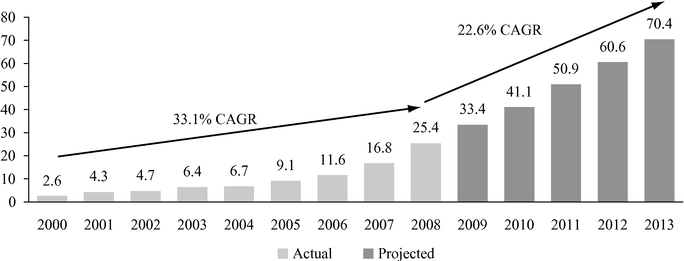
| Source: | Historical figures based on AWEA 2009 report and projected figures based on EER data as of October 2009. | |
| Note: | As of September 2009, AWEA estimates 31.1 GW have been installed. |
Drivers of U.S. Wind Energy Growth
Wind energy is a key component of the renewable energy strategy of the United States. AWEA estimates new wind projects completed in 2008 accounted for approximately 42% of the entire new power-producing capacity added in the United States. We believe the following factors are the main drivers of growth of wind energy in the United States:
Improvements in Wind Technologies and Cost Reductions
Wind turbine technology has evolved significantly over the last 20 years and we expect improved efficiencies to continue in the future as turbines become larger and more advanced. According to AWEA, the average size of installed wind turbines increased from 0.7 MW in 1998–1999 to 1.7 MW in 2008. AWEA further indicates that the cost of electricity generation from utility-scale wind systems has dropped more than 80% over the last 20 years as a result of technological advances, including:
- •
- advances in wind turbine blade aerodynamics and development of variable speed generators to improve conversion of wind
power to electricity over a range of wind speeds, resulting in higher capacity factors and increased capacity per turbine;
- •
- advances in remote operation and monitoring systems;
- •
- improved wind monitoring and forecasting tools, allowing more accurate prediction of wind power output and availability
and better system management and reliability; and
- •
- advances in turbine maintenance, resulting in increased turbine lives.
These technological improvements have decreased the cost of wind generation and increased the scalability of wind energy projects, increasing the amount of overall generation with fewer turbines. We expect wind turbine cost reductions and efficiency improvements to continue.
84
Set forth below is a chart with comparative cost information for electric power generation.
Comparative Cost of Electric Power Generation
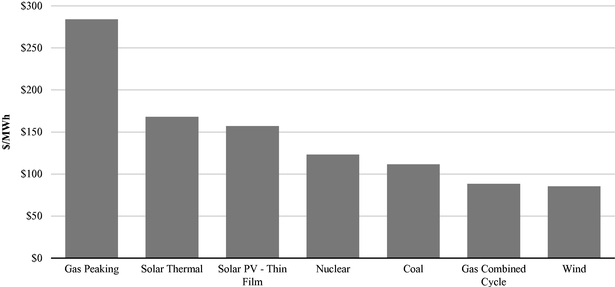
| Source: | "Levelized Cost of Energy Analysis—Version 3.0," website http://blog.cleanenergy.org/files/2009/04/lazard2009_levelizedcostofenergy.pdf, February 2009. | |
Note: |
For each generation source, cost is calculated by taking the midpoint of the range of Lazard estimates. Reflects PTC, ITC and accelerated asset depreciation, as applicable. Assumes 2008 dollars, 20-year economic life, 40% tax rate and 5-20 year tax life. Assumes 30% debt at 8.0% interest rate, 40% tax equity at 8.5% cost and 30% common equity at 12% cost for Alternative Energy generation technologies. Assumes 60% debt at 8.0% interest rate and 40% equity at 12% cost for conventional generation technologies. Assumes coal price of $2.50 per MMBtu and natural gas price of $8.00 per MMBtu. |
Environmental Concerns
The concerns about global warming caused by greenhouse gas emissions have also contributed to the growth of the wind energy industry. According to the Intergovernmental Panel on Climate Change Fourth Assessment Report, the eleven years between 1995 and 2006 ranked among the warmest since 1850. Awareness in the United States of climate change and the related effects of greenhouse gas emissions has resulted in increased demand for emissions-free energy generation. There is some political support to implement federal carbon policy in the form of a "cap-and-trade" program, although whether such a program will be enacted is uncertain. On December 7, 2009, the U.S. Environmental Protection Agency (EPA), in a step that could lead to the imposition of the first federal limits on climate-changing pollution from cars, power plants and factories, stated that there is compelling scientific evidence that global warming caused by emission of greenhouse gases endangers Americans' health. The imposition of a cap-and-trade program or other limits on and regulation of greenhouse gas emissions would likely drive up the costs of traditional fossil fuel energy sources and make wind power a more competitive alternative energy source.
85
Set forth below is a chart showing the levels of carbon dioxide emissions of various countries.
Total Carbon Dioxide Emissions from the Consumption of Energy in 2007
(Million metric tons carbon dioxide)
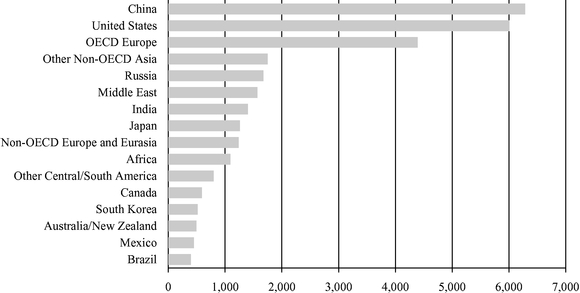
| Source: | EIA, "Total Carbon Dioxide Emissions from the Consumption of Energy", website http://tonto.eia.doe.gov/cfapps/ipdbproject/iedindex3.cfm?tid=90&pid=44&aid=8 |
State and Federal Government Incentives
One of the key factors contributing to the growth of wind energy in the United States is the existence of several government incentive programs and regulatory requirements at both the state and federal levels, including:
Renewable portfolio standards. An RPS is a program mandating that a specified percentage of electricity sales in a state or municipality comes from renewable energy. Currently, 29 states and the District of Columbia have RPS requirements, more than double the number of states with RPS requirements six years ago. For states with increasing RPS requirements over time, renewable energy is scheduled to reach a range of 10% to 40% when the programs are fully implemented. Additionally, a federal renewable portfolio requirement is included in energy legislation currently under consideration by the U.S. Congress, although its chances of enactment are uncertain.
Some state RPS programs (25 such programs as of October 2009) operate in tandem with a credit trading system in which participants buy and sell RECs. A REC is a stand-alone tradable instrument representing the attributes associated with one MWh of energy produced from a qualified renewable energy source. Retail energy suppliers can meet RPS requirements by purchasing RECs from renewable energy generators, in addition to producing or acquiring the electricity from renewable sources. REC prices can represent a significant additional revenue stream for wind energy generators. In RPS states where a liquid REC market does not exist, renewable energy can be bought or sold through "bundled" PPAs, where the PPA price includes the price for renewable energy attributes. In states that do not have RPS requirements, certain entities buy RECs voluntarily. These RECs, which are called voluntary RECs, have a lower price than RECs where there are RPS requirements.
86
The basic proposed or enacted goals of each state's RPS program as of December 2009 are identified in the map below:
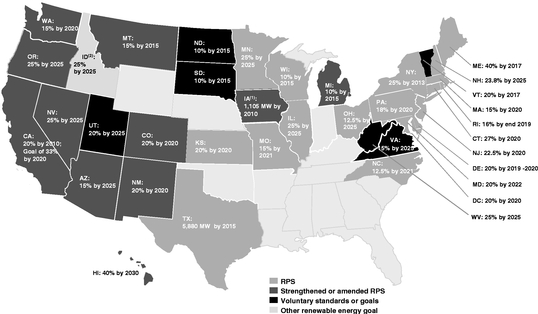
| Source: | FERC. December 2009. | |
Note: |
This map illustrates proposed or enacted goals of each state's RPS program, which may be revised from time to time. The NY PSC recently voted to increase the RPS target to 30% by 2015. Alaska has no RPS. |
|
| (1) | 105 MW RPS. 1,000 MW voluntary goal for renewable generation by 2010. | |
| (2) | Goals set by Governor. |
American Recovery and Reinvestment Act of 2009 (ARRA). The ARRA, which was enacted in February 2009, encourages the development of renewable energy projects in the near term by reducing financing costs and providing cash grants and tax incentives for renewable energy projects through 2012. The ARRA includes a three-year extension of wind PTCs through the end of 2012; the option to elect an ITC for up to 30% of a project's eligible capital costs in lieu of the PTC; and the additional option to receive the ITC as a cash grant from the U.S. Treasury in lieu of the ITC. According to the U.S. Treasury, approximately $1.7 billion of ARRA grants have been issued as of November 2009. We received approximately $115 million of ARRA grants for our Cohocton and Stetson I projects in September 2009.
The U.S. Department of Energy (DOE) has loan guarantee programs under Sections 1703 and 1705 of the ARRA. These programs call for over $40 billion of DOE loan guarantees to be allocated for innovative technology authorized under the Energy Policy Act of 2005 and approximately $15 billion to be made available for commercially proven technology.
Federal Tax Incentives
A number of federal tax incentives encourage the development of renewable energy resources, including the following:
- •
- Production tax credits. The federal PTC provides a federal tax credit of $21 per MWh for a renewable energy facility during the first ten years of its operation. This incentive currently applies to facilities that are placed in service before the end of 2012. Producers may monetize their value by entering into tax equity financing arrangements with investors. Although there can be no assurance that legislation will be enacted extending application of the PTC to projects
87
- •
- Investment tax credits. The federal ITC provides a federal
tax credit for 30% of total eligible capital costs for a renewable energy facility following commercial operation. A wind developer may elect an ITC in place of the PTC and has the option to collect
the ITC as a cash grant from the U.S. Treasury that is payable within 60 days of the application submission.
- •
- Accelerated depreciation. The Tax Reform Act of 1986 established Modified Accelerated Cost Recovery System (MACRS), which divides assets into classes and assigns a mandated number of years over which the assets in the class depreciate for tax purposes. Under MACRS, wind energy projects have a depreciation life of five years, which is substantially shorter than the 15 to 20-year lives of non-renewable facilities. Like PTCs, the accelerated depreciation benefit may be sold to investors.
placed in service after 2012, since 1992 the PTC has been extended and has been continuously available for wind energy projects, except for three non-consecutive periods between 1999 and 2004 when the PTC temporarily expired but was retroactively reauthorized by subsequent legislation.
Dependence on Foreign Energy Sources
According to EIA, foreign imports provided 26% of the energy consumed in the United States in 2008. Many of the regions rich in energy supplies are politically unstable, raising public concern regarding the dependence of the United States on foreign energy imports and related threats to U.S. national security. We believe that wind energy, which supplied only 1.3% of the total electrical production in the United States in 2008, can help to decrease the dependence on foreign energy sources and satisfy a portion of the expected increased demand for electricity in the United States.
Obstacles for the Construction of Conventional Power Plants
Environmental concerns have made it difficult to build new, or expand existing, fossil fuel projects. For example, according to data gathered by Sourcewatch, a collaborative encyclopedia website, only 35 of the approximately 150 coal plants proposed in the United States between 2000 and 2006 were built or under construction by the end of 2007. Nuclear energy projects have also faced significantly increasing capital costs and steep environmental hurdles, including complications relating to the disposal of spent nuclear fuel. As a result of these hurdles and complications, no new nuclear plant has been commissioned in the United States since 1979. Wind energy, in contrast, does not create solid waste by-products, emit greenhouse gases or deplete non-renewable resources, and thus is an attractive alternative to conventional power plants. According to the DOE's report "20% Wind Energy by 2030," wind energy industry experts estimate the nation has more than 8,000 GW of available land-based wind resources that can be captured economically. EER forecasts RPS demand of 175 GW by 2020.
Supply Chain Improvements in the United States
The success of wind energy is heavily dependant on its cost-competitiveness vis-à-vis other renewable technologies and conventional fuels. The increasing importance of the U.S. wind market is causing a supply chain shift among global producers, several of whom have recently announced plans to build U.S. manufacturing capacity. Historically, global turbine manufacturers have assembled turbines abroad and imported them to the United States, a logistical challenge that has in the past contributed to turbine shortages and high prices. According to AWEA, as recently as 2005, 70% of the wind industry supply chain was sourced from foreign locations. By 2008, the supply chain was sourced approximately 50% from domestic manufacturers and 50% from foreign companies. We expect this trend of increased domestic turbine manufacturing to continue.
The shift to domestic wind turbine manufacturing has been due largely to the desire of wind turbine manufacturers and developers to minimize delivery time and transportation costs, which can
88
represent up to approximately 18% of the final cost of a wind project. It also reflects the growth in U.S. demand for wind turbines and government support for wind power. According to AWEA, of manufacturers with turbines installed in the United States since 2005, over 95% (measured by capacity) either operate or plan to operate turbine assembly facilities in the United States. At least 14 major wind turbine manufacturers have or have announced that they will have turbine manufacturing facilities in the United States, according to EER. Furthermore, the regulatory stability of the U.S. wind market is attracting new entrants as well. This increase in local supply has primarily occurred in the last few years and resulted in underutilization of turbine manufacturing capacity as a consequence of the recent economic downturn. With turbine supply now exceeding demand, some turbine prices have decreased up to 20% from mid-2008 levels, according to EER.
Key Attributes of Our Regions: Northeast, West and Hawaii
Our projects are located in the Northeastern and Western regions of the continental United States and in Hawaii. These markets are characterized by relatively high electricity prices, a shortage of renewable energy and a favorable balance between wind resources and cost-effective sites to build. We believe that the combination of demand from aggressive RPS requirements, premium electricity pricing, and strong wind resources will create significant opportunities for attractive development activity.
The key attributes of our regions are set forth below:
Among the Highest Prices in the United States
Power and REC prices vary across regions and states. The price of electricity varies based on supply and demand dynamics, generation technology mix, costs of commodities and other inputs required to produce electricity, as well as the cost of relevant environmental laws and regulations. REC prices vary based on the relative strength of RPS programs and supply and demand dynamics. As illustrated below, we are actively developing wind energy projects to sell electricity in the five states with the highest electricity prices in the United States.
89
The chart below contains information concerning state power prices.
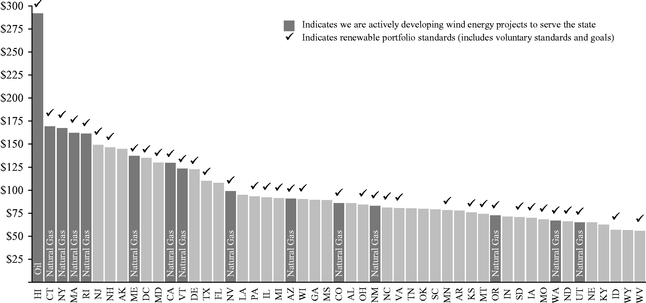
| Source: | EIA, 2008 average retail power prices by state. Data as of December 31, 2008. | |
| Note: | Indicated fuel source reflects primary electricity price driver. |
Markets with Largest Amount of Wind Energy Demand Relative to Amount in Interconnection Queue
We target markets where there is significant demand for wind generation supported by RPS programs relative to the amount of wind generation that is in the interconnection queue. A majority of our target markets, such as the ISO-NE and the New York Independent System Operator (NY-ISO) have RPS-driven demand for renewable energy that exceeds the supply of renewable energy currently proposed within the interconnection queue of each of those power markets. Based on EER estimates highlighted in the chart below, 2020 demand for renewable energy is expected to exceed the amount of supply currently in the interconnection queue by approximately 19 GW for New England and New York. In addition, the amount of supply in the interconnection queue for California, excluding solar, is 14 GW and the RPS demand in 2020 is 39 GW. This compares favorably with the Midwest Independent Transmission System Operator (MISO), the Electric Reliability Council of Texas (ERCOT) and the Southwest Power Pool (SPP), where the demand supported by RPS programs is much lower than the amount of wind generation currently in the interconnection queue as of October 2009.
90
The chart below presents renewable energy capacity in regional interconnection queues and the EER forecasted 2020 RPS demand for those regions as of October 2009.
RPS Demand vs. Major Interconnection Queues
(MW)
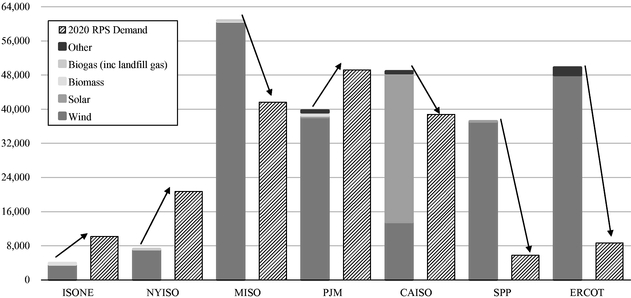
| Source: | RTO/ISO, Emerging Energy Research | |
| Note: | Includes active interconnection requests. Does not include operational projects. RPS demand estimates based on EER calculations. Interconnection queue data for Hawaii unavailable. |
Most Progressive Renewable Energy Standards
States in our markets in the Northeast, West and Hawaii have RPS legislation that calls for approximately 70 GW of installed renewable energy capacity to be built by 2020. In comparison, according to the EIA, as of year-end 2008 installed renewable energy in the Northeast, West and Hawaii was 18 GW, excluding large hydro generation in all states except New York. Unlike other states, New York includes large hydro as a source of renewable energy.
Northeast
A number of states in the Northeast have progressive renewable energy programs, which have increased growth opportunities and demand for wind development. According to EER, RPS-driven demand for renewable energy in New England exceeds the supply of renewable energy currently in the ISO-NE interconnection queue. This has strengthened the market for RECs. For example, Massachusetts's RPS program requires that renewable energy use increase at a rate of 0.5% per year, reaching 4% of total electrical generation within the state by 2009, subsequently increasing by 1% every year thereafter to 25% by 2030. The Massachusetts program establishes a series of alternative compliance payments that began at $50 per MWh in 2003 and are adjusted for inflation ($61 per MWh in 2009). New York's RPS program is intended to address increasing concerns about New York's dependence on fossil-fuel generation and its environmental impact. The New York program calls for an increase in renewable energy used in the state from approximately 19% in 2004 to 30% by 2015.
91
Because renewable generation capacity is currently substantially below the ultimate RPS goals, significant additional renewable generation capacity must be developed within the region, particularly in the New England states, if RPS program requirements are to be met. The current RPS mandates for the New England states and New York would result in total RPS-driven demand of approximately 31 GW in 2020, according to EER. By comparison, EIA data indicates that installed renewable capacity in New England and New York was 9 GW, excluding large hydro in New England, as of year-end 2008.
10 states in the Northeast and Mid-Atlantic participate in the Regional Greenhouse Gas Initiative (RGGI) to reduce greenhouse gas emissions from power plants in the participating states. The participating states have implemented a regional cap-and-trade program with a market-based emissions trading system. Under the program, participating states sell carbon dioxide emission allowances in regional auctions.
West
Our West markets include states with progressive RPS programs that provide support for long-term wind and other renewable energy demand. The Western states that we focus on include California, New Mexico, Arizona, Nevada, Washington and Colorado. These states have RPS programs that mandate that 15 to 33% of total electric generation come from renewable energy by 2015 to 2025, depending on the state. While these states represent our end markets, our wind projects may be built in other states and transmit power across state lines. For example, our Milford I project is located in Utah and transmits power to Los Angeles, California. In addition to RPS programs, some states have supplemental requirements related to wind energy, such as New Mexico, which has a specific requirement that a minimum of 20% of the total renewable energy generation must come from wind resources. The RPS programs and supplemental requirements in these states require additional renewable energy development in order for the RPS program requirements to be met, and thus present significant growth opportunities for wind energy development.
While we focus on several states in the West, California has historically been and remains the key end market for the majority of our projects in this region. California may face a shortage of renewable energy supply as renewable generation capacity has not kept pace with rising demand. With one of the most progressive RPS programs in the nation, California is an attractive end market for wind energy companies. California has historically been a leader in wind development, ranking third in the United States with over 9.0 GW of installed renewable generation capacity at year-end 2008, excluding capacity from large hydro generation, according to the EIA. Early adoption of an RPS target of 20% by 2017 was a key catalyst for new wind development, while a strengthened 33% RPS finalized in 2009 will make California's RPS program one of the highest in the continental United States through 2020. Based on its unique combination of competitive electricity pricing, strong renewable energy policy and excellent wind resources, California should be one of the top five wind-power markets in the United States by 2020, according to EER.
California's RPS program currently requires 20% of retail utility power sales to be generated by renewable sources by 2010, a requirement that can be satisfied with power imported from other Western states, including Utah, Wyoming, New Mexico, Nevada and Oregon. As of December 2009, California's investor-owned utilities were forecasted to fall short of their 2010 and 2020 renewable resources requirements of 20% and 33% respectively unless they add renewable resources at a much faster pace, according to the California Energy Commission (CEC). Penalties under California's RPS program for an RPS procurement deficit are $50/MWh, up to $25 million per year. The current RPS requirements for California would result in total RPS-driven demand of approximately 39 GW in 2020, according to EER. The majority of new renewable capacity is expected to be delivered by wind and solar energy, given the characteristics of this region. By comparison, EIA data indicates that installed renewable capacity was 9 GW, excluding large hydro, as of year-end 2008.
92
California's Global Warming Solutions Act of 2006 seeks to lower California's greenhouse gas emissions to 1990 levels by 2020, caps greenhouse gas emissions from major industries and imposes significant penalties for non-compliance. California also enacted a law in 2006 prohibiting utilities from making long-term commitments for electricity generated by plants that do not comply with the greenhouse gas emission performance standards established by the CEC. The law applies to out-of-state power purchases as well as in-state power purchases and is expected to have an adverse impact on California's ability to purchase power from coal-fired power plants.
Hawaii
Hawaii is a strong market for wind energy. In June 2009, Hawaii expanded its RPS to 40% by 2030, making it one of the most aggressive state renewable requirements in the United States. State goals for renewable generation are even stronger. In addition, although no legislation has been adopted, in January 2008 the Governor of Hawaii announced plans to achieve 70% of electricity sales from renewable sources by 2030.
According to EIA, Hawaii receives approximately 76% of its power from fuel oil generation and 14% of its power from coal. As a result, a significant and rapid shift to renewable energy capacity would be required to meet the state's stringent standards. Because oil is the predominant source for electricity in Hawaii, oil prices are the primary driver of local electricity prices. Hawaii imposes an oil import tax. The cost of oil in Hawaii is further compounded by the costs of transporting oil to and between its islands. The volatility and escalation of global oil prices directly correlate to volatile and increasing electricity prices in Hawaii. Hawaii's average electricity costs are the highest in the United States, with residential rates averaging over $250/MWh in 2009, giving wind energy a strong cost advantage.
The current RPS requirements for Hawaii would result in total RPS demand of approximately 900 MW in 2020, according to EER, the majority of which is expected to be delivered by wind energy. By comparison, EIA data indicates that installed renewable capacity, excluding large hydro, was 239 MW as of year-end 2008. Based on the limited availability of sites and the number of wind projects in the planning stages, we believe developers with an established presence in Hawaii have a significant advantage in this market.
93
Overview
We are an independent wind energy company focused solely on the development, financing, construction, ownership and operation of utility-scale wind energy projects in the United States. Our projects are located in the Northeastern and Western regions of the continental United States and in Hawaii. We have focused on these markets because we believe they provide the potential for future growth and investment returns at the higher end of the range available for wind projects. These markets are characterized by relatively high electricity prices, a shortage of renewable energy and sites with good wind resources that can be built in a cost-effective manner. Moreover, we have focused our efforts on projects and regions with significant expansion opportunities, often enabled by transmission solutions that we have developed.
As of November 30, 2009, we operated six projects with combined rated capacity of 477 MW, and we owned two lines that connect projects to the electricity grid (generator leads) with transmission capacity of approximately 1,200 MW. In 2009, we doubled the number of projects in our operating fleet, adding three new projects with an aggregate capacity of 385 MW. Two of these projects, Milford I, which sells power into Southern California, and Stetson I, which sells power in New England, include wholly-owned generator leads we built in anticipation of expanding these projects.
We manage our business with a team of professionals with experience in all aspects of wind energy project development, financing, construction and operations. We have a track record of selecting projects from our development pipeline and converting them into operating projects that we believe will meet our financial return requirements. By the end of 2010, we expect to have seven additional projects with 293 MW of capacity operating or under construction, one of which is already under construction. We target having approximately 1,000 MW of projects operating or under construction by the end of 2011. Thereafter, we target adding approximately 300 to 400 MW of operating/under-construction capacity each year to achieve our goal of having an operating/under-construction fleet in excess of 2,000 MW by the end of 2014. Expansions of current operating and under-construction projects make up approximately 51% (measured by capacity) of our targeted 2010-2011 projects. See "—Our Development Process" and "—Our Portfolio of Wind Energy Projects."
Wind energy project returns depend mainly on the following factors: energy prices, transmission costs, wind resources, turbine costs, construction costs, financing cost and availability and government incentives. In applying our strategy, we take into account the combination of all of these factors and focus on margins, return on invested capital and absolute value creation as opposed solely to project size. Some of our projects, while having high construction costs, still offer attractive returns because of favorable wind resources or energy prices. Additionally, in many cases, smaller, more profitable projects can create as much absolute value as do larger, lower-returning projects. We assess the profitability of each project by evaluating its net present value. We also evaluate a project on the basis of its Project EBITDA, as described under "Management's Discussion and Analysis of Financial Condition and Results of Operations—How We Measure Our Performance" as compared with the project's development and construction costs.
We closely manage our commodity-price risk and generally construct wind energy projects only if we have put in place some form of a fixed-price, long-term PPA and/or financial hedge to manage commodity risk. Approximately 85% of estimated revenues through 2011 from our current operating projects are hedged. We plan to hedge approximately 90% of the estimated revenues for 2011 for the seven projects we plan to have under construction in 2010. See "Business—Revenues; Hedging Activities."
The United States is one of the largest and fastest growing wind energy markets. In 2008 the United States surpassed Germany as the largest market for wind energy in the world, as cumulative
94
installed wind energy capacity increased approximately 51% and accounted for 42% of all new energy supply in the United States, according to AWEA. Moreover, our markets are among the highest growth U.S. markets due to state mandated RPS-driven demand, premium electricity pricing, a shortage of renewable energy and strong wind resources. States in our markets in the Northeast, West and Hawaii have RPS legislation that calls for approximately 70 GW of installed renewable energy capacity to be built by 2020.
We classify each project into one of the following three categories based on the project's stage of development: Operating/under-construction, Tier 1 and Tier 2. We use these categories to estimate our annual installed capacity and energy generation and for planning purposes, including allocation of capital to projects. For information regarding the criteria we use to put projects in these categories, see "—How We Classify Our Projects."
A summary of our projects, as of December 15, 2009, is set forth below:
| |
Northeast | West | Hawaii | |
|||||||||
|---|---|---|---|---|---|---|---|---|---|---|---|---|---|
Stage of Development(1)
|
Actual or In Development Capacity(2)(3) (MW) |
Actual or In Development Capacity(2)(3) (MW) |
Actual or In Development Capacity(2)(3) (MW) |
Total | |||||||||
Operating/Under-Construction |
269 | 203 | 30 | 502 | |||||||||
Tier 1 |
140 | 102 | 51 | 293 | |||||||||
Tier 2 |
498 | 3,182 | 70 | 3,750 | |||||||||
Total |
907 | 3,487 | 151 | 4,545 | |||||||||
- (1)
- Our
ability to complete our projects and achieve anticipated capacities is subject to numerous risks and uncertainties as described under "Risk Factors." We
are unlikely to complete all of the projects in our current development pipeline, while some of the projects we are likely to develop in the future are not in our current pipeline.
- (2)
- As
a result of wind and other conditions, a project or a turbine will not operate at its rated capacity at all times and the amount of electricity generated
will be less than its rated capacity.
- (3)
- For information on noncontrolling interests in our projects see Note 5 to our consolidated financial statements.
We believe our development pipeline of over 4,000 MW should enable us to meet our 2014 goal of having an operating/under-construction fleet of 2,000 MW. We have land rights for 85% of our development pipeline and meteorological data for nearly 90% of our development pipeline, in most cases covering at least three years. We have also conducted preliminary environmental screening for all of our projects. We are unlikely to complete all of the projects in our current development pipeline, while some of the projects we are likely to develop in the future are not in our current pipeline. Our ability to complete our projects and achieve anticipated generation capacities is subject to numerous risks and uncertainties as described under "Risk Factors."
Our Regions
Northeast
Our Northeast region includes New England and New York. We believe this region is one of the more attractive wind energy markets in the United States due to its relatively high electricity prices, tightening supply of renewable energy relative to demand and progressive renewable energy legislation. Every state in the Northeast region (other than Vermont) has an established RPS program and associated market for RECs. These programs have led to increased demand for wind energy development in these states.
95
In addition, the geographic proximity and interconnectivity of the various power markets within the Northeast, together with highly liquid electricity trading markets, gives projects within the region the flexibility to deliver power into and qualify RECs in different markets within the region.
The Northeast has relatively limited utility-scale development opportunities due to its population density and modest wind resources. Additionally, transmission limitations constrain future increases in wind generation capacity. However, given our pipeline of projects and proven success in developing, constructing and operating wind energy projects in this region, we believe our business is well positioned for continued growth in this region. Furthermore, the transmission infrastructure we own should allow us to efficiently and economically expand in this region. We believe the relative difficulty in developing wind energy projects in this region further strengthens our position as an early entrant in this market.
For information regarding the Northeastern market, see "Industry—Key Attributes of Our Regions: Northeast, West and Hawaii."
West
Our West region consists of the far west and Rocky Mountain states. Of these, California is the largest electricity market in the region. California may face a shortage of renewable energy supply as renewable generation capacity has not kept up with rising demand for renewable energy. With one of the most progressive RPS programs in the nation, California is an attractive market for renewable energy generators. However, recent bottlenecks in siting and permitting renewable energy projects have led to relatively small additions of new capacity. EER forecasts long term growth of renewable energy capacity in California will be driven by state transmission projects and programs such as the California Renewable Energy Transmission Initiative and the Western Renewable Energy Zones as well as developer-driven private transmission solutions. EER estimates that the state will add more than 8 GW of new transmission capacity through 2020.
We have developed a private transmission platform in the West, which enables us to deliver a significant amount of wind energy generation to the California market. We have a long-term PPA with the Southern California Public Power Authority (SCPPA) to supply 20 years of power to the cities of Los Angeles, Burbank and Pasadena from our Milford I project in Milford, Utah and completed an 88-mile, 1,000 MW generator lead to transmit our wind energy to California. Milford I is a 203 MW project that achieved commercial operation in November 2009. Given the capacity of the Milford generator lead, we can expand our Milford platform to deliver another 750 MW of wind energy to California. The Milford II expansion project, which is described later in this section, has a capacity of 102 MW and is expected to begin construction in 2010.
While California is the largest market in the West and presents a significant opportunity for wind energy, we are actively developing projects in the West to serve states other than California. These projects are largely Tier 2 projects.
For information regarding the Northeastern market, see "Industry—Key Attributes of Our Regions: Northeast, West and Hawaii."
Hawaii
We believe the Hawaii market offers a unique opportunity for us, as the state's high electricity prices and excellent wind resources offer potential for wind projects with attractive returns. The state currently generates approximately 90% of its electricity from oil and coal-based technology. To reach the state's 2030 RPS target of having 40% of Hawaii's electricity generation come from renewable energy, a large percentage of fossil-fuel electricity generation will need to be replaced with RPS eligible technologies such as wind.
96
Today there is approximately 63 MW of wind capacity in Hawaii; 30 MW of which comes from our KWP I project, the single largest wind energy project in Hawaii. We believe that conditions for developing wind energy projects in Hawaii strengthen our position as an early entrant in this market. There are relatively few buildable wind sites in the state and we believe developers with an established presence have a significant competitive advantage. We believe our development experience and knowledgeable staff in Hawaii, coupled with our platform in Hawaii, should position us for future growth in this market.
For information regarding the Northeastern market, see "Industry—Key Attributes of Our Regions: Northeast, West and Hawaii."
Revenues; Hedging Activities
We generate revenues from the sale of electricity from our operating projects and from the sale of RECs generated by these operations:
Electricity Sales
We typically sell the power generated by our projects (sometimes bundled with RECs) either pursuant to PPAs with local utilities, power companies and other entities or directly into the local power grid at market prices. Our PPAs have terms ranging from three to 20 years with fixed prices, market prices or a combination of fixed and market prices. We also seek to hedge a significant portion of the market component of our power sales revenue with financial swaps. Approximately 85% of estimated revenues for our current operating projects are hedged through 2011. We plan to hedge approximately 90% of estimated revenues for 2011 for the seven projects we plan to have under construction in 2010. "Management's Discussion and Analysis of Financial Condition and Results of Operations—Factors Affecting Our Results of Operations, Financial Condition and Cash Flows—Power Purchase Agreements and Financial Hedging."
Sales of RECs
The RECs associated with renewable electricity generation can be sold. In some states, we sell RECs to entities that must either purchase or generate specific quantities of RECs to comply with state or municipal RPS programs. Currently 25 states and the District of Columbia have adopted RPS programs that operate in tandem with a credit trading system in which generators sell RECs associated with the renewable power they generate in excess of state-mandated requirements.
Hedging
We enter into derivative contracts to hedge future electricity prices to mitigate a portion of the risk of market price fluctuations we will have by selling power at variable or market prices. We currently have entered into three financial swaps with a remaining weighted average tenor of approximately seven years, which will collectively hedge approximately 70% of our expected generation during the term of the swaps at Cohocton I, Steel Winds I and Stetson I and II. We intend to enter into additional financial swaps to hedge a similar percentage of expected generation for our other Tier 1 and Tier 2 projects that will sell power in liquid ISO markets as they near commercial operations. We have also entered into an oil swap with a remaining tenor of approximately four years to hedge future oil prices to mitigate a portion of the risk of market price fluctuations associated with our power generation at Kaheawa Wind Power I, the pricing of which is largely tied to the costs that MECO avoids by substituting our electrical production for the production it otherwise would have to generate by burning fossil fuels. For additional information regarding our hedging activities, please read "Management's Discussion and Analysis of Financial Condition and Results of Operations—Quantitative and Qualitative Disclosure about Market Risk."
97
Strategy
Our business strategy is to build a diverse portfolio of operating projects and development opportunities. We seek opportunities where, if we are able to execute successfully, we will be able to generate attractive returns for our stockholders. These returns depend mainly on the following factors:
- •
- Energy price. We assess project returns taking into
account the total realized price of energy that we earn from an operating project, or that we expect to earn from a project in our pipeline. The total realized price of energy includes power sales,
REC sales and capacity payments, as well as the effect of cash settlements from related hedging activities.
- •
- Wind. The quality of the wind resources at a project, and
the resulting energy production, is a key determinant of project performance. We measure wind resources at a given operating project by calculating the net capacity factor (NCF), and we forecast NCF
for each project in our pipeline. NCF is a measure (or estimate) of a turbine's production compared with the amount of power the turbine could have produced (or is capable of producing) running at
full capacity for a particular period of time.
- •
- Construction costs. The fully loaded installed costs of
the project also determine whether or not the project is capable of generating appropriate returns. Fully loaded construction costs include primarily the cost of turbines, and also take account the
cost of transmission facilities, balance-of-plant, interest during construction, financing costs and fees and development expenses.
- •
- Financing. Because we rely on third party financing to
construct our projects, we must be able to demonstrate to our lenders and tax equity investors that there is a sufficient likelihood of a project's ability to generate a given level of return, in
order to secure capital at a cost that will make the project attractive for us.
- •
- Government incentives. The availability of government incentives has historically been critical to our ability to secure third party financing for our projects, and to enable us to construct projects that are expected to provide us with an attractive return on investment. We expect that for the foreseeable future this will continue to be the case.
We intend to pursue the following objectives to execute our strategy.
Develop Pipeline and Expand Operating Projects
We have identified and are developing a broad pipeline of projects in our markets, including expanding our operating projects in existing locations, and we intend to continue developing our existing pipeline of projects and increasing the number of operating projects. We focus on expansion projects because we believe they present lower execution risks than other projects. This is due to factors including our experience with the wind resources at the project site, as well as our clearer understanding of how to address particular community stakeholder concerns. We target having approximately 1,000 MW of projects operating or under construction by the end of 2011. Thereafter, we target adding approximately 300 to 400 MW of operating/under-construction capacity each year to achieve our goal of having an operating/ under-construction fleet in excess of 2,000 MW by the end of 2014. Expansions of current operating and under-construction projects make up approximately 51% (measured by capacity) of our targeted 2010-2011 projects. We are unlikely to complete all of the projects in our current development pipeline, while some of the projects we are likely to develop in the future are not in our current pipeline. Our ability to complete our projects and achieve anticipated generation capacities is subject to numerous risks and uncertainties as described under "Risk Factors."
98
Develop Opportunities in Financially Attractive Markets
States in our markets in the Northeast, West and Hawaii are undergoing significant growth, which we expect to continue, reaching 70 GW of RPS-driven demand by 2020. In order to capitalize on this expected growth, we intend to identify and create a new pipeline of diverse development project opportunities in financially attractive markets, including those with relatively high electricity costs or a shortage of renewable energy and sites with good wind resources that can be built in a cost effective manner. Our team of developers focuses our prospecting and development efforts on identifying new opportunities and acquiring existing wind energy assets that we believe will meet our financial return requirements in these markets.
Implement Transmission Solutions
Our generator lead assets and capabilities are enabling us to develop projects in areas that would otherwise present significant transmission challenges, and we intend to continue to develop, build, own and operate generator leads connecting our projects to third-party electricity networks. We have built two generator leads that provide us with significant opportunities for future development. Our Stetson generator lead has approximately 140 MW of capacity available for our future expansion projects, and our Milford generator lead has approximately 750 MW of capacity available for future expansion projects. In 2010, we plan to build expansion projects using both the Stetson and Milford leads, leaving 700 MW of additional capacity on these lines.
Control Construction and Operations
We intend to continue to maintain control over both the construction and operational phases of our projects, because we believe exercising this control enhances our credibility, allows us to make rapid decisions and strengthens our relationships with landowners, local communities, regulators and other stakeholders. For construction projects, we manage and mitigate budget and schedule risks through arrangements with contractors that have significant experience constructing wind energy projects. We also work closely with the manufacturers of our turbines with the goal of enhancing the operating performance of our fleet.
Stabilize Revenues
We believe that stabilizing our revenues enhances our ability to obtain long-term, non-recourse financing for our projects on attractive terms. We therefore enter into long-term PPAs with utilities and electricity consumers, and, through the use of financial derivatives, we hedge our exposure to market prices for electricity. Both of these activities help to insulate our revenue stream against commodity price volatility. In addition, we seek to maximize the value of the RECs we generate by selling our electricity into markets that have higher RPS requirements and strong markets for RECs. We intend to continue to pursue each component of our revenue stabilization strategy, which we believe benefits us, our lenders and our tax equity investors.
Establish and Maintain Strong Local Presence
We believe that developing a substantial local presence in our markets, and encouraging substantial community stakeholder involvement, is critical to the success of each individual wind energy project because negative community sentiment can be a factor in project delays and increased costs. Through our locally deployed development teams, we work cooperatively with the communities where our projects are located to more fully understand each community's unique issues and concerns. We begin community outreach at an early stage of each project to better assess a project's feasibility, and we continue our efforts through the operating stage in order to enhance our ability to complete and operate a project successfully. This outreach often includes substantial interaction with local
99
government officials, community groups and local media, as we explain our plans, our track record and the benefits that we believe will accrue to the community, and we endeavor to respond to concerns that community members may express such as concerns about the environmental impact of our projects.
Pursue Financing
Our business is capital intensive and requires ongoing access to debt and equity capital markets to build our projects. We believe we demonstrated our capacity to do this during the difficult financial market conditions in 2008 and 2009, and we will continue to seek third party financing in order to grow our portfolio.
Competitive Strengths
We believe there are significant opportunities for growth in the U.S. wind energy industry in general and in our markets in particular, and we intend to use the following strengths to capitalize on these opportunities.
Track Record
Over the past several years we believe we have established a track record for developing complex wind energy projects in each of our three markets. Our project development strategy sometimes includes the construction of generator leads as in the case of Stetson I and Milford I, or the structuring and negotiation of creative financing and risk management solutions as in our PPA with SCPPA for Milford I. In certain cases, as in KWP I, we took over projects from other developers who were unable to complete them. We believe that this particular strength will help us obtain financing for projects that present technical or operational challenges, and thereby make it possible for us to take advantage of opportunities that might not be available to other wind energy competitors.
Agility in Accessing Capital
Wind energy project development and construction are capital intensive and require access to a relatively constant stream of financing, making our ability to access capital markets efficiently and effectively crucial to our growth. We cannot be sure that financing will be available to us on attractive terms when we require it, and the recent worldwide financial and credit crisis has reduced the availability of liquidity and credit. However, during the difficult market conditions that began in the fall of 2008 and have persisted through 2009, we refinanced or raised approximately $1.9 billion for our company and projects in 16 refinancing and new capital-raising activities.
Presence in Attractive Markets
We believe the markets in which we are already established—the Northeast, West and Hawaii—present significant growth opportunities because these markets are characterized by high electricity prices, a shortage of renewable energy and sites with good wind resources that can be built on cost-effectively. Many of our projects have significant expansion opportunities, and expansions of our current operating and under-construction projects make up approximately 51% (measured by capacity) of our targeted 2010-2011 projects. Expansions of existing projects allow us to capitalize on our site-specific knowledge of wind resources as well as our familiarity and relationships with the local community. Moreover, in some cases we will be able to use our existing generator leads to connect with the regional electricity grid. Each of these factors helps to minimize a project's execution risk and helps to arrange the required financing.
100
Turbine Flexibility
We have secured sufficient turbines to execute our 2010 project plan, and through our November 2009 agreement with Clipper, we have achieved a position of relatively few turbine commitments compared to prior periods. See "Management's Discussion and Analysis of Financial Condition and Results of Operations—Recent Developments." We therefore believe we are well positioned to take advantage of current conditions in the turbine market, which we believe is over-supplied. As a result, we have not entered into firm commitments to purchase turbines for projects in our development pipeline after 2010. Instead, we have agreements in place that give us the right, but not the obligation, to purchase additional turbines after 2010, allowing us to cancel our turbine orders with the forfeiture of deposits. We believe this gives us flexibility to acquire turbines at attractive prices and on favorable terms.
Experienced Management
Our management team, which holds a meaningful equity stake in our company, is experienced in all aspects of the wind energy business. Over the past two years, we have added several key personnel to our team, primarily in the areas of construction, operations and finance. We believe we can achieve our operating/under-construction fleet goal of over 2,000 MW by the end of 2014 without significant additions to headcount and overhead costs related to non-operating activities.
Our Development Process
There are several key activities that occur throughout our development efforts as we move projects from development to construction to operation—many of which we undertake concurrently. These activities include: prospecting; wind resource assessment; land rights procurement; revenue stabilization; turbine procurement; transmission and interconnection solutions; permitting; engineering procurement and construction oversight; and commissioning, maintenance and operations.
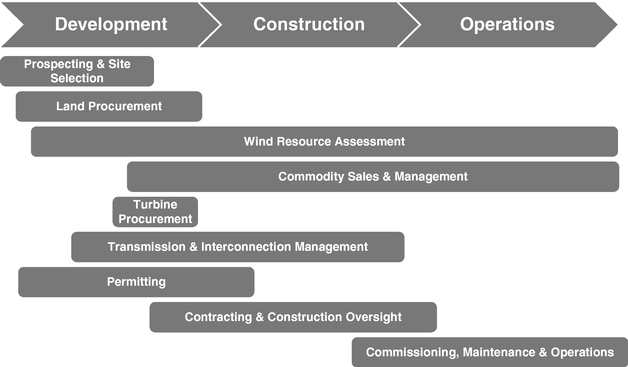
As progress is made for a project we advance it through our project classification system, as described in "—How We Classify Our Projects."
101
We evaluate projected investment returns during all stages of the development process and allocate capital among projects in a manner designed to optimize our overall investment returns. We also consider how projects will be financed. For additional information regarding our project financing activities, see "Management's Discussion and Analysis of Financial Condition and Results of Operations—Factors Affecting Our Results of Operations, Financial Condition and Cash Flows—Financing Requirements."
Prospecting
Prospecting is the earliest activity in our development process. It occurs before we classify a project as Tier 2. Many projects never reach the Tier 2 category. Prospecting involves a broad, high-level review of potential sites for their suitability for wind energy development. We make our initial assessments of potential sites based on a number of criteria, including wind resource suitability; constructability; access to transmission networks; site size and location; land ownership; and environmental zoning and other local and state laws and regulations, including available state-sponsored RPS programs. We also consider the capital cost, size and expansion opportunities at a proposed site and our view of the relevant markets for electricity and RECs. Our in-house meteorology, real estate, construction and transmission teams conduct initial reviews of publicly available information, including wind reports, land records, topographical maps and power transmission maps. They also use our proprietary data to identify significant impediments that could result in a project's failure to meet our investment objectives.
An important part of the prospecting process is an initial environmental screening, also referred to as a fatal flaw analysis. This is usually conducted using publicly available information, sometimes supplemented with a site visit, to identify documented or readily apparent environmentally sensitive areas. These areas include unique wildlife habitats, wetlands, culturally significant resources and proximity to wildlife reserves, national parks and scenic areas not generally suitable for commercial development. Prospecting may also include a preliminary assessment of a project's potential hazard to aviation safety. Once a site passes this initial review, we begin more detailed site-specific environmental assessments in connection with our permitting efforts and establish constraints for turbine siting and civil and site engineering. These typically include detailed mapping of environmental and cultural resources, studies to determine use of the site by migratory or sensitive wildlife and mapping of adjacent residential and other development, all aimed at our being able to operate a potential project safely without negatively affecting the local environment.
Wind Resource Assessment
We begin a wind resource assessment at the earliest stage of the development process. We base our initial assessment of the available wind resources on a review of publicly available wind maps. If the results of the initial assessment are positive, we seek to install meteorological towers to obtain long-term site-specific wind data and make wind resource estimates. Our own regional meteorological tower field teams install, maintain and decommission our meteorological towers. We have meteorological data for nearly 90% of our development pipeline, and of such data, for Tier 1 projects, 100% is for three or more years , while for Tier 1 and Tier 2 projects on a combined basis, 65% of such data is for one or more years and 57% is for three or more years. Our in-house meteorological team also prepares computer models to estimate potential wind levels. In order to obtain financing, we will also seek third-party assessments at later stages of a project's development.
Land Rights Procurement
Land rights procurement begins during the prospecting process. Land rights include all necessary agreements (such as leases, options, easements and letters of intent) needed to construct and operate the project, including those associated with turbines, transmission and collection lines, access roads,
102
facilities and any other easements that may be required. We use publicly available data or prior experience to determine if there are any known impediments to securing the land rights we need. From there, we conduct initial meetings with local landowners, government officials, community representatives and residents to gauge community support. If these meetings are favorable, we generally enter into land leases with landowners to secure all necessary rights to build on the site, including meteorological towers, roads, electric lines, turbines, and operation and maintenance facilities. These contracts usually have an initial term of 20 to 30 years from the commencement of commercial operations with an option for us to extend for an additional 20-year period. They generally require minimum annual lease payments during the development period, minimum payments per turbine or MW during the construction phase, and additional royalty payments based upon a percentage of the project's revenues during the operation phase. In some instances, we enter into option agreements or easements with landowners to obtain access to the project site rights to construct, operate and maintain the wind energy project and/or collection systems and generator leads or other access to transmission facilities. We have projects in development well in excess of our annual targets through 2014, with land rights for 85% of our development pipeline and no known material impediments to obtaining contractual control of the balance.
Revenue Stabilization
To make it more likely that a project will meet our investment return objectives and to protect against electricity price volatility, we review the electricity sales alternatives for each project. We decide whether to enter into a long-term, fixed-price PPA with an electric utility or other user, or to sell the power into the market and enter into a long-term financial hedge linked to electricity prices to secure our financial returns and stabilize project revenue streams, or both. For example, in California, we entered into what we believe to be the first third-party long-term, pre-paid PPA with a public utility for a wind energy project, which allowed us to secure our revenue stream and fund construction of the project. We also entered into a long-term PPA with Harvard University to provide 10% of its local electricity needs. When we can sell our electricity to power markets that are sufficiently liquid, we analyze hedging opportunities available to us later in the development process, such as long-term power swap agreements.
Turbine Procurement
We have secured sufficient turbines to execute our 2010 project plan. In the past, we entered into commitments to acquire turbines well in advance of deployment. Because we believe the turbine market is currently over-supplied, we have elected not to enter into firm commitments to purchase turbines for projects in our development pipeline after 2010. Specifically, we have maintained the right, but not the obligation, to buy turbines from Clipper for up to 632 MW of additional deliveries between 2011 and 2015, subject to the forfeiture of up to $89.5 million in deposits and progress payments that we have made and are scheduled to make to Clipper, if we decide not to buy any additional turbines from them. We believe this gives us flexibility to acquire turbines at attractive prices and on favorable terms.
Transmission and Interconnection
Since the availability of transmission infrastructure and access to a power grid or network are critical to a project's feasibility, we ascertain transmission capacity from public sources and our own proprietary data during the prospecting stage. If existing transmission infrastructure is available, we attempt to secure access to it when we select a potential site for development either during our prospecting activities or during the Tier 2 stage. We discuss availability with the relevant utilities and file an application with the appropriate independent system operator (ISO) or local electric utility to interconnect with the network. If transmission infrastructure does not exist or is not available for a
103
project, we study the feasibility of developing and constructing our own generator lead. We built a 200 MW-rated 38-mile 115 kV generator lead in Washington County, Maine as part of our 57 MW Stetson I project, establishing sufficient excess capacity to accommodate up to 140 MW of our future expansion projects, including our 25 MW Stetson II project, which is currently under construction. In Milford, Utah, we built an approximately 88-mile 1,000 MW-rated 345 kV generator lead, with sufficient capacity to accommodate up to 750 MW of our future expansion projects, including our 102 MW Milford II project.
Permitting
Once we have selected a site, we begin the permitting process with relevant local, state and federal government agencies. This process includes identifying required permits; holding preliminary informational meetings with permitting agencies and stakeholder groups; determining the studies needed for permit applications and conducting the studies; preparing environmental permitting and disclosure reports; participating in public meetings; responding to information requests; and seeking project approval. We also complete preliminary design engineering, taking into account environmentally sensitive areas to avoid or minimize adverse impacts. Because the permitting process is costly and time consuming, we review all aspects of the project, including our projected investment returns, before committing significant resources to these efforts. To date, we have received all material permits for our operating/under-construction projects, as well as several of our Tier 1 projects.
Local
Permitting at the local municipal or county level often consists of obtaining a special use or conditional use permit under a land use ordinance or code. Obtaining a permit usually depends on our demonstrating that the project will conform to development standards specified under the ordinance so that the project is compatible with existing land uses and protects natural and human environments. To facilitate this process, we work to build a positive relationship with the community and address any concerns. We also create project-specific websites to provide the community with pertinent information.
State
Our projects are often subject to state-level permitting requirements. These requirements may include comprehensive environmental reviews or may be limited to a specific regulatory program, or may involve both. State level comprehensive reviews typically take from six to 24 months from the date of filing to approval. Additional approvals may be required for specific aspects of a project, such as stream or wetland crossings, storm water management and highway department authorizations for oversize loads and state road closings during construction. Permitting requirements related to transmission lines may be required in certain cases.
Federal
Projects may also require federal approvals related to the potential effect of projects on aviation, the environment, endangered species and navigable waters. For additional information regarding required regulatory and environmental reviews, permits and laws, see "—Regulatory Matters" and "—Environmental Regulation."
Once a permit or other governmental approval has been granted, it may be appealed or challenged. The amount of time that may be needed to resolve an appeal can vary considerably.
Engineering Procurement and Construction Oversight
We manage the design and construction of our projects. Construction consists of turbine installations, substation construction, interconnection work, construction of the rest of the facility,
104
referred to as balance of plant, and, in certain cases, construction of long generator leads to connect our facility to a third-party electrical grid or network. We generally outsource turbine installation and the remaining construction to outside contractors. The contractors provide the management, supervision, labor, certain materials, tools, engineering, mobilization, testing and demobilization required to construct the project. Construction typically takes approximately seven to 15 months, with adverse weather conditions causing the largest variation in estimated completion dates. Our employees supervise and oversee all aspects of construction.
Commissioning, Maintenance and Operations
Commissioning occurs immediately prior to the completion of a wind energy project. It involves testing each turbine's operation and integration within a project and to transmission. Once commissioning is completed, the turbine supplier typically operates and maintains the turbine under a two to five-year operating agreement that runs concurrently with the turbine warranty. Such operating agreements usually include a guarantee of a turbine's availability to generate electricity a specified percentage of the time. The level of electricity generation covered by the availability guarantees is usually lower during the first several months of operation to allow for issues arising during the initial operation of newly-installed turbines that need to be addressed. While the turbine manufacturer is on-site operating and maintaining the turbines, we oversee the project. Following the expiration of the supplier operating agreements, we will need to operate and maintain the turbines directly. We have established two data analysis control centers in Temecula, California and Boston, Massachusetts, which control the operations of our turbines at all times.
Project Financing
The chart below provides a generic illustration of the various project finance structures we typically employ as a wind energy project moves through its lifecycle, from development to construction and finally into operation. As illustrated below, the final financing structure differs depending on whether
105
we elect to monetize the project's PTCs in the form of a tax equity financing or instead apply for an ARRA grant:
Lifecycle of a Typical Project Financing
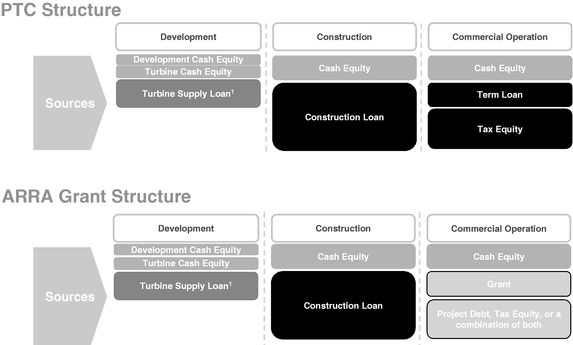
Note: The sizes of the figures in this diagram are not indicative of relative amounts financed.
- (1)
- The need for a turbine supply loan depends on the conditions of the turbine market, see "Management's Discussion and Analysis of Financial Condition and Results of Operations—Factors Affecting Our Results of Operations, Financial Condition and Cash Flows—Turbine Supply and Pricing."
Development and Turbine Financing
We have historically funded our project development expenses with equity. These costs primarily consist of land assembly, permitting activities, interconnection studies, meteorological studies, PPA negotiations and community outreach. In the future, we expect to fund the development of our projects with a combination of existing cash, cash flows from operations, debt financings, and the proceeds of this offering.
Historically we have needed to secure turbine orders at an early stage of a project's development. We used turbine supply loans to finance approximately 70%-80% of turbine progress payments, in advance of actual construction. This practice was prevalent in our industry due largely to excess demand for turbines and long lead times. These conditions have eased. We believe that, as a result of recent changes in the credit markets, turbine supply loans will increasingly be made for, and collateralized by, individual projects. This may require us to make a larger initial equity investment. However, we expect that our need to make long-term capital commitments to turbine purchases far in advance of anticipated delivery will be reduced.
Construction Financing
Once a project moves to the construction phase, we typically use a combination of equity capital and construction loans to finance the construction of the project. Proceeds from the construction loan fund construction and installation costs, including retirement of related turbine supply loans, through
106
commencement of commercial operations. Construction loans are short-term and typically appear as current debt on the balance sheet; however, as a prerequisite to funding, a construction lender usually requires that there be a committed term financing at commencement of commercial operations, which mitigates refinancing risk. In April 2009, we secured a $376 million construction loan to complete our Milford I project, which will be refinanced through a combination of a prepayment for energy from SCPPA, an ARRA grant and the proceeds of a tax equity financing.
Long-term Financing
Once a project has commenced commercial operations, we currently finance the majority of a project's costs through a combination of the ARRA grants, term loans, and tax equity financing transactions, and prepayments for energy, the proceeds of which are used to retire the construction loans and, in some cases, provide for a return of a portion of equity capital. The percentage of each of these forms of long-term financing varies by project.
The ARRA Grants
A recent development in financing our projects is the availability of U.S. Treasury grants under the ARRA. These grants are provided in lieu of the ITC or the PTC and cover 30% of ITC-eligible project costs, namely the costs of constructing energy-producing assets, which are usually approximately 90% of a project's total cost. Grants are available for projects placed in service in 2009 and 2010. Projects that commence construction in 2009 or 2010 and are placed in service before 2013 are also eligible. In 2009, we received ARRA grants of $115 million for our Stetson I and Cohocton projects. We expect to apply for an ARRA grant in early 2010 for our Milford I project, which became operational in November 2009, and to receive the grant proceeds in the first half of 2010.
Term Loans
A form of non-recourse project finance debt, term loans are sized against project-level cash flows and typically fully amortize in 10 to 12 years. We believe term loans at our operating projects are our least expensive and most attractive source of capital. We have historically used term loans to finance our projects on both a standalone basis and in combination with tax equity. We have also used multiple levels of term debt, as is the case with Cohocton, Stetson I, and Steel Winds I, which have been financed by a combination of senior debt at the project level as well as structurally subordinated debt at CSSW, LLC, our subsidiary that owns Cohocton I, Stetson I and Steel Winds I.
Tax Equity
Tax equity is a structured finance product that allows a wind energy project owner to monetize tax attributes that exceed the owner's federal income tax liability. The most common structure is through a "partnership flip" transaction where the project owner sells a noncontrolling ownership interest in the project subsidiary to an investor. The investor is typically allocated 99% of the tax attributes and a portion of the project's cash flows until it reaches a target internal rate of return, after which the investor's ownership interest in the project drops to a nominal value, usually 5%, and the owner of the controlling interest has an option to repurchase the investor's remaining interest at the then-current fair market value. Tax equity partnerships are extremely important for PTC structures, but less important for ARRA grant structures, where the grant effectively monetizes the tax credit through a cash payment to the project owner. However, tax equity structures may be utilized in combination with the ARRA grant to monetize accelerated depreciation benefits.
107
How We Classify Our Projects
We classify our projects into the following three categories based on their stage of development:
- •
- Operating/under-construction;
- •
- Tier 1; and
- •
- Tier 2.
We use these categories to estimate our annual installed capacity and energy generation and for planning purposes, including allocation of capital to projects. We engage in prospecting activities, involving a broad, high level review of potential sites that may be suitable for wind energy development. We do not include these prospecting activities in our pipeline.
We assess our projects during each of these stages to determine or confirm its suitability for development. We commit resources to those projects in which we have a high level of confidence. We often decide not to proceed with projects as a result of one or more factors. These decisions primarily occur during prospecting or the Tier 2 stage, but can occur during any developmental stage. We regularly look at and actively consider, but ultimately decide to abandon, many projects representing possible capacity several times larger than the capacity in our development pipeline. The development and construction of wind energy projects involve numerous risks and uncertainties, some of which are beyond our control, and these risks and uncertainties may prevent projects in our current pipeline from reaching completion. We are unlikely to complete all of the projects in our current development pipeline, while some of the projects we are likely to develop in the future are not in our current pipeline. See "Risk Factors—Risks Related to Our Business and the Wind Energy Industry."
Operating/Under-Construction Projects
Our operating projects have finished construction and commissioning and have achieved their commercial operations date. We currently have six operating projects with 477 MW of capacity. We are currently constructing our Stetson II project, an expansion project with 25 MW of capacity.
Tier 1 Projects
We believe we will complete each of our Tier 1 projects. For a project to reach the Tier 1 stage, we must have completed or be in the process of completing the key development activities. Of our approximately 293 MW of Tier 1 projects, we expect projects with an aggregate of 253 MW of potential capacity to become operating/under-construction projects during 2010. For us to classify a project as Tier 1, all or substantially all of the following milestones must have been achieved:
- •
- Land Rights—We have secured land rights for the project site
or, if the project is on federal or state land, we have applied for such rights, and the commercial terms for leases and easements have been agreed to and title commitments are being finalized;
- •
- Wind—We have collected wind meteorological data, and our final
wind analysis and the third-party confirmation necessary to secure construction financing are underway;
- •
- Power Sales—We have executed, or are in the final stage of
negotiating, PPAs or we are evaluating hedging positions if power would be sold into liquid power markets;
- •
- Turbines—Turbines have been contracted and scheduled for
delivery in accordance with the project design and construction timeline;
- •
- Transmission—We have received an engineering design that specifies our transmission needs, including the costs and completion date, and the transmission capacity has been confirmed;
108
- •
- Interconnection—We have made a final determination of the
facilities required to connect the project with the transmission system and of the cost and time needed to build these facilities;
- •
- Economics—We have confirmed the estimated cost of building the
project and conducted an economic analysis, and are finalizing a financial plan for construction; and
- •
- Permits—We have received, filed or are near filing all necessary permits and we have a high degree of confidence that the permits and approvals will be received.
Tier 2 Projects
We currently have an aggregate of approximately 3,750 MW of potential capacity that we classify as Tier 2 projects. Projects included in the Tier 2 category have met all or substantially all of the following milestones:
- •
- Land Rights—We have secured the critical land rights for the
project site through leases or options to lease or we have determined that there are no known material impediments to securing land rights and, in many instances, we have secured a critical mass of
land for the project site;
- •
- Wind—We have developed preliminary wind resource estimates
based on data from meteorological towers, internal screenings and proprietary data or we have completed a desktop review of wind resources;
- •
- Power Sales—Either marketing and bidding for potential PPAs
for those projects that do not have access to liquid power markets has occurred; or for projects newly classified as Tier 2, we have identified potential counterparties to PPAs for those
projects that do not have access to liquid power markets;
- •
- Turbines—For late stage Tier 2 projects we have
finalized our turbine selection for the project; otherwise we will determine if there is a suitable turbine available;
- •
- Transmission—Either the transmission utility is assessing the
adequacy of the transmission system to deliver power, unless the project will be selling power at the point of interconnection; or for projects newly classified as Tier 2 we have completed a
desktop feasibility review, have identified a potential transmission path to deliver electricity to the market, and have completed a fatal flaw analysis;
- •
- Interconnection—Either the transmission utility is assessing
the ability to connect the project to the transmission system, which results in a system impact study; or for projects just getting promoted to Tier 2 we have submitted a request to connect the
project to the transmission system or a third-party has prepared a preliminary evaluation of the system impact and the costs of interconnection;
- •
- Economics—We have completed an economic analysis with
assumptions based on preliminary wind resource estimates and preliminary capital cost estimates; or for projects just getting promoted to Tier 2 we have completed initial economic analysis
indicating that the project is likely to meet our financial return requirements; and
- •
- Permits—Except for projects just being promoted to Tier 2, we have identified the critical permitting path, established initial contact with project stakeholders and are conducting the environmental and pre-construction studies as necessary for the permitting process. In the case of projects just being promoted to Tier 2, we have completed a permitting risk analysis and have not identified any significant issue in our fatal flaw analysis, and in many instances have initiated basic engineering designs and construction feasibility analysis and have begun discussions with key project stakeholders.
109
A summary of the land under contract, wind data and environmental assessment status for each of the Tier 1 and Tier 2 projects in our development pipeline is set forth below.
Stage of Development
|
Land Under Contract |
% of MW with more than One Year of Wind Data |
% of MW with more than Three Years of Wind Data |
Early-Stage Environmental Screening |
||||||||||
|---|---|---|---|---|---|---|---|---|---|---|---|---|---|---|
Tier 1 |
92 | % | 100 | % | 100 | % | 100 | % | ||||||
Tier 2 |
84 | % | 63 | % | 53 | % | 100 | % | ||||||
Combined |
85 | % | 65 | % | 57 | % | 100 | % | ||||||
Our Portfolio of Wind Energy Projects
Operating Projects
Cohocton
Cohocton is a 125 MW project in the Town of Cohocton, Steuben County, New York. Cohocton commenced commercial operations in January 2009. The project consists of 50 2.5 MW Clipper turbines. Cohocton is the third largest wind project in the state of New York. Similar to Mars Hill, Cohocton qualifies a portion of its energy for New England RECs. The project provides local benefits to the community through property tax revenue and economic development, along with local renewable power sales.
Cohocton wheels approximately 55% of its energy to ISO-NE where its RECs are sold to various counterparties. 40% of Cohocton's RECs are sold to the New York State Energy Research and Development Authority (NYSERDA) under 10-year, fully financeable contracts. The remaining 5% of Cohocton's energy production is sold into the voluntary REC market. Cohocton's power is also sold directly into NYISO Zone C where it receives floating power prices. To stabilize Cohocton's electricity revenue, we hedge for approximately 70% of its electricity. Cohocton was among the first recipients of an ARRA grant, receiving approximately $76 million in August 2009. The remainder of our construction costs at Cohocton are financed with a combination of senior project debt from HSH Nordbank and structurally subordinated debt of CSSW, LLC. Our total installed development and construction costs for Cohocton were approximately $270 million, including approximately $10 million of financing-related costs and excluding prepaid turbine maintenance and warranty costs. We estimate Cohocton's long-term NCF will be approximately 25% to 27%, as described further in "Management's Discussion and Analysis of Financial Condition and Results of Operations." We typically use a 25-year period in estimating a project's long-term NCF.
Kaheawa Wind Power I (KWP I)
KWP I is a 30 MW project in the West Maui Mountains of Maui, Hawaii, that commenced commercial operations in June 2006. The project consists of 20 General Electric (GE) 1.5 MW turbines. The development rights to KWP I were purchased by First Wind in June, 2004 after several other developers had been unable to complete the project. We believe our success in developing KWP I stems from our partnering with local stakeholders and finding creative permitting solutions. For example, we entered into what we believe is the first habitat conservation plan that protects endangered species with respect to a wind project in the United States. Today, we operate a 1 MW prototype battery at KWP I to help stabilize wind energy output given Maui's small electricity grid. We undertook this battery program in cooperation with MECO to prepare for our expansion plans at KWP I.
KWP I has a 20-year PPA for power and RECs with Maui Electric Company (MECO). The PPA is 70% fixed price and 30% floating price at MECO's avoided cost, which historically is correlated to oil
110
prices. Currently MECO's avoided cost is approximately $95/MWh. To stabilize revenues on the floating portion of the contract, we entered into a seven-year oil swap with HSH Nordbank. KWP I qualified for and receives PTCs and MACRS depreciation, along with cash payments under its PPA, and is currently financed with a tax equity investment from JP Morgan. An unrelated third party owns 49% of the common equity relating to KWP I. Our total installed development and construction costs for KWP I were approximately $65 million, including approximately $10 million of financing-related costs such as capitalized interest, fees, and other costs related to turbine supply loans, construction loans, and term financing. This cost estimate excludes prepaid turbine maintenance and warranty costs. We estimate KWP I's long-term NCF will be approximately 41% to 43%, as described further in "Management's Discussion and Analysis of Financial Condition and Results of Operations."
Mars Hill
Mars Hill is a 42 MW project located in Mars Hill, Maine, that commenced commercial operations in March 2007. The project consists of 28 GE 1.5 MW turbines. At the time of its commissioning, Mars Hill was the largest utility-scale wind project in New England (until we commissioned our Stetson I project). We believe Mars Hill is also unique in its transmission arrangement, which qualifies its energy for New England RECs while still providing local benefit to the community through property tax revenue and economic development.
Our five-year Energy Management Service Agreement with New Brunswick Power Corporation (NB Power) provides for the wheeling arrangement as well as NB Power's purchase of our electricity. Our RECs are sold separately to various counterparties. Mars Hill qualified for and receives PTCs. It is currently financed with a tax equity investment from JP Morgan and Wells Fargo, and a term loan from HSH Nordbank. Our total installed development and construction costs for Mars Hill were approximately $95 million, including approximately $5 million of financing-related costs and excluding prepaid turbine maintenance and warranty costs. We estimate Mars Hill's long-term NCF will be approximately 35% to 37%, as described further in "Management's Discussion and Analysis of Financial Condition and Results of Operations."
Milford I
Milford I is a 203 MW project in Beaver and Millard Counties, Utah, located approximately 200 miles southwest of Salt Lake City. Milford I commenced commercial operations in November 2009. The project consists of 39 GE 1.5 MW turbines and 58 2.5 MW Clipper turbines (58.5 MW GE and 145 MW Clipper). As part of the Milford I project we also constructed an 88-mile, 1000 MW, 345 kV generator lead to interconnect to Intermountain Power Plant, a 2 GW coal-fired power plant in Delta, Utah. Securing right-of-way for this generator lead required gaining permission from more than 20 landowners and numerous permitting authorities. We sized the capacity of our line at 1,000 MW to accommodate future expansions, including our 102 MW Milford II project, which we plan to construct in 2010.
Intermountain Power Plant is electrically connected to CA-ISO via the STS Transmission line, a 500 kV direct current line that services the Los Angeles basin. By interconnecting our Milford project at Intermountain Power Plant, we are able to use the existing STS transmission line and provide renewable power directly to the Southern California market. We executed a 20-year PPA for Milford I with SCPPA in 2007 to sell 100% of our power and RECs at a fixed price. The PPA includes a prepayment for a portion of the annual expected generation and ongoing payments for the remainder of the electricity, plus additional payments for RECs and reimbursements of certain operating costs. We believe the prepayment feature of the PPA is innovative and allowed us to lower our cost of capital for financing the project. We believe this benefit was passed on to consumers in the form of a reduced power price. We plan to apply for and expect to receive an ARRA grant for Milford I. An unrelated third party owns 20% of the common equity relating to Milford I, subject to our right to purchase 12%
111
of the common equity from the third party. Our ownership of Milford I is subject to our tax equity financing. Our total installed development and construction costs for Milford I were approximately $490 million, including approximately $45 million of financing-related costs and excluding prepaid turbine maintenance and warranty costs. These costs also included the 88-mile, 1,000 MW generator lead, which we expect will benefit our future expansion projects. We estimate Milford I's long-term NCF will be approximately 24% to 26%, as described further in "Management's Discussion and Analysis of Financial Condition and Results of Operations."
Steel Winds I
Steel Winds I, which commenced commercial operations in June 2007, is a 20 MW project on the shores of Lake Erie in Lackawanna, New York, just south of Buffalo. The larger site on which the project is located was formerly a steel mill. The project consists of eight 2.5 MW Clipper turbines, the first turbines of this type Clipper produced. We undertook this project primarily as a means of testing and gaining operating experience with the Clipper wind turbines. The project's relatively small size allowed us to initially finance the project with 100% equity, which provided more flexibility as we worked with Clipper to understand the technology and deal with start-up issues that can be common in new turbine designs. We anticipate expanding Steel Winds in 2010 to bring the total project size to 35 MW, which we believe will introduce benefits of scale.
Steel Winds I sells its electricity and RECs to Constellation Energy. For its power, Steel Winds I receives New York Independent System Operator (NYISO) Zone A floating power prices. To stabilize its electricity revenue, we entered into a hedge with Morgan Stanley for approximately 85% of Steel Winds expected annual output. Steel Winds I receives a fixed price from Constellation for its RECs. The agreement with Constellation expires at the end of 2009, but we expect to enter a similar RECs contract for five years with a separate counterparty. Steel Winds I qualified for and receives PTCs and MACRS depreciation, along with cash payments for electricity and RECs. Our total installed development and construction costs for Steel Winds I were approximately $35 million, excluding prepaid turbine maintenance and warranty costs, and are financed by a combination of senior project debt from HSH Nordbank and debt of CSSW, LLC. We estimate Steel Winds I's long-term NCF will be approximately 29% to 31%, as described further in "Management's Discussion and Analysis of Financial Condition and Results of Operations."
Stetson I
Stetson I is a 57 MW project in Washington County, Maine located approximately 60 miles from our Mars Hill project. Stetson I became operational in January 2009. The project consists of 38 GE 1.5 MW turbines. When commissioned, Stetson I replaced Mars Hill as the largest wind energy project in New England. As part of the Stetson I project we also constructed a 38-mile, 200 MW, 115 kV generator lead to interconnect to the ISO-NE power grid. Securing right-of-way for this generator lead required permission from more than 110 landowners and numerous permitting authorities. We overbuilt the capacity of our transmission line by 140 MW to accommodate future expansions, 85 MW of which are planned for 2010 between our Stetson II and Rollins projects.
Because Stetson I connects directly into ISO-NE, all of its generation qualifies for New England RECs. We sell those RECs to numerous counterparties, similar to Mars Hill and Cohocton. Power from Stetson I is sold separately directly into ISO-NE, where we receive a floating price at the point of sale. Our point of sale has historically traded at a slight discount to Mass Hub, a liquid hub where electricity is traded. To stabilize our electricity revenue, we entered into a 10-year fixed-for-floating financial swap with Constellation for approximately 70% of our expected annual output. Stetson I was among the first projects for which an ARRA grant was given. We received $40 million in August 2009. The remainder of our construction costs are financed with a combination of senior project debt from HSH Nordbank and subordinated debt of CSSW, LLC. Our total installed development and
112
construction costs for Stetson I were approximately $175 million, including approximately $15 million of financing-related costs and excluding prepaid turbine maintenance and warranty costs. These costs also include the cost of the 38-mile, 200 MW generator lead. We estimate Stetson I's long-term NCF will be approximately 30% to 32%, as described further in "Management's Discussion and Analysis of Financial Condition and Results of Operations."
For more information about our operating projects see "Management's Discussion and Analysis of Financial Condition and Results of Operations."
Projects Scheduled to be in Construction in 2010
Kaheawa Wind Power II
Kaheawa Wind Power II (KWP II) is a 21 MW expansion project adjacent to our Kaheawa Wind Power I site on Maui. The project will consist of 14 GE 1.5 MW turbines and will use our existing infrastructure, including roads and site personnel. KWP II will connect to the Maui Electric Cooperative's (MECO) 69 kV transmission system, which crosses the KWP I and II sites. We are negotiating with Hawaii's Department of Land and Natural Resources for a directed lease agreement with a 25- to 27-year term and an option to extend for an additional 20 years. We are also in negotiations with MECO for a long-term PPA for 100% of the project's expected electric power and RECs. Permitting of the project is in progress and we are currently preparing a Habitat Conservation Plan in support of the two incidental-take authorizations.
We plan to use a battery system to store electricity as part of KWP II to stabilize the amount of power available from the project. This is important because Maui has a small electricity grid. We believe if we are successful in coupling battery technology with our wind energy projects, it would be a competitive advantage for us. An unrelated third party owns 8% of the common equity relating to KWP II. We estimate that our total installed development and construction costs for KWP II will be approximately $100 million, including approximately $10 million of financing-related costs, approximately one-third of which we believe will be related to turbine supply financing and two-thirds to construction financing. This cost estimate also includes the battery energy storage system and excludes prepaid turbine warranty costs. We estimate that KWP II's long-term NCF will be approximately 32% to 35%.
Kahuku
Kahuku is a 30 MW project on land we own on the north shore of Oahu, Hawaii. The project will consist of 12 Clipper 2.5 MW turbines. Kahuku will connect directly into the Hawaii Electric Company's (HECO) transmission system through a transmission line that transects the project area. A 20-year fixed-price PPA we executed with HECO in July 2009 was submitted to the Public Utility Commission in August 2009. Permitting for the project is in progress.
We plan to incorporate a battery system for storage, similar to KWP II, as part of Kahuku to stabilize the amount of power available from the project. As with KWP II, this is important because Oahu has a small electricity grid. We are also seeking to finance Kahuku with the DOE Loan Guarantee program under the ARRA. An unrelated third party owns 8% of the common equity relating to Kahuku. We estimate that our total installed development and construction costs for Kahuku will be approximately $140 million, including approximately $10 million of financing-related costs, the cost of the land we purchased and the Battery Energy Storage System, and excluding prepaid turbine maintenance and warranty costs. We estimate that Kahuku's long-term NCF will be approximately 30% to 32%.
113
Milford II
Milford II is a 102 MW expansion project in Beaver and Millard Counties, Utah, adjacent to our Milford I project. It will consist of 68 GE 1.5 MW turbines and will use our existing infrastructure, including our substation, interconnection, equipment, 88-mile generator lead and site personnel. Milford II will transmit power over the generator lead we built as part of our Milford I project. The project will be located on land owned by the Bureau of Land Management, the State of Utah and private landowners. We have entered into lease agreements with these landowners for terms of 60 years. We have received a right-of-way grant from the Bureau of Land Management and are in the process of securing additional County permits.
We anticipate that the project will sell all of its output into the Southern California market pursuant to a PPA with SCPPA. We believe the PPA will be executed in the first quarter of 2010, following municipal approval from city councils. We anticipate the PPA will have a prepayment feature similar to that in the Milford I PPA and a 20-year term starting when Milford II commences commercial operations. An unrelated third party owns 20% of Milford II, subject to our right to purchase 12% of the common equity from the third party. We estimate that our total installed development and construction costs for Milford II will be approximately $250 million, including approximately $30 million of financing-related costs, approximately half of which we believe will be related to turbine supply financing and half to construction financing, and excluding prepaid turbine warranty costs. We estimate that Milford II's long-term NCF will be approximately 24% to 26%.
Rollins
Rollins is a 60 MW expansion project in Penobscot County, Maine. It will consist of 40 GE 1.5 MW turbines and include an approximate 8-mile 115-kV transmission line that will tie into our existing Stetson I 38-mile generator lead. We have leased the land on which Rollins is located from private landowners under lease agreements with 25 to 27 year terms and options to extend the leases for an additional 20 years. We have a final interconnection agreement for this project with ISO-NE and Bangor Hydro Electric Company and we have received all necessary FERC approvals to deliver power through the Stetson lead to the New England grid. Two of our permits for Rollins are currently under appeal and the Maine Public Utility Commission is considering a request for reconsideration of its decision to require utilities to enter into long-term PPAs for Rollins. We cannot predict the outcome of these appeals and the request for reconsideration.
All of Rollins' energy and capacity will be sold to two utilities in Maine under 20-year PPAs, whose terms begin when Rollins commences commercial operations. The project's RECs will be sold separately in New England's to various counterparties. We estimate that our total installed development and construction costs for Rollins will be approximately $175 million, including approximately $15 million of financing-related costs and excluding prepaid turbine warranty costs. Of the financing-related costs, we anticipate approximately half will relate to turbine supply financing and half to construction financing. We estimate that Rollins' long-term NCF will be approximately 29% to 31%.
Sheffield
Sheffield is a 40 MW project in Sheffield, Vermont. It will consist of 16 2.5 MW Clipper turbines. We have entered into lease agreements with private landowners with 25- to 27-year terms and options to extend the leases for an additional 20 years. We executed a final interconnection agreement for this project with ISO-NE and Vermont Trans Co. in April 2008 and have received all necessary approvals to connect directly into ISO-NE through a transmission line that transects the project area. For our Sheffield project, we obtained the first Certificate of Public Good granted by the Vermont Public Service Board for a utility-scale wind energy project since 1996. Our construction- and operating-phase
114
storm water permits issued by the Vermont Department of Conservation are currently under appeal. We cannot predict the outcome of this appeal.
We have negotiated and received approval of four PPAs with three Vermont utilities: two PPAs with Vermont Electric Cooperative, Inc. (VEC), one with the City of Burlington Electric Department (BED) and one with the Washington Electric Cooperative (WEC). The PPAs with VEC include a 10-year contract for 25% of the electricity generated by the project and a 20-year contract for 25% of the electricity generated during the first 10 years and 50% of the electricity generated during the last 10 years. The PPA with WEC includes a 20-year contract for 10% of the electricity generated by the project, and the PPA with BED includes a 10-year contract for 40% of the electricity generated. During the subsequent 10 years following the BED PPA, the remaining 40% of the electricity generated will be sold at market prices. We estimate that our total installed development and construction costs for Sheffield will be approximately $105 million, including approximately $10 million of financing-related costs and excluding prepaid turbine maintenance and warranty costs. We estimate that Sheffield's long-term NCF will be approximately 29% to 31%.
Steel Winds II
Steel Winds II is a 15 MW expansion project in Lackawanna, New York. It will consist of six 2.5 MW Clipper turbines and will use our existing infrastructure, including interconnection equipment and site personnel. We are currently in the process of securing the necessary rights to conduct and operate the project. The project's System Reliability Impact Study and Facilities Study is complete and we are working towards an interconnection agreement with the New York Independent System Operator (NYISO) and National Grid. We anticipate selling power from Steel Winds II directly into the market through NYISO Zone A and hedging our revenue with a financial swap. We estimate that our total installed development and construction costs for Steel Winds II will be approximately $40 million, including approximately $5 million of financing-related costs and excluding prepaid turbine maintenance and warranty costs. We estimate that Steel Winds II's long-term NCF will be approximately 28% to 30%.
Stetson II
Stetson II is a 25 MW expansion project in Washington County, Maine. Construction on Stetson II began in October 2009, and we expect to achieve commercial operation in the second quarter of 2010. The project will consist of 17 GE 1.5 MW turbines. Stetson II will use our existing infrastructure, including our generator lead, substation and interconnection equipment. Half of Stetson II's electricity and RECs will be sold to Harvard University under a long-term PPA, providing 10% of Harvard's local electricity needs and making it the largest academic institutional buyer of wind power in the Northeast. The other half of Stetson II's electricity will be sold directly into ISO-NE. The revenue from the majority of this portion of Stetson II's output is hedged with a financial swap. We estimate that our total installed development and construction costs for Stetson II will be approximately $70 million, including approximately $10 million of financing-related costs and excluding prepaid turbine warranty costs. We estimate that Stetson II's long-term NCF will be approximately 27% to 29%.
Competition
While we compete with owners of electrical generation assets, including owners of fossil fuel generation assets, we believe our primary competitors are developers and operators focused on renewable energy generation. Renewable energy sources, including wind, biomass, geothermal and solar, currently benefit from various governmental incentives such as PTCs, ITCs, cash grants and loan guarantees, RPS programs and associated RECs and accelerated tax depreciation. Many of these incentives are not available with respect to energy generated from fossil fuels. More specifically, we believe our primary competitors among generators of renewable energy are developers and operators of
115
wind energy projects, given the wide range of technical and economic differences between the various forms of renewable energy.
In the wind energy sector, competition occurs primarily during the development stages of a wind energy project rather than during a project's operational phase. As discussed in "Risk Factors," wind energy projects require wind conditions that are found in limited geographic areas and at particular sites. Projects must also interconnect to electricity transmission or distribution networks to deliver electricity. We compete with other developers for desirable sites and for the ability to connect to transmission or distribution networks. Because the wind energy industry in the United States is at an early stage, we also compete with other wind energy developers for personnel with requisite industry knowledge and experience.
We can sell the electricity from our wind energy projects located near liquid power markets at wholesale market prices. In that case, we are price takers selling an undifferentiated commodity product, electricity, excluding the RECs associated with our electricity. Depending on the regulatory framework and market dynamics of a region, we may also face competition in bidding for long-term PPAs. If our power is expected to be sold pursuant to a PPA, we may compete with other wind energy companies, as well other renewable energy generators and electricity producers in general, when we bid on or negotiate for a PPA.
The wind energy industry has a range of developers, including large integrated independent power producers and established European producers, many of whom have greater financial and other resources than we do. According to EER, several trends have developed with regard to these producers, most notably one toward industry consolidation as wind energy developers seek synergies through both scale and increased geographic scope. While our pipeline spans several regions across the country, including the Northeastern and Western regions of the continental United States and Hawaii, we have not achieved the scale of many of the larger wind energy producers.
Suppliers
Turbines are the primary equipment of a wind energy project and turbine costs represent the majority of our project investment costs. Our turbine supply strategy has changed as the market became oversupplied. Instead of entering into commitments to acquire turbines well in advance of deployment, we now intend to acquire turbines relatively close to planned installation dates to avoid financing costs and potential storage costs as well as depletion of the warranty coverage. To date, we have purchased turbines from GE and Clipper. GE and Clipper have supplied us with turbines with aggregate generating capacity of 400.5 MW and 375 MW, respectively, through November 30, 2009. We have the right but not the obligation to acquire from Clipper additional turbines with aggregate generating capacity of 632.5 MW through 2015. If we decide not to take delivery of these turbines, we will forfeit the pro rata portion of the deposits, and progress payments corresponding to the schedule of future turbine purchases, up to a total of $89.5 million through January 15, 2011.
When we purchase turbines, we also enter into warranty agreements with the manufacturer. Warranties provide protections against costs associated with turbine non-performance. Warranties are typically two to five years in duration from the earlier of (i) 12 to 24 months from delivery or (ii) turbine commissioning. These warranties typically include a power curve warranty, which requires the manufacturer to pay liquidated damages if turbine output falls below a specified level at certain wind speeds and an availability warranty, which ensures the reliability of the turbines for electrical production. We also typically receive a sound level warranty. All liquidated damages payable under these warranties are subject to aggregate maximum caps. Finally, we receive a standard warranty with respect to the workmanship of the turbine equipment.
Other important suppliers include engineering and construction companies, with whom we contract prior to construction of our projects to perform civil engineering and electrical work as well as to build
116
the required infrastructure. We believe there are a sufficient number of capable engineering and construction companies available in our markets to meet our needs.
Customers
We sell electricity and associated RECs primarily to local utilities and institutions under multi-year PPAs or in local liquid ISO markets. For the year ended December 31, 2008, the electrical production we sold to MECO, New Brunswick and Constellation NewEnergy, Inc. accounted for 49%, 24% and 13%, respectively, of our electricity sales. We sell RECs to various counterparties, three of which accounted for approximately 75% of our total sales of RECs for the year ended December 31, 2008.
Legal Proceedings
From time to time, we are subject to legal proceedings and claims that arise in the ordinary course of business, including proceedings contesting our permits. As is the case with other electrical power producers, our operations are subject to extensive and rapidly changing federal and state environmental, health and safety and other laws and regulations.
In July 2008, we were served with a civil subpoena by the New York State Attorney General relating to an investigation into our activities in the State of New York. The subpoena we received requested documents and information relating to: (i) whether we improperly sought or obtained land-use agreements with citizens and public officials, (ii) whether improper benefits were given to public officials to influence their actions and (iii) whether we and our competitors entered into anti-competitive agreements or practices. We fully cooperated with the requests of the New York State Attorney General and engaged outside counsel who assisted us in connection with this matter and conducted our own internal investigation. In October 2008, we entered into the newly established New York code of conduct for wind companies, which established guidelines to facilitate public transparency in connection with the development of wind projects in New York. We are no longer under investigation by the New York Attorney General's office.
Employees
As of November 30, 2009, we had approximately 195 full-time employees. None of our employees is represented by a labor union or is covered by any collective bargaining agreement. We believe that our relations with our employees are satisfactory.
Insurance
We believe our insurance is on terms generally carried by companies engaged in similar businesses and owning similar properties in the United States and whose projects are financed in a manner similar to our projects. As is common in the wind industry, however, we do not insure fully against all the risks associated with our business either because insurance is not available or because the premiums for some coverage are prohibitive. For example, we do not maintain terrorism insurance. We maintain construction, operation and transportation insurance; casualty insurance, including windstorm, flood and earthquake coverage; business interruption insurance; primary and excess liability insurance and worker's compensation, automobile and title insurance. We maintain "all risk" property insurance coverage in amounts based on the full replacement value of our projects (subject to certain deductibles and sub-limits for flood and earthquake coverage) and business interruption insurance that varies from project to project based on the revenue generation potential of each project. Subject to applicable deductibles, our business interruption and property insurance covers, among other things, breakdowns for twelve months and casualty losses, respectively, for our transformers. We generally do not maintain insurance for certain environmental risks, such as environmental contamination. A loss not fully
117
covered by insurance could have a material adverse effect on our business, financial condition and results of operations.
Regulatory Matters
We are subject to extensive regulation by various federal, state and local government agencies. The federal government regulates the wholesale sale and transmission of electric power in interstate commerce and regulates certain environmental matters. States and local governments regulate the construction of electricity generating and transmission facilities, the intrastate distribution of electricity, retail electricity sales and, in certain cases, environmental matters.
Federal Energy Regulatory Commission
The electricity industry in the United States is decentralized and comprises the following sectors: (i) a generation sector, consisting of regulated electricity utility companies, wholesale electricity suppliers and governmental entities; (ii) a high-voltage transmission sector, consisting of the regulated electricity utility companies and the governmental entities that own transmission systems, regional transmission organizations, independent system operators and the companies controlling and scheduling the use of transmission networks; (iii) a distribution sector, consisting of regulated electricity utility companies and governmental entities that transport the energy from the high-voltage network to end users; and (iv) a retail supplier sector, consisting of regulated electricity utility companies and, in some limited markets, competitive suppliers, which sell electricity to retail consumers.
Our project companies that are not "Qualifying Facilities" (QFs) under FERC's regulations are "Exempt Wholesale Generators" (EWGs). EWGs are public utilities that own generating facilities that qualify for exemption from FERC's books and records regulations under the Public Utility Holding Company Act of 2005 because they are engaged exclusively in the business of owning and/or operating eligible generating facilities and selling electric energy at wholesale. As public utilities, our non-QF projects are authorized by FERC to sell electric capacity, energy and ancillary services at market-based rates. To maintain their eligibility for market-based rate authority, our non-QF public utilities are required to periodically reestablish that they do not have, or have adequately mitigated, market power, that they cannot erect barriers to market entry and that they do not engage in abusive affiliate transactions.
Our project companies that have a generating capacity of 20 MW or less are QFs that are exempt from most aspects of FERC regulation.
Other Regulation
As described further under "—Environmental Regulation," our activities are subject to extensive regulation by various federal environmental and natural resource agencies. Some of those agencies include: the U.S. Army Corps of Engineers (on wetland issues); the U.S. Environmental Protection Agency (on stormwater issues); the U.S. Fish and Wildlife Service (on wildlife and bird issues); and the Bureau of Land Management (in relation to its management of federal lands with significant wind resources).
Due to the height of wind turbines and their potential effect on aviation, we are required under certain circumstances to seek approval from the Federal Aviation Administration and/or to work with the Department of Defense.
ISO-NE and New York ISO
ISO-NE is a regional transmission organization (RTO), serving Connecticut, Maine, Massachusetts, New Hampshire, Rhode Island and Vermont. ISO-NE operates the region's interstate high-voltage
118
transmission lines and wholesale electricity marketplace, through which bulk electric power is bought, sold and traded. NYISO performs the same role in New York. ISO-NE and NYISO each manage the planning and interconnection of new transmission and generation in their respective regions. ISO-NE and NYISO are independent, not-for-profit corporations.
New York Public Service Commission
The NYPSC exercises limited jurisdiction over the owners of generating facilities in New York State. For example, the NYPSC exercises jurisdiction with respect to transfers of control over companies owning generating assets in New York State. In addition, the NYPSC must approve any debt issued by a generating owner that is secured by assets located in New York State. Under New York State law and EPACT 2005, NYPSC has authority to impose reliability standards that exceed those imposed by other state authorities.
Hawaii Public Utility Commission
The Hawaii Public Utilities Commission (Hawaiian PUC) regulates public utility companies operating in the state and establishes rates, tariffs, charges and fees. The Hawaiian PUC has been active in promoting energy efficiency and renewable energy projects. In 2005, Hawaii was one of six states that partnered with the EPA to explore approaches for reducing the cost of consumer electric and gas bills through policies and practices focused on energy efficiency and renewable energy sources. The Hawaiian PUC has established a Public Benefits Fund to promote the development of programs that increase energy efficiency and to decrease the state's reliance on fossil fuels. Under the program, each of the Hawaii electric companies transfers responsibility for its own energy efficiency programs to the Fund administrator with the goal of increasing the cost-effectiveness of all such programs.
Environmental Regulation
We are subject to various environmental, health and safety laws and regulations in each of the jurisdictions in which we operate. These laws and regulations require us to obtain and maintain permits and approvals, undergo environmental review processes and implement environmental, health and safety programs and procedures to control risks associated with the siting, construction, operation and decommissioning of wind energy projects, all of which involve a significant investment of time and monetary resources.
We incur costs in the ordinary course of business to comply with these laws, regulations and permit requirements. We do not anticipate material capital expenditures for environmental controls for our operating projects in the next several years. However, these laws and regulations frequently change and often become more stringent, or subject to more stringent interpretation or enforcement. Future changes could require us to incur materially higher costs.
Failure to comply with these laws, regulations and permit requirements may result in administrative, civil and criminal penalties, imposition of investigatory, cleanup and site restoration costs and liens, denial or revocation of permits or other authorizations and issuance of injunctions to limit or cease operations. In addition, claims for damages to persons or property may result from environmental and other impacts of our activities.
Environmental Permitting
We are required to obtain from federal, state and local governmental authorities a range of environmental permits and other approvals to build and operate our projects, including those described below. In addition to being subject to these regulatory requirements, we could experience significant opposition from third parties when we initially apply for permits or when there is an appeal proceeding after permits are issued. The delay or denial of a permit or the imposition of conditions that are costly
119
or difficult to comply with can impair or even prevent the development of a project or can increase the cost so substantially that the project is no longer attractive to us.
Federal Clean Water Act
Frequently our projects are located near wetlands and we are required to obtain permits under the federal Clean Water Act from the U.S. Army Corps of Engineers (Army Corps) for the discharge of dredged or fill material into waters of the United States, including wetlands and streams. The Army Corps may also require us to mitigate any loss of wetland functions and values that accompanies our activities. In addition, we may be required to obtain permits under the federal Clean Water Act for water discharges, such as storm water runoff associated with construction activities, and to follow a variety of best management practices to ensure that water quality is protected and impacts are minimized. Certain activities, such as stringing a power line across a navigable river, may also require permits under the Rivers and Harbors Act of 1899.
Federal Bureau of Land Management Permits
As some of our western U.S. projects are sited on Bureau of Land Management (BLM) lands, we are required to obtain rights-of-way from the BLM. The BLM encourages the development of wind energy within acceptable areas, consistent with the federal Energy Policy Act of 2005 and the BLM energy and mineral policy. Obtaining a grant requires that the proposed project prepare a plan of development and demonstrate that it will adhere to BLM's best management practices for wind energy development, including meeting criteria for protecting environmental, archeological and cultural resources.
National Environmental Policy Act and Endangered Species Requirements
Our projects may also be subject to environmental review under the federal National Environmental Policy Act (NEPA), which requires federal agencies to evaluate the environmental impact of all "major federal actions" significantly affecting the quality of the human environment. The granting of a land lease, a federal permit or similar authorization for a major development project, or the interconnection of a significant private project into a federal project generally is considered a "major federal action" that requires review under NEPA. As part of the NEPA review, the federal agency considers a broad array of environmental impacts, including impacts on air quality, water quality, wildlife, historical and archeological resources, geology, socioeconomics and aesthetics, and alternatives to the project. The NEPA review process, especially if it involves preparing a full Environmental Impact Statement (EIS), can be time-consuming and expensive. A federal agency may decide to deny a permit based on its environmental review under NEPA, though in most cases a project would be redesigned to reduce impacts or we would agree to provide some form of mitigation to offset impacts before a denial is issued.
Federal agencies granting permits for our projects also consider the impact on endangered and threatened species and their habitat under the federal Endangered Species Act. We also must comply with and are subject to liability under the Endangered Species Act, which prohibits and imposes stringent penalties for harming endangered or threatened species and their habitats. Our projects also need to comply with the Migratory Bird Treaty Act and the Bald and Golden Eagle Protection Act, which protect migratory birds and bald and golden eagles and are administered by the U.S. Fish and Wildlife Service. Most states also have similar laws. Because the operation of wind turbines may result in injury or fatalities to birds and bats, federal and state agencies often recommend or require that we conduct avian risk studies prior to issuing permits for our projects. They may also require ongoing monitoring or mitigation activities as a condition to approving a project, and may even refuse to issue a permit if the mitigation options are insufficient to address the risks. In addition, federal agencies consider a project's impacts on historic or archeological resources under the National Historic
120
Preservation Act and may require us to conduct archeological surveys or take other measures to protect these resources.
In connection with our KWP I project, we have a 20-year Habitat Conservation Plan to benefit four species protected under state and federal endangered species programs that have habitats in the project area. The plan is designed to minimize the incidental injury or death of wildlife, and includes regular monitoring of the project area and various mitigation measures. Not all projects will require implementation of a Habitat Conservation Plan, although we expect to implement such plans for our KWP II and Kahuku projects and many of the projects we develop in Hawaii due to the high occurrence of protected species in the state, and because of well-established state and federal policies that encourage these plans. In other states we expect to implement various kinds of mitigation measures, as necessary or appropriate to offset impacts to protected resources.
Other State and Local Programs
In addition to federal requirements, we are subject to a variety of state environmental review and permitting requirements. Many states where our projects are located or are being developed, including California, Hawaii, New York, Washington, Vermont and Maine, have laws that require state agencies to evaluate a broad array of environmental impacts before granting state permits. The state environmental review process often resembles the federal NEPA process described above and may be more stringent than the federal review. Our projects also may require state-law based permits in addition to federal permits. State agencies evaluate similar issues as federal agencies, including the project's impact on wildlife, historic sites, aesthetics, wetlands and water resources, agricultural operations and scenic areas. Some states, such as Oregon and Vermont, have a separate permitting and review process for energy facilities, including wind energy facilities. States may impose different or additional monitoring or mitigation requirements than federal agencies.
Our projects also are subject to local environmental and regulatory requirements, including county and municipal land use, zoning, building and transportation requirements. Local or state agencies also may require us to develop decommissioning plans for dismantling the project at the end of its functional life and establish financial assurances for carrying out the decommissioning plan.
Management, Disposal and Remediation of Hazardous Substances
We own and lease real property and are subject to requirements regarding the storage, use and disposal of petroleum products and hazardous substances, including spill prevention, control and countermeasure requirements. If our owned or leased properties are contaminated, whether during or prior to our ownership or operation, we could be responsible for the costs of investigation and cleanup and for any related liabilities, including claims for damage to property, persons or natural resources. That responsibility may arise even if we were not at fault, did not cause or were not aware of the contamination. In addition, waste we generate is at times sent to third-party disposal facilities. If those facilities become contaminated, we and any other persons who arranged for the disposal or treatment of hazardous substances at those sites may be jointly and severally responsible for the costs of investigation and remediation, as well as for any claims for damage to third parties, their property or natural resources.
Our Steel Winds I project is located on a former steel mill property that is a brownfield site. In 2007, the independent developer that was developing Steel Winds I entered into a Brownfield Site Cleanup Agreement with the New York State Department of Environmental Conservation (NYSDEC). The developer undertook to perform certain environmental investigatory and remediation activities on the portion of the site on which the project is located. In December 2007, NYSDEC issued a Certificate of Completion to the developer confirming that we had completed the requirements of the agreement and achieved a cleanup level consistent with commercial and industrial use of the site. The
121
issuance of the Certificate of Completion provides us with protection from cleanup liability to the State of New York, subject to certain limitations, but not against liability for third-party claims. The developer is required to implement certain ongoing environmental monitoring and maintenance requirements at the site as part of our liability protection.
Our Locations
In addition to the properties we own or lease on which we construct and operate our wind energy projects, we also lease offices in several locations. Our headquarters are located in Boston, Massachusetts. We lease our 35,877 square foot headquarters in Boston and our lease expires March 31, 2020. As of November 30, 2009, we also had offices in San Diego, San Francisco and Temecula, California; Honolulu, Hawaii; Portland, Lincoln, and Oakfield, Maine; Montpelier, Vermont and Portland, Oregon.
Intellectual Property
Other than service marks for our company name, "FIRST WIND", and our trademark "CLEAN ENERGY. MADE HERE.", we do not have any material intellectual property rights.
122
Executive Officers and Directors
The following discussion sets forth, after giving effect to our corporate reorganization, the names, ages, positions and descriptions of the business experience of our executive officers and directors.
Name
|
Age | Position(s) Held | ||||
|---|---|---|---|---|---|---|
| Paul Gaynor | 44 | Chief Executive Officer and Director | ||||
Michael Alvarez |
53 |
President, Chief Operating Officer and Chief Financial Officer |
||||
Kurt Adams |
43 |
Executive Vice President and Chief Development Officer |
||||
Paul Wilson. |
67 |
Executive Vice President, General Counsel and Secretary |
||||
Lori Erickson |
50 |
Senior Vice President, Human Resources |
||||
Carol J. Grant |
56 |
Senior Vice President, External Affairs |
||||
Andrew Ursitti |
41 |
Vice President and Chief Accounting Officer |
||||
Richard Aube |
41 |
Director |
||||
Patrick Eilers |
42 |
Director and Co-Chair of the Risk Oversight Committee |
||||
Peter Gish |
46 |
Director |
||||
Stephen Key |
66 |
Director and Chairman of the Audit Committee |
||||
Bryan Martin |
42 |
Director, Chairman of the Compensation Committee and Co-Chair of the Risk Oversight Committee |
||||
Jim Mogg |
59 |
Director and Chairman of the Board and the Nominating and Corporate Governance Committee |
||||
Matthew Raino |
31 |
Director |
||||
Paul Gaynor has served as our Chief Executive Officer since 2004 and served as our President from 2004 until 2009. Mr. Gaynor has also served as a member of our board of directors since 2008. Mr. Gaynor has more than 20 years of experience in the energy field, encompassing leadership and finance roles in the energy, power and pipeline sectors. Prior to joining us in 2004, Mr. Gaynor served as chief financial officer of Noble Power Assets, LLC, a private equity backed power plant acquisition company, from May 2003 to April 2004. Between September 2002 and April 2003, he held concurrent positions with the Singapore Power Group: (i) senior vice president and chief development officer of the Singapore Power Group and (ii) chief operating officer of Singapore Power International, an unregulated international subsidiary. In August 2000, he joined the Singapore Power Group as senior vice president and chief financial officer, where he was responsible for all financial matters of the company. Between 1998 and 2000 Mr. Gaynor worked for PSG International in London, a joint venture of GE Capital and Bechtel Enterprises as Senior Vice President and Chief Financial Officer. Prior to that Mr. Gaynor worked for GE Capital and GE Power Systems for nearly 10 years in a variety of positions. Mr. Gaynor serves on the board of managers of Deepwater Wind Holdings, LLC. Mr. Gaynor has a B.S. from Worcester Polytechnic Institute and an M.B.A. from the University of Chicago.
Michael Alvarez has served as our Executive Vice President and Chief Operating Officer since 2006 and President, Chief Operating Officer and Chief Financial Officer since 2009. Mr. Alvarez served as our Executive Vice President from 2006 to 2009. Prior to joining us, Mr. Alvarez served as the vice president of strategic planning of Edison International from 2005 to 2006. Prior to that, he served as
123
executive vice president, chief financial officer and general counsel of Nexant, Inc., a privately held San Francisco based company that provides software and advisory services to the global energy industry, from 2000 to 2006. Before Nexant, Mr. Alvarez was employed by PSG International in London, where he managed the development of the $2.3 billion, 1,700-kilometer TransCaspian natural gas pipeline. Mr. Alvarez serves on the board of managers of Deepwater Wind Holdings, LLC. Mr. Alvarez has a B.A. and a J.D. from the University of Virginia.
Kurt Adams has served as our Executive Vice President and Chief Development officer since October 2008, and before that, served as our Senior Vice President, Transmission from May 2008, when he joined us, to October 2008. Prior to joining us, Mr. Adams served as the chairman of the Maine Public Utilities Commission from 2005 to May 2008. While chairman, Mr. Adams served as a member of the New England Conference of Public Utilities Commissions, the National Association of Regulatory Utility Commissions (NARUC), the NARUC Electricity Committee, the NARUC Competitive Procurement Committee and as Maine's representative on the New England State Committee on Electricity. Prior to serving as the chairman of the Maine PUC, Mr. Adams was Governor John Baldacci's chief legal counsel from 2003 to 2005. Prior to that, Mr. Adams was at the law firm of Bernstein, Shur, Sawyer & Nelson in Portland, Maine. Mr. Adams has a B.A. in government from Skidmore College, an M.A. in International Affairs from George Washington University and a J.D. from the University of Maine Law School.
Paul Wilson has served as our Executive Vice President, General Counsel and Secretary since January 2009. Prior to joining us, Mr. Wilson was a senior corporate partner at the New York law firm of Debevoise & Plimpton LLP. During his time at Debevoise, he also served as the firm's Deputy Presiding Partner from 1993 to 1998, and as its Chief Financial Officer from 1980 to 1988, 1991 to 1993 and from 2001 to 2008. Mr. Wilson has an M.B.A. from the Columbia Graduate School of Business, an L.L.B. from Columbia Law School and an A.B. in International Relations from Brown University.
Lori Erickson has served as our Senior Vice President, Human Resources since September 2008. Prior to joining us, Ms. Erickson was Senior Vice President of Global Human Resources at Monster Worldwide (Monster.com) from 2004 to 2008. Prior to joining Monster, Lori was Senior Vice President of Human Resources for StorageNetworks from 1999 to 2003. Prior to StorageNetworks, Ms. Erickson held a variety of Human Resource roles at Honeywell Bull, Computervision, I-Cube/Razorfish and Shiva. Ms. Erickson holds a dual B.S. degree from Franklin Pierce College in Computer Science and Business Management.
Carol J. Grant has served as our Senior Vice President, External Affairs since November 2008. Prior to joining us, Ms. Grant served as Chief of Operations for Mayor David Cicilline in the City of Providence from 2003 to 2007. She was previously vice president of human resources for Textron from 1997 to 1999. From 1983 to 1997, Ms. Grant held executive positions in law, external affairs, and operations for NYNEX Corporation, including leadership of the entire business in Rhode Island. She also served as the founding Chair of the Rhode Island Airport Corporation during the period that the quasi-public organization was created and the new terminal at T.F. Green Airport was built. Ms. Grant has a B.A. from the University of Missouri and a J.D. from the University of Michigan School of Law.
Andrew Ursitti has served as our Vice President and Chief Accounting Officer since 2008. Previously, Mr. Ursitti was Vice President and Assistant Controller of CVS Caremark Corporation and of Caremark Rx, Inc., prior to its 2007 merger with CVS Corporation, from 2000 to 2008. Prior to joining Caremark Rx, Inc., Mr. Ursitti served in several accounting roles at Magellan Health Services, Inc., a specialty managed healthcare company, from 1996 to 2000. Mr. Ursitti has a B.S. in Accounting from Georgia College and State University and is a Certified Public Accountant and a member of the American Institute of Certified Public Accountants.
Richard Aube has served as a member of our board of directors and has served on our Audit Committee since 2008. Mr. Aube is a managing director of D. E. Shaw & Co., L.P. and has served as
124
co-head of the D. E. Shaw group's U.S. growth and buyout private equity unit since joining D. E. Shaw & Co., L.P. in 2005. Prior to joining D. E. Shaw & Co., L.P., Mr. Aube served as a partner at J.P. Morgan Partners, LLC, where he focused on private equity opportunities in the energy, chemical, general industrial and retail sectors from 2000 to 2005. Prior to that time he served as a partner at the Beacon Group, LLC and as co-manager of Beacon Group Energy Investors II, LP, and worked as an investment banker in the natural resources group at Morgan Stanley & Co. Inc. While at J.P. Morgan Partners, Mr. Aube served on the boards of directors of Bill Barrett Corporation; KRATON Polymers, LLC; Latigo Petroleum, Inc.; and PQ Corporation, and on the investment committee of Lime Rock Partners. Mr. Aube currently serves on the boards of directors of Aspen Marketing Services, Inc.; and on the Board of Managers of Green Rock Energy, L.L.C. Mr. Aube earned his A.B. from Dartmouth College.
Patrick Eilers has served as a member of our board of directors and has served on our Compensation Committee since 2008. Mr. Eilers also serves as the Co-Chair of our Risk Oversight Committee. Mr. Eilers is a managing director at Madison Dearborn Partners, LLC, where he is responsible for the firm's energy and power practice and he has held this position since 2007. From 2003 and 2007, Mr. Eilers served as a director of Madison Dearborn Partners, LLC, and from 1999 to 2003 he was a vice president. Prior to joining Madison Dearborn Partners, LLC, Mr. Eilers served as a director of Jordan Industries, Inc. from 1995 to 1997 and as an Associate of IAI Venture Capital, Inc. from 1990 to 1994. Mr. Eilers played professional football with the Chicago Bears, Washington Redskins and Minnesota Vikings from 1990 to 1995. Mr. Eilers currently serves on the Board of Directors of Magellan GP, LLC, Magellan Midstream Holdings GP, LLC and US Power Generating Company. Mr. Eilers has a B.S. in Mechanical Engineering and Biology from the University of Notre Dame and an M.B.A. from Northwestern University.
Peter Gish has served as a member of our board of directors since 2008. Mr. Gish has served as a partner, co-founder and board member of UPC Renewables since 2007, a company dedicated to developing wind and solar projects in Europe and Asia and has served as managing director of UPC North Africa Wind Partners since July 2003. From 1997 to 2005, Mr. Gish served as corporate and project counsel and managing director for UPC International Partnership CV II, an entity that successfully developed wind projects in Italy with capacity in excess of 700 MW. He has also served as on the steering committee of the National Wind Coordinating Committee since 2004 and as a lecturer in finance and public policy at the University of Massachusetts, Graduate School of Management. Mr. Gish has a Bachelors Degree in Religion from Dartmouth College, a J.D. from Boston College Law School, and a Masters Degree in Jurisprudence from Oxford University.
Stephen Key has served as a member of our board of directors and Chairman of our Audit Committee since July 2008. Mr. Key is sole proprietor of Key Consulting, LLC, a management and financial consulting business he started in 2003. From 1995 to 2001, Mr. Key was the executive vice president and chief financial officer of Textron Inc. and from 1992 to 1995 he served as the executive vice president and chief financial officer of ConAgra, Inc. From 1968 to 1991, Mr. Key worked at Ernst & Young, serving in various capacities, including as the managing partner of Ernst & Young's New York office from 1988 to 1991. His professional affiliations include: member, board of directors, member of compensation and governance committees, and chairman of the audit committee of Greenhill & Co., Inc. Mr. Key also serves on the board of managers of Deepwater Wind Holdings, LLC. Mr. Key earned an A.B. in Economics and Mathematics from Dartmouth College in 1966 and an M.B.A. from Cornell University in 1968.
Bryan Martin has served as a member of our board of directors and Chairman of our Compensation Committee since 2008. Mr. Martin also serves as the Co-Chair of our Risk Oversight Committee. Mr. Martin is a managing director of D. E. Shaw & Co., L.P., and has served as co-head of the D. E. Shaw group's U.S. growth and buyout private equity unit since joining D. E. Shaw & Co., L.P. in 2005. Prior to joining D. E. Shaw & Co., L.P., Mr. Martin served as a partner at J.P. Morgan
125
Partners, LLC, focusing on the firm's leveraged buyout investments in, among other sectors, the energy, retail and industrial growth sectors from 2000 to 2005. Before that, he was a partner at the Beacon Group, LLC and co-manager of Beacon Group Energy Investors II, LP. Mr. Martin began his career as an equity analyst at Fidelity Investments, ultimately co-managing that firm's Select Energy Fund and working on its Specialty Retail Fund. Mr. Martin has served on a wide variety of public and private boards of directors, including Carrizo Oil & Gas, Inc.; Crosstown Traders, Inc.; General Maritime; Aspen Marketing Services, Inc.; Shell Technology Investment Partners C.V.; and Vetco International Ltd., and on the investment committee of Lime Rock Partners. He currently serves on the board of directors of Franklin Holdings (Bermuda), Ltd. and on the board of managers of Green Rock Energy, L.L.C.; Snikiddy, LLC and Deepwater Wind Holdings, LLC. Mr. Martin received a B.A. in history from Yale University and an M.B.A. from Northwestern University.
Jim Mogg has served as a member of our board of directors and Chairman of our board of directors since July 2008. Mr. Mogg also serves as the Chairman of our Nominating and Governance Committee. During 2006, Mr. Mogg served as advisor to the chairman of Duke Energy Corporation; from 2004 to 2006 he served as group vice president and chief development officer of Duke Energy Corporation; and from 2000 to 2004 he served as chairman, president and chief executive officer of Duke Energy Field Services. Also, from 2000 to 2005 Mr. Mogg was vice chairman/chairman of TEPPCO Partners and from 2005 to 2007 he was chairman of DCP Midstream Partners. Prior to this time, Mr. Mogg served in various executive and senior management positions at Duke Energy and Pan Energy. Since May 2007, Mr. Mogg has served on the board of directors, the compensation committee and the nominating and corporate governance committee of Bill Barrett Corporation and the board of directors, compensation committee and corporate governance committee of Oneok, Inc. Mr. Mogg has a B.S. in Mathematics from Southwestern Oklahoma State University and completed the A.M.P. at Harvard Business School.
Matthew Raino has served as a member of our board of directors since 2009. Mr. Raino is a vice president at Madison Dearborn Partners, LLC, and has held this position since August 2007. From July 2003 to July 2005, Mr. Raino served as an associate at Madison Dearborn Partners, LLC. Mr. Raino has a B.B.A. from the University of Michigan and an M.B.A. from Northwestern University J.L. Kellogg Graduate School of Management.
There are no family relationships between our directors and executive officers.
Board Composition
Our certificate of incorporation provides that our board of directors will consist of such number of directors as determined from time to time by a resolution adopted by a majority of the total number of directors then in office. Initially, we expect that our board of directors will consist of 10 members, two of whom will qualify as "independent" under the rules and regulations of the SEC and Nasdaq. Prior to completion of this offering, an additional representative of each of the D. E. Shaw group and Madison Dearborn is expected to be elected to our board. In addition, we expect to add a third independent director within one year after the effective date of the registration statement relating to this offering. Any additional directorships resulting from an increase in the number of directors may only be filled by the directors then in office. The term of office for each director will be until his or her successor is elected and qualified or until his or her earlier death, resignation or removal. Stockholders will elect directors each year at our annual meeting. We expect that in the stockholders' agreement described below, our Sponsors will agree to vote for the election of certain persons as directors.
After completion of this offering, we will be deemed to be a "controlled company" under the Nasdaq Listing Rules because more than 50% of our voting power will be held by our Sponsors, who are entering into a stockholders' agreement in connection with the completion of this offering. We intend to rely upon the "controlled company" exception to the director independence requirements
126
under Rule 5605 of the Nasdaq Listing Rules. See "The Reorganization and Our Holding Company Structure—Stockholders' Agreement." Pursuant to this exception, we will be exempt from the rules that would otherwise require that our board of directors consist of a majority of independent directors and that our Compensation Committee and Nominating and Corporate Governance Committee be composed entirely of independent directors. The "controlled company" exception does not modify the independence requirements for the Audit Committee, and we intend to comply with the requirements of the Sarbanes-Oxley Act and Nasdaq rules, which require that our Audit Committee consist exclusively of independent directors, within one year after completion of this offering.
Board Committees
We currently have an Audit Committee, a Compensation Committee, a Nominating and Corporate Governance Committee and a Risk Oversight Committee. Our board of directors will adopt a written charter for each of its committees prior to completion of this offering, which will be available on our website. The composition, duties and responsibilities of these committees are set forth below. Committee members will hold office for a term of one year. Our board may establish other committees, as it deems appropriate, to assist with its responsibilities.
Audit Committee
The Audit Committee is responsible for: (1) selecting and compensating our independent registered public accounting firm; (2) approving the overall scope of our annual audits; (3) assisting the board in monitoring the integrity of our financial statements, the independent registered public accounting firm's qualifications and independence, the performance of our independent registered public accounting firm and our internal audit function and our compliance with legal and regulatory requirements; (4) annually reviewing our independent registered public accounting firm's report describing the registered public accounting firm's internal quality control procedures and any material issues raised by the most recent internal quality control review, or peer review, of the auditing firm; (5) discussing the annual audited financial and quarterly financial statements with management and the independent auditor; (6) discussing earnings press releases, as well as financial information and earnings guidance provided to analysts and rating agencies from time to time; (7) discussing policies with respect to risk assessment and risk management; (8) meeting separately, periodically, with management, internal auditors and the independent registered public accounting firm; (9) reviewing with the independent auditor any audit problems or difficulties and management's response; (10) setting clear hiring policies for employees or former employees of the independent registered public accounting firm; (11) handling such other matters that are specifically delegated to the Audit Committee by the board of directors from time to time; and (12) reporting regularly to the full board of directors.
Our Audit Committee consists of Messrs. Key (Chairman), Mogg and Aube. It will consist of such directors until such time as we add a third independent director to our board, who will replace Mr. Aube on the Audit Committee. Our board of directors has determined that Mr. Key and Mr. Mogg will be independent directors under the rules and regulations of the SEC and Nasdaq, and Mr. Key will qualify as an "audit committee financial expert" as such term is defined in Item 407(d)(5)(ii) of Regulation S-K.
Compensation Committee
The Compensation Committee is responsible for establishing and overseeing our compensation policies, plans and programs. Our Compensation Committee consists of Messrs. Martin (Chairman), Mogg and Eilers. The Compensation Committee of First Wind Holdings, LLC held three meetings during 2008 and six during 2009. For additional information relating to this committee, see "Executive Compensation—Our Compensation Committee."
127
Nominating and Corporate Governance Committee
Our Nominating and Corporate Governance Committee assists our board of directors in identifying individuals qualified to become members of management and members of our board of directors consistent with criteria established by our board and in developing our corporate governance principles. This committee's responsibilities include: (1) evaluating the composition, size and governance of our board of directors and its committees and making recommendations regarding future planning and the appointment of directors to our committees; (2) establishing a policy for considering stockholder nominees for election to our board of directors; (3) evaluating and recommending candidates for election to our board of directors; (4) overseeing the performance and self-evaluation process of our board of directors and developing continuing education programs for our directors; (5) reviewing our corporate governance principles and providing recommendations to the board regarding possible changes; (6) evaluating and recommending management candidates; and (7) reviewing and monitoring compliance with our code of ethics and our insider trading policy. Our Nominating and Corporate Governance Committee consists of Messrs. Mogg (Chairman), Key, Martin and Eilers.
Risk Oversight Committee
Our Risk Oversight Committee assists our board of directors in assessing major strategic, operational, regulatory, informational and external risks inherent in our business. The committee's responsibilities include: (1) reviewing and evaluating management's identification of all risks to our business and their relative priority; (2) assessing the adequacy of management's risk assessment, its plans for risk control or mitigation, and disclosure; and (3) together with our Audit Committee, assessing and discussing with our General Counsel, our Chief Financial Officer and our Independent Registered Public Accountant, significant risks or exposures, the steps management has taken to mitigate such risks or exposures and our underlying policies with respect to risk assessment and risk management. Our Risk Oversight Committee consists of Messrs. Eilers (Co-Chairman), Martin (Co-Chairman), Gaynor and Key, who is also Chairman of the Audit Committee.
Compensation Committee Interlocks and Insider Participation
No member of our Compensation Committee is an officer or employee of us, nor is any member a former officer or employee of ours. There are no interlocking relationships between any of our executive officers and the Compensation Committee, on the one hand, and the executive officers and the compensation committees of any other companies, on the other hand.
Code of Ethics
We have adopted a code of ethics applicable to our principal executive, financial and accounting officers and all persons performing similar functions. We intend to satisfy the requirements of Item 5.05 of Form 8-K regarding disclosure of amendments to, or waivers from, provisions of our code of ethics that apply to our principal executive, financial and accounting officers by posting such information on our website.
Indemnification
Our certificate of incorporation and bylaws provide indemnification rights to the members of our board of directors. Additionally, we will enter into separate indemnification agreements with the members of our board of directors to provide additional indemnification benefits, including the right to receive advance reimbursements for expenses incurred in connection with a defense for which the director is entitled to indemnification.
128
Compensation Discussion and Analysis
This section describes our compensation programs for executive officers. We address why we believe our programs are appropriate for our company and our stockholders, and we explain the process used for determining levels of compensation. Currently, First Wind has six executive officers. These executives have the broadest job responsibilities and policy-making authority in the company, and they are accountable for the company's performance. The details of compensation for our Chief Executive Officer, President, Chief Operating Officer and Chief Financial Officer, former Chief Financial Officer and the three other highest paid executive officers (collectively called the Named Executive Officers) can be found in the Summary Compensation Table on page 137.
Any reference to the grant of Series B Units in this section is to First Wind Holdings, LLC's old Series B Units, which were issued prior to the reclassification of First Wind Holdings, LLC's units that we are undertaking in connection with the reorganization we are effecting immediately before completion of this offering. See "The Reorganization and Our Holding Company Structure."
We believe our success depends on the continued contributions of our executive officers. We have designed our executive compensation programs with the philosophy of attracting, motivating and retaining experienced and qualified executive officers and directors with compensation that recognizes individual merit and overall business results. We intend for our policies to support attaining our strategic objectives by aligning the interests of our executive officers with those of our stockholders through operational and financial performance goals and equity-based compensation.
The principal elements of our executive compensation program for 2009 were base salary, annual cash bonuses and long-term incentive compensation, and other benefits. Other benefits provided to our executive officers include life, disability, health and dental insurance benefits, a qualified 401(k) retirement savings plan with company matching contributions, a fitness reimbursement benefit and paid vacation and holidays. We believe that the combination of these elements appropriately compensates the executives for their service, while also providing an incentive for the executives to create long-term value.
Our Compensation Committee
The Compensation Committee of our board of directors is responsible primarily for overseeing our compensation policies and determining compensation of executive officers and members of the board. The members of our Compensation Committee are Messrs. Martin (Chairman), Mogg and Eilers. Mr. Mogg is an independent director under Nasdaq rules. We will continue to be a controlled company following this offering. We believe that because two of the members of the Compensation Committee are affiliated with major stockholders, the focus of the Compensation Committee in their deliberations on compensation matters will continue to be aligned with stockholders interests.
The Compensation Committee holds regularly scheduled meetings and reports its activities to the board. In performing its functions, the Compensation Committee is supported by our Human Resources organization. The Compensation Committee retains independent experts and advisors as necessary to provide expert advice and opinion on compensation matters, market trends and changing legislation that governs executive compensation.
Responsibilities of the Compensation Committee
- •
- Approve compensation philosophy and principles that apply generally to our employees.
In General
129
- •
- Administer our equity compensation programs unless the Compensation Committee deems it advisable for the board to approve
any grants or awards under such programs, in which case the Compensation Committee makes recommendations to the board. The Compensation Committee may delegate a portion of this authority to the Chief
Executive Officer to the extent it determines is appropriate.
- •
- Select a peer group of companies against which to benchmark and compare our compensation programs.
- •
- Perform any other activities as the Compensation Committee deems appropriate or as are requested by the board.
- •
- Review and approve company-wide and personal goals and objectives relevant to each executive officer's
compensation.
- •
- Evaluate, at least annually, the performance of each executive officer in light of his or her goals.
- •
- Set the base salary, bonus and long-term incentive compensation of each executive officer based on, as the
Compensation Committee deems appropriate, the Compensation Committee's evaluation of:
- •
- competitive compensation practices;
- •
- the mix of base salary, bonus and long-term incentive compensation;
- •
- each executive officer's performance in achieving his or her goals;
- •
- each executive officer's compensation, including long-term incentive compensation, in past years; and
- •
- other factors as the Compensation Committee deems necessary or appropriate.
- •
- Review and approve employment agreements, severance arrangements and change of control agreements and provisions, as well as any special supplemental benefits, for each executive officer, including in connection with the hiring of a new executive officer.
With Respect to Review of Executive Officers' Compensation
Compensation Program Objectives
Our objective is to hold executive officers accountable for the ethical, financial and competitive performance of the company. The program is designed to reward results that are superior to those of our competitors and that provide positive total stockholder return. To do this, our compensation program is based on these fundamental principles:
- •
- maintain high standards by requiring executive behavior that reflects our commitment to the highest standards of corporate
governance and ethics;
- •
- pay for performance based on the company's results and on the individual's contributions toward those results;
- •
- deliver rewards in ways that motivate and reward executives to think and act in both the near-term and
long-term interests of our constituents, our customers, our employees and our stockholders; and
- •
- enable us to attract and retain qualified, talented executives with the knowledge, experience and skills necessary to drive continued growth and success.
130
The Compensation Committee reviews our executive compensation programs on an annual basis, to determine if the programs are effective in achieving the objectives established by the Compensation Committee.
Our Chief Executive Officer, President, Chief Financial Officer, General Counsel and Senior Vice President of human resources are regularly invited to attend meetings of the Compensation Committee, but are excused from the meetings during any discussion of their own compensation. No executive officer determines his or her own compensation or the compensation of any other executive officer. As members of the board, the members of the Compensation Committee receive information concerning the performance of the company during the year and regularly interact with the company's management. During the Compensation Committee's deliberations on executive compensation, the Chief Executive Officer gives the Compensation Committee and the board an assessment of his own performance during the year just ended. He also reviews the performance of the other executive officers with the Compensation Committee and makes recommendations regarding their compensation. The vice president responsible for human resources assists in the preparation of and reviews the compensation recommendations made to the Compensation Committee.
The Compensation Committee meets outside the presence of our Chief Executive Officer to consider the appropriate compensation for our Chief Executive Officer and meets outside the presence of our President, Chief Operating Officer and Chief Financial Officer to consider the appropriate compensation for our President, Chief Operating Officer and Chief Financial Officer. For all other Named Executive Officers, the Compensation Committee meets outside the presence of all executive officers except our Chief Executive Officer and our President, Chief Operating Officer and Chief Financial Officer. Both our Chief Executive Officer and our President, Chief Operating Officer and Chief Financial Officer review the performance of each named executive officer with the Compensation Committee and will make recommendations to the Compensation Committee with respect to the appropriate base salary, discretionary cash bonuses and the grant of long-term equity incentive awards. Based in part on these recommendations from our Chief Executive Officer and President, Chief Operating Officer and Chief Financial Officer, and the other considerations discussed below, the Compensation Committee will approve the annual compensation package of each of our executive officers, other than our Chief Executive Officer. The Compensation Committee alone will analyze the performance of our Chief Executive Officer and determine the base salary, discretionary cash bonus and the grant of long-term equity incentive awards for our Chief Executive Officer. The Compensation Committee may seek input from our executive officers in addition to our Chief Executive Officer and President, Chief Operating Officer and Chief Financial Officer when establishing future performance goals of our individual executive officers.
The Compensation Committee establishes specific performance targets for our executive officers to achieve in order to receive certain types of compensation, including merit base pay increases, annual bonuses and performance awards under our Long Term Incentive Plan (LTIP Plan). We expect these performance targets to be good indicators of the executive officers' impact on our operational success and provide specific standards that motivate the officers to perform in the company and our stockholders' best interests. We expect these targets to include performance measures that relate to increasing the value of the company, including, but not limited to: meeting financial targets associated with the operation and construction of our projects, achieving certain milestones with respect to our project development portfolio and specific major tasks that need to be accomplished to enhance our financial condition. Specifically, compensation will be based upon a competitive plan and paid based on a combination of group and individual goals that include meeting or exceeding key financial criteria and other goals established by the board to enhance the value of our common stock.
131
Certain Principles of Our Executive Compensation Programs
Allocation Between Long-term and Current Compensation
Current compensation consists of base pay and annual cash bonuses. Long-term compensation will consist entirely of awards under our LTIP Plan. The allocation between long-term and current compensation will be based on the nature of each executive's annual performance objectives and our retention objectives.
Allocation Between Cash and Non-cash Compensation
The allocation between cash and non-cash compensation will be based on each executive's annual performance objectives and the retention objectives of the company and may vary from year to year. In 2009, all current and short term compensation was paid in cash and any long term incentives were provided with equity in the form of B-Units. We may decide in future years to pay some or all of short term and long term incentives in equity depending upon the nature of each executive's annual performance objectives and the goals and retention objectives of our company.
Our Executive Compensation Programs
Overall, our executive compensation programs are designed to be consistent with the objectives and principals set forth above. The basic elements of our executive compensation programs are summarized in the table below, followed by a more detailed discussion of each compensation program.
| Element | Characteristics | Purpose | ||
|---|---|---|---|---|
| Base Salary | Fixed amount that may be adjusted annually. | Attract and retain talent | ||
Annual Bonus — Non Equity Incentive Plan |
Based on performance against both company and individual goals and objectives. |
Align executives' efforts with and motivate them to drive stockholder value and support both the short-term and long-term financial growth and stability of the company and reward results. |
||
Long-Term Incentive Plan |
Based on performance individually and as an executive group. |
Retain and motivate our executives over a longer term |
||
401(k) Plan |
Voluntary annual contributions matched by the company. |
Enhance overall compensation package in accordance with market competitive practice. |
||
Welfare Benefits |
Ongoing participation in medical, life, disability, dental and other employee benefits. |
Attract and retain talent and maintain the overall compensation package in accordance with market competitive practice. |
The Compensation Committee generally considers total compensation when setting the compensation of the executive officers. Amounts realized by executives from prior compensation, such as gains from previous equity based awards, are taken into account in setting other elements of compensation. The Compensation Committee reviews each executive officer's total compensation and benefits package. In doing so, the Compensation Committee considers the retention value of the
132
long-term equity currently held by the executive and it considers the impact that retirement or termination would have on the executive's total compensation. Based on this review, the Compensation Committee may decide to adjust one or more elements of an executive's total compensation. Certain compensation decisions may specifically affect other elements of compensation. For example, because the bonus program is targeted as a percentage of the employee's base salary, increases in base salary also increase the amount of bonus for which executives are eligible. With respect to new executive officers, we take into account their prior base salary and annual cash incentives, as well as the contributions expected to be made by the new executive officer. We also believe that each of our executive officers should be fairly compensated relative to the pay levels of our other executive officers.
Annual Cash Compensation
To attract and retain qualified executives, we provide a competitive total compensation package. To obtain information about competitive compensation we have primarily relied on informal reviews of compensation practices of similar companies as well as information we receive from executive search firms. Our Compensation Committee has also retained the services of external compensation consultants to provide them with competitive pay practice information. In 2009, the compensation consultants provided advice to the Compensation Committee with respect to executive employment contracts and severance practices.
We have not established a competitive peer group with which to make comparative compensation determinations, and do not "benchmark" any particular target levels of compensation. However, we expect to identify a peer group of companies for comparative market evaluation of our compensation in 2010.
Base Salary
We review the salaries of our executives as a group and individually annually. The factors considered when establishing the base salary for each executive officer include but are not limited to: the individual's performance, relevant experience, role, responsibilities and contribution level and the pay of our other executives. In addition, external market factors are also considered when reviewing base salaries of our executive officers.
The base salaries paid to our Named Executive Officers for fiscal 2009 are set forth below in the summary compensation table. See "—2009 Summary of Compensation Table." For fiscal 2009, the Compensation Committee did not increase the salary of any executive officer as part of an annual review, although Mr. Alvarez received a 7.1% increase in conjunction with his promotion to President. Mr. Adams was promoted to Executive Vice President and Chief Development Officer, and he received a salary increase to $315,000 per year. Mr. Metzner, whose employment ended on November 12, 2009 served as our Executive Vice President and Chief Financial Officer, and was paid an annual salary of $350,000. Mr. Wilson serves as our Executive Vice President, General Counsel and Secretary and receives an annual salary of $350,000.
Annual Cash Bonuses / Non-Equity Incentive Plans
The annual bonus plan for our Named Executive Officers provides for cash bonuses with a target bonus based upon a percentage of the officer's base salary. This percentage is generally between 50% and 100% of base salary, but may be modified by the Compensation Committee from time to time depending upon the executive's role and contribution level and/-or the incentive objectives of the company. The actual bonus paid may exceed the target bonus if certain goals are exceeded. Our 2009 cash bonus awards were recommended by the Chief Executive Officer based on performance measured against pre-established company and individual performance goals. The Compensation Committee alone determined the bonus our Chief Executive Officer received for the 2009 year, based on the
133
Compensation Committee's evaluation of his performance relative to the company and individual performance goals described below. The extent to which each of the goals was met for the individual executive guided our Chief Executive Officer and the Compensation Committee, as applicable, in recommending and determining the bonus earned by each individual.
For 2009, the Compensation Committee established the following company goals to direct the efforts of all of our employees:
- •
- achieve planned project financial results;
- •
- raise capital required to execute 2009 plan;
- •
- complete construction projects on time and on budget; and
- •
- achieve public company readiness.
In addition to these company goals, each of the Named Executive Officer had individual goals and objectives as follows:
| Executive | 2009 Individual Performance Goals | |
|---|---|---|
| Paul Gaynor | ||
| Michael Alvarez | ||
| Kurt Adams | ||
| Paul Wilson | ||
| Michael Metzner | ||
| * |
- *
- Sixth named executive officer to be provided by amendment.
In general, the bonuses for 2009 for our Named Executive Officers were determined by performance measured against both company and individual goals and objectives. The amounts that each executive received can be found in the summary compensation table below. See "—2009 Summary of Compensation Table." Pursuant to an employment agreement between First Wind and Mr. Wilson, Mr. Wilson received a sign-on bonus of $500,000 payable in two installments of $350,000 on 12/31/2008 and $150,000 on June 30, 2009. In addition, for 2009 Mr. Wilson will receive a guaranteed annual year-end bonus of $350,000. Beginning in 2010, Mr. Wilson will be subject to the same base salary and bonus structure as all other executive officers.
Long-Term Equity Incentive Compensation
We use long-term equity compensation to retain, motivate and align the interests of our officers and employees with those of our stockholders. As with cash compensation, the Compensation Committee determines all long-term awards. Our approach is to keep equity compensation competitive and meaningful, yet reflective of the individual's performance and long-term value to the company. To achieve this, the Compensation Committee does the following:
- •
- considers the value of such awards using the same formula that is used for financial accounting purposes;
- •
- evaluates the executive's level of current and potential job responsibility and assesses the company's desire to retain
that executive over the long term; and
- •
- judges the retention value of existing long-term equity for that executive.
Certain employees and some of our officers, including our Named Executive Officers, received such grants in 2009.
134
Other Benefits
Retirement Savings Opportunity
All employees may participate in our 401(k) Retirement Savings Plan, or 401(k) Plan as soon as they become an employee. We provide this 401(k) Plan to help our employees save a portion of their cash compensation for retirement in a tax efficient manner. We match the contributions made by our employees to the 401(k) Plan. Employees are immediately 100% vested in both their own contributions as well as the company match. Our NEO's participate in the 401(k) plan on the same basis as all other employees.
Health and Welfare Benefits
All full-time employees, including our Named Executive Officers, may participate in our health and welfare benefit programs, including medical, dental and vision care coverage, disability insurance and life insurance.
Other Perquisites
Our executive officers are eligible to participate in the same benefit programs that are broadly available to other employees, and under the same terms and conditions and at the same levels as other employees, subject to any limitations required by the benefit plans themselves such as compensation limits imposed by the Internal Revenue Service.
Messrs. Alvarez and Wilson have arrangements with the company that provide for us to pay travel and temporary housing expenses.
Mr. Alvarez, when accepting his promotion to President in March 2009, agreed to spend an increased amount of his time in the Boston office. The company provides him with a company car and a furnished apartment in South Boston. The company also reimburses him for expenses related to quarterly visits by family members from San Francisco. Any of these reimbursements that are taxable to Mr. Alvarez are grossed up.
Mr. Wilson's arrangement provides for a housing allowance of up to $4,000 per month for temporary living expenses including rent, parking and other expenses associated with his temporary housing in Boston as well as certain travel expenses. Any of these reimbursements that are taxable to Mr. Wilson are grossed up.
As Chief Development Officer, Mr. Adams is provided with a company car.
Mr. Metzner received reimbursement for legal fees associated with the review of his employment contract and his separation agreement. Mr. Metzner received other separation benefits including severance payments and continuation of his medical and dental benefits at the company's expense. In 2008, Mr. Metzner also received relocation benefits including temporary housing, moving costs and cost associated with purchase of a new home. Any relocation benefits that were taxable to Mr. Metzner were grossed up under his employment agreement.
The expenses described in this perquisite section are included in the Summary of Compensation Table in the All Other Compensation column and in the Supplemental Other Compensation table.
Employment Agreements of Executive Officers
Effective November 1, 2009, all executive officers moved to "at-will" employment arrangements. This was done to standardize the terms and conditions under which we employ people and to more closely align the interests of executive officers with those of our equity holders.
135
Severance and Change of Control Arrangements
Our employees and executive officers are entitled to certain benefits upon the involuntary termination of their employment without cause. The severance provisions are governed by the terms of our severance plan. Severance benefits are cash payments made to executives over a specified period of time. The level of severance benefits is determined based on the contribution level and length of service of each person. These severance benefit levels were initially established by reviewing competitive data that is generally available combined with specific data provided by our compensation consultants. The Compensation Committee may, in its sole discretion, modify or terminate the Severance Plan, or the terms of any individual's severance benefit at any time, should business conditions or competitive practice warrant such change or termination.
Stock Ownership Guidelines
We do not have stock ownership guidelines for our executive officers because we believe our current incentive compensation arrangements provide the appropriate alignment between executive officers and our stockholders. We will continue to periodically review best practices and evaluate our position with respect to stock ownership guidelines.
Securities Trading Policy
Our securities trading policy provides that executive officers, including the Named Executive Officers, and our directors, may not, among other things, purchase or sell puts or calls to sell or buy our stock, engage in short sales with respect to our stock, buy our securities on margin, or otherwise hedge their ownership of our stock. The purchase or sale of stock by our executive officers and directors may only be made during certain windows of time and under the other conditions contained in our policy.
Tax Deductibility of Executive Compensation
Limitations on deductibility of compensation may apply under Section 162(m) of the Code, as discussed below. An exception applies to this deductibility limitation for a limited period of time in the case of companies that become publicly traded. In addition, following such limited period of time, an exception to the $1 million limit applies with respect to certain performance based compensation.
Although deductibility of compensation is preferred, tax deductibility is not a primary objective of our compensation programs. We believe that achieving our compensation objectives set forth above is more important than the benefit of tax deductibility, and we reserve the right to maintain flexibility in how we compensate our executive officers that may result in limited deductibility of amounts of compensation from time to time.
136
2009 Summary Compensation Table
The following table shows information concerning the annual compensation for services provided to us by our Chief Executive Officer, our President, Chief Operating Officer and Chief Financial Officer, our former Chief Financial Officer and our three other most highly compensated executive officers during the fiscal year ended December 31, 2009. Any reference to the grant of Series B Units in this section is to First Wind Holdings, LLC's old Series B Units, which were issued prior to the reclassification of First Wind Holdings, LLC's units that we are undertaking in connection with our reorganization, which we are effecting immediately before this offering. See "The Reorganization and Our Holding Company Structure."
Name and Principal Position
|
Year | Salary | Bonus | Stock Awards(1) | Non-Equity Incentives |
All Other Compensation(2) |
Total | ||||||||||||||||
|---|---|---|---|---|---|---|---|---|---|---|---|---|---|---|---|---|---|---|---|---|---|---|---|
| Paul Gaynor | 2007 | $ | 300,000 | $ | 500,000 | $ | 708,092 | $ | 18,606 | $ | 1,526,698 | ||||||||||||
| Chief Executive Officer | 2008 | ||||||||||||||||||||||
| and Director | 2009 | ||||||||||||||||||||||
| Michael Alvarez(3) | 2007 | $ | 300,000 | $ | 375,000 | $ | 125,000 | $ | 18,327 | $ | 818,327 | ||||||||||||
| President, Chief Operating | 2008 | ||||||||||||||||||||||
| Officer and Chief Financial Officer | 2009 | ||||||||||||||||||||||
| Kurt Adams | 2008 | ||||||||||||||||||||||
| Executive Vice President, and Chief Development Officer | 2009 | ||||||||||||||||||||||
| Paul Wilson(4) | 2008 | ||||||||||||||||||||||
| Executive Vice President, General Counsel and Secretary | 2009 | ||||||||||||||||||||||
| Michael Metzner(5) | 2008 | ||||||||||||||||||||||
| Executive Vice President and Former Chief Financial Officer | 2009 | ||||||||||||||||||||||
| * | |||||||||||||||||||||||
- *
- Sixth
named executive officer to be provided by amendment.
- (1)
- Represents
the dollar amount recognized for financial statement reporting purposes in 2007 under FAS 123R, except that no estimate of forfeitures is
made.
- (2)
- Represents
the matching contribution of up to 4% made by us to the Named Executive Officer's 401(k) Plan; plus payments made by us for long-term
disability, short-term disability and life insurance premiums as well medical insurance and dental premiums paid by us, plus payments by us to provide other personal benefits to the Named
Executive Officers as described in the supplemental table below.
- (3)
- Mr. Alvarez
was promoted to President in March 2009 and assumed the role of Chief Financial Officer in November 2009.
- (4)
- Mr. Wilson
received a signing bonus of $350,000 at the end of 2008.
- (5)
- Michael Metzner was our Chief Financial Officer between June 2008 and November 2009 when he left the company.
137
Other Compensation
| |
Other Compensation | |||||||||||||||||||
|---|---|---|---|---|---|---|---|---|---|---|---|---|---|---|---|---|---|---|---|---|
Name
|
Tax Reimbursements ($) |
Welfare Benefit Premiums ($) |
Company Contributions ($) |
Vehicle Expense ($) |
Temporary Living Expenses ($) |
Family Travel ($) |
Relocation ($) |
Legal Fees ($) |
Other Benefits ($) |
Total ($) |
||||||||||
Paul Gaynor |
||||||||||||||||||||
Michael Alvarez |
||||||||||||||||||||
Kurt Adams |
||||||||||||||||||||
Paul Wilson |
||||||||||||||||||||
Michael Metzner |
||||||||||||||||||||
* |
||||||||||||||||||||
- *
- Sixth named executive officer to be provided by amendment.
Grants of Plan-based Awards
In 2009, an aggregate of Series B Units were awarded to certain of our Named Executive Officers pursuant to restricted unit agreements, as summarized in the table below.
| |
|
Estimated Future Payments Under Non-Equity Incentive Plan Awards |
|
|
||||||||
|---|---|---|---|---|---|---|---|---|---|---|---|---|
| |
|
All Other Stock |
Grant Date Fair Value |
|||||||||
| |
|
|
Target ($) | |
||||||||
Name
|
Grant Date | Threshold ($) | Maximum ($) | Awards Units (#) | Stock Awards | |||||||
Paul Gaynor |
||||||||||||
Michael Alvarez |
||||||||||||
Kurt Adams |
||||||||||||
Paul Wilson |
||||||||||||
Michael Metzner |
||||||||||||
* |
||||||||||||
- *
- Sixth named executive officer to be provided by amendment.
Outstanding Equity Awards at Fiscal Year End
The following table sets forth the outstanding equity awards of our Chief Executive Officer, our Chief Financial Officer, our former Chief Financial Officer and our three other most highly compensated executive officers as of December 31, 2009.
Name
|
No. of Series B Units That Have Not Vested(1) |
Market Value of Series B Units That Have Not Vested ($) |
||
|---|---|---|---|---|
Paul Gaynor |
||||
Michael Alvarez |
||||
Kurt Adams |
||||
Paul Wilson |
||||
Michael Metzner |
||||
* |
- *
- Sixth
named executive officer to be provided by amendment.
- (1)
- The number of units in this column shows a combination of the unvested Series B Units that each executive held as of December 31, 2009. The tables below show the vesting schedule for each Series B Unit.
138
The following table shows the vesting schedule for Series B Units granted to our Chief Executive Officers, our Chief Financial Officer, our former Chief Financial Officer and our three other most highly compensated executive officers as of December 31, 2009. Our reorganization and this offering will not accelerate the vesting periods of our outstanding Series B Units.
| |
Series B-1 Units | ||||||||||||||||||||||||
|---|---|---|---|---|---|---|---|---|---|---|---|---|---|---|---|---|---|---|---|---|---|---|---|---|---|
| |
Units Granted |
Grant Date |
Vesting Commences for 31.91% of B-1 Units(2)(3) |
Vesting Commences for 7.76% of B-1 Units(2)(3) |
Vesting Commences for 11.78% of B-1 Units(2)(3) |
Vesting Commences for 3.10% of B-1 Units(2)(3) |
Vesting Commences for 4.08% of B-1 Units(2)(3 |
Vesting Commences for 41.38% of B-1 Units(2)(3) |
|||||||||||||||||
Paul Gaynor |
6,192,000 | 4/28/2006 | 4/28/2006 | 7/28/2006 | 10/2/2006 | 11/1/2006 | 1/3/2007 | 1/1/2008 | |||||||||||||||||
Michael Alvarez(1) |
|||||||||||||||||||||||||
Kurt Adams(1) |
|||||||||||||||||||||||||
Paul Wilson(1) |
|||||||||||||||||||||||||
Michael Metzner(1) |
|||||||||||||||||||||||||
* |
|||||||||||||||||||||||||
- *
- Sixth named executive officer to be provided by amendment.
| |
All Other Series B Units | ||||||||||||
|---|---|---|---|---|---|---|---|---|---|---|---|---|---|
| |
Series | Units Granted | Grant Date | Vesting Commences(3) |
|||||||||
Paul Gaynor |
B2 | 8,000,000 | 12/30/2006 | 12/30/2007 | |||||||||
|
B3 | ||||||||||||
Michael Alvarez |
B2 | 2,500,000 | 12/30/2006 | 12/30/2007 | |||||||||
|
B3 | ||||||||||||
|
B4 | ||||||||||||
Kurt Adams |
B3 | ||||||||||||
|
B4 | ||||||||||||
Paul Wilson |
B4 | ||||||||||||
Michael Metzner |
B3 | ||||||||||||
* |
|||||||||||||
- *
- Sixth
named executive officer to be provided by amendment.
- (1)
- These
individuals were not granted Series B-1 Units.
- (2)
- Not
all Series B-1 Units began to vest on the same date. On April 28, 2006, 31.91% of the Series B-1 Units
began to vest. On July 28, 2006, 7.76% of the Series B-1 Units began to vest. On October 2, 2006, 11.78% of the Series B-1 Units began to vest. On
November 1, 2006, 3.10% of the Series B-1 Units began to vest. On January 3, 2007 4.08% of the Series B-1 Units began to vest. Pursuant to an
amendment to the restricted unit agreements entered into in connection with the Series B-1 Units on March 31, 2008, all remaining Series B-1 Units (41.38%)
began to vest on January 1, 2008.
- (3)
- Once vesting commences, units vest in thirds over the course of a three-year period, with the exception of the Series B-1 Units that began to vest on March 31, 2008, which vest in thirds on January 1, 2008, January 1, 2009 and January 1, 2010. For example, the 31.91% of B-1 Units that began to vest on April 28, 2007 vest one third on April 28, 2007, one third on April 28, 2008 and one third on April 29, 2009.
Restricted Series B Units
Pursuant to the terms of the amended and restated limited liability company agreement of First Wind Holdings, LLC, as of December 31, 2007, we were authorized to issue up to 56,929,571 Series B Units as restricted grants to our officers, directors and employees. On April 7, 2008, First Wind Holdings, LLC increased the aggregate number of authorized Series B Units to 77,212,000 and on May 20, 2008 First Wind Holdings, LLC increased the aggregate number of authorized Series B Units to 180,000,000, of which 45,000,000 are not subject to any restrictions. After completion of this offering,
139
each holder of a restricted Series B Unit will receive one new Series B Unit and one share of Class B common stock for each restricted unit. The new Series B Units are (together with a corresponding number of shares of our class B common stock) exchangeable for shares of our Class A common stock as further described in "The Reorganization and Our Holding Company Structure." Unvested Series B Units will not be exchangeable until they have vested. Before this offering , we have made grants with respect to all reserved Series B Units, a substantial number of which remain subject to vesting over time as described below. The Series B Units are intended to constitute "profits interests" within the meaning of Revenue Procedures 93-27 and 2001-43. The "Outstanding Equity Awards at Fiscal Year End" table above provides individual quantitative information with respect to grants of all series of Series B Units to each of our Named Executive Officers as of December 31, 2009.
Initiation of Vesting
A portion of the Series B-1 units began to vest on the date the units were granted, April 28, 2006. Additional Series B-1 units became vesting units on capital call completion dates according to a "funding fraction," where the numerator is the capital contributed as of such date and the denominator is the aggregate capital commitment. Each unit that becomes a vesting unit on any particular capital call date is considered to be in the same "tranche" of vesting units. On March 31, 2008, the Restricted Unit Agreements with respect to the Series B-1 Units were amended to allow all remaining unvesting Series B-1 units to begin vesting as of January 1, 2008. Each Series B-2 and B-3 Unit began vesting on its respective grant date. B-4 Units began vesting on the either the grant date or the recipient's hire date depending upon whether the grant was a new hire award or a performance based or promotion based award.
Vesting of Series B Units
If an officer remains continuously employed by us from the date he or she is granted Series B Units through the first anniversary of the date a tranche began to vest, 1/3 of his or her units in such tranche will become vested shares. Assuming continued employment by us, an additional 1/3 of the units in the tranche will vest on the second anniversary of the date the tranche began to vest and the remaining 1/3 will vest upon the third anniversary of the date the tranche began to vest.
Vesting Upon Change of Control
In the event of a sale or business combination that results in a majority of our Series A Units being held by any person or group of persons who were not stockholders as of April 28, 2006, or upon a liquidation event, all unvested units that have not previously vested will become vested units provided the officer has remained continuously employed by us from the date his or her shares of Series B Units were granted through the date of the change of control or liquidation event. However, at our discretion, we may require an executive to continue with us in substantially the same capacity and for substantially the same compensation for a transition period of up to nine months. If we exercise this right, 10% of the proceeds payable upon a change of control or liquidation event with respect to such executive's vested units may be held back by us until he or she has fulfilled his or her transition period obligations.
Forfeiture of Existing Shares/Repurchase of Executive Shares
If (i) an officer's employment with us is terminated for cause, (ii) after any termination the officer breaches the terms of his non-compete and confidentiality agreement or (iii) the officer resigns without good reason, the officer will forfeit to us all of his or her Series B Units. If the officer's employment with us is terminated without cause or if the executive resigns for good reason, we have the right to repurchase any or all of his or her vested units and the executive must forfeit to us all of his or her unvested units and all rights arising from such Series B Units.
140
The restricted unit agreements define "cause" as: (i) the executive's conviction of a crime involving a securities law; (ii) the executive's willful misconduct or gross negligence in connection with his or her employment; (iii) the executive's substance abuse; (iv) the executive's misappropriation of our funds; (v) the executive's continued failure to perform his or her duties; or (vi) the executive's willful breach of an applicable non-competition and confidentiality agreement.
The term "good reason" means: (i) a material reduction in the executive's responsibilities; (ii) our requirement that the executive relocate more than 50 miles away from the location of employment as of the effective date of the restricted unit agreement; or (iii) our failure to pay the executive's salary.
An officer will be considered "disabled" if the officer is unable to perform on a full-time basis, due to an accident, physical or mental illness or other similar circumstance, the employment responsibilities and duties assigned to such officer. An officer will not be considered disabled, however, unless this inability to perform lasts for over 180 days during any consecutive 12-month period.
Non-Competition and Confidentiality Agreements
All officers granted restricted units discussed above were required to concurrently enter into non-competition and confidentiality agreements. Pursuant to these agreements, within the United States, Mexico and Canada, each officer has agreed not to compete with our business, as it exists during the term of the agreement, either directly or indirectly for a period ending two years after the officer is no longer employed by us. In addition, each officer must keep confidential non-public information belonging to us for a period of three years following the end of his or her employment with us. These agreements are discussed further in "—Potential Payments upon Termination or Change in Control" below.
Stock Vested in the Fiscal Year Ended December 31, 2009
None of our executives owned or exercised any stock options during 2009. The table below shows the number of units held by each executive that vested during 2009, along with the value each executive realized upon this vesting.
| |
Number of Units Acquired on Vesting (#) |
Value realized on Vesting ($)(2) |
|||
|---|---|---|---|---|---|
Paul Gaynor |
|||||
Series B-1 |
|||||
Series B-2 |
|||||
Series B-3 |
|||||
Michael Alvarez(1) |
|||||
Series B-1 |
|||||
Series B-2 |
|||||
Series B-3 |
|||||
Series B-4 |
|||||
Kurt Adams(1) |
|||||
Series B-3 |
|||||
Series B-4 |
|||||
Paul Wilson(1) |
|||||
Series B-4 |
|||||
Michael Metzner(1) |
|||||
Series B-3 |
|||||
* |
|||||
- *
- Sixth
named executive officer to be provided by amendment.
- (1)
- These
individuals were not granted Series B-1 Units.
- (2)
- The value shown was calculated by multiplying each Series B Unit that vested during the fiscal year ended December 31, 2009 by the market value of the unit on December 31, 2009.
141
Pension Benefits
Other than our 401(k) Plan, we do not have any plan that provides for payments or other benefits at, following, or in connection with, retirement.
Non-Qualified Deferred Compensation
We do not have any plan that provides for the deferral of compensation on a basis that is not tax qualified.
Potential Payments Upon Termination or Change in Control
Employment Agreements
All employment agreements were terminated with effect on November 1, 2009, pursuant to the company's program to move to an "at-will" employment status with all employees. See "—Employment Agreements of Executive Officers."
Our executive officers are entitled to certain benefits upon the involuntary termination of their employment without cause. The severance provisions are governed by the terms of our severance plan which was adopted on November 1, 2009. Severance benefits are cash payments made to executives over a specified period of time.
Restricted Unit Agreements
Each of our Named Executive Officers has been granted Series B Units, which are governed by an individual Restricted Unit Agreement. The typical vesting schedule for the Series B Units is discussed above under "—Restricted Series B Units," although these agreements provide for the accelerated vesting of the units upon a change in control. A "change in control" means: (1) a sale or business combination that results in a majority of our Series A Units being held by any person or group of persons who were not our stockholders on April 28, 2006 or (2) a liquidation event.
Quantification of Payments
The table below reflects the amount of the termination benefit payable to the Named Executive Officers in the event of a termination of employment or a change in control. The amount of compensation payable to each executive in each situation is listed as our best estimate of the amount that the executive would receive; the exact amount of termination benefits could only be determined upon an actual termination of the executive. We have assumed that all expenses to which the executive might be entitled to have already been paid to the executive as of December 31, 2009, and that no mitigating circumstances exist that would allow us to decrease the payments to the executives. The amounts shown also assume that the applicable termination was effective as of December 31, 2009.
Potential Payments upon Termination of Change in Control Summary Table
The table below reflects the amount of compensation payable to our Named Executive Officers as of December 31, 2009 in the event of a termination of employment or a Change in Control. The
142
amount of compensation payable to each such officer in each situation is listed. The amounts shown assume that such termination is effective as of December 31, 2009:
Executive
|
Benefits | Involuntary, Not-for- Cause Termination(1) |
Death or Disability(2) |
Change in Control(3) |
|||||||||
|---|---|---|---|---|---|---|---|---|---|---|---|---|---|
Paul Gaynor |
Base Salary | ||||||||||||
|
Accelerated B Units | ||||||||||||
|
Total | ||||||||||||
Michael Alvarez |
Base Salary | ||||||||||||
|
Accelerated B Units | ||||||||||||
|
Total | ||||||||||||
Kurt Adams |
Base Salary | ||||||||||||
|
Accelerated B Units | ||||||||||||
|
Total | ||||||||||||
Paul Wilson |
Base Salary | ||||||||||||
|
Accelerated B Units | ||||||||||||
|
Total | ||||||||||||
Michael Metzner |
Base salary | ||||||||||||
|
Accelerated B Units | ||||||||||||
|
Total | ||||||||||||
* |
Base salary | ||||||||||||
|
Accelerated B Units | ||||||||||||
|
Total | ||||||||||||
- *
- Sixth
named executive officer to be provided by amendment.
- (1)
- The
amounts in this column reflect the value of the severance benefits payable as governed by the First Wind Severance Plan. The President, COO and CFO and
Chief Executive Officer receive 12 months of salary continuation, and other executive officers receive six months of salary continuation under the plan.
- (2)
- If
the executive dies or becomes disabled all vesting of unvested B Units is accelerated. The amounts in this column reflect the value of unvested
Series B Units held by the executive as of December 31, 2009. The amounts were calculated based on the market value of the Unit on December 31, 2009.
- (3)
- The amounts in this column reflect the value of unvested Series B Units held by the executive as of December 31, 2009.
143
Director Compensation
The following table sets forth annual compensation for our non-employee directors for 2009.
Name
|
Fees Earned or Paid in Cash($) |
Stock Awards(1) | |||||
|---|---|---|---|---|---|---|---|
Zaid Alsikafi(2) |
$ | — | |||||
Richard Aube |
— | ||||||
Patrick Eilers |
— | ||||||
Peter Gish |
— | ||||||
Stephen Key |
100,000 | ||||||
Bryan Martin |
— | ||||||
Chris McGowan(3) |
— | ||||||
Jim Mogg |
180,000 | ||||||
Matthew Raino(4) |
— | ||||||
- (1)
- Represents the dollar amount recognized for financial statement reporting purposes in 2007 under FAS 123R,
except that no estimate of forfeitures is made.
- (2)
- Mr.
Alsikafi left the board in 2009.
- (3)
- Mr.
McGowan joined and left the board in 2009.
- (4)
- Mr. Raino joined the board in 2009.
In addition, during 2008, we issued 1,603,000 Series B Units and 2,874,000 Series B Units to Messrs. Key and Mogg, respectively, for their service on our board of directors. The Series B Units held by directors vest on the same schedule as the other Series B Units. We compensate Messrs. Key and Mogg with an annual retainer fee for their service on our board of directors. Mr. Mogg's annual retainer was set at a higher level because of the additional duties and responsibilities inherent in the position of the Chairman of the board of directors. Following this offering, our non-employee directors (including directors elected by our Sponsors pursuant to their stockholders' agreement) are expected to receive compensation that is commensurate with arrangements offered to directors of companies that are similar to ours. We have not nor do we expect to compensate our employee directors for their service on our board of directors. We also expect to reimburse all directors for reasonable out-of-pocket expenses that they incur in connection with their service as directors, in accordance with our general expense reimbursement policies. Our independent directors will also be eligible to receive stock options and other equity based awards when, as and if determined by the Compensation Committee pursuant to the terms of our LTIP Plan.
Description of Long-Term Incentive Plan
Our LTIP Plan was adopted by our board of directors on and approved by our stockholders on . The LTIP Plan allows for the grant of stock options, stock appreciation rights, restricted stock, restricted stock units, unrestricted stock, dividend equivalent rights and cash awards. The primary purpose of the LTIP Plan is to enhance our ability to attract and retain highly qualified officers, directors, key employees and other persons, to motivate such persons to continue in our service and to expend maximum effort to improve our business results, by providing to such persons an opportunity to acquire or increase a direct proprietary interest in our operations and future success. We have reserved shares of Class A common stock for issuance under the LTIP Plan.
144
Administration
Our board of directors has appointed the Compensation Committee to administer the LTIP Plan pursuant to its terms, except in the event our board of directors chooses to take action under the LTIP Plan. Our Compensation Committee at all times will be comprised of two or more individuals that constitute "outside directors" as defined in Section 162(m) of the Internal Revenue Code and, in the discretion of our board of directors, "nonemployee directors" as defined in Rule 16b-3 under the Exchange Act. Unless otherwise limited by the board, the Compensation Committee has broad discretion to administer the LTIP Plan, including the power to determine to whom and when awards will be granted, to determine the amount of such awards (measured in cash, shares of Class A common stock or as otherwise designated), to determine the vesting and exercisability of awards and to prescribe and interpret the other terms and provisions of each award agreement, to delegate duties under the LTIP Plan and to execute all other responsibilities permitted or required under the LTIP Plan.
Class A Common Stock Reserved for Issuance under the LTIP Plan
Our Class A common stock issued or to be issued under the LTIP Plan consists of authorized but unissued shares and issued shares that we have reacquired. If any shares covered by an award are not purchased or are forfeited, or if an award is settled in cash or otherwise terminates without delivery of any Class A common stock, then the number of shares of Class A common stock counted against the aggregate number of shares available under the LTIP Plan with respect to the award will, to the extent of any such forfeiture, cash settlement or termination, again be available for making awards under the LTIP Plan.
Eligibility
Awards may be made under the LTIP Plan to any individual who provides services to us, including non-employee directors and consultants, and is designated by our board of directors or Compensation Committee as eligible to receive an award.
Amendment or Termination of the LTIP Plan
Our board of directors may amend, suspend or terminate the LTIP Plan at any time and for any reason. The LTIP Plan will terminate in any event 10 years after the date of its adoption by the board. Amendments to the LTIP Plan will be submitted for stockholder approval to the extent stated by the board of directors, required by the Internal Revenue Code or other applicable law or required by applicable stock exchange listing requirements. In addition, an amendment to the LTIP Plan will be contingent on stockholder approval if the amendment would materially increase the benefits accruing to participants under the LTIP Plan, materially increase the aggregate number of shares of Class A common stock that may be issued under the LTIP Plan or materially modify the requirements as to eligibility for participation in the LTIP Plan.
Options
The LTIP Plan permits the granting of options to purchase shares of Class A common stock intended to qualify as incentive stock options under the Internal Revenue Code and stock options that do not qualify as incentive stock options. The exercise price of each stock option intended to qualify as incentive stock options may not be less than 100% of the fair market value of the Class A common stock on the date of grant. In the case of certain 10% stockholders who receive incentive stock options, the exercise price may not be less than 110% of the fair market value of the Class A common stock on the date of grant. An exception to these requirements is made for options that we grant in substitution for options held by employees of companies that we acquire. In such a case the exercise price is
145
adjusted to preserve the economic value of the employee's stock option from his or her former employer.
The term of each stock option is fixed at the time of grant and may not exceed 10 years from the date of grant. The board of directors or Compensation Committee determines at what time or times each option may be exercised and the period of time, if any, after retirement, death, disability or termination of employment during which options may be exercised. Options may be made exercisable in installments. The exercisability of options may be accelerated by our board of directors or Compensation Committee.
In general, an optionee may pay the exercise price of an option in cash or in cash equivalents, by tendering shares of Class A common stock to the extent provided in an award agreement, pursuant to "net settlement" of the option or by means of a broker assisted cashless exercise to the extent provided in an award agreement and permitted by applicable law, or as otherwise provided in an award agreement and permitted by applicable law.
Stock options granted under the LTIP Plan may not be sold, transferred, pledged or assigned other than by will or under applicable laws of descent and distribution. However, we may permit in an award agreement the limited transfers of non-qualified options for the benefit of family members of grantees.
Other Awards
The LTIP Plan permits the granting of the following additional types of awards:
- •
- shares of unrestricted stock, which are shares of Class A common stock, issued at no cost or for a purchase price
that are free from any restrictions under the LTIP Plan. Unrestricted shares of Class A common stock may be issued to participants in recognition of past services or other valid consideration,
and may be issued in lieu of cash compensation to be paid to participants;
- •
- shares of restricted stock, which are shares of Class A common stock subject to restrictions (including a
substantial risk of forfeiture);
- •
- restricted stock units, which are Class A common stock units subject to restrictions;
- •
- dividend equivalent rights, which are rights entitling the recipient to receive credits for dividends that would be paid
if the recipient had held a specified number of shares of Class A common stock;
- •
- stock appreciation rights, which are rights to receive a number of shares or, in the discretion of the administrator, an
amount in cash or a combination of shares and cash, based on the increase in the fair market value of the shares underlying the rights during a specified period of time;
- •
- subject to applicable legal limitations and the terms of the LTIP Plan and its purposes, other awards related to
Class A common stock, including, but are not limited to, convertible or exchangeable debt securities, other rights convertible or exchangeable into Class A common stock, purchase rights
for Class A common stock, awards with value and payment contingent upon achievement of performance targets or any other factors designated by our board of directors or Compensation Committee,
and awards valued by reference to the book value of Class A common stock or the value of securities of or the performance of specified subsidiaries, with terms and conditions determined by our
board of directors or Compensation Committee;
- •
- performance and annual incentive awards, ultimately payable in Class A common stock or cash, as determined by the board or committee administering the LTIP Plan. Multi-year and annual incentive awards may be subject to achievement of specified goals tied to business criteria, as described below. The board or committee administering the LTIP Plan may specify the amount of the incentive award as a percentage of these business criteria, a percentage in excess of a
146
- •
- cash awards may be granted as an element of or a supplement to any awards permitted under the 2008 Plan.
threshold amount or as another amount, which need not bear a strictly mathematical relationship to these business criteria. The board or committee administering the LTIP Plan may modify, amend or adjust the terms of each award and performance goal. Awards to individuals who are covered under Section 162(m) of the Internal Revenue Code, or who are likely to be covered in the future, will comply with the requirement that payments to such employees qualify as performance based compensation under Section 162(m) of the Internal Revenue Code to the extent that the board or committee administering the LTIP Plan so designates. Such employees include the Chief Executive Officer and the three highest compensated executive officers (other than the Chief Executive Officer), determined at the end of each year; and
Section 162(m) of the Internal Revenue Code
Section 162(m) of the Internal Revenue Code limits publicly-held companies to an annual deduction for federal income tax purposes of $1 million for compensation paid to each of their covered employees. The LTIP Plan, for a period of time following this offering, will qualify for an exception to the rules imposed by Section 162(m) of the Internal Revenue Code. Therefore, awards will be exempt from the limitations on the deductibility of annual compensation in excess of $1.0 million. In addition, Section 162(m) of the Internal Revenue Code contains an exemption for performance based compensation. The LTIP Plan is designed to permit us to grant awards that qualify as performance based for purposes of satisfying the conditions of Section 162(m).
Under the LTIP Plan, one or more of the following business criteria, on a consolidated basis, and/or with respect to specified subsidiaries or business units, except with respect to the total stockholder return and earnings per share criteria, will be used exclusively by the Compensation Committee in establishing performance goals:
- •
- total stockholder return;
- •
- such total stockholder return as compared to total return (on a comparable basis) of a publicly available index such as
the Standard & Poor's 500 Stock Index;
- •
- EBITDA as well as year-over-year EBITDA growth;
- •
- commissioned wind energy projects and value creation per kW; and
- •
- working capital.
The maximum number of shares of common stock subject to options or stock appreciation rights that can be awarded under the LTIP Plan to any person is per year. The maximum number of shares of common stock that can be awarded under the LTIP Plan to any person, other than pursuant to an option or a stock appreciation right, is per year. Under the LTIP Plan, the maximum amount that may be earned as an annual incentive award or other cash award in any calendar year by any one person is $2 million, and the maximum amount that may be earned as a performance award or other cash award in respect of a performance period by any one person is $5 million.
Adjustments for Stock Dividends and Similar Events
We may make appropriate adjustments in outstanding awards and the number of shares available for issuance under the LTIP Plan, including the individual limitations on awards, to reflect recapitalizations, reclassifications, stock splits, reverse splits, stock dividends and other similar events.
Effect of Certain Corporate Transactions
Upon certain change of control transactions, such as the sale of our company, the board of directors or Compensation Committee may vest awards granted under the LTIP Plan and may make other or additional adjustments to awards as it deems appropriate.
147
The following table sets forth certain information regarding the beneficial ownership of our Class A common stock and Class B common stock as of , by (i) each person who, to our knowledge, beneficially owns more than 5% of our Class A common stock or our Class B common stock; (ii) each of our directors and named executive officers; and (iii) all of our executive officers and directors as a group. The information set forth below gives effect to our reorganization. See "The Reorganization and Our Holding Company Structure." The information set forth below after this offering assumes the sale of shares of our Class A common stock in this offering and no exercise of the underwriters' over-allotment option.
The number of shares beneficially owned by each stockholder is determined under SEC rules. Under these rules, beneficial ownership includes any shares as to which the stockholder has sole or shared voting power or investment power. Each of the stockholders listed below has sole voting and investment power with respect to the stockholder's shares unless noted otherwise, subject to community property laws where applicable. Shares of common stock that may be acquired by a stockholder within 60 days following pursuant to the exercise of options are deemed to be outstanding for the purpose of computing the percentage ownership of such stockholder but are not deemed to be outstanding for computing the percentage ownership of any other stockholder.
| |
|
Percentage of Shares of Class A Common Stock Beneficially Owned(1) |
|
Percentage of Shares of Class B Common Stock Beneficially Owned(1) |
|||||||||
|---|---|---|---|---|---|---|---|---|---|---|---|---|---|
| |
Shares of Class A Common Stock Beneficially Owned(1) |
Shares of Class B Common Stock Beneficially Owned(1)(2) |
|||||||||||
Name
|
Before Offering |
After Offering |
Before Offering |
After Offering |
|||||||||
Stockholders owning 5% or more: |
|||||||||||||
The D. E. Shaw group(3) |
|||||||||||||
Madison Dearborn(4) |
|||||||||||||
Directors and executive officers: |
|||||||||||||
Paul Gaynor(5) |
|||||||||||||
Michael Alvarez |
|||||||||||||
Kurt Adams |
|||||||||||||
Paul Wilson |
|||||||||||||
Michael Metzner |
|||||||||||||
Richard Aube |
|||||||||||||
Patrick Eilers |
|||||||||||||
Peter Gish |
|||||||||||||
Stephen Key |
|||||||||||||
Bryan Martin |
|||||||||||||
Jim Mogg |
|||||||||||||
Matthew Raino |
|||||||||||||
All executive officers and directors as a group (14 persons) |
|||||||||||||
- *
- Less than one percent
- (1)
- Unless
otherwise indicated, all shares of stock are held directly with sole voting and investment power.
- (2)
- Figure
shown includes the sum of all Series B-1, B-2 and B-3 Units beneficially owned by the individual,
irrespective of whether such shares are vested.
- (3)
- Includes shares of common stock held directly by D. E. Shaw MWP Acquisition Holdings, L.L.C. (the "Subject Shares"). D. E. Shaw MWP Acquisition Holdings, L.L.C. has power to vote or direct the vote
148
of (and the power to dispose or direct the disposition of) the Subject Shares. D. E. Shaw & Co., L.P., as investment adviser to D. E. Shaw MWP Acquisition Holdings, L.L.C., may be deemed to have the shared power to vote or direct the vote of (and the shared power to dispose or direct the disposition of) the Subject Shares. As general partner of D. E. Shaw & Co., L.P., D. E. Shaw & Co., Inc. may be deemed to have the shared power to vote or to direct the vote of (and the shared power to dispose or direct the disposition of) the Subject Shares. Neither D. E. Shaw & Co., L.P. nor D. E. Shaw & Co., Inc. owns any common stock directly, and each such entity disclaims beneficial ownership of the Subject Shares. David E. Shaw does not own any common stock directly. By virtue of David E. Shaw's position as President and sole shareholder of D. E. Shaw & Co., Inc., which is the general partner of D. E. Shaw & Co., L.P., which in turn is the investment adviser of D. E. Shaw MWP Acquisition Holdings, L.L.C., David E. Shaw may be deemed to have the shared power to vote or direct the vote of (and the shared power to dispose or direct the disposition of) the Subject Shares. David E. Shaw disclaims beneficial ownership of the Subject Shares. Messrs. Aube and Martin, directors of First Wind, are each Managing Directors of D. E. Shaw & Co., L.P. and thus may be deemed to have the shared power to vote or to direct the vote of (and the shared power to dispose or direct the disposition of) the Subject Shares. Messrs. Aube and Martin disclaim beneficial ownership of the Subject Shares. The address for the D. E. Shaw group is 120 West Forty Fifth Street, 39th floor, New York, New York 10036
- (4)
- of
these shares are held of record by Madison Dearborn Capital Partners IV, L.P. (MDCP) and of these shares are held of record by
Northwestern University. MDCP has an irrevocable proxy to vote the shares held by Northwestern University in all matters subject to stockholder approval. All of these shares may be deemed to be
beneficially owned by Madison Dearborn Partners IV, LP (MDP IV), the sole general partner of MDCP. Messrs. John A. Canning, Jr., Paul J. Finnegan and Samuel M. Mencoff are
the sole members of a limited partner committee of MDP IV that has the power, acting by majority vote, to vote or dispose of the shares beneficially held by MDCP. Mr. Eilers is a limited
partner of MDP IV and a Managing Director of Madison Dearborn Partners, LLC (the general partner of MDP IV), and therefore may be deemed to share beneficial ownership of the shares beneficially
held by MDCP. Messrs. Canning, Finnegan, Mencoff, and Eilers and MDP IV each hereby disclaims any beneficial ownership of any shares held by MDCP, except to the extent of each such person's
pecuniary interest therein. The address of MDCP and each of the persons described in this footnote is Three First National Plaza, Suite 3800, 70 West Madison Street, Chicago, Illinois 60602.
- (5)
- of these shares are held of record in the name of Summer Holdings, LLC, a Delaware limited liability company (SH), of which Paul Gaynor is the sole manager. As set out in the operating agreement of SH, the manager of SH has sole voting and investment control of the shares held of record by SH. The members of SH include Paul Gaynor and certain family trusts established by Paul Gaynor or his spouse. The address of each of SH, Paul Gaynor and the said family trusts is Attn: Don Cordell, Bowditch & Dewey, LLP, 175 Crossing Blvd, Suite 500, Framingham, MA 01702.
149
CERTAIN RELATIONSHIPS AND RELATED PARTY TRANSACTIONS
In this section, any reference to Series B Units issued prior to the completion of this offering is to First Wind Holdings, LLC's old Series B Units, which were issued prior to the reclassification of units in connection with our reorganization immediately before completion of this offering. In the reorganization, all old Series B Units will be converted into new Series B Units, and holders will receive an equal number of shares of our Class B common stock.
Since January 1, 2007, there has not been, nor is there currently proposed, any transaction or series of similar transactions to which we were or are a party in which the amount involved exceeded or exceeds $120,000 and in which any of our directors, director nominees, executive officers, holders of more than 5% of any class of our voting securities, or any member of the immediate family of any of the foregoing persons, had or will have a direct or indirect material interest, other than compensation arrangements with directors and executive officers, which are described where required in "Management" and "Executive Compensation", and the transactions described or referred to below.
Proposed Transactions with First Wind Holdings Inc.
In connection with the reorganization, we will engage in certain transactions with certain of our directors, director nominees and other persons and entities that will become beneficial owners of 5% or more of our voting securities through their ownership of shares of our Class A common stock and Class B common stock. These transactions are described in "The Reorganization and Our Holding Company Structure."
Historical Transactions with First Wind Holdings, LLC
Before this offering, our business was conducted through First Wind Holdings, LLC. The only entities who have at any time been beneficial owners of five percent or more of the voting units of First Wind Holdings, LLC are UPC Wind Partners II, LLC, the D. E. Shaw group and Madison Dearborn. Set forth below is a description of certain transactions between First Wind Holdings, LLC and certain of our directors, executive officers and principal securityholders.
Securities Issuances and Related Matters
2006 Series A Unit Issuances
On April 28, 2006, First Wind Holdings, LLC converted all of its then issued and outstanding voting and nonvoting units into 51 million Series A Units and received commitments from its members to contribute $322.6 million to First Wind Holdings, LLC in exchange for the right to purchase 322.6 million Series A Units with a purchase price of $1.00 per unit. On April 28, 2006, First Wind Holdings, LLC used proceeds of $78.6 million from the issuance of Series A Units to retire demand loans payable to a certain member, to repurchase from certain members 43.0 million Series A Units for cash of $32.2 million, and to finance the development and construction of wind energy projects. First Wind Holdings, LLC entered into a Unit Redemption Agreement that, as amended in December 2008, provided for cash payments of up to $5.5 million to be made, and up to 4.5 million Series A-1 Units to be issued, to UPC Wind Partners II, LLC. The payments and issuance are subject to certain conditions. In December 2009, $1.0 million was paid and 4.5 million Series A-1 Units were issued. Payment of the remaining $4.5 million is subject to certain conditions.
2007 Series A Unit Issuances
On January 3, 2007 and March 15, 2007, pursuant to its amended and restated limited liability agreement, First Wind Holdings, LLC issued an aggregate of 13,348,928 Series A Units for aggregate
150
consideration of $13,348,928. The table below sets forth the number of Series A Units sold to our directors, executive officers and 5% stockholders and their affiliates in connection with these financings.
Name
|
Series A Units | Aggregate Purchase Price | |||||
|---|---|---|---|---|---|---|---|
The D. E. Shaw group |
6,050,000 | $ | 6,050,000 | ||||
Madison Dearborn |
6,050,000 | 6,050,000 | |||||
UPC Wind Partners, II LLC(1) |
1,026,812 | 1,026,812 | |||||
Paul Gaynor |
12,791 | 12,791 | |||||
Michael Alvarez |
183,743 | 183,743 | |||||
Total |
13,348,928 | $ | 13,348,928 | ||||
- (1)
- Certain of the outstanding membership interests in UPC Wind Partners II, LLC are owned by BEC Montana Properties 2, LLC, an entity owned and controlled by Brian Caffyn, a member of the board of management of First Wind Holdings, LLC, Swift Diamond Holdings LLC, an entity owned and controlled by Peter Gish and Summer Holdings, LLC, an entity owned and controlled by Paul Gaynor.
2008 Series A Unit Issuances
In 2008, pursuant to the amended and restated limited liability agreement and in connection with a refinancing of indebtedness held by HSH Nordbank AG, New York Branch (HSH), First Wind Holdings, LLC issued an aggregate of 460,340,707 additional Series A Units for aggregate consideration of $460,340,707. The table below sets forth the number of Series A Units sold to our directors, executive officers and 5% stockholders and their affiliates in connection with these financings.
Name
|
Series A Units | Aggregate Purchase Price | |||||
|---|---|---|---|---|---|---|---|
The D. E. Shaw group |
225,371,215 | $ | 225,371,215 | ||||
Madison Dearborn |
225,371,215 | 225,371,215 | |||||
UPC Wind Partners, II LLC(1) |
9,458,287 | 9,458,287 | |||||
Michael Alvarez |
73,228 | 73,228 | |||||
Total |
460,340,707 | $ | 460,340,707 | (2) | |||
- (1)
- Certain of the outstanding membership interests in UPC Wind Partners II, LLC are owned by BEC Montana
Properties 2, LLC, an entity owned and controlled by Brian Caffyn, Swift Diamond Holdings LLC, an entity owned and controlled by Peter Gish, and Summer Holdings, LLC, an
entity owned and controlled by Paul Gaynor.
- (2)
- Includes an aggregate of $23.4 million of loan conversions.
2008 Series A-1 Unit Issuances
On December 12, 2008, pursuant to its amended and restated limited liability company agreement, First Wind Holdings, LLC issued 30,000,000 Series A-1 Units to each of the D. E. Shaw group and Madison Dearborn for an aggregate of 60,000,000 Series A-1 Units for aggregate consideration of $60,000,000.
2008 Series B Unit Issuances
On May 27, 2008, in connection with additional capital commitments of $141.0 million provided by the Sponsors, First Wind Holdings, LLC increased the aggregate number of authorized Series B Units to 180,000,000. First Wind Holdings, LLC issued 22,059,000 Series B Units to each of our Sponsors, for an aggregate of 44,118,000 newly issued Series B Units, which vested immediately upon issuance.
151
2008 Distributions to Members
In May 2008, in accordance with terms of its limited liability company agreement, First Wind Holdings, LLC paid cash distributions to its members (including the D. E. Shaw group and Madison Dearborn) totaling $8,591,000 in respect of federal income taxes to be assessed at the member level.
2009 Series A-1 Unit Issuances
Pursuant to capital call provisions in the April 28, 2006 amended and restated limited liability company agreement of First Wind Holdings, LLC and corresponding provisions in a related unit subscription agreement, on January 30, 2009 and February 26, 2009, First Wind Holdings, LLC issued an aggregate of 140,000,000 additional Series A-1 Units for aggregate consideration of $140,000,000. The table below sets forth the number of Series A-1 Units sold to our directors, executive officers and 5% stockholders and their affiliates in connection with these financings.
Name
|
Series A-1 Units | Aggregate Purchase Price | |||||
|---|---|---|---|---|---|---|---|
The D. E. Shaw group |
70,000,000 | $ | 70,000,000 | ||||
Madison Dearborn |
70,000,000 | 70,000,000 | |||||
Total |
140,000,000 | $ | 140,000,000 | ||||
In addition, as described above, in 2009 pursuant to the unit redemption agreement with UPC Wind Partners, II LLC, First Wind Holdings, LLC issued 4,500,000 Series A-1 Units to UPC Wind Partners, II LLC upon certain of our projects' commencing commercial operations.
First Wind Energy, LLC
First Wind Energy, LLC employs all of our officers and personnel and is owned 99% by First Wind Holdings, LLC with the balance of its equity owned by the D. E. Shaw group and Madison Dearborn. The D. E. Shaw group and Madison Dearborn purchased their interests in First Wind Energy, LLC in January 2008 in exchange for an aggregate capital contribution of $200.
Registration Rights Agreement
In connection with the completion of this offering, we will enter into a resale and registration rights agreement with certain of our current investors to register for sale under the Securities Act shares of our equity securities in the circumstances described below. All persons who purchased our units under our April 2006 amended and restated limited liability company agreement and certain members of our management will be party to the resale and registration rights agreement. For a description of these registration rights, see "The Reorganization and Our Holding Company Structure—Resale and Registration Rights Agreement."
Related Party Loans and Advances
For the year ended December 31, 2007, we made distributions to our tax equity investors and a noncontrolling member of the subsidiary that owns our Kaheawa Wind Power I project of $23.7 million.
On May 3, 2007, we entered into term promissory notes with certain of our principal security holders and executive officers. Pursuant to our promissory notes with D. E. Shaw MWP Acquisition Holdings, L.L.C., Madison Dearborn Capital Partners IV, L.P., Michael Alvarez and UPC Wind Partners II, LLC, a Delaware limited liability company, we borrowed $4.6 million, $4.6 million, $30,000 and $0.8 million, respectively. The notes bear interest at 8% per annum. In May 2008, these borrowings were converted to capital contributions for which the lending members received 10,802,191 Series A Units in the aggregate.
152
On May 29, 2007, we entered into a second set of term promissory notes with certain of our principal investors and executive officers. Pursuant to our promissory notes with D. E. Shaw MWP Acquisition Holdings, L.L.C., Madison Dearborn Capital Partners IV, L.P., Michael Alvarez and UPC Wind Partners II, LLC we borrowed $5.5 million, $5.5 million, $40,000 and $0.8 million from these parties, respectively. The notes bear interest at 8% per annum. In May 2008, these borrowings were converted to capital contributions for which the lending members received 12,628,937 Series A Units.
On May 2, 2008, we received voting interests in Deepwater Wind Holdings, LLC, a wind energy development company focused on developing wind energy projects offshore the continental United States, in exchange for a contribution of cash and other assets. We and the D. E. Shaw Group currently own approximately 15% and 70%, respectively, of the outstanding voting interests in Deepwater Wind Holdings, LLC, with the balance of the membership interests held by third-party investors. Messrs. Gaynor, Alvarez, Key and Martin serve on the board of managers of Deepwater Wind Holdings, LLC. Deepwater Wind Holdings, LLC is in the process of developing offshore wind energy projects and has no completed projects to date.
Indemnification, Employment and Related Agreements
Our certificate of incorporation and bylaws include provisions that authorize and require us to indemnify our officers and directors to the fullest extent permitted under Delaware law, subject to limited exceptions. In connection with this offering, we plan to enter into separate indemnification agreements with each of our directors and certain of our officers. If entered into, these agreements will require us to indemnify these individuals and their affiliates, including our Sponsors, to the fullest extent permitted under Delaware law against liabilities that may arise by reason of their service to us, and to advance expenses incurred as a result of any proceeding against them as to which they could be indemnified. We also intend to enter into indemnification agreements with our future directors and executive officers. We have also entered into restricted unit agreements and non-competition and confidentiality agreements with our named executive officers. See "Management." The amended and restated limited liability company agreement of First Wind Holdings, LLC will also provide indemnification rights to its managing member, members, officers and their respective affiliates, including our Sponsors. Because First Wind Holdings, LLC is a limited liability company, the indemnification provisions in its amended and restated limited liability company agreement will not be subject to the limitations set forth in the Delaware General Corporation Law with respect to the indemnification that may be provided by a Delaware corporation to its directors and officers.
Purchase of Prattsburgh Real Property
On February 22, 2008 we entered into a purchase agreement with Windfarm Prattsburgh, LLC, a Delaware limited liability company and our indirect wholly owned subsidiary; UPC Wind Partners II, LLC; and BEC New York Properties, LLC, a Delaware limited liability company that is owned by Brian Caffyn, with respect to a parcel of land situated in the town of Prattsburgh, New York pursuant to which Windfarm Prattsburgh, LLC purchased the parcel of land from BEC New York Properties, LLC. Windfarm Prattsburgh, LLC agreed to purchase the parcel for (i) consideration of 152,527 Series A Units in UPC Wind Partners LLC to be granted to UPC Wind Partners II, LLC as the seller's designee and (ii) a payment of $23,000 from Windfarm Prattsburgh, LLC to BEC New York Properties, LLC. In connection with that transaction, First Wind Holdings, LLC granted 152,527 Series A Units for non-cash consideration to UPC Wind Partners II, LLC.
Procedures for Approval of Related Person Transactions
A "Related Party Transaction" is a transaction, arrangement or relationship in which we or any of our subsidiaries was, is or will be a participant, the amount of which involved exceeds $120,000, and in
153
which any related party had, has or will have a direct or indirect material interest. A "Related Person" means:
- •
- any person who is, or at any time during the applicable period was, one of our executive officers or one of our directors;
- •
- any person who is known by us to be the beneficial owner of more than 5.0% of our common stock;
- •
- any immediate family member of any of the foregoing persons, which means any child, stepchild, parent, stepparent, spouse,
sibling, mother-in-law, father-in-law, son-in-law, daughter-in-law,
brother-in-law or sister-in-law of a director or a beneficial owner of more than 5.0% of our common stock, and any person (other than a tenant or
employee) sharing the household of such director or beneficial owner of more than 5.0% of our common stock; and
- •
- any firm, corporation or other entity in which any of the foregoing persons is a partner or principal or in a similar position or in which such person has a 10.0% or greater beneficial ownership interest.
Our board of directors will adopt a written related party transactions policy prior to the completion of this offering. Pursuant to this policy, the Audit Committee will review all material facts of all Related Party Transactions and either approve or disapprove entry into the Related Party Transaction, subject to certain limited exceptions. In determining whether to approve or disapprove entry into a Related Party Transaction, the Audit Committee shall take into account, among other factors, the following: (1) whether the Related Party Transaction is on terms no less favorable than terms generally available to an unaffiliated third-party under the same or similar circumstances and (2) the extent of the Related Person's interest in the transaction. Further, the policy requires that all Related Party Transactions required to be disclosed in our filings with the SEC be so disclosed in accordance with applicable laws, rules and regulations.
154
THE REORGANIZATION AND OUR HOLDING COMPANY STRUCTURE
Overview
On May 9, 2008, First Wind Holdings Inc. was incorporated as a Delaware corporation. After completion of the reorganization described below and this offering, our outstanding capital stock will consist of Class A common stock and Class B common stock. Our Class A common stock will be held by the investors in this offering as well as certain entities in the D. E. Shaw group. Our Class B common stock will be held by our Sponsors, certain of our employees and other existing investors in First Wind Holdings, LLC. Each share of our Class B common stock votes together with the Class A common stock as a single class, subject to certain exceptions. After completion of this offering, our Sponsors will own % of our outstanding Class A common stock and Class B common stock on a combined basis (or % if the underwriters exercise their over-allotment option in full) and will have effective control over the outcome of votes on all matters requiring approval by our stockholders.
We were formed in contemplation of this offering and, upon its completion, all of our business and operations will be conducted through First Wind Holdings, LLC, which owns all of our interests in our operating subsidiaries. We will be the sole managing member of First Wind Holdings, LLC. All of the outstanding equity of First Wind Holdings, LLC will be either exchanged for our Class A common stock or reclassified into Series B Units of First Wind Holdings, LLC (the holders of which will simultaneously purchase, at par value, an equal number of shares of our Class B common stock). Our Sponsors, certain of our employees and other existing investors will own all of First Wind Holdings, LLC's Series B Units, which have no voting rights, except with regard to certain amendments of First Wind Holdings, LLC's amended and restated limited liability company agreement that adversely affect the rights of holders of Series B Units. Each holder of the newly classified Series B Units in First Wind Holdings, LLC will receive an equal number of shares of our Class B common stock. One Series B Unit and one share of Class B common stock are together convertible into one share of Class A common stock. Certain entities in the D. E. Shaw group have elected to receive Class A common stock in lieu of receiving Series B Units (and the corresponding shares of Class B common stock).
When a membership unit of First Wind Holdings, LLC is reclassified as a Series B Unit in the reorganization, we will issue the holder one share of our Class B common stock in exchange for the payment of its par value. Thereafter, when a holder exchanges a Series B Unit for a share of our Class A common stock or forfeits a Series B Unit as a result of applicable vesting provisions related to compensatory equity grants, the holder must also exchange or forfeit one share of our Class B common stock. The combination of a fully vested Series B Unit and a share of Class B common stock will be exchangeable for a share of our Class A common stock. Unvested Series B Units will not be exchangeable until they have vested. Of the Series B Units to be issued in our reorganization, Series B Units will be fully vested and Series B Units will vest over .
Concurrently with the completion of this offering, the D. E. Shaw group and Madison Dearborn will enter into a stockholders' agreement pursuant to which they will agree to vote all shares of Class A common stock and Class B common stock then held by them, and acquired in the future, together on certain matters submitted to a vote of our common stockholders, including the election of directors. As a result, they will be able to exercise control over such matters requiring the approval of our stockholders, including the election of our directors and the approval of significant corporate transactions.
The shares of our Class A common stock that will be outstanding after this offering will represent 100% of the rights of the holders of all classes of our capital stock to share in all distributions, except for the right of holders of our Class B common stock to receive its par value upon our liquidation, dissolution or winding up.
155
Pursuant to a resale and registration rights agreement that we will enter into with certain of our current investors, we will upon request use our best efforts to file a registration statement in order to register the resales of the shares of our Class A common stock that are issuable upon exchange of fully vested Series B Units. See "—Resale and Registration Rights Agreement."
The graphic below illustrates our holding company structure and anticipated ownership immediately after the completion of this offering (assuming no exercise of the underwriters' over-allotment option).
- (1)
- The
members of First Wind Holdings, LLC, other than us, will consist of our Sponsors and certain of our employees and current investors in First Wind
Holdings, LLC.
- (2)
- Each
share of Class A common stock and Class B common stock is entitled to one vote per share. The Class A stockholders will have the
right to receive all distributions made on account of our capital stock, except for the right of the Class B stockholders to receive their $0.0001 per share par value pari passu upon
liquidation, dissolution or winding up. Certain entities in the D. E. Shaw group have elected to receive Class A common stock in lieu of receiving Series B Units (and the corresponding
shares of Class B common stock). As a result, the D. E. Shaw group will hold Series B Units, Class A common stock and Class B common stock.
- (3)
- Series A Units and Series B Units will have equal economic rights.
Holding Company Structure
Our only business after this offering will be to act as the sole managing member of First Wind Holdings, LLC and, as such, we will operate and control all of its business and affairs and will consolidate its financial results into our financial statements. Following this offering, First Wind Holdings, LLC will have two classes of equity outstanding: Series A Units held by us and Series B Units held by our Sponsors and certain of our employees and other current investors in First Wind
156
Holdings, LLC. The ownership interests of holders of Series B Units of First Wind Holdings, LLC will be accounted for as a noncontrolling interest in our consolidated financial statements after this offering.
Restructuring of Certain Entities in the D. E. Shaw Group
Entities in the D. E. Shaw group hold % of First Wind Holdings, LLC's units immediately before this offering. Certain entities in the D. E. Shaw group have elected not to receive a combination of Class B common stock and Series B Units in exchange for their holdings in First Wind Holdings, LLC but will instead receive Class A common stock through a series of reorganization steps that will involve merging certain entities in the D. E. Shaw group into us immediately before completion of this offering. All other existing holders of units in First Wind Holdings, LLC at the time of the reorganization will receive a combination of Class B common stock and Series B Units in exchange for their holdings.
Amended and Restated Limited Liability Company Agreement of First Wind Holdings, LLC
Following our reorganization and this offering, we will operate our business through First Wind Holdings, LLC and its consolidated subsidiaries. The operations of First Wind Holdings, LLC, and the rights and obligations of its members, will be governed by the amended and restated limited liability company agreement of First Wind Holdings, LLC, the form of which is filed as an exhibit to the registration statement of which this prospectus forms a part. The following is a description of the material terms of this limited liability company agreement.
Governance
We will serve as the sole managing member of First Wind Holdings, LLC. As such, we will control its business and affairs and be responsible for the management of its business. No other members of First Wind Holdings, LLC, in their capacity as such, will have any authority or right to control the management of First Wind Holdings, LLC or to bind it in connection with any matter.
Voting and Economic Rights of Members
First Wind Holdings, LLC will have two series of outstanding equity: Series A Units, which may only be issued to us, as sole managing member, and Series B Units. The Series B Units will be held by our Sponsors and certain of our employees and other current investors in First Wind Holdings, LLC. After completion of this offering Series B Units will be fully-vested and Series B Units will have been granted but remain subject to vesting. The Series A Units and Series B Units will entitle their holders to equal economic rights. Holders of Series B Units will have no voting rights, except for the right to approve amendments to the amended and restated limited liability company agreement of First Wind Holdings, LLC that adversely affect the rights of the holders of Series B Units.
Net profits and net losses of First Wind Holdings, LLC will be allocated, and distributions made, to its members pro rata in accordance with the number of membership units of First Wind Holdings, LLC they hold (whether or not vested). Accordingly, net profits and net losses of First Wind Holdings, LLC will initially be allocated, and distributions will be made, approximately % to us and approximately % to the initial holders of Series B Units (or % and %, respectively, if the underwriters exercise their over-allotment option in full).
Subject to the availability of net cash flow at the First Wind Holdings, LLC level, and to applicable law and contractual restrictions, we intend to cause First Wind Holdings, LLC to distribute to us, and the holders of Series B Units, cash payments for the purposes of funding tax obligations in respect of any taxable income and net capital gain that is allocated to us and the holders of Series B Units, respectively, as members of First Wind Holdings, LLC. See "—Restrictive Covenants" and "—Tax Consequences." If First Wind Holdings, LLC makes distributions to its members in any given year, the
157
determination to pay dividends, if any, to our Class A stockholders will be made by our board of directors. We do not expect to declare or pay any cash or other dividends in the foreseeable future on our Class A common stock, as we intend to reinvest any cash flow generated by operations in our business. Class B common stock will not be entitled to any dividend payments. Our debt agreements effectively limit our ability to pay dividends on our Class A common stock, and we may also enter into credit agreements or other borrowing arrangements in the future that prohibit or restrict our ability to declare or pay dividends on our Class A common stock.
Coordination of First Wind Holdings Inc. and First Wind Holdings, LLC
At any time that we issue a share of our Class A common stock for cash (including in connection with this offering) we will transfer the net proceeds we receive promptly to First Wind Holdings, LLC, and First Wind Holdings, LLC will issue to us one of its Series A Units. Alternatively, we may transfer the net proceeds to a member of First Wind Holdings, LLC in exchange for the surrender of one Series B Unit of First Wind Holdings, LLC (together with one share of Class B common stock) held by such member, which Series B Unit will be automatically converted into a Series A Unit. When we issue a share of our Class A common stock pursuant to our LTIP Plan, we will contribute to First Wind Holdings, LLC any proceeds we receive in connection with such issuance and First Wind Holdings, LLC will issue to us one of its Series A Units, having the same restrictions, if any, attached to the shares of Class A common stock issued under the LTIP Plan. If we issue other classes or series of equity securities, First Wind Holdings, LLC will issue, and any Series B Units transferred to us in exchange for such newly issued equity securities will be automatically converted into, an equal number of equity securities of First Wind Holdings, LLC with designations, preferences and other rights and terms that are substantially the same as our newly issued equity securities. Conversely, if we redeem any shares of our Class A common stock (or our equity securities of other classes or series) for cash, First Wind Holdings, LLC will, immediately prior to our redemption, redeem an equal number of Series A Units (or its equity securities of the corresponding classes or series) held by us, upon the same terms and for the same price, as the shares of our Class A common stock (or our equity securities of such other classes or series) are redeemed.
Pursuant to the amended and restated limited liability company agreement of First Wind Holdings, LLC, we will agree, as sole managing member, that we will not conduct any business other than the management and ownership of First Wind Holdings, LLC and its subsidiaries, or own any other assets (other than on a temporary basis), although we may incur indebtedness and may take other actions if we determine in good faith that doing so is in the best interest of First Wind Holdings, LLC. In addition, membership units of First Wind Holdings, LLC, as well as shares of our common stock, will be subject to equivalent stock splits, dividends and reclassifications.
Issuances and Transfer of Units
Series A Units may only be issued to us as the sole managing member of First Wind Holdings, LLC, and are non-transferable. Series B Units may only be issued to persons or entities we permit. Such issuances of units shall be in exchange for cash or other consideration, including the services of First Wind Holdings, LLC's employees. Series B Units may not be transferred, except to certain permitted affiliate transferees of our Sponsors, and any such transfer must be accompanied by the transfer of an equal number of shares of our Class B common stock to the same transferee.
Exchange Rights
We have reserved for issuance shares of our Class A common stock, which is the aggregate number of shares of our Class B common stock to be outstanding after completion of the reorganization and this offering.
158
Redemption of Shares of Class B Common Stock
Any holder of Series B Units who has acquired an equal number of shares of Class B common stock in connection with the original issuance of Series B Units, including all holders of the Series B Units to be issued to our Sponsors and certain of our employees and other current investors in First Wind Holdings, LLC in connection with the reorganization, must deliver an equal number of shares of Class B common stock to us for redemption in connection with exercising its right to exchange Series B Units for shares of our Class A common stock.
Exculpation and Indemnification
The amended and restated limited liability company agreement contains provisions limiting the liability of First Wind Holdings, LLC's managing member, members, officers and their respective affiliates, including our Sponsors, to First Wind Holdings, LLC or any of its members. Moreover, the amended and restated limited liability company agreement contains broad indemnification provisions for First Wind Holdings, LLC's managing member, members, officers and their respective affiliates, including our Sponsors. Because First Wind Holdings, LLC is a limited liability company, these provisions are not subject to the limitations on exculpation and indemnification contained in the Delaware General Corporation Law with respect to the indemnification that may be provided by a Delaware corporation to its directors and officers.
Restrictive Covenants
Non-Competition
Pursuant to the terms of the amended and restated limited liability company agreement of First Wind Holdings, LLC and the individual restricted unit agreements we have with all of our employees who are members of First Wind Holdings, LLC, such employees agree not to compete with us during the term of their employment with us. In addition, they agree not to compete with us for a period of two years following the termination of their employment.
Confidential Information
All of our employees who are members of First Wind Holdings, LLC (employee members) have agreed to protect the confidential information of First Wind Holdings, LLC. This covenant will survive the termination of their employment.
Forfeiture of Series B Units
Unless otherwise determined by our board of directors in its sole discretion, or previously agreed to by the employee member, his or her permitted transferees and us, employee members will forfeit both vested and unvested Series B Units in First Wind Holdings, LLC if their employment with us is terminated for cause or if they leave without good reason.
Voting Rights of Class A Stockholders and Class B Stockholders
Each share of our Class A common stock and Class B common stock will entitle its holder to one vote. Immediately after this offering, our Class B stockholders will collectively hold approximately % of the combined voting power of our common stock (or % if the underwriters exercise their over-allotment option in full). In addition, the D. E. Shaw group will hold approximately % of the combined voting power of our common stock as a result of its ownership of our Class A common stock. After completion of this offering, our Sponsors will own % of our outstanding Class A common stock and Class B common stock on a combined basis (or % if the underwriters exercise
159
their over-allotment option in full) and will have effective control over the outcome of votes on all matters requiring approval by our stockholders.
Tax Consequences
The holders of membership units of First Wind Holdings, LLC, including us, generally will incur U.S. federal, state and local income taxes on their proportionate share of any net taxable income of First Wind Holdings, LLC. Net profits and net losses of First Wind Holdings, LLC generally will be allocated to its members pro rata in proportion to the number of membership units they hold. The amended and restated limited liability company agreement of First Wind Holdings, LLC will provide for cash distributions to its members if the taxable income of First Wind Holdings, LLC in a given year gives rise to taxable income for its members in excess of the cash otherwise distributed to them in that year. In accordance with this agreement, First Wind Holdings, LLC intends to make distributions to the holders of its membership units for the purpose of funding their tax obligations in respect of the income of First Wind Holdings, LLC that is allocated to them. Generally, these tax distributions will be computed based on our estimate of the net taxable income of First Wind Holdings, LLC allocable per unit multiplied by an assumed tax rate equal to the highest combined U.S. federal and applicable state and local tax rate applicable to any member (taking into account the deductibility of state and local taxes for U.S. federal income tax purposes).
First Wind Holdings, LLC intends to make an election under Section 754 of the Internal Revenue Code of 1986, as amended, which is effective for 2010 and for each taxable year in which an exchange of Series B Units, together with an equal number of shares of our Class B common stock, for shares of our Class A common stock occurs. As a result of this election, our initial acquisition of new Series A Units, and the subsequent exchanges of Series B Units, together with an equal number of shares of our Class B common stock, for shares of our Class A common stock, are expected to result in increases in the tax basis in the tangible and intangible assets of First Wind Holdings, LLC at the time of our acquisition of membership units and any future exchanges, which will increase the tax depreciation and amortization deductions available to us. These increases in tax basis and tax depreciation and amortization deductions are expected to reduce the amount of tax that we would otherwise be required to pay in the future. We will be required to pay a portion of the cash saving we actually realize from such increase (or are deemed to realize in the case of an early termination payment by us, or a change in law, as discussed below) to the holders of the Series B Units pursuant to a tax receivable agreement. See "—Tax Receivable Agreement" below.
Tax Receivable Agreement
We will enter into a tax receivable agreement with holders of Series B Units after giving effect to the reorganization and with any future holder of Series B Units. That agreement will require us to pay such holders % of the amount of cash savings, if any, in U.S. federal, state and local income tax that we actually realize (or are deemed to realize in the case of an early termination payment by us, or a change in control, as discussed below) as a result of the increases in tax basis described above and of certain other tax benefits related to entering into the tax receivable agreement, including tax benefits attributable to payments under the tax receivable agreement. This will be the obligation of First Wind Holdings Inc. and not the obligation of First Wind Holdings, LLC. We expect to benefit from the remaining % of cash savings, if any, realized. For purposes of the tax receivable agreement, cash savings in income tax will be computed by comparing our actual income tax liability to the amount of such taxes that we would have been required to pay had there been no increase in our share of the tax basis of the tangible and intangible assets of First Wind Holdings, LLC. The term of the tax receivable agreement will commence after completion of this offering and will continue until all such tax benefits have been used or expired, unless we exercise our right to terminate the tax receivable agreement for an agreed-upon value of payments remaining to be made under the agreement. Estimating the amount
160
of payments that we may be required to make under the tax receivable agreement is imprecise by its nature, because the actual increase in our share of the tax basis, as well as the amount and timing of any payments under the tax receivable agreement, will vary depending on a number of factors, including:
- •
- the timing of exchanges of Series B Units, together with an equal number of shares of our Class B common
stock, for shares of our Class A common stock—for instance, the increase in any tax deductions will vary depending on the fair market value, which may fluctuate over time, of the
depreciable and amortizable assets of First Wind Holdings, LLC at the time of the exchanges;
- •
- the price of our Class A common stock at the time of exchanges of Series B Units (and an equal number of
shares of our Class B common stock)—the increase in our share of the basis in the assets of First Wind Holdings, LLC, as well as the increase in any tax deductions, will be
related to the price of our Class A common stock at the time of these exchanges;
- •
- the tax rates in effect at the time we use the increased amortization and depreciation deductions; and
- •
- the amount and timing of our income—we will be required to pay % of the tax savings, as and when realized, if any. If we do not have taxable income, we generally will not be required to make payments under the tax receivable agreement for that taxable year because no tax savings will have been actually realized.
We expect that, as a result of the size of the increases in our share of the tax basis of the tangible and intangible assets of First Wind Holdings, LLC attributable to our interest therein, the payments that we make under the tax receivable agreement will likely be substantial for periods in which we generate taxable income. However, because we have not generated taxable income to date and do not expect to generate taxable income in the near-term, it is difficult to predict when and if we will make payments under the tax receivable agreement. Assuming that there are no material changes in the relevant tax law, and that we earn sufficient taxable income to realize the full tax benefit of the increased depreciation and amortization of our assets, we expect that future aggregate payments under the tax receivable agreement in respect of our initial purchase of membership units of First Wind Holdings, LLC will be approximately $ million and range from approximately $ million to $ million per year over the next 15 years (or $ million and range from approximately $ million to $ million per year over the next 15 years if the underwriters exercise their over-allotment option in full). A $1.00 increase (decrease) in the assumed initial public offering price of $ per Class A share (the midpoint of the range set forth on the cover of this prospectus) would increase (decrease) the aggregate amount of future payments to holders of Series B Units in respect of the purchase by $ million (or $ million if the underwriters exercise their over-allotment option in full).
In addition, the tax receivable agreement will provide that, upon certain mergers, asset sales, other forms of business combinations or other changes of control, our (or our successors') obligations with respect to exchanged or acquired Series B Units (whether exchanged or acquired before or after such transaction) would be based on certain assumptions, including that we would have sufficient taxable income to fully use the deductions arising from the increased tax basis and other benefits related to entering into the tax receivable agreement.
Decisions made by the members of First Wind Holdings, LLC in the course of running our business, such as with respect to mergers, asset sales, other forms of business combinations or other changes in control, may influence the timing and amount of payments that are received by an exchanging or selling member under the tax receivable agreement. For example, the earlier disposition of assets following an exchange or acquisition transaction will generally accelerate payments under the
161
tax receivable agreement and increase the present value of such payments, and the disposition of assets before an exchange or acquisition transaction will increase an existing owner's tax liability without giving rise to any rights of an existing owner to receive payments under the tax receivable agreement.
Were the Internal Revenue Service to successfully challenge the tax basis increases described above, we would not be reimbursed for any payments previously made under the tax receivable agreement. As a result, in certain circumstances, we could make payments under the tax receivable agreement in excess of our actual cash savings in income tax.
Resale and Registration Rights Agreement
In connection with the reorganization, we will enter into a resale and registration rights agreement with our Sponsors, certain of our employees and other current investors in First Wind Holdings, LLC to register for sale under the Securities Act shares of our equity securities in the circumstances described below. All persons who purchased our units under our April 2006 amended and restated limited liability company agreement and certain of our employees will be party to the resale and registration rights agreement. This agreement will provide certain holders of our common stock with the right to require us to register shares of our Class A common stock that are received by them in the reorganization or that are issuable upon exchange of fully vested Series B Units and an equal number of shares of our Class B common stock and will provide the other stockholders who will be party to the agreement with the right to include their equity securities in a registration statement under most other circumstances. The following description summarizes such rights and circumstances following our reorganization as a corporation.
Demand Rights
Subject to certain limitations, at any time after completion of this offering, certain of our stockholders will have the right, by delivering written notice to us, to require us to register the number of our equity securities requested to be so registered in accordance with the registration rights agreement. Within 10 days of receipt of notice of a demand registration, we will be required to give notice to all other holders of registrable equity securities. We will include in the registration all securities with respect to which we receive a written request for inclusion in the registration within 10 days of the date we send our notice.
Piggyback Rights
Any holder of registrable equity securities will be entitled to request to participate in, or "piggyback" on, registrations of any of our securities for sale by us or by a third-party at any time after this offering. We call this right a piggyback right and the resulting registration a piggyback registration. The piggyback right will apply to any registration following this offering other than a demand registration described above or a registration on Form S-4 or S-8.
Conditions and Limitations; Expenses
The registration rights outlined above will be subject to conditions and limitations, including the right of the underwriters to limit the number of shares to be included in a registration statement and our right to delay or withdraw a registration statement under specified circumstances.
Holders of securities with registration rights will not be able to make any public sale of our equity securities (including sales under Rule 144) during a period that begins seven days before the effectiveness of a registration statement and that ends, in the case of this offering, 180 days after this offering and, in any other underwritten offering in which registration rights were exercised, a period not to exceed 90 days or such shorter period as may be requested by the underwriters. In either case, the managing underwriters for the relevant offering may agree to shorten this period.
162
Stockholders' Agreement
In connection with the reorganization, our Sponsors will enter into a stockholders' agreement with respect to all shares of common stock held by them and any additional shares that they acquire in the future. Pursuant to this agreement, they will agree to vote all their shares of Class A common stock and Class B common stock together on certain matters submitted to our common stockholders for a vote, including the election of directors. Because our Sponsors will own % of our outstanding Class A common stock and Class B common stock on a combined basis (or % if the underwriters exercise their over-allotment option in full), our Sponsors will have effective control over the election of our directors.
163
Pursuant to our certificate of incorporation, we have the authority to issue an aggregate of shares of capital stock, consisting of shares of Class A common stock, par value $0.001 per share, shares of Class B common stock, $0.0001 par value and shares of preferred stock, par value $0.001 per share.
Selected provisions of our organizational documents are summarized below. Forms of our organizational documents are attached as exhibits to the registration statement of which this prospectus is a part. In addition, the summary below does not give full effect to the terms of the provisions of statutory or common law that may affect the rights of a stockholder.
Class A Common Stock
After completion of this offering we will have a total of shares of Class A common stock and shares of Class B common stock outstanding. Before this offering, all of our outstanding shares of common stock were held of record by First Wind Holdings, LLC. We have reserved shares of Class A common stock for issuance to employees under our LTIP Plan.
Voting Rights
Each share of Class A common stock is entitled to one vote in the election of directors and on all other matters submitted to a vote of our stockholders. Class A stockholders may not cumulate their votes in the election of directors. Each of our directors is elected on an annual basis by our Class A stockholders and Class B stockholders voting as a single class.
Dividends and Distributions
Holders of our Class A common stock are entitled to receive dividends if, as and when such dividends are declared by our board out of assets legally available therefor after payment of dividends required to be paid on shares of preferred stock, if any.
Liquidation
In the event of any dissolution, liquidation, or winding up of our affairs, whether voluntary or involuntary, after payment of our debts and other liabilities and making provision for any holders of our preferred stock who have a liquidation preference, our remaining assets will be distributed ratably among the holders of Class A common stock.
Other Rights
Holders of our Class A common stock have no redemption or conversion rights or other subscription rights. There are no redemption or sinking fund provisions applicable to the Class A common stock.
The rights preferences and privileges of holders of Class A common stock are subject to, and may be adversely affected by, the rights of holders of shares of any series of preferred stock that we may designate and issue in the future.
Class B Common Stock
Issuance of Class B Common Stock with Series B Units
Shares of our Class B common stock are issuable only in connection with the issuance of Series B Units of First Wind Holdings, LLC. When a Series B Unit is issued by First Wind Holdings, LLC, we will issue the holder one share of our Class B common stock in exchange for the payment of its par
164
value. Each share of our Class B common stock will be redeemed for its par value and cancelled by us if the holder of the corresponding Series B Unit exchanges or forfeits its Series B Unit pursuant to the terms of the amended and restated limited liability company agreement of First Wind Holdings, LLC or otherwise.
Voting Rights
Our Class B stockholders will be entitled to one vote for each share held of record on all matters submitted to a vote of our stockholders.
Class B stockholders will not be entitled to cumulate their votes in the election of directors. Generally, all matters to be voted on by stockholders must be approved by a majority (or, in the case of election of directors, by a plurality) of the votes entitled to be cast by all Class B stockholders and Class A stockholders present in person or represented by proxy, voting together as a single class. Except as otherwise provided by law or as described in "—Anti-Takeover Effects of Delaware Law and Our Certificate of Incorporation and Bylaw Provisions" amendments to our certificate of incorporation must be approved by a majority of the combined voting power of all shares of Class B common stock and Class A common stock, voting together as a single class. However, amendments to our certificate of incorporation that would alter or change the powers, preferences or special rights of the shares of Class B common stock so as to affect them adversely also must be approved by a majority of the votes entitled to be cast by the holders of the shares affected by the amendment, voting as a separate class. Accordingly, any amendment to our certificate of incorporation to increase or decrease the number of authorized shares of Class B common stock must be approved by the vote of the holders of a majority of the shares of Class B common stock, voting together as a single class.
See "The Reorganization and Our Holding Company Structure—Stockholders' Agreement" for a description of the terms of the stockholders' agreement that our Sponsors will enter into in connection with the reorganization.
Dividend Rights
Our Class B stockholders will not participate in any dividends declared by our board of directors.
Liquidation
In the event of any dissolution, liquidation, or winding up of our affairs, whether voluntary or involuntary, after payment of our debts and other liabilities and making provision for any holders of our preferred stock who have a liquidation preference, Class B stockholders will only be entitled to receive the $0.0001 par value per share of our Class B common stock.
Other Matters
In the event of our merger or consolidation with or into another company in connection with which shares of Class A common stock are converted into, or exchangeable for, shares of stock, other securities or property (including cash), all Class B stockholders will be entitled to receive the same kind and amount of shares of stock and other securities and property (including cash); provided, that if shares of Class B common stock are exchanged for shares of capital stock, such shares exchanged for, or changed into, may differ to the extent that the shares of our Class A common stock and Class B common stock differ. No shares of Class B common stock will have preemptive rights to purchase additional shares of Class B common stock.
165
Preferred Stock
Our certificate of incorporation authorizes our board of directors, subject to any limitations prescribed by law, without further stockholder approval, to establish and to issue from time to time one or more classes or series of preferred stock, par value $0.001 per share, covering up to an aggregate of shares of preferred stock. Each class or series of preferred stock will cover the number of shares and will have preferences, voting powers, qualifications and special or relative rights or privileges determined by the board of directors, which may include, among others, dividend rights, liquidation preferences, voting rights, conversion rights, preemptive rights and redemption rights.
Certain Effects of Authorized But Unissued Stock
The authorized but unissued shares of common stock and preferred stock are available for future issuance without stockholder approval. These additional shares may be utilized for a variety of corporate purposes, including future public offerings to raise additional capital, corporate acquisitions and employee benefit plans.
The ability of our board of directors to issue authorized but unissued common stock and preferred stock could render more difficult or discourage an attempt to obtain control of the company by means of a proxy contest, tender offer, merger or otherwise, and thereby protect the continuity of our management.
Anti-Takeover Effects of Delaware Law and Our Certificate of Incorporation and Bylaw Provisions
A number of provisions in our certificate of incorporation, our bylaws and Delaware law may make it more difficult to acquire control of us. These provisions could deprive the stockholders of opportunities to realize a premium on the shares of common stock owned by them. In addition, these provisions may adversely affect the prevailing market price of our common stock. These provisions are intended to:
- •
- enhance the likelihood of continuity and stability in the composition of the board and in the policies formulated by the
board;
- •
- discourage transactions that may involve an actual or threatened change in control of us;
- •
- discourage tactics that may be involved in proxy fights; and
- •
- encourage persons seeking to acquire control of our company to consult first with the board of directors to negotiate the terms of any proposed business combination or offer.
Advance Notice Procedures for Stockholder Proposals and Director Nominations
Our bylaws provide that stockholders seeking to bring business before an annual meeting of stockholders, or to nominate candidates for election as directors at an annual meeting of stockholders, must provide timely notice thereof in writing. To be timely, a stockholder's notice generally must be delivered to or mailed and received at our principal executive offices not less than 90 and no more than 120 calendar days prior to the first anniversary of the preceding year's annual meeting of stockholders. In addition, our bylaws specify requirements as to the form and content of a stockholder's notice. These provisions may preclude stockholders from bringing matters before an annual meeting of stockholders or from making nominations for directors at an annual meeting of stockholders.
Stockholder Meetings
Our bylaws provide that stockholders are permitted to call special meetings of stockholders for as long as our Sponsors hold the majority of our outstanding voting stock. After such time, only our board
166
of directors, Chairman of the board of directors or Chief Executive Officer are permitted to call a meeting of stockholders.
Supermajority Vote to Amend Bylaws
Our certificate of incorporation requires the affirmative vote of the holders of at least 80% of the combined voting power of all shares of our stock then outstanding to adopt, amend or repeal any bylaws of the company.
Limitation of Liability
Our certificate of incorporation and bylaws provide that to the fullest extent permitted by Delaware law, as that law may be amended and supplemented from time to time, that our directors will not be personally liable to us or our stockholders for monetary damages for breach of fiduciary duty, except for liability (i) for any breach of the director's duty of loyalty to the company or our stockholders, (ii) for acts or omissions not in good faith or that involve intentional misconduct or a knowing violation of law, (iii) under Section 174 of the Delaware General Corporation Law or (iv) for any transaction from which the director derived any improper personal benefit. The effect of this provision of the certificate of incorporation is to eliminate the rights of the company and our stockholders (through stockholders' derivative suits on our behalf) to recover monetary damages against a director for breach of the fiduciary duty of care as a director (including breaches resulting from negligent behavior) except in the situations described in clauses (i) through (iv) above. Our bylaws also set forth certain indemnification provisions and provide for the advancement of expenses incurred by a director in defending a claim by reason of the fact that he was a director of the company (or was serving as a director or officer of another entity at our request), provided that the director agrees to repay the amounts advanced if the director is not entitled to be indemnified by us under the provisions of the Delaware General Corporation Law. The indemnification provisions of our certificate of incorporation may reduce the likelihood of derivative litigation against directors and may discourage or deter stockholders or management from bringing a lawsuit against directors for breaches of their fiduciary duties, even though an action, if successful, otherwise might have benefited us and our stockholders.
The rights to indemnification and advancement of expenses are not exclusive of any other rights to indemnification our directors or officers, or their respective affiliates, including our Sponsors, may be entitled to under any agreement, vote of stockholders or disinterested directors or otherwise. We intend to enter into indemnification agreements with each of our directors and some of our officers pursuant to which we agree to indemnify the director or officer and his or her affiliates, including our Sponsors, against expenses, judgments, fines or amounts paid in settlement incurred by the director or officer and such affiliates, including our Sponsors, and arising out of his capacity as a director, officer, employee and/or agent of the company or other enterprise of which he is a director, officer, employee or agent acting at our request to the maximum extent permitted by applicable law, subject to certain limitations. Additionally, under Delaware law, we may purchase and maintain insurance for the benefit and on behalf of our directors and officers insuring against all liabilities that may be incurred by the director or officer in or arising out of his capacity as our director, officer, employee and/or agent.
First Wind Holdings, LLC's amended and restated limited liability company agreement contains corresponding provisions with regard to its managing member, members, officers and their respective affiliates. Because First Wind Holdings, LLC is a limited company, these indemnification provisions, which will also benefit our Sponsors, are not subject to the limitations of the Delaware General Corporation Law regarding indemnification of officers and directors of Delaware corporations.
167
Certificate of Incorporation Provisions Relating to Corporate Opportunities and Interested Directors
Our certificate of incorporation provides that each of the Sponsors has no obligation to offer us an opportunity to participate in business opportunities presented to it or its affiliates even if the opportunity is one that we might reasonably have pursued, and that none of those entities nor their respective affiliates will be liable to us or our stockholders for breach of any duty by reason of any such activities unless, in the case of any person who is a director or officer of our company, such business opportunity is expressly offered to such director or officer in writing solely in his or her capacity as an officer or director of our company. Stockholders will be deemed to have notice of and consented to this provision of our certificate of incorporation.
168
SHARES ELIGIBLE FOR FUTURE SALE
Prior to the date of this prospectus, there has been no public market for our Class A common stock. The sale of a substantial amount of our Class A common stock in the public market after we complete this offering, or the perception that such sales may occur, could adversely affect the prevailing market price of our Class A common stock. Furthermore, because some of our shares will not be available for sale shortly after this offering due to the contractual and legal restrictions on resale described below and the fact that a significant number of our shares of Class A common stock (including Class A common stock issuable upon exchange of a combination of fully vested Series B Units and an equal number of shares of our Class B common stock) are subject to registration rights held by certain of our stockholders, the sale of a substantial amount of Class A common stock in the public market after these restrictions lapse or in the future by these stockholders could adversely affect the prevailing market price of our Class A common stock and our ability to raise equity capital in the future.
After completion of this offering, we will have shares of Class A common stock outstanding. All of the shares of Class A common stock sold in this offering will be freely tradable without restrictions or further registration under the Securities Act, unless the shares are purchased by our "affiliates" as that term is defined in Rule 144 under the Securities Act and except certain shares that will be subject to the lock-up periods described under the caption "Underwriting," after completion of this offering. Any shares purchased by our affiliates may not be resold except in compliance with Rule 144 volume limitations, manner of sale and notice requirements, pursuant to another applicable exemption from registration or pursuant to an effective registration statement. The shares of Class A common stock issuable to our Class B stockholders will be "restricted securities" as that term is defined in Rule 144 under the Securities Act. These restricted securities may be sold in the public market by our employees only if they are registered or if they qualify for an exemption from registration under Rule 144 under the Securities Act. This rule is summarized below.
Rule 144
In general, under Rule 144, beginning 90 days after this offering, a person (or group of persons whose Class A common stock is required to be aggregated) who is not deemed to have been an affiliate of ours at any time during the preceding three months, and who has beneficially owned our Class A common stock for at least six months, including the holding period of any prior owner other than one of our affiliates, would be entitled sell those shares without regard to volume limitations. Sales of our common stock by any such person would be subject to the availability of current public information about us if the shares to be sold were held by such person for less than one year.
An affiliate of ours who has held our Class A common stock (or Class B common stock exchangeable therefor) for at least six months would be entitled to sell in any three month period a number of shares that does not exceed the greater of:
- •
- 1% of the then outstanding shares, which will equal approximately shares immediately after completion of
this offering; and
- •
- the average weekly trading volume in our shares on the Nasdaq Global Market during the four calendar weeks preceding the filing of a notice on Form 144 with respect to such a sale, subject to restrictions.
To the extent that our affiliates sell their Class A common stock, other than pursuant to Rule 144 or a registration statement, the purchaser's holding period for the purpose of effecting a sale under Rule 144 commences on the date of transfer from the affiliate. Sales under Rule 144 are also subject to manner of sale provisions and notice requirements and to the availability of current public information about us.
169
Class A Common Stock Issuable Upon Exchange of Series B Units
After completion of this offering, Series B Units of First Wind Holdings, LLC will be outstanding. Each vested Series B Unit (together with a share of Class B common stock) will be exchangeable for a share of Class A common stock, subject to the timing and volume limitations described under "The Reorganization and Our Holding Company Structure—Amended and Restated Limited Liability Company Agreement of First Wind Holdings, LLC—Exchange Rights." Pursuant to a resale and registration rights agreement that we will enter into with certain of our current investors, we will agree to file a registration statement for the sale of shares of Class A common stock received by them in the reorganization or issued to them in exchange for Series B Units and Class B common stock. If all initial holders of Series B Units exercised their exchange and resale rights, shares of Class A common stock would be issued and registered for resale (representing % of the number of shares of our Class A common stock outstanding immediately after this offering). Thereafter, holders of Series B Units will be able to exercise their exchange and registration rights in accordance with similar timing and volume limitations. See "The Reorganization and Our Holding Company Structure—Resale and Registration Rights Agreement."
Stock Issued Under Employee Plans
We intend to file a registration statement on Form S-8 under the Securities Act to register approximately shares of Class A common stock issuable under our LTIP Plan or upon conversion of restricted Series B Unit awards into Class A common stock. This registration statement is expected to be filed following the effective date of the registration statement of which this prospectus is a part and will be effective upon filing. All of these shares of Class A common stock will be eligible for resale in the public market without restriction after the effective date of the Form S-8 registration statements, subject to Rule 144 limitations applicable to affiliates. Under Rule 701 under the Securities Act, as currently in effect, each of our employees, officers, directors, and consultants who purchased or received shares pursuant to a written compensatory plan or contract is eligible to resell these shares 90 days after the date of this prospectus in reliance upon Rule 144, but without compliance with specific restrictions. Rule 701 provides that affiliates may sell their Rule 701 shares under Rule 144 without complying with the holding period requirement and that non-affiliates may sell their shares in reliance on Rule 144 without complying with the holding period, public information, volume limitation or notice provisions of Rule 144.
Lock-Up Period
Notwithstanding the foregoing, our executive officers, directors and existing stockholders have agreed not to offer, sell, contract to sell, pledge or otherwise dispose of any shares of our Class A common stock for a period of 180 days after the date of this prospectus. See "Underwriting."
170
MATERIAL U.S. FEDERAL TAX CONSIDERATIONS FOR NON-U.S. HOLDERS OF CLASS A
COMMON STOCK
The following is a general discussion of the material U.S. federal income and estate tax consequences of the ownership and disposition of our Class A common stock by a beneficial owner that is a "Non-U.S. Holder," other than a Non-U.S. Holder that owns, or has owned, actually or constructively, more than 5% of our Class A common stock. A "Non-U.S. Holder" is a person or entity that, for U.S. federal income tax purposes, is a:
- •
- nonresident alien individual, other than certain former citizens and residents of the United States subject to tax as
expatriates;
- •
- foreign corporation; or
- •
- foreign estate or trust.
A "Non-U.S. Holder" does not include a nonresident alien individual who is present in the United States for 183 days or more in the taxable year of disposition. Such an individual is urged to consult his or her own tax adviser regarding the U.S. federal income tax consequences of the sale, exchange or other disposition of our Class A common stock.
If an entity that is classified as a partnership for U.S. federal income tax purposes holds our Class A common stock, the U.S. federal income tax treatment of a partner will generally depend on the status of the partner and the activities of the partnership. Partnerships holding our Class A common stock and partners in such partnerships are urged to consult their tax advisers as to the particular U.S. federal income tax consequences of holding and disposing of our Class A common stock.
This discussion is based on the Internal Revenue Code of 1986, as amended (the Code), and administrative pronouncements, judicial decisions and final, temporary and proposed Treasury Regulations, changes to any of which subsequent to the date of this prospectus may affect the tax consequences described herein. This discussion does not address all aspects of U.S. federal income and estate taxation that may be relevant to Non-U.S. Holders in light of their particular circumstances and does not address any tax consequences arising under the laws of any state, local or foreign jurisdiction. Prospective holders are urged to consult their tax advisers with respect to the particular tax consequences to them of owning and disposing of our Class A common stock, including the consequences under the laws of any state, local or foreign jurisdiction.
Dividends
As discussed under "Dividend Policy" above, we do not currently expect to pay dividends. In the event that we do pay dividends, dividends paid to a Non-U.S. Holder of our Class A common stock generally will be subject to withholding tax at a 30% rate or a reduced rate specified by an applicable income tax treaty. In order to obtain a reduced rate of withholding, a Non-U.S. Holder will be required to provide an Internal Revenue Service Form W-8BEN certifying its entitlement to benefits under a treaty.
If dividends paid to a Non-U.S. Holder are effectively connected with the Non-U.S. Holder's conduct of a trade or business in the United States (and, if an income tax treaty applies, are attributable to a permanent establishment in the United States), the Non-U.S. Holder, although exempt from the withholding tax discussed in the preceding paragraph, will generally be taxed in the same manner as a U.S. person. In this case, we will not have to withhold U.S. federal withholding tax if the Non-U.S. Holder complies with applicable certification and disclosure requirements. In general, the Non-U.S. Holder will be required to provide a properly executed Internal Revenue Service Form W-8ECI in order to claim an exemption from withholding. A non-U.S. corporation receiving
171
effectively connected dividends may also be subject to an additional "branch profits tax" imposed at a rate of 30% (or a lower treaty rate).
Gain on Disposition of Class A Common Stock
A non-U.S. holder generally will not be subject to U.S. federal income tax on gain realized on a sale or other disposition of our Class A common stock unless:
- •
- the gain is effectively connected with a trade or business of the Non-U.S. holder in the United States, or
- •
- the company is or has been a U.S. real property holding corporation, as defined in the Code, at any time within the five-year period preceding the disposition or the Non-U.S. Holder's holding period, whichever period is shorter, and our Class A common stock has ceased to be traded on an established securities market prior to the beginning of the calendar year in which the sale or disposition occurs.
The company believes that it is not, and does not anticipate becoming, a U.S. real property holding corporation.
If a Non-U.S. Holder is engaged in a trade or business in the United States and gain recognized by the Non-U.S. Holder on a sale or other disposition of our Class A common stock is effectively connected with a conduct of such trade or business, the Non-U.S. Holder will generally be taxed in the same manner as a U.S. person, subject to an applicable income tax treaty providing otherwise. Non-U.S. Holders whose gain from dispositions of our Class A common stock may be effectively connected with a conduct of a trade or business in the United States are urged to consult their own tax advisers with respect to the U.S. tax consequences of the ownership and disposition of our Class A common stock, including the possible imposition of a branch profits tax.
Information Reporting Requirements and Backup Withholding
Information returns will be filed with the Internal Revenue Service in connection with payments of dividends on our Class A common stock. Unless the Non-U.S. Holder complies with certification procedures to establish that it is not a U.S. person, information returns may be filed with the Internal Revenue Service in connection with the proceeds from a sale or other disposition of our Class A common stock and the Non-U.S. Holder may be subject to U.S. backup withholding on dividend payments on our Class A common stock or on the proceeds from a sale or other disposition of our Class A common stock. The certification procedures required to claim a reduced rate of withholding under a treaty described above will satisfy the certification requirements necessary to avoid backup withholding as well. The amount of any backup withholding from a payment to a Non-U.S. Holder will be allowed as a credit against such holder's U.S. federal income tax liability and may entitle such holder to a refund, provided that the required information is timely furnished to the Internal Revenue Service.
Federal Estate Tax
Individual Non-U.S. Holders and entities the property of which is potentially includible in such an individual's gross estate for U.S. federal estate tax purposes (for example, a trust funded by such an individual and with respect to which the individual has retained certain interests or powers), should note that, absent an applicable treaty benefit, our Class A common stock will be treated as U.S. situs property subject to U.S. federal estate tax.
172
Under the terms and subject to the conditions contained in an underwriting agreement dated , we have agreed to sell to the underwriters named below, for whom , and are acting as representatives, the following respective numbers of shares of Class A common stock:
Underwriter
|
Number of Shares |
|
|---|---|---|
|
||
|
||
|
||
Total |
||
The underwriting agreement provides that the underwriters are obligated to purchase all the shares of Class A common stock in this offering if any are purchased, other than those shares covered by the over-allotment option described below. The underwriting agreement also provides that if an underwriter defaults the purchase commitments of non-defaulting underwriters may be increased or this offering may be terminated.
We have granted to the underwriters a 30-day option to purchase on a pro rata basis up to additional shares of Class A common stock from us at the initial public offering price less the underwriting discounts and commissions. The option may be exercised only to cover any over-allotments of Class A common stock.
The underwriters propose to offer the shares of Class A common stock initially at the public offering price on the cover of this prospectus and to selling group members at that price less a selling concession of $ per share. The underwriters and selling group members may allow a discount of $ per share on sales to other broker/dealers. After the initial public offering the underwriters may change the public offering price and concession and discount to broker/dealers.
The following table summarizes the compensation we will pay:
| |
Per Share | Total | |||||||||||
|---|---|---|---|---|---|---|---|---|---|---|---|---|---|
| |
Without Over- allotment |
With Over- allotment |
Without Over- allotment |
With Over- allotment |
|||||||||
Underwriting discounts and commissions paid by us |
$ | $ | $ | ||||||||||
We estimate that our out-of-pocket expenses for this offering will be approximately $ .
The representatives have informed us that they do not expect sales to accounts over which the underwriters have discretionary authority to exceed 5% of the shares of Class A common stock being offered.
We have agreed that we will not offer, sell, contract to sell, pledge or otherwise dispose of, directly or indirectly, or file with the SEC a registration statement under the Securities Act relating to, any shares of our Class A common stock or securities convertible into or exchangeable or exercisable for any shares of our Class A common stock, or publicly disclose the intention to make any offer, sale, pledge, disposition or filing, without the prior written consent of for a period of 180 days after the date of this prospectus. However, in the event that either (1) during the last 17 days of the "lock-up" period, we release earnings results or material news or a material event relating to us occurs or (2) prior to the expiration of the "lock-up" period, we announce that we will release earnings results during the 16-day period beginning on the last day of the "lock-up" period, then in either case the expiration of the "lock-up" will be extended until the expiration of the 18-day period beginning on the
173
date of the release of the earnings results or the occurrence of the material news or event, as applicable, unless waives, in writing, such an extension.
Our officers and directors and stockholders have agreed that they will not offer, sell, contract to sell, pledge or otherwise dispose of, directly or indirectly, any shares of our Class A common stock or securities convertible into or exchangeable or exercisable for any shares of our Class A common stock, enter into a transaction that would have the same effect, or enter into any swap, hedge or other arrangement that transfers, in whole or in part, any of the economic consequences of ownership of our Class A common stock, whether any of these transactions are to be settled by delivery of our Class A common stock or other securities, in cash or otherwise, or publicly disclose the intention to make any offer, sale, pledge or disposition, or to enter into any transaction, swap, hedge or other arrangement, without, in each case, the prior written consent of for a period of 180 days after the date of this prospectus. However, in the event that either (1) during the last 17 days of the "lock-up" period, we release earnings results or material news or a material event relating to us occurs or (2) prior to the expiration of the "lock-up" period, we announce that we will release earnings results during the 16-day period beginning on the last day of the "lock-up" period, then in either case the expiration of the "lock-up" will be extended until the expiration of the 18-day period beginning on the date of the release of the earnings results or the occurrence of the material news or event, as applicable, unless waives, in writing, such an extension. has informed us that it does not have a present intent or arrangement to shorten or waive any of the "lock-up" periods with respect to us or any of our officers, directors or stockholders, and will consider the release of any shares subject to a "lock-up" arrangement on a case-by-case basis. Upon a request to release any shares subject to a "lock-up" arrangement, would consider the particular circumstances surrounding the request, including, but not limited to, the length of time before the "lock-up" period expires, the number of shares requested to be released, reasons for the request, the possible impact on the trading price of our common stock, historical trading volumes of our common stock and whether the holder of our shares requesting the release is an officer, director or stockholder of ours.
We have agreed to indemnify the underwriters against liabilities under the Securities Act, or contribute to payments that the underwriters may be required to make in that respect, to the extent these liabilities arise out of or are based upon untrue statements or alleged untrue statements of material facts contained in the offering materials, including this prospectus, or omissions or alleged omissions of material facts required or necessary to be stated therein, with an exception for certain information furnished to us by the underwriters specifically for use in such offering materials.
We have applied to list the shares of Class A common stock on the Nasdaq Global Market.
In connection with the offering the underwriters may engage in stabilizing transactions, over-allotment transactions, syndicate covering transactions and penalty bids in accordance with Regulation M under the Exchange Act.
- •
- Stabilizing transactions permit bids to purchase the underlying security so long as the stabilizing bids do not exceed a
specified maximum.
- •
- Over-allotment involves sales by the underwriters of shares in excess of the number of shares the underwriters are obligated to purchase, which creates a syndicate short position. The short position may be either a covered short position or a naked short position. In a covered short position, the number of shares over-allotted by the underwriters is not greater than the number of shares that they may purchase in the over-allotment option. In a naked short position, the number of shares involved is greater than the number of shares in the over-allotment option. The underwriters may close out any covered short position by either exercising their over-allotment option and/or purchasing shares in the open market.
174
- •
- Syndicate covering transactions involve purchases of the Class A common stock in the open market after the
distribution has been completed in order to cover syndicate short positions. In determining the source of shares to close out the short position, the underwriters will consider, among other things,
the price of shares available for purchase in the open market as compared to the price at which they may purchase shares through the over-allotment option. If the underwriters sell more
shares than could be covered by the over-allotment option, a naked short position, the position can only be closed out by buying shares in the open market. A naked short position is more
likely to be created if the underwriters are concerned that there could be downward pressure on the price of the shares in the open market after pricing that could adversely affect investors who
purchase in the offering.
- •
- Penalty bids permit the representatives to reclaim a selling concession from a syndicate member when the Class A common stock originally sold by the syndicate member is purchased in a stabilizing or syndicate covering transaction to cover syndicate short positions.
These stabilizing transactions, syndicate covering transactions and penalty bids may have the effect of raising or maintaining the market price of our Class A common stock or preventing or retarding a decline in the market price of the Class A common stock. As a result the price of our Class A common stock may be higher than the price that might otherwise exist in the open market. These transactions may be effected on the Nasdaq Global Market and, if commenced, may be discontinued at any time.
Before this offering , there has been no public market for our Class A common stock. The initial public offering price will be determined by negotiations between us and the representatives. Among the factors to be considered in determining the initial public offering price will be our future prospects and those of our industry in general, our financial operating information in recent periods, and market prices of securities and financial and operating information of companies engaged in activities similar to ours.
A prospectus in electronic format may be made available on the websites maintained by one or more of the underwriters, or selling group members, if any, participating in this offering and one or more of the underwriters participating in this offering may distribute prospectuses electronically. The representatives may agree to allocate a number of shares to underwriters and selling group members for sale to their online brokerage account holders. Internet distributions will be allocated by the underwriters and selling group members that will make internet distributions on the same basis as other allocations.
In the ordinary course, the underwriters and their affiliates have provided, and may in the future provide, investment banking, commercial banking, financial advisory or other financial services to us and our affiliates for which they have received compensation and may receive compensation in the future. Affiliates of have entered into hedging transactions with us. Affiliates of have entered into tax equity financing transactions with us.
European Economic Area
In relation to each Member State of the European Economic Area that has implemented the Prospectus Directive, each, a "Relevant Member State," each underwriter represents and agrees that with effect from and including the date on which the Prospectus Directive is implemented in that Relevant Member State, or the "Relevant Implementation Date," it has not made and will not make an offer of securities to the public in that Relevant Member State prior to the publication of a prospectus in relation to the securities that has been approved by the competent authority in that Relevant Member State or, where appropriate, approved in another Relevant Member State and notified to the competent authority in that Relevant Member State, all in accordance with the Prospectus Directive, except that it may, with effect from and including the Relevant Implementation Date, make an offer of securities to the public in that Relevant Member State at any time,
175
- (a)
- to
legal entities that are authorized or regulated to operate in the financial markets or, if not so authorized or regulated, whose corporate purpose is
solely to invest in securities;
- (b)
- to
any legal entity that has two or more of (1) an average of at least 250 employees during the last financial year; (2) a total balance sheet
of more than €43,000,000 and (3) an annual net turnover of more than €50,000,000, as shown in its last annual or consolidated accounts;
- (c)
- to
fewer than 100 natural or legal persons (other than qualified investors as defined in the Prospectus Directive) subject to obtaining the prior consent of
the manager for any such offer; or
- (d)
- in any other circumstances that do not require the publication by the Issuer of a prospectus pursuant to Article 3 of the Prospectus Directive.
For the purposes of this provision, the expression an "offer of securities to the public" in relation to any securities in any Relevant Member State means the communication in any form and by any means of sufficient information on the terms of the offer and the securities to be offered so as to enable an investor to decide to purchase or subscribe the securities, as the same may be varied in that Member State by any measure implementing the Prospectus Directive in that Member State and the expression Prospectus Directive means Directive 2003/71/EC and includes any relevant implementing measure in each Relevant Member State.
United Kingdom
Each of the underwriters severally represents, warrants and agrees as follows:
- (a)
- it
has only communicated or caused to be communicated and will only communicate or cause to be communicated an invitation or inducement to engage in
investment activity (within the meaning of section 21 of the Financial Services and Markets Act 2000 (FSMA)) to persons who have professional experience in matters relating to investments
falling with Article 19(5) of the Financial Services and Markets Act 2000 (Financial Promotion) Order 2005 or in circumstances in which section 21 of FSMA does not apply to the company;
and
- (b)
- it has complied with, and will comply with all applicable provisions of FSMA with respect to anything done by it in relation to the shares of Class A common stock in, from or otherwise involving the United Kingdom.
Singapore
This prospectus has not been registered as a prospectus with the Monetary Authority of Singapore. Accordingly, this prospectus and any other document or material in connection with the offer or sale, or invitation for subscription or purchase, of the shares may not be circulated or distributed, nor may the shares be offered or sold, or be made the subject of an invitation for subscription or purchase, whether directly or indirectly, to persons in Singapore other than (i) to an institutional investor under Section 274 of the Securities and Futures Act, Chapter 289 of Singapore (the "SFA"), (ii) to a relevant person, or any person pursuant to Section 275(1A), and in accordance with the conditions, specified in Section 275 of the SFA or (iii) otherwise pursuant to, and in accordance with the conditions of, any other applicable provision of the SFA.
Where the shares are subscribed or purchased under Section 275 by a relevant person that is:
- •
- a corporation (which is not an accredited investor) the sole business of which is to hold investments and the entire share capital of which is owned by one or more individuals, each of whom is an accredited investor; or
176
- •
- a trust (where the trustee is not an accredited investor) whose sole purpose is to hold investments and each beneficiary is an accredited investor, shares, debentures and units of shares and debentures of that corporation or the beneficiaries' rights and interest in that trust shall not be transferable for 6 months after that corporation or that trust has acquired the shares under Section 275 except: (1) to an institutional investor under Section 274 of the SFA or to a relevant person, or any person pursuant to Section 275(1A), and in accordance with the conditions, specified in Section 275 of the SFA; (2) where no consideration is given for the transfer; or (3) by operation of law.
Japan
The securities have not been and will not be registered under the Securities and Exchange Law of Japan (the Securities and Exchange Law) and each underwriter has agreed that it will not offer or sell any securities, directly or indirectly, in Japan or to, or for the benefit of, any resident of Japan (which term as used herein means any person resident in Japan, including any corporation or other entity organized under the laws of Japan), or to others for re-offering or resale, directly or indirectly, in Japan or to a resident of Japan, except pursuant to an exemption from the registration requirements of, and otherwise in compliance with, the Securities and Exchange Law and any other applicable laws, regulations and ministerial guidelines of Japan.
Hong Kong
The shares may not be offered or sold by means of any document other than (i) in circumstances that do not constitute an offer to the public within the meaning of the Companies Ordinance (Cap.32, Laws of Hong Kong), or (ii) to "professional investors" within the meaning of the Securities and Futures Ordinance (Cap.571, Laws of Hong Kong) and any rules made thereunder, or (iii) in other circumstances that do not result in the document being a "prospectus" within the meaning of the Companies Ordinance (Cap.32, Laws of Hong Kong), and no advertisement, invitation or document relating to the shares may be issued or may be in the possession of any person for the purpose of issue (in each case whether in Hong Kong or elsewhere), which is directed at, or the contents of which are likely to be accessed or read by, the public in Hong Kong (except if permitted to do so under the laws of Hong Kong) other than with respect to shares that are or are intended to be disposed of only to persons outside Hong Kong or only to "professional investors" within the meaning of the Securities and Futures Ordinance (Cap. 571, Laws of Hong Kong) and any rules made thereunder.
177
Resale Restrictions
The distribution of the Class A common stock in Canada is being made only on a private placement basis exempt from the requirement that we prepare and file a prospectus with the securities regulatory authorities in each province where trades of Class A common stock are made. Any resale of the Class A common stock in Canada must be made under applicable securities laws, which will vary depending on the relevant jurisdiction, and which may require resales to be made under available statutory exemptions or under a discretionary exemption granted by the applicable Canadian securities regulatory authority. Purchasers are advised to seek legal advice prior to any resale of the Class A common stock.
Representations of Purchasers
By purchasing Class A common stock in Canada and accepting a purchase confirmation a purchaser is representing to us and the dealer from whom the purchase confirmation is received that:
- •
- the purchaser is entitled under applicable provincial securities laws to purchase the Class A common stock without
the benefit of a prospectus qualified under those securities laws;
- •
- where required by law, that the purchaser is purchasing as principal and not as agent;
- •
- the purchaser has reviewed the text above under "—Resale Restrictions"; and
- •
- the purchaser acknowledges and consents to the provision of specified information concerning its purchase of the Class A common stock to the regulatory authority that by law is entitled to collect the information.
Further details concerning the legal authority for this information is available on request.
Rights of Action—Ontario Purchasers Only
Under Ontario securities legislation, certain purchasers who purchase a security offered by this prospectus during the period of distribution will have a statutory right of action for damages, or while still the owner of the Class A common stock, for rescission against us in the event that this prospectus contains a misrepresentation without regard to whether the purchaser relied on the misrepresentation. The right of action for damages is exercisable not later than the earlier of 180 days from the date the purchaser first had knowledge of the facts giving rise to the cause of action and three years from the date on which payment is made for the Class A common stock. The right of action for rescission is exercisable not later than 180 days from the date on which payment is made for the Class A common stock. If a purchaser elects to exercise the right of action for rescission, the purchaser will have no right of action for damages against us. In no case will the amount recoverable in any action exceed the price at which the Class A common stock were offered to the purchaser and if the purchaser is shown to have purchased the securities with knowledge of the misrepresentation, we will have no liability. In the case of an action for damages, we will not be liable for all or any portion of the damages that are proven to not represent the depreciation in value of the Class A common stock as a result of the misrepresentation relied upon. These rights are in addition to, and without derogation from, any other rights or remedies available at law to an Ontario purchaser. The foregoing is a summary of the rights available to an Ontario purchaser. Ontario purchasers should refer to the complete text of the relevant statutory provisions.
Enforcement of Legal Rights
All of our directors and officers as well as the experts named herein may be located outside of Canada and, as a result, it may not be possible for Canadian purchasers to effect service of process
178
within Canada upon us or those persons. All or a substantial portion of our assets and the assets of those persons may be located outside of Canada and, as a result, it may not be possible to satisfy a judgment against us or those persons in Canada or to enforce a judgment obtained in Canadian courts against us or those persons outside of Canada.
Taxation and Eligibility for Investment
Canadian purchasers of Class A common stock should consult their own legal and tax advisors with respect to the tax consequences of an investment in the Class A common stock in their particular circumstances and about the eligibility of the Class A common stock for investment by the purchaser under relevant Canadian legislation.
179
The validity of the shares offered hereby and certain other legal matters in connection with this offering will be passed upon for us by Davis Polk & Wardwell LLP, New York, New York. Certain legal matters in connection with the shares of Class A common stock offered hereby will be passed upon for the underwriters by Kirkland & Ellis LLP, Chicago, Illinois. Kirkland & Ellis LLP represents Madison Dearborn Capital Partners IV, L.P. and entities affiliated with it, including First Wind Holdings, LLC, in connection with various legal matters.
The consolidated financial statements (including the financial statement schedule) of First Wind Holdings, LLC at December 31, 2008 and for the year then ended, appearing in this Prospectus and Registration Statement have been audited by Ernst & Young LLP, independent registered public accounting firm, as set forth in their report thereon, appearing elsewhere herein, and are included in reliance upon such report given on the authority of such firm as experts in accounting and auditing.
The consolidated financial statements of First Wind Holdings, LLC and subsidiaries as of December 31, 2007 and for the years ended December 31, 2007 and 2006 included in this prospectus and in the registration statement and the related financial statement schedule included elsewhere in the registration statement have been audited by KPMG LLP, independent registered public accounting firm, as stated in their report appearing in this prospectus, and have been so included in reliance upon the report of such firm given upon their authority as experts in accounting and auditing.
The audit report of KPMG LLP covering the December 31, 2007 and 2006 consolidated financial statements contains an explanatory paragraph that states that First Wind Holdings, LLC's recurring losses from operations, negative operating cash flows, accumulated deficit, and insufficient resources to meet its funding needs through January 1, 2009 raises substantial doubt about First Wind Holdings, LLC's ability to continue as a going concern. The consolidated financial statements as of December 31, 2007 and for the years ended December 31, 2007 and 2006 do not include any adjustments that might result from the outcome of that uncertainty.
The financial statements of First Wind Holdings Inc. have been omitted because the entity has not commenced commercial operations, and has no activities except in connection with its formation, as described in "The Reorganization and Our Holding Company Structure."
CHANGE OF INDEPENDENT REGISTERED PUBLIC ACCOUNTING FIRM
On February 3, 2009, we decided to engage new auditors as our independent accountants to audit our financial statements. Our board of directors approved the change of accountants to Ernst & Young LLP. Accordingly, as of February 3, 2009, KPMG LLP was dismissed as our independent registered public accounting firm.
During the two fiscal years ended December 31, 2007 and the subsequent interim period through February 3, 2009, there were no: (1) disagreements with KPMG LLP on any matter of accounting principles or practices, financial statement disclosure or auditing scope procedure, which disagreements if not resolved to their satisfaction would have caused them to make reference in connection with their opinion to the subject matter of the disagreement, or (2) reportable events, except that KPMG advised us of the following material weakness in our internal control over financial reporting that related to the adequacy of our financial and accounting organization support for our financial accounting and reporting needs. These weaknesses resulted from a lack of sufficient personnel, and contributed to significant deficiencies related to: (1) effective policies and procedures designed to ensure certain costs are capitalized in accordance with generally accepted accounting principles and captured in the
180
appropriate accounting period; (2) an effective process to ensure the completeness of accounts payable and accrued expenses; and (3) an effective review and approval process for journal entries.
The audit report of KPMG LLP on the consolidated financial statements of First Wind Holdings LLC as of and for the years ended December 31, 2007 and 2006 did not contain any adverse opinion or a disclaimer of opinion, nor was it qualified or modified as to uncertainty, audit scope or accounting principles, except as follows: The audit report of KPMG LLP on the consolidated financial statements of First Wind Holdings LLC as of and for the years ended December 31, 2007 and 2006 contained an explanatory paragraph stating that: "The accompanying consolidated financial statements have been prepared assuming that the Company will continue as a going concern. As discussed in Note 1 to the consolidated financial statements, the Company has suffered recurring losses from operations and negative operating cash flows, has an accumulated deficit amounting to $116.4 million as of December 31, 2007, and does not have sufficient resources available to meet its funding needs through January 1, 2009. Those conditions raise substantial doubt about its ability to continue as a going concern. Management's plans in regard to these matters are also described in Note 2. The consolidated financial statements do not include any adjustments that might result from the outcome of this uncertainty."
A letter from KPMG LLP is attached as Exhibit 16.1 to this Form S-1.
During the last two fiscal years and subsequent interim periods preceding their engagement, Ernst & Young LLP was not consulted on any matter relating to accounting principles with respect to a specific transaction, either completed or proposed, or the type of audit opinion that might be rendered on our financial statements.
WHERE YOU CAN FIND MORE INFORMATION
We have filed with the SEC, under the Securities Act, a registration statement on Form S-1 with respect to the Class A common stock offered by this prospectus. This prospectus, which constitutes part of the registration statement, does not contain all of the information set forth in the registration statement or the exhibits and schedules that are part of the registration statement, portions of which are omitted as permitted by the rules and regulations of the SEC. Statements made in this prospectus regarding the contents of any contract or other documents are summaries of the material terms of the contract or document. With respect to each contract or document filed as an exhibit to the registration statement, reference is made to the corresponding exhibit. For further information pertaining to us and to the Class A common stock offered by this prospectus, reference is made to the registration statement, including the exhibits and schedules thereto, copies of which may be inspected without charge at the public reference facilities of the SEC at 100 F Street, N.E., Room 1580, Washington, D.C. 20549. Copies of all or any portion of the registration statement may also be obtained by calling the SEC at 1-800-SEC-0330. In addition, the SEC maintains a website that contains reports, proxy and information statements, and other information that is filed electronically with the SEC. The website can be accessed at www.sec.gov.
After effectiveness of the registration statement, of which this prospectus is a part, we will be required to comply with the requirements of the Securities Exchange Act of 1934, as amended, and, accordingly, will file current reports on Form 8-K, quarterly reports on Form 10-Q, annual reports on Form 10-K and other information with the SEC. Those reports and other information will be available for inspection and copying at the public reference facilities and internet website of the SEC referred to above.
181
INDEX TO CONSOLIDATED FINANCIAL STATEMENTS
First Wind Holdings Inc.
The financial statements of First Wind Holdings Inc. have been omitted from this presentation because the entity has not commenced operations, and has no activities except in connection with its formation, as described in "The Reorganization and Our Holding Company Structure."
F-1
Report of Independent Registered Public Accounting Firm
The Board of Managers
First Wind Holdings, LLC
We have audited the accompanying consolidated balance sheet of First Wind Holdings, LLC and subsidiaries as of December 31, 2008, and the related consolidated statements of operations, members' capital, and cash flows for the year then ended. Our audit also included the financial statement schedule listed in the Index at Item 16. These financial statements and schedule are the responsibility of the Company's management. Our responsibility is to express an opinion on these financial statements and schedule based on our audit.
We conducted our audit in accordance with the standards of the Public Company Accounting Oversight Board (United States). Those standards require that we plan and perform the audit to obtain reasonable assurance about whether the financial statements are free of material misstatement. We were not engaged to perform an audit of the Company's internal control over financial reporting. Our audit included consideration of internal control over financial reporting as a basis for designing audit procedures that are appropriate in the circumstances, but not for the purpose of expressing an opinion on the effectiveness of the Company's internal control over financial reporting. Accordingly, we express no such opinion. An audit also includes examining, on a test basis, evidence supporting the amounts and disclosures in the financial statements, assessing the accounting principles used and significant estimates made by management, and evaluating the overall financial statement presentation. We believe that our audit provides a reasonable basis for our opinion.
As more fully explained in Note 2, the Company is obligated to repay approximately $651.1 million of debt during the six months ending June 30, 2010 and the Company has not finalized plans for repayment or refinancing of this debt.
In our opinion, the financial statements referred to above present fairly, in all material respects, the consolidated financial position of First Wind Holdings, LLC and subsidiaries at December 31, 2008, and the consolidated results of their operations and their cash flows for the year then ended, in conformity with U.S. generally accepted accounting principles. Also, in our opinion, the related financial statement schedule, when considered in relation to the basic financial statements as a whole, presents fairly in all material respects the information set forth therein.
As discussed in Note 3, the consolidated financial statements have been adjusted for the retrospective application of Financial Accounting Standard Board Accounting Standards Codification No. 810, Consolidation, which became effective for the Company on January 1, 2009.
/s/ Ernst & Young LLP
Boston, MA
April 30, 2009 except for Note 2 as to which the date
is September 18, 2009 and the adoption of Accounting
Standards Codification 810, Consolidation, and related
disclosure in Note 3 as to which the date
is December 22, 2009
F-2
Report of Independent Registered Public Accounting Firm
The Board of Directors and Members
First Wind Holdings, LLC:
We have audited the accompanying consolidated balance sheet of First Wind Holdings, LLC and subsidiaries as of December 31, 2007 and the related consolidated statements of operations, members' capital (deficit) and cash flows for the years ended December 31, 2007 and 2006. These consolidated financial statements are the responsibility of the Company's management. Our responsibility is to express an opinion on these consolidated financial statements based on our audits.
We conducted our audits in accordance with the standards of the Public Company Accounting Oversight Board (United States). Those standards require that we plan and perform the audit to obtain reasonable assurance about whether the financial statements are free of material misstatement. An audit includes examining, on a test basis, evidence supporting the amounts and disclosures in the financial statements. An audit also includes assessing the accounting principles used and significant estimates made by management, as well as evaluating the overall financial statement presentation. We believe that our audits provide a reasonable basis for our opinion.
In our opinion, the consolidated financial statements referred to above present fairly, in all material respects, the financial position of First Wind Holdings, LLC and subsidiaries as of December 31, 2007, and the results of their operations and their cash flows for the years ended December 31, 2007 and 2006, in conformity with U.S. generally accepted accounting principles.
The accompanying consolidated financial statements have been prepared assuming that the Company will continue as a going concern. As discussed in Note 2 to the consolidated financial statements, the Company has suffered recurring losses from operations and negative operating cash flows, has an accumulated deficit amounting to $116.4 million as of December 31, 2007, and does not have sufficient resources available to meet its funding needs through January 1, 2009. Those conditions raise substantial doubt about its ability to continue as a going concern. Management's plans in regard to these matters are also described in Note 2. The consolidated financial statements do not include any adjustments that might result from the outcome of this uncertainty.
As discussed in the first paragraph under the caption "Significant New Accounting Policies" in Note 3, the consolidated financial statements have been adjusted for the retrospective application of Financial Accounting Standards Board Accounting Standards Codification 810, Consolidation, which became effective for the Company on January 1, 2009.
/s/ KPMG LLP
Boston, Massachusetts
July 29, 2008, except for the first paragraph under the
caption "Significant New Accounting Policies" in
Note 3 to the consolidated financial statements relating
to the retrospective change in accounting for noncontrolling
interests which is as of December 22, 2009.
F-3
FIRST WIND HOLDINGS, LLC AND SUBSIDIARIES
Consolidated Balance Sheets
(in thousands)
(as adjusted)
| |
December 31, | |
|||||||||||
|---|---|---|---|---|---|---|---|---|---|---|---|---|---|
| |
September 30 2009 |
||||||||||||
| |
2007 | 2008 | |||||||||||
| |
|
|
(unaudited) |
||||||||||
Assets |
|||||||||||||
Current assets: |
|||||||||||||
Cash and cash equivalents |
$ | 3,527 | $ | 40,729 | $ | 48,559 | |||||||
Restricted cash |
621 | 1,433 | 144,357 | ||||||||||
Accounts receivable |
2,713 | 3,027 | 2,945 | ||||||||||
Prepaid expenses and other current assets |
2,689 | 10,096 | 6,010 | ||||||||||
Derivative assets |
— | 3,536 | 9,343 | ||||||||||
Total current assets |
9,550 | 58,821 | 211,214 | ||||||||||
Property, plant and equipment, net |
192,076 | 187,316 | 478,166 | ||||||||||
Construction in progress |
346,320 | 571,586 | 910,563 | ||||||||||
Turbine deposits |
201,472 | 438,116 | 71,573 | ||||||||||
Long-term derivative assets |
— | 22,279 | 37,579 | ||||||||||
Other non-current assets |
17,065 | 23,580 | 19,504 | ||||||||||
Deferred financing costs, net of accumulated amortization of $5,212 and $2,426 and $2,930 as of December 31, 2007 and 2008 and September 30, 2009, respectively |
4,183 | 9,893 | 7,791 | ||||||||||
Total assets |
$ | 770,666 | $ | 1,311,591 | $ | 1,736,390 | |||||||
Liabilities and Members' Capital |
|||||||||||||
Current liabilities: |
|||||||||||||
Accrued capital expenditures and turbine deposits |
$ | 75,024 | $ | 31,929 | $ | 56,364 | |||||||
Accounts payable and accrued expenses |
15,267 | 42,868 | 23,380 | ||||||||||
Derivative liabilities |
4,181 | 838 | 3,294 | ||||||||||
Due to related parties |
21,722 | — | — | ||||||||||
Current portion of long-term debt |
222,028 | 4,548 | 344,206 | ||||||||||
Total current liabilities |
338,222 | 80,183 | 427,244 | ||||||||||
Long-term debt, net of current portion |
243,421 | 527,893 | 510,172 | ||||||||||
Long-term derivative liabilities |
37,791 | 8,442 | 11,121 | ||||||||||
Deferred revenue |
850 | 1,447 | 2,324 | ||||||||||
Other Liabilities |
— | 34,221 | 4,656 | ||||||||||
Asset retirement obligations |
2,506 | 6,313 | 11,212 | ||||||||||
Total liabilities |
622,790 | 658,499 | 966,729 | ||||||||||
Commitments and contingencies |
|||||||||||||
Members' capital: |
|||||||||||||
First Wind Holdings, LLC Members' capital |
151,762 | 670,484 | 853,156 | ||||||||||
Accumulated deficit |
(116,422 | ) | (131,610 | ) | (171,945 | ) | |||||||
Total First Wind Holdings, LLC members' capital |
35,340 | 538,874 | 681,211 | ||||||||||
Noncontrolling interests in subsidiaries |
112,536 | 114,218 | 88,450 | ||||||||||
Total members' capital |
147,876 | 653,092 | 769,661 | ||||||||||
Total liabilities and members' capital |
$ | 770,666 | $ | 1,311,591 | $ | 1,736,390 | |||||||
See accompanying notes to consolidated financial statements.
F-4
FIRST WIND HOLDINGS, LLC AND SUBSIDIARIES
Consolidated Statements of Operations
(in thousands)
(as adjusted)
| |
Years Ended December 31, | Nine Months Ended September 30, |
|||||||||||||||||
|---|---|---|---|---|---|---|---|---|---|---|---|---|---|---|---|---|---|---|---|
| |
2006 | 2007 | 2008 | 2008 | 2009 | ||||||||||||||
| |
|
|
|
(unaudited) |
(unaudited) |
||||||||||||||
Revenues: |
|||||||||||||||||||
Revenues |
$ | 7,063 | $ | 23,817 | $ | 28,790 | $ | 21,712 | $ | 30,468 | |||||||||
Risk management activities related to operating projects |
8,848 | (11,471 | ) | 10,688 | (6,180 | ) | 27,580 | ||||||||||||
Total revenues |
15,911 | 12,346 | 39,478 | 15,532 | 58,048 | ||||||||||||||
Cost of revenues: |
|||||||||||||||||||
Wind energy project operating expenses |
1,339 | 9,175 | 10,613 | 6,592 | 13,269 | ||||||||||||||
Depreciation and amortization of operating assets |
1,945 | 8,800 | 10,611 | 6,978 | 23,445 | ||||||||||||||
Total cost of revenues |
3,284 | 17,975 | 21,224 | 13,570 | 36,714 | ||||||||||||||
Gross (loss) income |
12,627 | (5,629 | ) | 18,254 | 1,962 | 21,334 | |||||||||||||
Other operating expenses: |
|||||||||||||||||||
Project development expenditures |
16,028 | 25,861 | 35,855 | 19,348 | 32,694 | ||||||||||||||
General and administrative |
6,598 | 13,308 | 44,358 | 28,856 | 28,599 | ||||||||||||||
Depreciation and amortization |
294 | 1,215 | 2,325 | 1,712 | 2,443 | ||||||||||||||
Total other operating expenses |
22,920 | 40,384 | 82,538 | 49,916 | 63,736 | ||||||||||||||
Loss from operations |
(10,293 | ) | (46,013 | ) | (64,284 | ) | (47,954 | ) | (42,402 | ) | |||||||||
Risk management activities related to non-operating projects |
(13,131 | ) | (21,141 | ) | 42,138 | 12,369 | — | ||||||||||||
Other income |
458 | 843 | 1,277 | 1,369 | (1,044 | ) | |||||||||||||
Interest expense, net of capitalized interest |
(3,049 | ) | (9,585 | ) | (5,296 | ) | (4,119 | ) | (3,819 | ) | |||||||||
Net loss |
(26,015 | ) | (75,896 | ) | (26,165 | ) | (38,335 | ) | (47,265 | ) | |||||||||
Less: Net loss attributable to noncontrolling interest |
— | 7,825 | 11,107 | 5,185 | 6,771 | ||||||||||||||
Net loss attributable to members of First Wind Holdings, LLC |
$ | (26,015 | ) | $ | (68,071 | ) | $ | (15,058 | ) | $ | (33,150 | ) | $ | (40,494 | ) | ||||
Net loss attributable per unit: |
|||||||||||||||||||
Basic and diluted net loss attributable per Series A unit |
$ | (0.24 | ) | $ | (0.36 | ) | $ | (0.05 | ) | $ | (0.15 | ) | $ | (0.06 | ) | ||||
Weighted average number of Series A units (basic and diluted) |
107,712,405 | 189,161,855 | 278,266,400 | 226,161,565 | 649,648,023 | ||||||||||||||
See accompanying notes to consolidated financial statements.
F-5
FIRST WIND HOLDINGS, LLC AND SUBSIDIARIES
Consolidated Statements of Cash Flows
(in thousands)
(as adjusted)
| |
Years Ended December 31, | Nine Months Ended September 30, |
||||||||||||||||||
|---|---|---|---|---|---|---|---|---|---|---|---|---|---|---|---|---|---|---|---|---|
| |
2006 | 2007 | 2008 | 2008 | 2009 | |||||||||||||||
| |
|
|
|
(unaudited) |
(unaudited) |
|||||||||||||||
Cash flows from operating activities: |
||||||||||||||||||||
Net loss |
$ | (26,015 | ) | $ | (75,896 | ) | $ | (26,165 | ) | $ | (38,335 | ) | $ | (47,265 | ) | |||||
Adjustments to reconcile net loss to net cash used in operating activities: |
||||||||||||||||||||
Depreciation and amortization |
2,184 | 9,878 | 12,936 | 8,568 | 25,888 | |||||||||||||||
Amortization and write-off of deferred financing costs |
1,253 | 5,319 | 2,611 | 3,360 | (100 | ) | ||||||||||||||
Unrealized losses (gains) on derivative instruments |
2,811 | 30,707 | (58,507 | ) | (10,797 | ) | (15,972 | ) | ||||||||||||
Loss on equity investment |
— | — | 856 | — | 1,255 | |||||||||||||||
Accretion of asset retirement obligations |
45 | 137 | 609 | 122 | 546 | |||||||||||||||
Share-based compensation expense |
560 | 1,543 | 8,803 | 5,889 | 5,283 | |||||||||||||||
Foreign currency translation |
— | — | (130 | ) | — | 155 | ||||||||||||||
Changes in assets and liabilities: |
||||||||||||||||||||
Accounts receivable |
(980 | ) | (1,488 | ) | (314 | ) | 71 | 82 | ||||||||||||
Prepaid expenses and other current assets |
(1,810 | ) | (660 | ) | (7,532 | ) | (8,113 | ) | 4,086 | |||||||||||
Other non-current assets |
(589 | ) | (2,153 | ) | (5,127 | ) | (783 | ) | 2,250 | |||||||||||
Other liabilities |
— | — | 497 | — | — | |||||||||||||||
Accounts payable and accrued expenses |
2,380 | 6,243 | 29,277 | 23,929 | (16,827 | ) | ||||||||||||||
Deferred revenue |
4 | — | 597 | 195 | 877 | |||||||||||||||
Due to/from related parties |
(11,642 | ) | — | — | — | — | ||||||||||||||
Net cash (used) in operating activities |
(31,799 | ) | (26,370 | ) | (41,589 | ) | (15,894 | ) | (39,742 | ) | ||||||||||
Cash flows from investing activities: |
||||||||||||||||||||
Capital expenditures and turbine deposits |
(305,039 | ) | (339,806 | ) | (473,090 | ) | (347,840 | ) | (183,516 | ) | ||||||||||
(Increase) decrease in restricted cash |
(6,242 | ) | 5,799 | (812 | ) | (1,061 | ) | (142,924 | ) | |||||||||||
(Increase) in other non-current assets |
— | — | (3,366 | ) | (2,166 | ) | — | |||||||||||||
Net cash used in investing activities |
(311,281 | ) | (334,007 | ) | (477,268 | ) | (351,067 | ) | (326,440 | ) | ||||||||||
Cash flows from financing activities: |
||||||||||||||||||||
Proceeds from borrowings |
266,487 | 416,545 | 371,828 | 335,309 | 458,761 | |||||||||||||||
ARRA grant proceeds, net |
— | — | — | — | 114,965 | |||||||||||||||
Proceeds from capital contributions |
156,607 | 13,349 | 496,714 | 97,290 | 164,917 | |||||||||||||||
Proceeds from sale of subsidiary company interests, net of transaction costs |
— | 143,967 | 17,920 | 19,280 | 2,500 | |||||||||||||||
Repurchase of subsidiary company interests |
(32,172 | ) | — | — | — | (4,571 | ) | |||||||||||||
Deferred financing costs |
(3,723 | ) | — | — | (1,669 | ) | — | |||||||||||||
Repayment of borrowings |
(43,798 | ) | (213,784 | ) | (314,926 | ) | (68,770 | ) | (358,107 | ) | ||||||||||
(Payments to) proceeds from loans from related parties |
3,099 | 21,722 | — | — | — | |||||||||||||||
Distributions to noncontrolling interests |
— | (23,692 | ) | (6,886 | ) | (5,349 | ) | (3,453 | ) | |||||||||||
Distributions to members |
— | — | (8,591 | ) | (8,591 | ) | (1,000 | ) | ||||||||||||
Net cash provided by financing activities |
346,500 | 358,107 | 556,059 | 367,500 | 374,012 | |||||||||||||||
Net increase (decrease) in cash and cash equivalents |
3,420 | (2,270 | ) | 37,202 | 539 | 7,830 | ||||||||||||||
Cash and cash equivalents, beginning of period |
2,377 | 5,797 | 3,527 | 3,527 | 40,729 | |||||||||||||||
Cash and cash equivalents, end of period |
$ | 5,797 | $ | 3,527 | $ | 40,729 | $ | 4,066 | $ | 48,559 | ||||||||||
Supplemental disclosures of cash flow information: |
||||||||||||||||||||
Cash paid during the year for: |
||||||||||||||||||||
Interest |
$ | 1,777 | $ | 5,879 | $ | 33,924 | $ | 11,104 | $ | 34,652 | ||||||||||
Non-cash investing activities: |
||||||||||||||||||||
Capital expenditures and turbine deposits funded directly from borrowings |
— | — | — | — | 223,370 | |||||||||||||||
Fair value of assets exchanged for equity in equity method investee |
— | — | 610 | — | — | |||||||||||||||
Fair value of asset retirement obligations |
2,059 | 265 | 3,198 | — | 4,356 | |||||||||||||||
Fair value of land acquired |
— | — | 153 | 153 | — | |||||||||||||||
Non-cash financing activities: |
||||||||||||||||||||
Conversion of member loans including interest |
— | — | 23,398 | 23,398 | — | |||||||||||||||
F-6
FIRST WIND HOLDINGS, LLC AND SUBSIDIARIES
Consolidated Statements of Members' Capital
(in thousands)
(as adjusted)
| |
Company voting Units |
Company non- voting Units |
Series A Units |
Series A-1 Units |
Series A-2 Units |
Series B Units |
Members' Capital |
Accumulated deficit |
Subtotal First Wind Holdings, LLC |
Noncontrolling Interests |
Total | |||||||||||||||||||||||
|---|---|---|---|---|---|---|---|---|---|---|---|---|---|---|---|---|---|---|---|---|---|---|---|---|---|---|---|---|---|---|---|---|---|---|
Balance at December 31, 2005 |
900 | 193 | — | — | — | — | $ | 551 | $ | (25,222 | ) | $ | (24,671 | ) | $ | — | $ | (24,671 | ) | |||||||||||||||
Issuance of Series A Units |
— | — | 167,931 | — | — | — | 167,931 | — | 167,931 | — | 167,931 | |||||||||||||||||||||||
Conversion of company Units |
(900 | ) | (193 | ) | 51,000 | — | — | — | — | — | — | — | — | |||||||||||||||||||||
Repurchase of Series A Units |
— | — | (42,972 | ) | — | — | — | (32,172 | ) | — | (32,172 | ) | — | (32,172 | ) | |||||||||||||||||||
Issuance of Series B Units, net of forfeitures |
— | — | — | — | — | 36,337 | — | — | — | — | — | |||||||||||||||||||||||
Share-based compensation |
— | — | — | — | — | — | 560 | — | 560 | — | 560 | |||||||||||||||||||||||
Net loss |
— | — | — | — | — | — | — | (26,015 | ) | (26,015 | ) | — | (26,015 | ) | ||||||||||||||||||||
Capital adjustment as a result of push down accounting |
— | — | — | — | — | — | — | 2,886 | 2,886 | — | 2,886 | |||||||||||||||||||||||
Balance at December 31, 2006 |
— | — | 175,959 | — | — | 36,337 | 136,870 | (48,351 | ) | 88,519 | — | 88,519 | ||||||||||||||||||||||
Issuance of Series B units, net of forfeitures |
— | — | — | — | — | 1,000 | — | — | — | — | — | |||||||||||||||||||||||
Share-based compensation |
— | — | — | — | — | — | 1,543 | — | 1,543 | — | 1,543 | |||||||||||||||||||||||
Issuance of Series A Units |
— | — | 13,349 | — | — | — | 13,349 | — | 13,349 | — | 13,349 | |||||||||||||||||||||||
Proceeds from sale of subsidiary company interests |
— | — | — | — | — | — | — | — | — | 144,053 | 144,053 | |||||||||||||||||||||||
Distributions to noncontrolling interests of subsidiary in excess of members' capital balance |
— | — | — | — | — | — | — | — | — | (21,992 | ) | (21,992 | ) | |||||||||||||||||||||
Distributions to noncontrolling interests of subsidiary |
— | — | (1,700 | ) | (1,700 | ) | ||||||||||||||||||||||||||||
Net loss |
— | — | — | — | — | — | — | (68,071 | ) | (68,071 | ) | (7,825 | ) | (75,896 | ) | |||||||||||||||||||
Balance at December 31, 2007 |
— | — | 189,308 | — | — | 37,337 | 151,762 | (116,422 | ) | 35,340 | 112,536 | 147,876 | ||||||||||||||||||||||
Issuance of Series A Units |
— | — | 436,942 | — | — | — | 427,602 | — | 427,602 | — | 427,602 | |||||||||||||||||||||||
Issuance of Series A-1 Units |
— | — | — | 60,000 | — | — | 60,000 | — | 60,000 | — | 60,000 | |||||||||||||||||||||||
Issuance of Series B Units, net of forfeitures |
— | — | — | — | — | 130,626 | 9,265 | — | 9,265 | — | 9,265 | |||||||||||||||||||||||
Issuance of Series A Units on conversion of members' loans |
— | — | 23,398 | — | — | — | 23,398 | — | 23,398 | — | 23,398 | |||||||||||||||||||||||
Share-based compensation |
— | — | — | — | — | — | 8,803 | — | 8,803 | — | 8,803 | |||||||||||||||||||||||
Distributions to noncontrolling interests of subsidiaries in excess of members' capital balance |
— | — | — | — | — | — | — | — | — | (171 | ) | (171 | ) | |||||||||||||||||||||
Transaction costs associated with sale of subsidiary company interests |
— | — | — | — | — | — | (1,755 | ) | — | (1,755 | ) | — | (1,755 | ) | ||||||||||||||||||||
Distributions to members |
— | — | — | — | — | — | (8,591 | ) | — | (8,591 | ) | (6,886 | ) | (15,477 | ) | |||||||||||||||||||
Foreign currency translation adjustment |
— | — | — | — | — | — | — | (130 | ) | (130 | ) | — | (130 | ) | ||||||||||||||||||||
Proceeds from sale of subsidiary company interests |
— | — | — | — | — | — | — | — | — | 19,846 | 19,846 | |||||||||||||||||||||||
Net loss |
— | — | — | — | — | — | — | (15,058 | ) | (15,058 | ) | (11,107 | ) | (26,165 | ) | |||||||||||||||||||
Balance at December 31, 2008 |
— | — | 649,648 | 60,000 | — | 167,963 | 670,484 | (131,610 | ) | 538,874 | 114,218 | 653,092 | ||||||||||||||||||||||
Issuance of Series A-1 Units |
— | — | — | 143,033 | — | — | 140,000 | — | 140,000 | — | 140,000 | |||||||||||||||||||||||
Issuance of Series A-2 Units |
44,878 | 24,275 | 24,275 | 24,275 | ||||||||||||||||||||||||||||||
Issuance of Series B Unit, net of forfeitures |
— | — | — | — | — | (11,384 | ) | — | ||||||||||||||||||||||||||
Repurchase of noncontrolling interest |
— | — | — | — | — | — | 13,544 | — | 13,544 | (18,044 | ) | (4,500 | ) | |||||||||||||||||||||
Share-based compensation |
— | — | — | — | — | — | 5,783 | — | 5,783 | — | 5,783 | |||||||||||||||||||||||
Transaction costs associated with sale of subsidiary company interests |
— | — | — | — | — | — | 70 | — | 70 | — | 70 | |||||||||||||||||||||||
Distributions to members |
— | — | — | — | — | — | (1,000 | ) | — | (1,000 | ) | (3,453 | ) | (4,453 | ) | |||||||||||||||||||
Proceeds from sale of subsidiary company interests |
— | — | — | — | — | — | — | — | — | 2,500 | 2,500 | |||||||||||||||||||||||
Foreign currency translation adjustment |
— | — | — | — | — | — | — | 159 | 159 | — | 159 | |||||||||||||||||||||||
Net loss |
— | — | — | — | — | — | — | (40,494 | ) | (40,494 | ) | (6,771 | ) | (47,265 | ) | |||||||||||||||||||
Balance at September 30, 2009 |
— | — | 649,648 | 203,033 | 44,878 | 156,579 | $ | 853,156 | $ | (171,945 | ) | $ | 681,211 | $ | 88,450 | $ | 769,661 | |||||||||||||||||
See accompanying notes to consolidated financial statements.
F-7
FIRST WIND HOLDINGS, LLC AND SUBSIDIARIES
Notes to Consolidated Financial Statements
(in thousands, except unit data)
(information is unaudited with respect to September 30, 2009 and
for the nine months ended September 30, 2008 and 2009)
NOTE 1—BUSINESS
First Wind Holdings, LLC (First Wind) and its subsidiaries (collectively, the Company) are engaged in the development, construction and operation of wind energy projects principally in the Northeastern and Western regions of the continental United States and Hawaii. First Wind is a limited liability company organized under the laws of Delaware.
At September 30, 2009, the Company has the following wind energy projects in operation or under construction:
| Operational Projects | |||
Kaheawa Wind Power I (KWP I)(1) |
Hawaii |
||
Mars Hill |
Maine |
||
Steel Winds I |
New York |
||
Stetson I |
Maine |
||
Cohocton I |
New York |
||
Construction Projects |
|||
Milford I(2) |
Utah |
||
- (1)
- The
Company owns a 51% interest in KWP I.
- (2)
- The Company owns an 80% interest in Milford I, along with an option to purchase an additional 12% interest.
Cohocton I and Stetson I became operational in January 2009, and Milford I became operational in November 2009. The Company had seven wind energy projects in the Tier 1 stage of development at September 30, 2009.
On May 9, 2008, First Wind Holdings Inc., a wholly-owned subsidiary of First Wind, was incorporated in the State of Delaware. On July 31, 2008, First Wind Holdings Inc. filed with the United States Securities and Exchange Commission (SEC) a Registration Statement on Form S-1 (the Registration Statement) to register its Class A common stock under the Securities Act of 1933, as amended, for an initial public offering.
NOTE 2—LIQUIDITY AND GOING CONCERN
The Company began its business in 2002, and has limited operating history, generating substantial net losses and negative cash flows from operating activities since inception. The Company uses indebtedness, secured by certain of its assets, to procure wind turbine generators and fund the construction of its wind energy projects. Wind energy project development, currently the Company's principal business activity, is a complex and capital-intensive process. The process involves identifying suitable geographic areas for potential projects; identifying available resources within the geographic areas, such as land and electrical transmission infrastructure; studying the strength and patterns of wind; and performing preliminary engineering in support of the proposed project. The Company's
F-8
FIRST WIND HOLDINGS, LLC AND SUBSIDIARIES
Notes to Consolidated Financial Statements (Continued)
(in thousands, except unit data)
(information is unaudited with respect to September 30, 2009 and
for the nine months ended September 30, 2008 and 2009)
NOTE 2—LIQUIDITY AND GOING CONCERN (Continued)
accumulated losses since inception reflect the cost of these activities, and have been principally funded through equity contributions from certain of its members, along with borrowings and tax equity financings. The Company expects to incur substantial losses in the future as it develops and constructs new wind energy projects, hires additional employees and expands its operations. In addition, factors such as increases in the costs of labor or materials; higher than-anticipated financing costs for its wind energy projects; non-performance by third-party suppliers or subcontractors and major incidents and/or catastrophic events may cause the Company to experience increased costs to its wind energy projects. As a result, the Company's net losses and accumulated deficit may also increase significantly.
The Company's consolidated financial statements have been prepared assuming its ability to continue as a going concern; however, as of December 31, 2007, the Company had suffered recurring losses from operations and negative operating cash flows, had an accumulated deficit of $116,422, and did not have sufficient resources available to meet its funding needs through January 1, 2009. Those conditions raise substantial doubt about the Company's ability to continue as a going concern. The consolidated financial statements as of December 31, 2007 and for the years ended December 31, 2006 and 2007 do not include any adjustments that might result from the outcome of this uncertainty.
During 2008 and the first quarter of 2009, the Company repaid or refinanced a significant amount of its indebtedness through additional equity contributions made by its majority owners as further described in Notes 7 and 11. While these events provided liquidity to continue to operate the Company's business, as of April 30, 2009, the Company did not have sufficient resources to meet its funding needs through January 1, 2010 which at that time raised substantial doubt about the Company's ability to continue as a going concern.
In July and September 2009, the Company completed a $115,000 debt financing, and in September 2009, the Company received grant proceeds of $115,090 under the American Recovery and Reinvestment Act of 2009 (ARRA) for two projects that became operational in 2009. The Company expects to retain approximately $50,000 of the ARRA grant proceeds after making related mandatory debt prepayments. These events provided the Company with sufficient liquidity to continue operations and to invest in certain growth activities through additional project development and construction spending and removed the substantial doubt about whether the Company will continue as a going concern through December 31, 2009. The Company will continue to closely manage its expenditures to ensure that sufficient funds are available to meet its operating requirements through December 31, 2009. The Company's ability to continue as a going concern after December 31, 2009, is largely dependent on its ability to raise additional capital to finance its committed funding needs as well as provide funding for project development and construction of its wind energy projects.
As of August 31, 2009, in addition to capital required to fund operations as discussed above, the Company had significant debt maturities in 2010, with $383,760 coming due prior to March 31, 2010, and an additional amount of $267,346 coming due in June 2010. As of September 30, 2009, the Company had significant debt maturities totaling $747,036 coming due prior to September 30, 2010. Subsequent to September 30, 2009, in connection with receipt of the ARRA grant proceeds described above, $166,101 of this maturing debt amount was partially extended past 2010 ($97,582) and partially
F-9
FIRST WIND HOLDINGS, LLC AND SUBSIDIARIES
Notes to Consolidated Financial Statements (Continued)
(in thousands, except unit data)
(information is unaudited with respect to September 30, 2009 and
for the nine months ended September 30, 2008 and 2009)
NOTE 2—LIQUIDITY AND GOING CONCERN (Continued)
repaid ($39,771), with $25,000 of the remaining balance of $28,748 expected to be repaid prior to December 31, 2009. Additionally, the Company expects to repay the $303,200 of construction financing for its Milford I project outstanding at September 30, 2009 and included in the maturing debt amount above with a combination of proceeds from a tax equity financing, a prepayment for energy under the Milford I PPA (with both contracts having been executed at December 22, 2009) and an ARRA grant (with the Company's application expected to be made in early 2010). The Company expects to refinance turbine supply loans making up $267,347 of this balance and due in June 2010 with a combination of construction financing and permanent financing for the projects whose turbines were procured under the related turbine supply agreements. As of December 22, 2009, the refinancing transactions related to the turbine supply loans had not been completed.
The Company requires additional capital to fund its current contractual obligations and future growth plans. To fund its future operations and meet its existing commitments, including servicing these near term debt maturities, the Company is exploring alternatives to extend the maturities of its indebtedness and/or raise additional capital through one or more of the following sources: (i) public or private issuances of parent company equity, debt or convertible securities (ii) project-level construction financing for projects currently under development and (iii) permanent project-level financings for existing projects or for new projects as they become operational, including but not limited to tax equity financings, ARRA grants or ARRA loan guarantees. However, there can be no assurance that any additional financing will be available or, if such financing is available, that it will be available on terms acceptable to the Company. Moreover, additional funds may be necessary sooner than the Company currently anticipates in the event of changes to development schedules, increases in development costs, unanticipated prepayments to vendors or to meet other unanticipated expenses. If the Company is unable to complete the refinancing transactions described above, raise additional capital or generate sufficient operating cash flow, it would be in default of its lending agreements and it may be required to delay development and construction of its wind energy projects, reduce overhead costs, reduce the scope of its projects or abandon or sell some or all of its development projects, all of which could adversely affect the Company's business, financial position and results of operations.
NOTE 3—SUMMARY OF SIGNIFICANT ACCOUNTING POLICIES
Principles of Consolidation and Basis of Presentation
The consolidated financial statements reflect the operations of the Company and all of its majority-owned subsidiaries and have been prepared in accordance with U.S. generally accepted accounting principles (U.S. GAAP). Upon consolidation, all intercompany accounts and transactions are eliminated. The consolidated financial statements include First Wind's accounts and operations and those of its subsidiaries in which the Company has a controlling financial interest. The usual condition for a controlling financial interest is ownership of a majority of the voting interests of an entity; however, a controlling financial interest may also exist in entities such as variable interest entities (VIE), through arrangements that do not involve controlling voting interests.
F-10
FIRST WIND HOLDINGS, LLC AND SUBSIDIARIES
Notes to Consolidated Financial Statements (Continued)
(in thousands, except unit data)
(information is unaudited with respect to September 30, 2009 and
for the nine months ended September 30, 2008 and 2009)
NOTE 3—SUMMARY OF SIGNIFICANT ACCOUNTING POLICIES (Continued)
The Company consolidates any VIE of which it is the primary beneficiary. A variable interest holder is required to consolidate a VIE if that party will absorb a majority of the expected losses of a VIE, receive a majority of the expected residual returns of the VIE, or both. Such a holder is considered the primary beneficiary. Conversely, the Company will not consolidate a VIE in which it has a majority ownership interest when the Company is not considered the primary beneficiary. When the Company does not have a controlling interest in an entity, but exerts a significant influence over the entity, the Company applies the equity method of accounting for its interest.
The Company utilizes a hypothetical liquidation at book value (HLBV) method to account for noncontrolling interests in projects where it has entered into tax equity capital transactions. HLBV utilizes a balance sheet methodology that considers the noncontrolling interest holders' claim on the net assets of the subsidiary assuming a liquidation event. Equity in income or loss under HLBV is determined by calculating the change in the amount of net worth the tax equity investors are legally able to claim based on an assumed liquidation at book value of the entity at the beginning of the reporting period compared to the end of that period. The periodic changes in noncontrolling interest in the consolidated balance sheets, excluding impact of cash distributions, are recognized by the Company as "Net loss attributable to noncontrolling interests" in the consolidated statements of operations.
The Company accounts for noncontrolling interests in consolidated subsidiaries not related to tax equity capital transactions by applying the noncontrolling interests' proportional ownership interest to the periodic operating results of the consolidated subsidiary.
Segment Data
The Company manages its operations on a consolidated, single-segment basis for purposes of assessing performance and making operating decisions.
Use of Estimates and Market Risks
The preparation of financial statements in conformity with U.S. GAAP requires that management make estimates, assumptions and judgments that affect the reported amounts of assets and liabilities and disclosure of contingencies at the date of the financial statements and the reported amounts of revenue and expenses during the reporting period. Management's estimates, assumptions and judgments are derived and continually evaluated based on available information, historical experience and various other assumptions that are believed to be reasonable under the circumstances. Because the use of estimates is inherent in the financial reporting process, actual results could differ from those estimates. In recording transactions and balances resulting from business operations, the Company uses estimates based on the best information available. Estimates are used for such items as property, plant and equipment depreciable lives; amortization periods for identifiable intangible assets; valuation of long-term commodity contracts and asset retirement obligations; assumptions for equity-based payments, and recorded loss contingencies. In addition, estimates are used to test long-lived assets for impairment and to determine the fair value of impaired assets. As better information becomes available
F-11
FIRST WIND HOLDINGS, LLC AND SUBSIDIARIES
Notes to Consolidated Financial Statements (Continued)
(in thousands, except unit data)
(information is unaudited with respect to September 30, 2009 and
for the nine months ended September 30, 2008 and 2009)
NOTE 3—SUMMARY OF SIGNIFICANT ACCOUNTING POLICIES (Continued)
or actual amounts are determinable, the recorded estimates are revised. Consequently, operating results can be affected by revision to prior accounting estimates.
The Company is subject to risks associated with price movements of energy commodities and RECs; reliability of the systems, procedures and other infrastructure necessary to operate the business; changes in laws and regulations; weather conditions; financial market conditions and access to and pricing of capital; the creditworthiness of its counterparties; and the successful operation of power markets.
Concentration of Credit Risk
Financial instruments that potentially subject the Company to concentrations of credit risk are primarily cash and cash equivalents, accounts receivable, turbine supply agreements and derivative instruments. The amounts reflected in the consolidated balance sheets for accounts receivable approximate their fair value due to their short-term maturities. The Company mitigates its risk with respect to cash and cash equivalents and derivative instruments by maintaining its deposits and contracts at high-quality financial institutions and monitoring the credit ratings of those institutions.
The Company derives the largest portion of its electricity and attributes sales from a small number of customers. The Company has experienced no credit losses to date on its electricity and attributes sales, and does not anticipate material credit losses to occur in the future with respect to related accounts receivable; therefore, no allowance for doubtful accounts has been provided.
Revenues by major customer were as follows:
| |
Year Ended December 31, | Nine Months Ended September 30, |
|||||||||||||||||||||||||||||
|---|---|---|---|---|---|---|---|---|---|---|---|---|---|---|---|---|---|---|---|---|---|---|---|---|---|---|---|---|---|---|---|
| |
2006 | 2007 | 2008 | 2008 | 2009 | ||||||||||||||||||||||||||
| |
|
|
|
|
|
|
(unaudited) |
(unaudited) |
|||||||||||||||||||||||
Maui Electric Company |
$ | 6,512 | 92 | % | $ | 14,117 | 59 | % | $ | 14,301 | 49 | % | $ | 11,687 | 54 | % | $ | 7,997 | 26 | % | |||||||||||
New Brunswick Generation Company |
37 | — | 6,504 | 28 | 6,872 | 24 | 4,642 | 21 | 4,792 | 16 | |||||||||||||||||||||
Constellation NewEnergy, Inc. |
— | — | 1,093 | 5 | 3,699 | 13 | 2,569 | 12 | 1,974 | 6 | |||||||||||||||||||||
Other Contract Sales |
514 | 8 | 2,103 | 8 | 3,918 | 14 | 2,814 | 13 | 8,124 | 27 | |||||||||||||||||||||
Sales into Liquid ISOs |
— | — | — | — | — | — | — | — | 7,581 | 25 | |||||||||||||||||||||
|
$ | 7,063 | 100 | % | $ | 23,817 | 100 | % | $ | 28,790 | 100 | % | $ | 21,712 | 100 | % | $ | 30,468 | 100 | % | |||||||||||
Derivative Financial Instruments and Risk Management Activities
In the normal course of business, the Company employs financial instruments to manage its exposure to fluctuations in interest rates and commodity prices. The Company does not engage in speculative derivative activities or derivative trading activities. The Company enters into long-term cash settled swap agreements to hedge commodity price variability inherent in electricity sales arrangements. In instances where the Company sells electricity at market prices (e.g., where it has no fixed price, long-term power purchase agreement (PPA) in place), the Company seeks to protect itself against
F-12
FIRST WIND HOLDINGS, LLC AND SUBSIDIARIES
Notes to Consolidated Financial Statements (Continued)
(in thousands, except unit data)
(information is unaudited with respect to September 30, 2009 and
for the nine months ended September 30, 2008 and 2009)
NOTE 3—SUMMARY OF SIGNIFICANT ACCOUNTING POLICIES (Continued)
significant variability in spot electricity prices by entering into financial hedge transactions to help stabilize projected revenue streams. These price swap agreements involve periodic notional quantity settlements where the Company will swap market for fixed, based on a commodity or market price index, over the term of an agreement.
The Company uses interest rate swap agreements to convert anticipated cash interest payments under its variable rate financing arrangements to a fixed rate basis. These agreements involve the receipt of variable payments in exchange for fixed payments over the term of the agreements without the exchange of the underlying principal amounts.
The Company records, as either assets or liabilities, all derivative instruments in the consolidated balance sheets at their respective fair values. The estimated fair values of derivative instruments are calculated based on market rates. These values represent the estimated amounts the Company would receive or pay on termination of agreements, taking into consideration current market rates and the current creditworthiness of the counterparty.
When specific hedge accounting criteria are not met, all changes in a derivative's fair value are recognized currently in earnings. Special accounting for qualifying hedges allows a derivative's gains and losses to offset related results on the hedged item in the statement of operations and requires that a company must formally document, designate and assess the effectiveness of transactions that receive hedge accounting. The Company has not formally documented or designated its commodity price and interest rate swaps as hedges and therefore does not apply hedge accounting to these instruments. These instruments have been marked to market through earnings.
Cash and Cash Equivalents
Cash and cash equivalents consist of all cash balances and highly liquid investments with original maturity of three months or less. The cash held by the Company is only available for Company-related uses and distribution of such cash to its members is restricted by terms of its financing agreements.
Restricted Cash
Restricted cash consists of cash balances held by subsidiaries of First Wind for which the use of funds is restricted by various financing arrangements to meet current obligations and debt service requirements of those specific subsidiaries. Proceeds from the ARRA grant required to be used for the repayment of certain debt have been included in restricted cash because the debt had not been repaid and the covenant restrictions had not been released at September 30, 2009.
Revenue Recognition
The Company earns revenue from the sale of: (1) electricity, (2) RECs and (3) capacity. The Company recognizes revenues from the sale of electricity at market prices or under long-term PPAs based upon the output delivered at rates specified under the contracts. The Company recognizes revenues from the sale of RECs based upon the certificates delivered at rates specified under the
F-13
FIRST WIND HOLDINGS, LLC AND SUBSIDIARIES
Notes to Consolidated Financial Statements (Continued)
(in thousands, except unit data)
(information is unaudited with respect to September 30, 2009 and
for the nine months ended September 30, 2008 and 2009)
NOTE 3—SUMMARY OF SIGNIFICANT ACCOUNTING POLICIES (Continued)
contracts. Capacity payments are made to energy generators, including wind energy projects, as an incentive to promote development and continued operational capacity sufficient to meet anticipated requirements. Market systems have been established to ensure that generators receive these payments based on their availability to generate electricity. The Company defers recognition of revenue from sales of electricity, capacity and RECs in instances when criteria to recognize revenue have not been met.
The Company evaluates its long-term PPAs to determine whether they are leases. At the inception of the lease or subsequent modification, the Company determines whether the lease is an operating or capital lease based upon its terms and characteristics. The Company has determined that one of its long-term power purchase agreements at KWP I (KWP I PPA) is an operating lease. The Company recognizes revenue under the KWP I PPA as contingent rental income, which is included in revenues in the accompanying consolidated statements of operations when it becomes probable of receipt.
Prior to commercial operations of its wind energy projects, during the turbine commissioning stage, the Company may generate electricity produced in the process of testing its wind turbines. Revenue from testing is deferred and amortized over the estimated life of the wind energy project.
Cost of Revenues
Cost of revenues includes wind energy project operating expenses and depreciation and amortization of operating assets. Wind energy project operating expenses consist of such costs as contracted operations and maintenance fees, turbine and related equipment warranty fees, land rent, insurance, professional fees, operating personnel salaries and permit compliance.
Property, Plant and Equipment
Property, plant and equipment are stated at cost, less accumulated depreciation. Renewals and betterments that increase the useful lives of the assets are capitalized. Repairs and maintenance expenditures are expensed as incurred. Wind energy project equipment and related assets are depreciated over their estimated useful life of 20 years on a straight-line basis. Non-wind energy project-related property, plant and equipment are depreciated over their estimated useful lives, which range from 3 to 7 years, on a straight-line basis.
Construction in progress expenditures, insurance, interest and other costs related to construction activities are capitalized. As each project begins commercial operations, construction in progress is reclassified to property, plant and equipment and depreciated over the estimated useful lives of the underlying assets.
Many of the Company's construction and equipment procurement agreements contain damage clauses relating to construction delays and contractually specified performance targets. These clauses are negotiated to cover lost margin or revenues from the wind energy project's not being able to operate when required or to perform as guaranteed. Liquidated damages received related to construction activities, and those payments received related to the failure to meet contractually
F-14
FIRST WIND HOLDINGS, LLC AND SUBSIDIARIES
Notes to Consolidated Financial Statements (Continued)
(in thousands, except unit data)
(information is unaudited with respect to September 30, 2009 and
for the nine months ended September 30, 2008 and 2009)
NOTE 3—SUMMARY OF SIGNIFICANT ACCOUNTING POLICIES (Continued)
specified performance targets or completion dates prior to commercial operations, are recorded as a reduction of construction in progress.
The proceeds from the ARRA grant have been recorded as a reduction of the cost of the wind energy project's property, plant and equipment. The proceeds will be recognized into the statement of operations as a reduction in depreciation over the life of the wind energy project.
Project Development Costs
The Company expenses all project development costs, primarily consisting of initial permitting, land rights, preliminary engineering work, analysis of project wind resources, analysis of project economics and legal work, until management deems a project probable of being technically, commercially and financially viable. Once this determination has been made, the Company classifies the project as being in the Tier 1 stage of development, at which point it begins capitalizing project development costs.
Should the Company decide to abandon or discontinue development of a Tier 1 project, previously capitalized costs are charged to expense in the period that such determination is made. At December 31, 2008, the Company determined that it is more likely than not that it will discontinue development of its Prattsburgh I project, which is located in New York. Upon reaching this determination, previously capitalized development costs of $3,547 were expensed in December 2008 and included in project development expenditures in the statement of operations. In the third quarter of 2009, the Company made the decision to develop its Oakfield I project according to a new timeframe. This resulted in the Company expensing $3,103 of previously capitalized development costs and recategorizing the project from Tier 1 to Tier 2.
Interest Capitalization
The Company capitalizes interest on borrowed funds used to finance capital projects. Capitalization is discontinued when a project is ready for its intended use or when construction ceases or is terminated. Interest capitalized for the years ended December 31, 2006, 2007 and 2008 and the nine months ended September 30, 2008 and 2009, respectively, is classified as follows in the accompanying consolidated balance sheets:
| |
Year Ended December 31, | Nine Months Ended, September 30, |
||||||||||||||
|---|---|---|---|---|---|---|---|---|---|---|---|---|---|---|---|---|
| |
2006 | 2007 | 2008 | 2008 | 2009 | |||||||||||
| |
|
|
|
(unaudited) |
(unaudited) |
|||||||||||
Property, plant and equipment |
$ | 4,182 | $ | 1,597 | $ | — | $ | — | $ | — | ||||||
Construction in progress |
2829 | 14,007 | 9,565 | 6,435 | 22,212 | |||||||||||
Turbine deposits |
4337 | 2,093 | 31,649 | 20,754 | 19,122 | |||||||||||
|
$ | 11,348 | $ | 17,697 | $ | 41,214 | $ | 27,189 | $ | 41,334 | ||||||
F-15
FIRST WIND HOLDINGS, LLC AND SUBSIDIARIES
Notes to Consolidated Financial Statements (Continued)
(in thousands, except unit data)
(information is unaudited with respect to September 30, 2009 and
for the nine months ended September 30, 2008 and 2009)
NOTE 3—SUMMARY OF SIGNIFICANT ACCOUNTING POLICIES (Continued)
Impairment of Long-Lived Assets
Long-lived assets primarily include property, plant and equipment. The Company periodically reviews long-lived assets for impairment whenever events or changes in business circumstances indicate that the carrying amount of the assets may not be fully recoverable or that the useful lives are no longer appropriate. Each impairment test is based on a comparison of the undiscounted cash flows to the recorded value of the asset. If there is an indication of impairment, the recorded value of the asset is reduced to its estimated fair value based on a discounted cash flow analysis. Determining the fair value of long-lived assets includes significant judgment by management, and different judgments could yield different results. No impairment of long-lived assets was indicated for the years ended December 31, 2006, 2007, and 2008 and for the nine months ended September 30, 2008 and 2009.
Asset Retirement Obligations
The Company records the fair value of an asset retirement obligation as a liability in the period in which a legal obligation associated with the retirement of tangible long-lived assets is incurred. Fair value is calculated utilizing a market approach based on the amount required to enter into an identical liability. The calculation takes into consideration the credit risk of the Company. The company has recorded the offsetting asset to the initial obligation as an increase to the carrying amount of the related long-lived asset and depreciation of that cost over the life of the asset. The liability is accreted at the end of each period to reflect the passage of time and changes in the initial fair value measurement.
The Company enters into agreements to lease land on which to construct and operate its wind energy projects. Pursuant to certain lease agreements, the Company is required to decommission its wind energy project equipment and provide for reclamation of the leased property, excluding removal of access roads, upon the expiration, termination or cancellation of the lease agreements.
Determination of asset retirement obligations requires a significant number of assumptions and estimates that affect the valuation of the obligation. These estimates can change as the result of various factors including new developments or better information. Accordingly, the Company periodically re-evaluates these estimates. A significant change therein could materially change the value of the obligation.
Deferred Financing Costs
Deferred financing costs represent external costs incurred to obtain financing and are amortized using the effective interest method over the terms of the related debt agreements. Prior to a wind energy project's reaching substantial completion, non-cash interest from amortization of deferred financing costs related to construction activities is capitalized. In 2009, the Company reclassified all deferred financing fees relating to specific turbine supply loans to turbine deposits. These fees will be incorporated into the costs of the projects and will be amortized as a portion of property, plant and equipment when the project begins operations.
F-16
FIRST WIND HOLDINGS, LLC AND SUBSIDIARIES
Notes to Consolidated Financial Statements (Continued)
(in thousands, except unit data)
(information is unaudited with respect to September 30, 2009 and
for the nine months ended September 30, 2008 and 2009)
NOTE 3—SUMMARY OF SIGNIFICANT ACCOUNTING POLICIES (Continued)
Included in interest expense for the years ended December 31, 2007 and 2008 is $2,109 and $1,280, respectively, of deferred financing costs that were written off as a result of the repayment of construction financing related to KWP I, and upon the amendment and restatement of the First Wind Holdings Loan, Wind Acquisition Loan and Wind Acquisition IV Loan (as defined in Note 7). In conjunction with the amendment and restatement of the First Wind Holdings Loan, Wind Acquisition Loan and Wind Acquisition IV Loan, the Company incurred $10,483 of transaction costs, which were capitalized as part of deferred financing costs.
Other Non-Current Assets
Other non-current assets primarily include deposits, prepaid expenses and acquired intangible assets, consisting primarily of a premium paid to acquire control of the assets of the Company's Mars Hill project, land studies, maps and surveys, wind studies and data, interconnection studies and permits. Finite-lived acquired intangible assets are amortized using the straight-line method over their expected period of benefit, which generally is over 20 years. At December 31, 2007 and 2008, the Company had intangible assets of $14,386, with accumulated amortization of $92 and $1,396, respectively. As of September 30, 2009, the Company had intangible assets of $14,386 with accumulated amortization of $1,967. The Company recorded amortization expense of $1,304 for the year ended December 31, 2008 and $571 for the nine months ended September 30, 2009, and as of December 31, 2008, amortization of finite-lived intangible assets is expected to range from $705 to $760 per year for each of the next five years, with an aggregate amount of $9,287 remaining to be expensed thereafter.
Income Taxes
The Company has been organized as a limited liability company and, with the exception of certain subsidiaries that have elected to be taxed as corporations, is treated as a partnership for federal and state income tax purposes. No provision for federal income taxes has been made for the limited liability companies, as federal income taxes are assessed at the member level. However, no provision has been made for federal income taxes for the wind energy projects which have elected to be treated as a corporation as a result of the companies' current operating losses. In certain state jurisdictions, income taxes are assessed directly to the Company. In such state jurisdictions, income tax is accounted for under the asset and liability method. The Company recorded no income tax expense for the years ended December 31, 2006, 2007 and 2008 and the nine months ended September 30, 2008 and 2009, respectively.
The ARRA grant is not available to tax-exempt entities. To ensure that the Company was eligible for the ARRA grant, it elected to have certain of its subsidiaries taxed as corporations. The deferred tax assets resulting from the initial basis differences upon making this election have been fully reserved with a valuation allowance, as the Company does not have sufficient basis to determine that it is more likely than not that the Company will be able to utilize these deferred tax assets. The Company will reassess the need for a valuation allowance at each reporting period.
F-17
FIRST WIND HOLDINGS, LLC AND SUBSIDIARIES
Notes to Consolidated Financial Statements (Continued)
(in thousands, except unit data)
(information is unaudited with respect to September 30, 2009 and
for the nine months ended September 30, 2008 and 2009)
NOTE 3—SUMMARY OF SIGNIFICANT ACCOUNTING POLICIES (Continued)
Share-Based Compensation
The Company accounts for share-based compensation under ASC 718-10, Compensation—Stock Compensation (ASC 718-10). ASC 718-10 requires that the Company recognize as compensation expense grants of certain equity instruments. Compensation expense is determined by estimating the fair value of the equity instrument as of the grant date and recognizing it over the period earned, which primarily reflects the vesting period. The fair value of the Company's share-based compensation grants is estimated using a probability-weighted expected return model.
Commitments and Contingencies
Liabilities for loss contingencies arising from claims, assessments, litigation, fines and penalties and other sources are recorded when it is probable that a liability has been incurred and the amount of the assessment can be reasonably estimated. Legal costs incurred in connection with loss contingencies are expensed as incurred.
Leases
In the ordinary course of business, the Company has entered into non-cancelable operating leases, such as land leases to site its wind energy projects, office facilities and related equipment leases and construction equipment leases. These leases expire at various dates through 2034, but include options that permit renewals for additional periods. Rent abatements and escalations are recognized on a straight-line basis over the lease term, including any option period included in the determination of the lease term.
Fair Value of Financial Instruments
The carrying amount of cash and cash equivalents, restricted cash, accounts receivable, accounts payable and accrued expenses approximates their fair value because of the short-term maturity of these instruments. The carrying amounts of debt are comparable to market as the instruments generally bear interest at variable rates, with the exception of the Alberta Investment Management Corporation (AIMCO) loan, which was executed late in the third quarter of 2009 and therefore approximates market value. The estimated fair values of derivative instruments are calculated based on market rates. These values represent the estimated amounts the Company would receive or pay to terminate agreements, taking into consideration current market rates and the current creditworthiness of the Company and the counterparty.
Net Loss Per Unit
The Company computes net loss per unit utilizing a two-class method to incorporate participating securities. Participating securities are those securities which may participate in the dividends and earnings of a company according to a defined formula. We have identified the Series A, Series A-1, Series A-2, and Series B Units as participating securities under the two-class method. Earnings or losses are allocated to all participating securities as if they were distributed in accordance with the terms of
F-18
FIRST WIND HOLDINGS, LLC AND SUBSIDIARIES
Notes to Consolidated Financial Statements (Continued)
(in thousands, except unit data)
(information is unaudited with respect to September 30, 2009 and
for the nine months ended September 30, 2008 and 2009)
NOTE 3—SUMMARY OF SIGNIFICANT ACCOUNTING POLICIES (Continued)
the Company's Limited Liability Company Agreement. For all periods presented all of the losses would have been allocated to the Series A Units, which would have sufficient capital to absorb all losses and therefore, would be the only participating security included in the calculation of earnings per common unit.
Significant New Accounting Policies
Effective January 1, 2009, the Company adopted Financial Accounting Standards Board Accounting Standards Codification No. 810, Consolidation. This standard requires most identifiable assets, liabilities, noncontrolling interests, and goodwill acquired in a business combination to be recorded at "full fair value" and require noncontrolling interests (previously referred to as minority interests) to be reported as a component of equity, which changes the accounting for transactions with holders of noncontrolling interest. The adoption of this standard required the reclassification of amounts previously classified within the Company's consolidated balance sheets as minority interest to a separate component of members' capital. In addition, net income attributable to the noncontrolling interests is reflected separately within the consolidated statements of operations. Prior period financial statements have been reclassified to conform to the current year's presentation. Other than the changes in presentation, the adoption of these standards had no material impact on the Company's financial position, results of operations or cash flows.
In January 2009, the Company adopted additional disclosure requirements under ASC 815-10-65. This statement is intended to improve financial reporting about derivative instruments and hedging activities by requiring enhanced disclosures to enable investors to better understand their effects on an entity's financial position, financial performance, and cash flows. The adoption of this standard had no material impact on the Company's financial position, results of operations or cash flows.
Effective April 1, 2009, the Company adopted additional guidance surrounding subsequent events under ASC 855-10. The updated guidance modifies the names of the two types of subsequent events either as recognized subsequent events (previously referred to as Type I subsequent events) or non-recognized subsequent events (previously referred to as Type II subsequent events). The standard additionally modifies the definition of subsequent events to refer to events or transactions that occur after the balance sheet date, but before the financial statements are issued (for public entities) or available to be issued (for nonpublic entities). It also requires the disclosure of the date through which subsequent events have been evaluated. The adoption of this standard had no material impact on the Company's financial position, results of operations or cash flows.
On June 29, 2009, the Financial Accounting Standards Board (FASB) issued Statement No. 168, The FASB Accounting Standards Codification and Hierarchy of Generally Accepted Accounting Principles (Codification). The Company adopted this guidance in July 2009 and has modified all references to U.S. GAAP literature to conform to the requirements of the Codification.
F-19
FIRST WIND HOLDINGS, LLC AND SUBSIDIARIES
Notes to Consolidated Financial Statements (Continued)
(in thousands, except unit data)
(information is unaudited with respect to September 30, 2009 and
for the nine months ended September 30, 2008 and 2009)
NOTE 3—SUMMARY OF SIGNIFICANT ACCOUNTING POLICIES (Continued)
Reclassifications
Certain amounts in the consolidated financial statements have been reclassified to conform to the 2009 presentation. These reclassifications did not materially affect previously reported net loss or members' capital.
NOTE 4—INTERIM FINANCIAL DATA
Unaudited Interim Financial Information
The accompanying interim consolidated balance sheet as of September 30, 2009, the consolidated statements of operations for the nine months ended September 30, 2008 and 2009, the consolidated statements of cash flows for the nine months ended September 30, 2008 and 2009 and the consolidated statements of members' capital for the nine months ended September 30, 2009 are unaudited. These unaudited interim financial statements have been prepared in accordance with U.S. GAAP. In the opinion of the Company's management, the unaudited interim financial statements have been prepared on the same basis as the audited consolidated financial statements, and include all adjustments, consisting solely of normal recurring adjustments and accruals necessary for the fair presentation of the Company's financial position as of September 30, 2009 and its results of operations and cash flows for the nine months ended September 30, 2008 and 2009. The results for the nine months ended September 30, 2009 are not necessarily indicative of the results to be expected for the year ending December 31, 2009.
NOTE 5—NONCONTROLLING INTERESTS AND TAX EQUITY TRANSACTIONS
The Company has sold equity interests in certain of its operating projects under tax equity financing arrangements. These financing arrangements entitle the tax equity investors to substantially all of the operating cash flow, production tax credits and taxable income or loss generated by the project until the tax equity investors achieve their targeted investment returns and return of capital. Upon the tax equity investors' achieving their targeted investment returns, the Company has the option to acquire the equity interests, at the higher of their capital account balance or the then-current fair market value of their interest, from the tax equity investors. The Company retains controlling interests in the subsidiaries that own the projects and, therefore, continues to consolidate these subsidiaries. The terms of the Company's tax equity financing arrangements also include restrictions on the transfer of assets from the relevant subsidiary without the consent of the tax equity investors.
During the year ended December 31, 2007, the Company completed two tax equity financings and received approximately $146,262 in aggregate up-front payments in exchange for equity interests in the Company's subsidiaries that own KWP I and Mars Hill. For the years ended December 31, 2007 and 2008, and the nine months ended September 30, 2009, the Company made distributions to its tax equity investors and a noncontrolling member of the subsidiary that owns KWP I of $23,692, $8,762 and $3,453, respectively.
F-20
FIRST WIND HOLDINGS, LLC AND SUBSIDIARIES
Notes to Consolidated Financial Statements (Continued)
(in thousands, except unit data)
(information is unaudited with respect to September 30, 2009 and
for the nine months ended September 30, 2008 and 2009)
NOTE 5—NONCONTROLLING INTERESTS AND TAX EQUITY TRANSACTIONS (Continued)
On January 31, 2008, the Company executed an agreement for $208,000 of tax equity financing related to a portfolio of its New York projects (Steel Winds I, Cohocton I and Prattsburgh I). In August 2008, $19,675 was funded with respect to the Company's Steel Winds I project. Funding under this agreement was scheduled to occur in tranches upon commencement of commercial operations of each applicable project and the satisfaction of certain other conditions precedent, including commencement of commercial operations of each applicable project by the end of 2009. The Company's counterparty in this tax equity financing was an indirect subsidiary of Lehman Brothers Holdings, Inc. (Lehman), which filed for bankruptcy on September 15, 2008. In September 2009, First Wind Holdings executed an agreement with the Lehman subsidiary to repurchase its Class B shares in New York Wind II for $4,500. The effect of the repurchase on the Company's equity in the wind energy project was as follows:
Equity in Subsidiary prior to repurchase |
$ | 17,777 | |||
Purchase price of Class B Units |
(4,500 | ) | |||
Noncontrolling interest carrying value |
18,044 | ||||
Equity in subsidiary subsequent to repurchase |
$ | 31,321 | |||
On September 28, 2009, the Company entered into a tax equity financing agreement with Stanton Equity Trading Delaware LLC for the sale of equity interests in its Milford I project, a 203 MW wind energy project in Utah. Funding will take place in three phases, with the initial installment of $2,500 having been received on September 29, 2009.
NOTE 6—PROPERTY, PLANT AND EQUIPMENT, NET
Property, plant and equipment are comprised of the following as of December 31, 2007 and 2008 and September 30, 2009:
| |
December 31, | September 30, | ||||||||
|---|---|---|---|---|---|---|---|---|---|---|
| |
2007 | 2008 | 2009 | |||||||
| |
|
|
(unaudited) |
|||||||
Land |
$ | 8,064 | $ | 8,850 | $ | 9,200 | ||||
Land and leasehold improvements |
10,191 | 10,204 | 23,624 | |||||||
Furniture, fixtures, vehicles and other |
10,077 | 13,174 | 10,071 | |||||||
Asset retirement obligations |
2,324 | 4,872 | 9,887 | |||||||
Wind power generation equipment |
173,556 | 173,984 | 473,777 | |||||||
|
204,212 | 211,084 | 526,559 | |||||||
Accumulated depreciation |
(12,136 | ) | (23,768 | ) | (48,393 | ) | ||||
|
$ | 192,076 | $ | 187,316 | $ | 478,166 | ||||
F-21
FIRST WIND HOLDINGS, LLC AND SUBSIDIARIES
Notes to Consolidated Financial Statements (Continued)
(in thousands, except unit data)
(information is unaudited with respect to September 30, 2009 and
for the nine months ended September 30, 2008 and 2009)
NOTE 6—PROPERTY, PLANT AND EQUIPMENT, NET (Continued)
Depreciation expense for all property, plant and equipment for the years ended December 31, 2006, 2007 and 2008 was $2,147, $9,823 and $11,596. Depreciation expense for the nine months ended September 30, 2008 and 2009 was $8,527 and $24,625, respectively.
The property, plant and equipment subject to the KWP I lease were comprised of the following as of December 31, 2007 and 2008 and September 30, 2009.
| |
December 31, | September 30, | ||||||||
|---|---|---|---|---|---|---|---|---|---|---|
| |
2007 | 2008 | 2009 | |||||||
| |
|
|
(unaudited) |
|||||||
Land and leasehold improvements |
$ | 6,880 | $ | 6,880 | $ | 6,880 | ||||
Furniture, fixtures, vehicles and other |
— | 16 | 365 | |||||||
Asset retirement obligations |
568 | 568 | 758 | |||||||
Wind Power Generation Equipment |
52,182 | 52,194 | 51,845 | |||||||
|
59,630 | 59,658 | 59,848 | |||||||
Accumulated depreciation |
(4,746 | ) | (7,680 | ) | (9,950 | ) | ||||
|
$ | 54,884 | $ | 51,978 | $ | 49,898 | ||||
Since the revenues of KWP I are based on the variable output of the plant, there are no minimum future rental payments; therefore, the revenues of KWP I are classified as contingent rental payments under ASC 840-10. Contingent rental payments included in income were $14,117 and $14,301 for the years ended December 31, 2007 and 2008, respectively, and $11,687 and $7,997 for the nine months ended September 30, 2008 and 2009, respectively.
The ARRA was signed into law on February 17, 2009. Section 1603 of the ARRA allows the Treasury Secretary to provide cash grants to eligible renewable energy projects in lieu of the production tax credit or the investment tax credit. The Company received proceeds from this grant program in the amount of $115,090 in September 2009 for its Cohocton I and Stetson I projects. Proceeds are applied against property, plant and equipment on the balance sheet and are shown as financing activity on the statement of cash flows.
NOTE 7—DEBT
The Company enters into loan agreements with financial institutions to finance the construction of wind energy projects and the acquisition of turbines and related equipment. The Company's consolidated debt includes recourse and non-recourse borrowings entered into by First Wind and its wholly or partially-owned subsidiaries. On December 12, 2008, the Company completed the first stage of a significant refinancing, described further below, with respect to various indebtedness held by its primary lender, HSH Nordbank AG, New York Branch (HSH). On February 26, 2009, the second and final stage of this refinancing was completed. The December 12, 2008, and February 26, 2009, transactions with HSH are collectively referred to herein as the "HSH Refinancing." On July 17, 2009,
F-22
FIRST WIND HOLDINGS, LLC AND SUBSIDIARIES
Notes to Consolidated Financial Statements (Continued)
(in thousands, except unit data)
(information is unaudited with respect to September 30, 2009 and
for the nine months ended September 30, 2008 and 2009)
NOTE 7—DEBT (Continued)
the Company and HSH amended some of the terms of the HSH Refinancing (the July 2009 Amendment).
The Company had the following loans outstanding as of December 31, 2007 and 2008 and September 30, 2009:
| |
|
Interest rate at December 31, |
|
|
|
|
|
|||||||||||||||||||
|---|---|---|---|---|---|---|---|---|---|---|---|---|---|---|---|---|---|---|---|---|---|---|---|---|---|---|
| |
|
Interest rate at September 30, 2009 |
|
Balance at December 31, | |
|||||||||||||||||||||
| |
Interest rate margin |
Final Maturity(1) |
Balance at September 30, 2009 |
|||||||||||||||||||||||
| |
2007 | 2008 | 2007 | 2008 | ||||||||||||||||||||||
| |
(unaudited) |
|
|
(unaudited) |
|
|
|
(unaudited) |
||||||||||||||||||
Debt Facilities: |
||||||||||||||||||||||||||
First Wind Acquisition, LLC: |
||||||||||||||||||||||||||
Turbine supply loan(2) |
LIBOR + 4.75% | 6.77 | % | 4.73% - 7.67 | % | 5.02 | % | 2010 | $ | 212,973 | $ | 285,791 | $ | 224,283 | ||||||||||||
Term loan |
LIBOR + 4.75% | 6.77 | % | 7.67 | % | 5.02 | % | 2010 | 6,622 | 7,200 | 7,200 | |||||||||||||||
First Wind Acquisition III, LLC: |
||||||||||||||||||||||||||
Turbine supply loan |
LIBOR + 2.75% | 7.77 | % | 4.88 | % | 0.00 | % | 2010 | 83,743 | 95,500 | — | |||||||||||||||
First Wind Acquisition IV, LLC: |
||||||||||||||||||||||||||
|
4.70 | % | ||||||||||||||||||||||||
Turbine supply loan(2) |
LIBOR + 4.25% | — | 5.29 | % | 5.06 | % | 2010 | — | 94,010 | 43,064 | ||||||||||||||||
Maine Wind Partners, LLC: |
||||||||||||||||||||||||||
Term loan |
LIBOR + 2.8% | 6.48% - 8.48 | % | 4.24 | % | 4.24 | % | 2022 | 21,814 | 17,889 | 15,120 | |||||||||||||||
First Wind Holdings, LLC: |
||||||||||||||||||||||||||
Revolver loan |
LIBOR + 4.25% | 5.48 | % | 5.29 | % | 0.00 | % | (1) | 133,577 | 25,757 | — | |||||||||||||||
First Wind Construction, LLC: |
||||||||||||||||||||||||||
Construction equipment financing |
Fixed | 8.00 | % | 8.00 | % | 8.00 | % | 2013 | 6,531 | 5,738 | 5,148 | |||||||||||||||
Milford Wind corridor Phase I, LLC |
||||||||||||||||||||||||||
Construction financing |
LIBOR + 3.25% | — | — | 4.06 | % | 2010 | (3) | — | — | 303,200 | ||||||||||||||||
New York Wind, LLC |
||||||||||||||||||||||||||
Term loan |
LIBOR + 4.00% | 0.00 | % | 0.00 | % | 4.81 | % | 2012 | (4) | — | — | 94,560 | ||||||||||||||
CSSW, LLC |
||||||||||||||||||||||||||
Term loan |
Fixed | 0.00 | % | 0.00 | % | 12.00 | % | 2018 | — | — | 115,000 | |||||||||||||||
Evergreen Wind Power V, LLC |
||||||||||||||||||||||||||
Term loan |
LIBOR + 3.50% | 0.00 | % | 0.00 | % | 4.31 | % | 2014 | (4) | — | — | 71,541 | ||||||||||||||
First Wind Energy, LLC: |
||||||||||||||||||||||||||
Vehicle loan |
Various | 1.90% - 11.59 | % | 0.00% - 11.30 | % | 0.00% - 11.28 | % | 2009 - 2013 | 189 | 556 | 574 | |||||||||||||||
Gross Indebtedness |
465,449 | 532,441 | 879,690 | |||||||||||||||||||||||
Unamortized Discount |
— | — | (25,312 | ) | ||||||||||||||||||||||
Carrying Value |
465,449 | 532,441 | 854,378 | |||||||||||||||||||||||
Debt with maturities less than one year |
(222,028 | ) | (4,548 | ) | (344,206 | )(3)(4) | ||||||||||||||||||||
Total long-term debt |
$ | 243,421 | $ | 527,893 | $ | 510,172 | ||||||||||||||||||||
- (1)
- Reflects
amendments to such facilities executed with HSH Refinancing.
- (2)
- On
April 22, 2009, the Company repaid $65,166 and $95,176 under the Wind Acquisition Loan and Wind Acquisition IV Loan, respectively, and repaid the
entire amount of $95,500 outstanding under the Wind Acquisition III Loan.
- (3)
- As
of September 30, 2009, the Company had the intent and ability to refinance the Milford I construction loan on a long-term basis
through a combination of tax equity financing, prepayment for energy under the Milford I PPA and the Milford I ARRA grant.
- (4)
- Subsequent to September 30, 2009, the Company repaid $17,500 and $22,230 of the Evergreen Wind Power V, LLC and New York Wind, LLC term loans, respectively, and extended an aggregate amount of $97.6 million of these loans to maturity dates beyond December 31, 2010.
F-23
FIRST WIND HOLDINGS, LLC AND SUBSIDIARIES
Notes to Consolidated Financial Statements (Continued)
(in thousands, except unit data)
(information is unaudited with respect to September 30, 2009 and
for the nine months ended September 30, 2008 and 2009)
NOTE 7—DEBT (Continued)
HSH Refinancing
On December 12, 2008, the Company entered into an omnibus agreement with HSH that incorporated the amendment and restatement of the Wind Acquisition, Wind Acquisition IV Loan and a then-existing term loan and letter of credit facility at First Wind Holdings. Pursuant to this agreement, the Company's sponsors each made capital contributions of $275,152 and each paid $170,216 directly to HSH in respect of principal and interest of $30,216 and $140,000 due under the Wind Acquisition Loan and the First Wind Holdings Loan, respectively, as part of the Initial HSH Refinancing. The Company also agreed to certain reporting requirements, mandatory prepayment provisions and limitations on permitted indebtedness and member distributions under the HSH Refinancing. Under the HSH Refinancing, the three facilities had cross-default and cross-collateralization provisions that were subject to modification or elimination upon the occurrence of certain events described therein. Pursuant to the July 2009 Amendment, the First Wind Holdings' term loan was repaid in full and the letter of credit facility was amended and restated. The letter of credit facility is no longer cross-defaulted to or cross-collateralized with the Wind Acquisition Loan and the Wind Acquisition IV Loan but the Wind Acquisition Loan and Wind Acquisition IV Loan continue to cross-default to and be cross-collateralized with one another until the occurrence satisfaction of certain conditions set forth in the applicable loan agreements (a Release Event).
Debt Facilities
First Wind Acquisition, LLC. On June 30, 2006, the Company, through First Wind Acquisition, LLC, a wholly-owned subsidiary, entered into a secured term loan facility (the Wind Acquisition Loan) with HSH that allowed the Company to borrow funds for the procurement of wind turbine generators. The Wind Acquisition Loan was amended in 2007 to allow, among other things, First Wind Acquisition, LLC to advance to Kahuku Wind Power LLC, a majority-owned subsidiary of the Company, up to $7,200 under a North Shore Intercompany Note (the North Shore Note).
As a result of the July 2009 amendment, the Company may borrow up to $231,482 (reduced from $374,400) under the Wind Acquisition Loan (including $7,200 in respect of the North Shore Note, the maturity of which was extended to December 31, 2009 and may be extended an additional 90 days if the Company obtains a binding commitment for the sale of the North Shore property). When the Company repaid amounts associated with the Company's Milford I project on April 22, 2009, the maturity of the Wind Acquisition Loan (other than the North Shore Note) was extended to June 30, 2010. No amounts were available for borrowing under the Wind Acquisition Loan as of September 30, 2009. Prior to the July 2009 Amendment, interest on the Wind Acquisition Loan was payable in arrears at LIBOR plus 4.25% until January 30, 2009, at which time the interest rate increased to LIBOR plus 4.50% until March 31, 2009. On April 1, 2009, until final maturity, the interest rate increased to LIBOR plus 4.75% and remains at that level pursuant to the July 2009 Amendment. The interest rate will increase to LIBOR plus 6.25% if certain terms of the agreement are not met. The Wind Acquisition Loan has a commitment fee of 50.0% of the applicable margin per annum (a rate of 2.125% at December 31, 2008) of the average daily unutilized portion of the commitment. Interest on the North Shore Note accrues at the interest rate of the Wind Acquisition Loan. The North Shore
F-24
FIRST WIND HOLDINGS, LLC AND SUBSIDIARIES
Notes to Consolidated Financial Statements (Continued)
(in thousands, except unit data)
(information is unaudited with respect to September 30, 2009 and
for the nine months ended September 30, 2008 and 2009)
NOTE 7—DEBT (Continued)
Note has a commitment fee that is payable at 0.50% of the unutilized portion of the commitment per annum.
The Wind Acquisition Loan and North Shore Note are secured by the assets, comprised of turbine deposits and turbine contracts, of First Wind Acquisition, LLC, all the membership interests of Kahuku Wind Power, LLC, and the development assets and contracts, and membership interests of the Company's Kaheawa Wind Power II, Prattsburgh I, Stetson II, Rollins and Oakfield projects. They also are secured by a pledge of the Company's equity interest in First Wind Acquisition, LLC and by a second lien on the membership interests of CSSW, LLC, New York Wind III, LLC, Stetson Holdings, LLC, which lien is subordinate to repayment of the CSSW loan discussed further below and which second lien terminates when a Release Event occurs. The Company also guarantees the Wind Acquisition Loan on a secured basis (as described under First Wind Acquisition IV Loan below) until a Release Event occurs. The Wind Acquisition Loan is subject to cross-collateralization with the Wind Acquisition IV Loan until a Release Event occurs.
First Wind Acquisition III, LLC. On December 21, 2006, the Company, through First Wind Acquisition III, LLC, a wholly-owned subsidiary, entered into a secured promissory note (the Wind Acquisition III Loan) with HSH, which allowed the Company to borrow up to $95,500 for the procurement of Clipper wind turbine generators and related equipment for the Company's Cohocton I project (Cohocton I). Interest was payable at LIBOR plus a margin of 2.25%. A commitment fee was payable at an amount equal to 0.50% per annum (a rate of 1.375% at December 31, 2008) on the unutilized portion of the commitment. The Wind Acquisition III Loan was limited recourse to the Company and was secured by the assets of Cohocton I. The Wind Acquisition III Loan had an original maturity of September 30, 2007.
On May 10, 2007, the Company amended and restated the Wind Acquisition III Loan in connection with the syndication by HSH of this loan. In a series of amendments beginning on September 28, 2007, the Company extended the maturity date of the Wind Acquisition III Loan to June 30, 2008. The interest rate payable on the Wind Acquisition III Loan was amended to LIBOR plus a margin of 2.75%. The Wind Acquisition III Loan provided that the margin would decrease to 2.25% at such time as the Company executed a tax equity financing transaction for Cohocton I, which occurred on January 31, 2008. On June 30, 2008, the Company extended the maturity date of the Wind Acquisition III Loan to March 31, 2009. On March 30, 2009, the Wind Acquisition III Loan was repaid with borrowings under the New York Wind Loan (as defined below).
First Wind Acquisition IV, LLC. On April 3, 2008, the Company, through First Wind Acquisition IV, LLC, a wholly-owned subsidiary, entered into a secured term loan facility (the Wind Acquisition IV Loan) with HSH for the procurement of Clipper wind turbine generators and related equipment. The Wind Acquisition IV Loan was amended and restated under the HSH Refinancing.
As a result of the July 2009 Amendment, the Wind Acquisition IV Loan allows the Company to borrow up to $43,064 (reduced from $130,000). When the Company repaid amounts associated with the Company's Milford I project on April 22, 2009, the maturity of the Wind Acquisition IV Loan was
F-25
FIRST WIND HOLDINGS, LLC AND SUBSIDIARIES
Notes to Consolidated Financial Statements (Continued)
(in thousands, except unit data)
(information is unaudited with respect to September 30, 2009 and
for the nine months ended September 30, 2008 and 2009)
NOTE 7—DEBT (Continued)
extended to June 30, 2010. No amounts were available for borrowing under this facility as of September 30, 2009.
Prior to the July 2009 Amendment, interest was payable in arrears at LIBOR plus 4.25% until January 30, 2009, at which time the interest rate increased to LIBOR plus 4.50% until March 31, 2009. On April 1, 2009, until final maturity, the interest rate increased to LIBOR plus 4.75% and remains at that level pursuant to the July 2009 Amendment. The interest rate will increase to LIBOR plus 6.25% if certain terms of the agreement are not met. The Wind Acquisition IV Loan has a commitment fee of 50.0% of the applicable margin per annum (a rate of 2.375% at July 17, 2009) of the average daily unutilized portion of the commitment.
The Wind Acquisition IV Loan is secured by the assets, comprised of turbine deposits and turbine contracts, of First Wind Acquisition IV, LLC and the assets, comprised of development assets and construction contracts, and membership interests of the Company's Sheffield and Steel Winds II projects. It is also secured by a pledge of First Wind Holding's equity interest in First Wind Acquisition IV, LLC, First Wind O&M, LLC's interest in the O&M Agreements with certain subsidiaries of the Company. It also is secured by a second lien on the membership interests of CSSW, LLC, New York Wind III, LLC, Stetson Holdings, LLC, which second lien is subordinate to repayment of the AIMCO loan discussed further below and which second lien terminates when a Release Event occurs. The Company also guarantees the Wind Acquisition IV Loan and has pledged many of its assets as security for such guarantee, including all of its accounts, investment property, certain contracts and its equity interests in certain of its subsidiaries as security for such guarantee (including First Wind Acquisition, LLC, First Wind Acquisition IV, LLC, First Wind Vermont Holdings, LLC, Hawaii Holdings, LLC, First Wind Maine Holdings, LLC and Mars Hill Partners, LLC). The Wind Acquisition IV Loan cross-defaults to and is cross-collateralized with the Wind Acquisition Loan until a Release Event occurs as defined therein.
First Wind Holdings, LLC. On October 17, 2007, the Company entered into a loan agreement (the First Wind Holdings Loan) with HSH to finance the development, construction, ownership and operation of three projects in the State of New York: Steel Winds I, Cohocton I and Prattsburgh I. At December 31, 2008, the First Wind Holdings loan had an outstanding balance of $26,000 on its revolving commitment. This amount was repaid in January 2009, and cannot be redrawn. The First Wind Loan has been amended and restated several times and pursuant to the July 2009 Amendment, is now solely a letter of credit facility.
Pursuant to the July 2009 Amendment, the First Wind Holdings Loan provides letter of credit commitments to the Company that total $21,000 (reduced from $45,000 subject to step-downs pursuant to the terms of such prior documentation). This commitment was reduced on October 2, 2009 by $1,355 and $3,500 upon transfer of the letters of credit related to the Mars Hill project and to the Steel Winds I project, respectively, to stand-alone letter of credit facilities.
Interest on the revolving commitment is payable in arrears at LIBOR plus 4.25%. The First Wind Holdings Loan has a revolving commitment fee which is payable at an amount equal to 3.50% per annum of the average daily unutilized portion of the commitment. Prior to the July 2009 Amendment,
F-26
FIRST WIND HOLDINGS, LLC AND SUBSIDIARIES
Notes to Consolidated Financial Statements (Continued)
(in thousands, except unit data)
(information is unaudited with respect to September 30, 2009 and
for the nine months ended September 30, 2008 and 2009)
NOTE 7—DEBT (Continued)
letters of credit issued under the letter of credit commitment are subject to a fronting fee and a letter of credit fee equal to 0.25% and 7.00% per annum, respectively on the average daily amount of the undrawn amount of all outstanding letters of credit plus the amount of all outstanding letter of credit disbursements. Pursuant to the July 2009 Amendment, the letters of credit issued under the letter of credit facility are subject to a fronting fee and a letter of credit fee equal to 0.25% and 0.50% per annum, respectively on the average daily amount of the undrawn balance of all outstanding letters of credit plus the amount of all outstanding letter of credit disbursements. Pursuant to the July 2009 Amendment and as a result of the transfer of the letters of credit related to the Mars Hill project and to the Steel Winds project, the letters of credit issued under the letter of credit facility are secured only with cash collateral.
Maine Wind Partners, LLC. On December 14, 2006, the Company, through Maine Wind Partners, LLC, an indirect wholly-owned subsidiary of the Company and owner of Mars Hill, entered into a financing agreement with HSH to borrow up to $70,000 to finance the construction of Mars Hill. Proceeds of $42,272 from the financing agreement were used to repay a turbine supply loan that financed the acquisition of turbines for Mars Hill.
On March 27, 2007, the Company sold membership interests in the subsidiary that owns Mars Hill to JPMorgan and Wells Fargo & Company for proceeds from a tax equity financing. The outstanding balance under the financing agreement as of March 27, 2007 was approximately $65,000, and the Company used the proceeds from the sale of the membership interests to partially repay this balance. The Mars Hill construction loan converted into a $24,750 term loan facility (Maine Wind Loan). Interest is payable, at the Company's option, at LIBOR plus a margin ranging from 1.50% to 3.50% or a Base Rate Loan, as defined in the financing agreement, plus a margin ranging from 0.50% to 2.50%. The Maine Wind Loan matures on March 31, 2022. The Maine Wind Loan is to be repaid from cash flows from Mars Hill in quarterly principal payments commencing on June 30, 2007, and then quarterly principal and interest payments commencing on September 30, 2007. Maine Wind Partners, LLC has made all required principal and interest payments under the Maine Wind Loan as of December 31, 2007 and 2008. Distributions of cash flows to First Wind are subject to Maine Wind Partners, LLC's meeting certain debt service covenants, including a minimum debt service coverage ratio.
Kaheawa Wind Power, LLC and Hawaii Wind Partners II, LLC. In 2005, the Company, through partially-owned subsidiaries, entered into two loan agreements, a senior construction loan agreement (the Senior Loan) and a sponsor construction loan agreement (the Sponsor Loan), with a syndicate of financial institutions arranged by HSH to finance the construction of Kaheawa Wind Power I (KWP I). The Senior Loan allowed the Company to borrow up to $58,500, including a $1,500 letter of credit facility, based on satisfying, in January 2006, certain environmental conditions under a 20-year Habitat Conservation Plan (HCP). The Sponsor Loan allowed the Company to borrow up to $4,500 at LIBOR plus a margin of 7.50% and at LIBOR plus a margin of 4.00% for any amount in excess of $4,500. On July 31, 2006, the Company amended the Sponsor Loan to borrow an additional $1,141 to finance construction overruns.
F-27
FIRST WIND HOLDINGS, LLC AND SUBSIDIARIES
Notes to Consolidated Financial Statements (Continued)
(in thousands, except unit data)
(information is unaudited with respect to September 30, 2009 and
for the nine months ended September 30, 2008 and 2009)
NOTE 7—DEBT (Continued)
The Company completed construction of KWP I in June 2006, and in August 2006 converted the Senior Loan and Sponsor Loan from construction loans to term loans. The Company executed a tax equity financing transaction on August 16, 2007 and used proceeds in the amount of $67,683 from this tax equity financing transaction to repay the Senior Loan and Sponsor Loan.
In connection with the repayment of the Senior Loan, KWP I amended and restated the term loan with HSH to provide for a $3,000 letter of credit facility to support its obligations under the land lease and the HCP and to provide support for a commodity swap agreement. This term loan allows KWP I to draw up to $15,000 to finance any payment due on the termination of this commodity swap. The term loan has a term of five years from the termination of the commodity swap and bears interest at LIBOR plus a margin of 6.00%. As of December 31, 2008 and June 30, 2009, the commodity swap was still effective and no amount on this term loan had been drawn.
New York Wind Loan. On March 30, 2009, the Company, through New York Wind, LLC, an indirect subsidiary of First Wind, entered into a secured promissory note (New York Wind Loan) with Norddeutsche Landesbank Girozentrale, New York Branch, and HSH, which allowed the Company to borrow $95,500 under a term loan facility for repayment of the Wind Acquisition III Loan, and up to $10,000 under a letter of credit facility. Interest is generally payable at LIBOR plus a margin of 4%. The New York Wind Loan's term loan facility is non-recourse to First Wind, and the letter of credit facility is guaranteed by First Wind. The New York Wind Loan is secured by a pledge of First Wind's interest in New York Wind, LLC and its subsidiaries, as well as by the assets of New York Wind, LLC and its subsidiaries, including Cohocton I. The New York Wind Loan matures on March 29, 2010. In November 2009, the Company's Cohocton project repaid $22,230 of amounts outstanding under the credit facility. On December 18, 2009, the maturity date for $47,330 of the remaining balance due under the New York Wind Loan was extended to June 30, 2012.
Milford Construction Loan. On April 22, 2009, the Company, through Milford Wind Corridor Phase I, LLC, an indirect subsidiary of First Wind, entered into a secured credit agreement (Milford Construction Loan) with a syndicate of banks led by Royal Bank of Scotland Plc. The Milford Construction Loan allows the Company to borrow up to $376,360 under a construction loan facility for construction of Milford I. Interest is generally payable quarterly in arrears at one-month LIBOR plus a margin of 3.25%. The Milford Construction Loan is non-recourse to First Wind, and is secured by a pledge of First Wind's interest in Milford Wind Corridor I, LLC and its subsidiaries, as well as by the assets of Milford Wind Corridor Phase I, LLC. The Milford Construction Loan matures upon the earliest of (i) March 31, 2010, (subject to extension to December 31, 2010 upon lender approval of the Company's repayment plan with respect to the loan), (ii) the closing of the sale of Milford I under the Southern California Public Power Authority (SCPPA) PPA and (iii) the occurrence of (a) the closing of a tax equity financing transaction with respect to Milford I or the funding of a grant under the American Recovery and Reinvestment act of 2009 and (b) the payment of the SCPPA Prepayment amount under the PPA.
CSSW. During July and September 2009, the Company completed a transaction with Alberta Investment Management Company (AIMCO) in which it raised $115,000 through issuance of:
F-28
FIRST WIND HOLDINGS, LLC AND SUBSIDIARIES
Notes to Consolidated Financial Statements (Continued)
(in thousands, except unit data)
(information is unaudited with respect to September 30, 2009 and
for the nine months ended September 30, 2008 and 2009)
NOTE 7—DEBT (Continued)
(i) indebtedness in CSSW, LLC, a newly-formed subsidiary that owns its Cohocton I, Stetson I and Steel Winds I operating projects and (ii) Series A-2 units in First Wind Holdings, LLC. This transaction closed in two phases, with $100,000 of proceeds received at the phase I closing on July 17, 2009 and the additional $15,000 of proceeds received at the phase II closing on September 16, 2009. The Company ascribed value to the loan and the Series A-2 Units based on their relative fair values at the time of the transaction. As such, approximately $24 million was allocated to the Series A-2 Units and approximately $91 million was allocated to the loan. The loan will be accreted back to par value over its life using the effective interest method. Interest is generally payable semi-annually at a fixed rate of 12%. The Company has the option to increase the outstanding principal amount of the loan by the amount of interest accrued (PIK Interest). PIK Interest bears interest at a fixed rate of 14%. The AIMCO loan matures on January 17, 2018.
The AIMCO loan is secured by a pledge of the membership interests of CSSW, LLC, New York Wind III (the indirect owner of the Steel Winds and Cohocton projects) and Stetson Holdings (the indirect owner of the Stetson I project). Repayment is guaranteed by CSSW Holdings, LLC and CSSW, LLC.
Evergreen Wind Power V, LLC. On July 17, 2009, the Company's Stetson I project entered into a credit facility in the amount of $71,541 with an additional $5,000 available for letters of credit (the Evergreen Wind Power V Loan). Interest is generally payable quarterly in arrears at the three-month LIBOR plus 3.50%. The Company repaid in the fourth quarter of 2009 approximately $17,540 of amounts outstanding under the credit facility (the Prepayment). In conjunction with the Prepayment, the maturity date of the Evergreen Wind Power V Loan was extended to June 30, 2014.
F-29
FIRST WIND HOLDINGS, LLC AND SUBSIDIARIES
Notes to Consolidated Financial Statements (Continued)
(in thousands, except unit data)
(information is unaudited with respect to September 30, 2009 and
for the nine months ended September 30, 2008 and 2009)
NOTE 7—DEBT (Continued)
Aggregate Debt Repayments
The Company's estimated aggregate debt repayments for the five years following December 31, 2008 and September 30, 2009 are as follows:
| |
December 31, 2008 |
September 30, 2009 |
|||||
|---|---|---|---|---|---|---|---|
| |
|
(unaudited) |
|||||
2009(1) |
$ | 4,548 | $ | 73,946 | |||
2010(2) |
516,263 | 274,843 | |||||
2011 |
1,905 | 5,353 | |||||
2012 |
1,689 | 52,435 | |||||
2013 |
3,015 | 7,117 | |||||
Thereafter(3) |
9,371 | 465,997 | |||||
|
$ | 536,791 | $ | 879,690 | |||
- (1)
- $39,771 of this amount had been repaid with proceeds from the Cohocton and Stetson ARRA grants as of
December 22, 2009, with an additional $25,000 expected to be so repaid by December 31, 2009.
- (2)
- Repayments
reflected as due in 2010 give effect to completed refinancing transactions and are principally composed of $267,347 of turbine supply loans that
mature on June 30, 2010.
- (3)
- Repayments reflected after 2013 include $303,200 for the Milford I construction loan. This amount was included in total debt at September 30, 2009; however, the Company has the intent and ability to refinance this loan with a combination of tax equity, prepayment for energy under the PPA and an ARRA grant.
The classification of maturities in the Company's aggregate debt repayment schedule is presented in accordance with ASC 470-10, Debt (ASC 470-10). Under ASC 470-10, obligations which would have been classified as short-term as of the balance sheet date may be presented as long-term if the Company has actually refinanced, or has both the intent and ability to refinance, the obligation on a long-term basis at the time its financial statements are issued. As previously described, as of December 31, 2008, the maturities of the First Wind Holdings Loan, the Wind Acquisition I Loan and the Wind Acquisition IV loan were extended to June 2010, upon the closing of the Milford Wind Corridor I Construction Loan. Additionally, the Wind Acquisition III Loan, which would have matured in March 2009, was refinanced with the New York Wind Loan, which matures in March 2010. As of September 30, 2009, the Milford Wind Corridor I construction loan is expected to be repaid with a combination of tax equity financings and a prepayment of project revenues in the first quarter of 2010. Upon Evergreen Wind Power V, LLC's receipt of an ARRA grant and meeting other conditions specified in the loan agreement, the Evergreen Wind Power V, LLC loan was extended until June 2014.
F-30
FIRST WIND HOLDINGS, LLC AND SUBSIDIARIES
Notes to Consolidated Financial Statements (Continued)
(in thousands, except unit data)
(information is unaudited with respect to September 30, 2009 and
for the nine months ended September 30, 2008 and 2009)
NOTE 8—DERIVATIVE FINANCIAL INSTRUMENTS
As discussed in Note 3, in the normal course of business, the Company employs a variety of financial instruments to manage its exposure to fluctuations in interest rates and energy and energy-related commodities. The Company does not apply hedge accounting to these instruments and records changes in fair value related to derivative financial instruments in the consolidated statements of operations. The following tables reflect the amounts that are recorded in the Company's consolidated balance sheets as of December 31, 2007 and 2008 and September 30, 2009 related to derivative financial instruments:
| |
December 31, 2007 | December 31, 2008 | September 30, 2009 | |||||||||||||||||||||||||
|---|---|---|---|---|---|---|---|---|---|---|---|---|---|---|---|---|---|---|---|---|---|---|---|---|---|---|---|---|
| |
Interest Rate Derivatives |
Commodity Derivatives |
Total | Interest Rate Derivatives |
Commodity Derivatives |
Total | Interest Rate Derivatives |
Commodity Derivatives |
Total | |||||||||||||||||||
| |
|
|
|
|
|
|
(unaudited) |
(unaudited) |
(unaudited) |
|||||||||||||||||||
Balance Sheet: |
||||||||||||||||||||||||||||
Assets: |
||||||||||||||||||||||||||||
Derivative assets |
$ | — | $ | — | $ | — | $ | — | $ | 3,536 | $ | 3,536 | $ | 16 | $ | 9,327 | $ | 9,343 | ||||||||||
Long-term derivative |
— | — | — | — | 22,279 | 22,279 | — | 37,579 | 37,579 | |||||||||||||||||||
Total assets |
$ | — | $ | — | $ | — | $ | — | $ | 25,815 | $ | 25,815 | $ | 16 | $ | 46,906 | $ | 46,922 | ||||||||||
Liabilities: |
||||||||||||||||||||||||||||
Derivative liabilities |
$ | 584 | $ | 3,597 | $ | 4,181 | $ | 372 | $ | 466 | $ | 838 | $ | 1,192 | $ | 2,102 | $ | 3,294 | ||||||||||
Long-term derivative liabilities |
301 | 37,490 | 37,791 | 738 | 7,704 | 8,442 | 3,155 | 7,966 | 11,121 | |||||||||||||||||||
Total liabilities |
$ | 885 | $ | 41,087 | $ | 41,972 | $ | 1,110 | $ | 8,170 | $ | 9,280 | $ | 4,347 | $ | 10,068 | $ | 14,415 | ||||||||||
The following tables reflect the amounts that are recorded in the Company's consolidated statements of operations for the years ended December 31, 2006, 2007 and 2008 and the nine months ended September 30, 2008 and 2009 related to derivative financial instruments:
| |
December 31, 2006 | December 31, 2007 | December 31, 2008 | |||||||||||||||||||||||||
|---|---|---|---|---|---|---|---|---|---|---|---|---|---|---|---|---|---|---|---|---|---|---|---|---|---|---|---|---|
| |
Interest Rate Derivatives |
Commodity Derivative Instruments |
Total | Interest Rate Derivatives |
Commodity Derivative Instruments |
Total | Interest Rate Derivatives |
Commodity Derivative Instruments |
Total | |||||||||||||||||||
Statement of Operations: |
||||||||||||||||||||||||||||
Revenue: |
||||||||||||||||||||||||||||
Risk management activities related to operating projects: |
||||||||||||||||||||||||||||
Net cash settlements |
$ | — | $ | (922 | ) | $ | (922 | ) | $ | — | $ | (1,670 | ) | $ | (1,670 | ) | $ | — | $ | (4,072 | ) | $ | (4,072 | ) | ||||
Fair value changes |
— | 9,770 | 9,770 | — | (9,801 | ) | (9,801 | ) | — | 14,760 | 14,760 | |||||||||||||||||
|
— | 8,848 | 8,848 | — | (11,471 | ) | (11,471 | ) | — | 10,688 | 10,688 | |||||||||||||||||
Expenses: |
||||||||||||||||||||||||||||
Risk management activities related to non-operating projects |
||||||||||||||||||||||||||||
Net cash settlements |
— | — | — | — | — | — | — | (1,835 | ) | (1,835 | ) | |||||||||||||||||
Fair value changes |
— | (13,131 | ) | (13,131 | ) | — | (21,141 | ) | (21,141 | ) | — | 43,973 | 43,973 | |||||||||||||||
Interest expense: |
||||||||||||||||||||||||||||
Net cash settlements |
(35 | ) | — | (35 | ) | (982 | ) | — | (982 | ) | (1,728 | ) | — | (1,728 | ) | |||||||||||||
Fair value changes |
550 | — | 550 | 235 | — | 235 | 194 | — | 194 | |||||||||||||||||||
Net gain (loss) |
$ | 515 | $ | (4,283 | ) | $ | (3,768 | ) | $ | (747 | ) | $ | (32,612 | ) | $ | (33,359 | ) | $ | (1,534 | ) | $ | 52,826 | $ | 51,292 | ||||
F-31
FIRST WIND HOLDINGS, LLC AND SUBSIDIARIES
Notes to Consolidated Financial Statements (Continued)
(in thousands, except unit data)
(information is unaudited with respect to September 30, 2009 and
for the nine months ended September 30, 2008 and 2009)
NOTE 8—DERIVATIVE FINANCIAL INSTRUMENTS (Continued)
| |
Nine months ended September 30, 2008 (unaudited) |
Nine months ended September 30, 2009 (unaudited) |
|||||||||||||||||||
|---|---|---|---|---|---|---|---|---|---|---|---|---|---|---|---|---|---|---|---|---|---|
| |
Interest Rate Derivatives |
Commodity Derivative Instruments |
Total | Interest Rate Derivatives |
Commodity Derivative Instruments |
Total | |||||||||||||||
Statement of Operations: |
|||||||||||||||||||||
Revenues: |
|||||||||||||||||||||
Risk management activities related to operating projects: |
|||||||||||||||||||||
Net cash settlements |
$ | — | $ | (3,976 | ) | $ | (3,976 | ) | $ | — | $ | 8,388 | $ | 8,388 | |||||||
Fair value changes |
— | (2,204 | ) | (2,204 | ) | — | 19,192 | 19,192 | |||||||||||||
|
— | (6,180 | ) | (6,180 | ) | — | 27,580 | 27,580 | |||||||||||||
Expenses: |
|||||||||||||||||||||
Risk management activities related to non-operating projects: |
|||||||||||||||||||||
Net cash settlements |
— | — | — | — | — | — | |||||||||||||||
Fair value changes |
— | 12,369 | 12,369 | — | — | — | |||||||||||||||
Interest expense: |
|||||||||||||||||||||
Net cash settlements |
(1,043 | ) | — | (1,043 | ) | — | — | — | |||||||||||||
Fair value changes |
266 | — | 266 | (3,819 | ) | — | (3,819 | ) | |||||||||||||
Net gain (loss) |
$ | (777 | ) | $ | 6,189 | $ | 5,412 | $ | (3,819 | ) | $ | 27,580 | $ | 23,761 | |||||||
Interest Swap Agreements
The Company is subject to market risks from changes in interest rates. The Company regularly assesses these risks and has established business strategies to provide natural offsets, supplemented by the use of derivative instruments, to protect against adverse effects. Under interest rate swap agreements, the Company generally agrees to swap, at specified intervals, the difference between the variable rates implicit in its debt financing agreements for contractually stated fixed rates based on agreed-upon notional amounts. The obligation of the Company to make payments on debt facilities with respect to interest is in no way conditional upon the Company's receipt of payments from its swap counterparties.
Commodity Swap Agreements
The Company enters into long-term cash settled swap agreements to hedge commodity price variability inherent in electricity sales arrangements. In instances where the Company sells at market prices (e.g., where it has no long-term PPA in place), the Company generally seeks to protect itself against variability in spot electricity prices by entering into financial hedge transactions with investors to
F-32
FIRST WIND HOLDINGS, LLC AND SUBSIDIARIES
Notes to Consolidated Financial Statements (Continued)
(in thousands, except unit data)
(information is unaudited with respect to September 30, 2009 and
for the nine months ended September 30, 2008 and 2009)
NOTE 8—DERIVATIVE FINANCIAL INSTRUMENTS (Continued)
secure project returns and stabilize projected revenue streams. These price swap agreements involve periodic notional quantity settlements where the Company will swap market for fixed price payments, based on a commodity or market price index, over the term of an agreement.
Fair value changes and cash settlements related to commodity derivative instruments prior to wind energy projects' reaching commercial operations are recorded in earnings in the accompanying consolidated statements of operations as risk management activities related to non-operating projects. Once wind energy projects reach commercial operations, fair value changes and cash settlements related to commodity derivative instruments are recorded in earnings in the accompanying consolidated statements of operations as risk management activities related to operating projects.
The Company was a party to five commodity swap contracts and one interest rate swap contract as of December 31, 2008. As of September 30, 2009, the Company was a party to four commodity swap contracts and three interest rate swap contracts, the details of which are as follows:
| |
|
|
|
|
|
|
|
|
|
September 30, 2009 (unaudited) |
||||||||||||||||||||||||||||
|---|---|---|---|---|---|---|---|---|---|---|---|---|---|---|---|---|---|---|---|---|---|---|---|---|---|---|---|---|---|---|---|---|---|---|---|---|---|---|
| |
|
Current or Remaining National Amount |
|
|
|
|
|
|
|
|||||||||||||||||||||||||||||
| |
Underlying | Notional | Periodic Settlement |
Expiration | Derivative Assets |
Derivative Liabilities |
Long-term Derivative Assets |
Long-term Derivative Liabilities |
Derivative Assets |
Derivative Liabilities |
Long-term Derivative Assets |
Long-term Derivative Liabilities |
||||||||||||||||||||||||||
Commodity Swaps: |
||||||||||||||||||||||||||||||||||||||
Project: |
||||||||||||||||||||||||||||||||||||||
Cohocton(1) |
NYISO Real-time Zone C | 1,091 | GWh | Monthly | 2019 | $ | 1,637 | $ | — | $ | — | $ | 430 | $ | 3,392 | $ | — | $ | 7,608 | $ | — | |||||||||||||||||
Steel Winds I |
NYISO Real-time Zone A | 364 | GWh | Monthly | 2016 | 378 | — | — | 122 | 788 | 28 | 1,809 | — | |||||||||||||||||||||||||
Kaheawa Wind Power I |
Western Texas Intermediate Oil on NYMEX | 311 | BBL | Quarterly | 2013 | — | 466 | — | 7,152 | — | 2,102 | — | 7,966 | |||||||||||||||||||||||||
Stetson I(2) |
ISO-NE (MA Hub) | 1,303 | GWh | Monthly | 2019 | 1,521 | — | 22,279 | — | 5,147 | — | 28,162 | — | |||||||||||||||||||||||||
Interest Rate Swaps: |
||||||||||||||||||||||||||||||||||||||
Entity: |
||||||||||||||||||||||||||||||||||||||
First Wind Acquisition, LLC |
Receiving LIBOR, Paying 5.43% fixed | 118,688 | USD | Monthly | 2009 | — | — | — | — | 16 | 604 | — | — | |||||||||||||||||||||||||
Maine Wind Partners, LLC |
Receiving LIBOR, Paying 5.19% fixed | 9,072 | USD | Quarterly | 2017 | — | 372 | — | 738 | — | 324 | — | 589 | |||||||||||||||||||||||||
Stetson Holdings, LLC |
Receiving LIBOR Paying 4.95% fixed | 37,800 | USD | Monthly | 2014 | — | — | — | — | — | 236 | — | 2,566 | |||||||||||||||||||||||||
|
$ | 3,536 | $ | 838 | $ | 22,279 | $ | 8,442 | $ | 9,343 | $ | 3,294 | $ | 37,579 | $ | 11,121 | ||||||||||||||||||||||
- (1)
- Forward
starting commodity swap effective January 1, 2009.
- (2)
- Forward
starting commodity swap effective July 1, 2009.
- (3)
- Notional
amount is as of December 31, 2008 unless otherwise noted.
- (4)
- Notional amount is as of December 31, 2007.
F-33
FIRST WIND HOLDINGS, LLC AND SUBSIDIARIES
Notes to Consolidated Financial Statements (Continued)
(in thousands, except unit data)
(information is unaudited with respect to September 30, 2009 and
for the nine months ended September 30, 2008 and 2009)
NOTE 8—DERIVATIVE FINANCIAL INSTRUMENTS (Continued)
As a result of not applying hedge accounting to its swap contracts, the Company has reported non-cash losses and gains related to marking the values of its swap contracts to market for the years ended December 31, 2007 and 2008 and the nine months ended September 30, 2009. These losses and gains were a result of fluctuations in the underlying forward electricity and oil prices for which the commodity price swap contracts are intended to economically hedge, and changes in underlying interest rates for which the interest rate swap contracts are intended to economically hedge. As commodity prices increase, the Company realizes commensurate increases in the price for which it sells its variable rate electricity.
As of September 30, 2009, the Company has letters of credit in the amount of $17,352 as collateral related to certain commodity and interest rate swaps. The Company has no credit risk-related contingent features in any of its derivative contracts as of September 30, 2009.
NOTE 9—ASSET RETIREMENT OBLIGATIONS
The following table presents a reconciliation of the beginning and ending aggregate carrying amounts of asset retirement obligations for the years ended December 31, 2006, 2007 and 2008 and the nine months ended September 30, 2009:
Balance at December 31, 2006 |
$ | 2,104 | |||
Additions—incurred during the year |
265 | ||||
Accretion |
137 | ||||
Balance at December 31, 2007 |
2,506 | ||||
Additions—incurred during the year |
3,198 | ||||
Accretion |
609 | ||||
Balance at December 31, 2008 |
6,313 | ||||
Additions—incurred during the year |
4,356 | ||||
Accretion |
543 | ||||
Balance at September 30, 2009 |
$ | 11,212 | |||
Accretion expense is included in wind energy project operating expenses on the accompanying consolidated statements of operations. The Company records assets related to asset retirement obligations to property, plant and equipment, which are depreciated on a straight-line basis over 20 years.
NOTE 10—FAIR VALUE MEASUREMENTS
The Company holds interest rate and commodity price swaps that are carried at fair value. The Company determines fair value based upon quoted prices when available or through the use of alternative approaches when market quotes are not readily accessible or available.
F-34
FIRST WIND HOLDINGS, LLC AND SUBSIDIARIES
Notes to Consolidated Financial Statements (Continued)
(in thousands, except unit data)
(information is unaudited with respect to September 30, 2009 and
for the nine months ended September 30, 2008 and 2009)
NOTE 10—FAIR VALUE MEASUREMENTS (Continued)
Valuation techniques for fair value are based upon observable and unobservable inputs. Observable inputs reflect market data obtained from independent sources, while unobservable inputs reflect the Company's best estimate, considering all relevant information. These valuation techniques involve some level of management estimation and judgment. The valuation process to determine fair value also includes making appropriate adjustments to the valuation model outputs to consider risk factors. The fair value hierarchy of the Company's inputs used to measure the fair value of assets and liabilities during the current period consists of three levels:
- •
- Level 1—Quoted prices for identical instruments in
active markets.
- •
- Level 2—Quoted prices for similar instruments in active
markets; quoted prices for identical or similar instruments in markets that are not active; and model-derived valuations in which all significant inputs and significant value drivers are observable in
active markets.
- •
- Level 3—Valuations derived from valuation techniques in which one or more significant inputs or significant value drivers are unobservable.
If inputs used to measure an asset or liability fall within different levels of the hierarchy, the categorization is based on the lowest level input that is significant to the fair value measurement of the asset or liability. The Company's assessment of the significance of a particular input to the fair value measurement in its entirety requires judgment, and considers factors specific to the asset or liability.
In accordance with the fair value hierarchy described above, the following table shows the fair value of the Company's financial assets and liabilities that are required to be measured at fair value as of December 31, 2008 and September 30, 2009:
| |
December 31, 2008 | September 30, 2009 (unaudited) |
|||||||||||||||||||||||
|---|---|---|---|---|---|---|---|---|---|---|---|---|---|---|---|---|---|---|---|---|---|---|---|---|---|
| |
Fair Value Measurements Using |
|
Fair Value Measurements Using |
|
|||||||||||||||||||||
| |
Liabilities at Fair Value |
Liabilities at Fair Value |
|||||||||||||||||||||||
| |
Level 1 | Level 2 | Level 3 | Level 1 | Level 2 | Level 3 | |||||||||||||||||||
Assets: |
|||||||||||||||||||||||||
Interest rate derivatives |
$ | — | $ | — | $ | — | $ | — | $ | 16 | $ | — | $ | — | $ | 16 | |||||||||
Commodity price swap derivatives |
— | — | 25,815 | 25,815 | — | — | 46,906 | 46,906 | |||||||||||||||||
|
$ | — | $ | — | $ | 25,815 | $ | 25,815 | $ | 16 | $ | — | $ | 46,906 | $ | 46,922 | |||||||||
Liabilities: |
|||||||||||||||||||||||||
Interest rate derivatives |
$ | — | $ | 1,110 | $ | — | $ | 1,110 | $ | 604 | $ | 3,716 | $ | — | $ | 4,320 | |||||||||
Commodity price swap derivatives |
— | 7,618 | 552 | 8,170 | — | 10,095 | — | 10,095 | |||||||||||||||||
|
$ | — | $ | 8,728 | $ | 552 | $ | 9,280 | $ | 604 | $ | 13,811 | $ | — | $ | 14,415 | |||||||||
F-35
FIRST WIND HOLDINGS, LLC AND SUBSIDIARIES
Notes to Consolidated Financial Statements (Continued)
(in thousands, except unit data)
(information is unaudited with respect to September 30, 2009 and
for the nine months ended September 30, 2008 and 2009)
NOTE 10—FAIR VALUE MEASUREMENTS (Continued)
The following table sets forth a reconciliation of changes in the fair value of derivative liabilities classified as Level 3 in the fair value hierarchy for the year ended December 31, 2008 and the nine months ended September 30, 2009:
| |
Year Ended December 31, 2008 |
Nine Months Ended September 30, 2009 |
|||||||
|---|---|---|---|---|---|---|---|---|---|
| |
|
(unaudited) |
|||||||
Balance, beginning of period |
$ | (23,391 | ) | $ | 25,263 | ||||
Net gains (unrealized): |
|||||||||
Included in earnings |
48,654 | 21,643 | |||||||
Balance, end of period |
$ | 25,263 | $ | 46,906 | |||||
Changes in unrealized gains relating to derivatives still held as of the end of the period |
$ | 48,654 | $ | 21,643 | |||||
NOTE 11—MEMBERS' EQUITY
Distribution Preferences and Voting Rights of Series A Units and Series B Units
The amended and restated limited liability company agreement of First Wind (LLC Agreement) authorizes First Wind to issue Series A Units and Series B Units. The Series B Units may be issued in various series at the discretion of First Wind. In general, Series A Units have been issued to First Wind's sponsors and various lenders in return for capital contributions or concurrently with the issuance of debt and Series B Units have been issued to members of management as compensation. Specific issuances of Series A Units and Series B Units are described in more detail below in "—Series A Unit Issuances" and "—Series B Unit Issuances," respectively.
Distributions and Allocations.
With respect to distributions of excess cash, distributions upon liquidation and allocations of profits for partnership tax purposes, the Series B Units are generally subordinated to the Series A-1 and Series A-2 Units to the extent of the capital contributions increased annually by the preference rate of the holders of the Series A-1 and Series A-2 Units, then to the Series A Units to the extent of the capital contributions increased annually by the preference rate of the holders of the Series A Units, and then share pro rata with the Series A-1 Units, Series A-2 Units and Series A Units thereafter. Individual series of Series B Units are generally subordinated to the extent of the immediately previous Series B Unit series' profits interest and share pro rata with previous series and the Series A Units thereafter.
With respect to the allocations of losses for partnership tax purposes, losses are first allocated to the Series A-2 Units, Series A-1 Units, Series A Units and Series B units, pro rata in accordance to their adjusted capital account (as discussed above). Individual series of Series B Units, however, share pro rata with the Series A Units and the other series of Series B Units only to the extent of their
F-36
FIRST WIND HOLDINGS, LLC AND SUBSIDIARIES
Notes to Consolidated Financial Statements (Continued)
(in thousands, except unit data)
(information is unaudited with respect to September 30, 2009 and
for the nine months ended September 30, 2008 and 2009)
NOTE 11—MEMBERS' EQUITY (Continued)
capital accounts. Once their capital accounts are reduced to zero, individual series of Series B Units cease to share in the allocations of losses.
Voting Rights.
As of September 30, 2009, the LLC Agreement provided that the holders of the various series of the Company's units have the right to designate members of the Company's board of managers as follows:
- •
- the holders of a majority of the Series A Units held by the D. E. Shaw group (and its transferees and successors)
are entitled to designate two managers and each successor thereof;
- •
- the holders of a majority of the Series A Units held by Madison Dearborn (and its transferees and successors) are
entitled to designate two managers and each successor thereof; and
- •
- the holders of a majority of the Series B Units are entitled to designate two managers and each successor thereof;
and
- •
- UPC Wind Partners II, LLC is entitled to designate one manager and each successor thereof.
Except as otherwise provided in the LLC Agreement, the affirmative vote of a majority of the holders of Series A Units is required for action to be taken by the members. Holders of Series A Units are entitled to act by written consent. In general, the holders of the Series B Units do not have voting rights. Any amendment to LLC Agreement of the Company that would adversely affect the holders of the Series B Units without so affecting the holders of all units, however, requires the written consent of a majority of the holders of the vested Series B Units, voting together as a single class.
Series A Unit Issuances
On April 28, 2006, the Company converted all of its then issued and outstanding voting and nonvoting units into 51,000,000 Series A Units and received commitments from its members to contribute $322,600 to First Wind in exchange for the right to purchase 322,600,901 Series A Units with a purchase price of $1.00 per Series A Unit. On April 28, 2006, First Wind used proceeds of $78,623 from the issuance of Series A Units to retire demand loans payable to a certain member, to repurchase from certain members 42,972,114 of Series A Units for cash of $32,172, and to finance the development and construction of wind energy projects. The repurchase of the 42,972,114 Series A Units includes an earn-out payment of $1,000 related to commercial operation of the Company's Steel Winds I project with an additional maximum amount of $9,000, payable in $4,500 of cash and 4,500,000 Series A-1 Units, expected to be paid upon certain wind energy projects' commencing commercial operations and the occurrence of certain other conditions.
The LLC Agreement contains provisions limiting its managing member's, members' and officers', and their respective affiliates', liability to First Wind and its unit holders.
In 2007, the Company received additional capital commitments of $217,973 from its members and was authorized to issue a total of 540,573,016 Series A Units as of December 31, 2007. During 2007, members of First Wind made aggregate capital contributions of $13,349. As of December 31, 2007, certain members of First Wind had guaranteed $200,000 of the Company's obligations, comprised of
F-37
FIRST WIND HOLDINGS, LLC AND SUBSIDIARIES
Notes to Consolidated Financial Statements (Continued)
(in thousands, except unit data)
(information is unaudited with respect to September 30, 2009 and
for the nine months ended September 30, 2008 and 2009)
NOTE 11—MEMBERS' EQUITY (Continued)
First Wind Holdings, LLC's $150,000 revolver loan and $50,000 of First Wind Acquisition, LLC's $267,200 turbine supply loan and revolver loan.
In May 2008 and in accordance with the terms of its limited liability company agreement, the Company paid cash distributions to its members totaling $8,591 in respect of federal income taxes to be assessed at the member level.
At December 31, 2008, First Wind was authorized to issue an unlimited number of Series A Units and Series A-1 Units. During 2008, members of First Wind made aggregate capital contributions of $520,265. In addition to cash, these contributions included the issuance of 152,527 Series A units in exchange for a parcel of land acquired from a member and 23,397,748 Series A Units issued upon conversion of member loans consisting of principal of $21,722 and accrued interest of $1,676. As of December 31, 2008, First Wind had no outstanding member capital commitments.
In 2009, First Wind issued 140,000,000 Series A-1 Units to its members in exchange for $140,000 of capital contributions and in satisfaction of obligations to certain members.
In addition, the Company issued 4,500,000 A-1 Units in connection with certain wind energy projects' commencing commercial operations.
In connection with the AIMCO transaction described in Note 7, the Company issued 44,877,965 Series A-2 Units and allocated approximately $24 million of the proceeds from the transaction thereto. The Series A-2 Units have an initial preference of $0.38 per unit that increases ratably over the eight years subsequent to their issuance such that, at the end of this period, their capital preference will be $1 per unit, which is identical to Series A and Series A-1 Units.
Series A-1 Warrant
On December 12, 2008, First Wind issued a warrant to purchase Series A-1 Units (HSH Warrant) to HSH in conjunction with the HSH Refinancing. The HSH Warrant entitles the holder to purchase 10,000,000 Series A-1 Units at a price of $1.00 per unit. The number of units and the per unit price are subject to adjustment on the occurrence of certain events that would otherwise dilute the value of the HSH Warrant relative to the value of the Company, and the HSH Warrant also contains a cashless exercise provision under which it could be exercised, in whole or in part, by the holder's tendering the right to receive the number of Series A-1 Units equivalent in fair value to the exercise price in lieu of cash.
The HSH Warrant is exercisable until the earlier of a Qualified Public Offering (as such term is defined in the LLC Agreement) or December 12, 2010. If neither a Qualified Public Offering nor issuance of Series A-1 Units to a party other than the existing members of First Wind Holdings, LLC at December 12, 2008, or HSH has occurred by December 12, 2010, the expiration date of the HSH Warrant will extend by one year to December 12, 2011.
Series B Unit Issuances
As of September 30, 2009, First Wind was authorized to issue up to 180,000,000 Series B Units. As of December 31, 2007 and 2008, First Wind had issued 37,337,000 and 167,962,777 Series B Units,
F-38
FIRST WIND HOLDINGS, LLC AND SUBSIDIARIES
Notes to Consolidated Financial Statements (Continued)
(in thousands, except unit data)
(information is unaudited with respect to September 30, 2009 and
for the nine months ended September 30, 2008 and 2009)
NOTE 11—MEMBERS' EQUITY (Continued)
respectively. These units are generally used for employee compensation plans and are granted by series at zero cost to the employee. Employee Series B Unit awards generally cliff vest in three equal annual installments over a three-year term of continuous service, with accelerated vesting upon a change in control as defined in a Restricted Unit Agreement (RUA).
On April 28, 2006, 16,962,000 Series B Units were granted and began vesting on a tranche basis, proportionate to each capital contribution by Series A Unit members relative to the then total Series A Unit commitment. On March 31, 2008, all outstanding Series B Units that had not begun to vest were modified, with one-third of the amount immediately vesting and the remainder vesting ratably over two years. On December 31, 2006, 19,375,000 Series B Units were granted and 1,000,000 Series B Units were granted in the first quarter of 2007, and began vesting over this three-year term. The Series B Units are subject to repurchase by First Wind upon the occurrence of specific events as defined in the RUA.
In April 2008, the Company increased the aggregate number of authorized Series B Units to 77,212,000 and issued 33,075,000 Series B Units to employees and certain directors of the Company.
In June 2008, the Company issued 53,810,000 Series B Units to employees and certain directors of the Company. Commensurate with this issuance, the aggregate number of Series B Units issued to employees, directors and members of the Company was 168,340,000.
The terms of the RUA require the forfeiture of any unvested Series B Units upon a unit holder's separation of service from the Company. A total of 377,223 and 19,243,324 Series B Units were forfeited or canceled during 2008 and during the nine months ended September 30, 2009, respectively.
In May 2008, in connection with the additional capital commitments of $141,031 provided by certain members, First Wind increased the aggregate number of authorized Series B Units to 180,000,000, of which 45,000,000 are not subject to any restrictions. First Wind issued 44,118,000 Series B Units of the aforementioned 45,000,000 Series B Units, which vested immediately upon issuance to these members.
During the nine months ended September 30, 2009, the Company issued 7,859,117 Series B Units to First Wind employees.
NOTE 12—SHARE-BASED COMPENSATION
As discussed in Note 11, First Wind is authorized to issue up to 180,000,000 Series B Units. Effective January 1, 2006, the Company adopted ASC 718-20 Compensation-Stock Compensation (ASC 718-20), which establishes the accounting for employee share-based awards. Under the provisions of ASC 718-20, share-based compensation is measured at the grant date, based on the calculated fair value of the award, and is recognized as an expense over the requisite employee service period (generally the vesting period of the grant). The Company recognizes share-based compensation expenses associated with the Series B Units on a straight-line basis over the requisite service period using the fair value method. The fair value of each Series B Unit was estimated using a probability-weighted expected return model. Under a probability-weighted expected return model, the value of an enterprise equity instrument is estimated based upon an analysis of future values assuming various possible future liquidity events. Equity instrument value is based upon the probability-weighted present value of expected cash flows, considering each of the possible future events, as well as the rights and preferences of each share class.
F-39
FIRST WIND HOLDINGS, LLC AND SUBSIDIARIES
Notes to Consolidated Financial Statements (Continued)
(in thousands, except unit data)
(information is unaudited with respect to September 30, 2009 and
for the nine months ended September 30, 2008 and 2009)
NOTE 12—SHARE-BASED COMPENSATION (Continued)
The Series B-1 Units granted on April 28, 2006 vest proportionately with the capital contributions of First Wind's members over a three-year term of continuous service. On March 31, 2008, all outstanding Series B-1 Unit awards were modified to provide similar vesting provisions as subsequent series issuances of Series B Units, which vest over a three-year term of continuous service.
The following table summarizes Series B Unit activity for the periods presented below:
| |
Year Ended December 31, | |
|
||||||||||||||||
|---|---|---|---|---|---|---|---|---|---|---|---|---|---|---|---|---|---|---|---|
| |
Nine Months Ended September 30, 2009 (unaudited) |
||||||||||||||||||
| |
2007 | 2008 | |||||||||||||||||
| |
Units | Weighted Average Grant Date Fair Value |
Units | Weighted Average Grant Date Fair Value |
Units | Weighted Average Grant Date Fair Value |
|||||||||||||
Outstanding balance at beginning of year |
36,337,000 | $ | 0.15 | 37,337,000 | $ | 0.15 | 123,844,777 | $ | 0.32 | ||||||||||
Granted, at fair value |
1,000,000 | $ | 0.15 | 86,885,000 | 0.40 | 7,859,117 | 0.42 | ||||||||||||
Forfeited |
— | — | (377,223 | ) | 0.15 | (18,358,991 | ) | 0.39 | |||||||||||
Canceled |
— | — | — | — | (884,333 | ) | 0.24 | ||||||||||||
Outstanding at end of period |
37,337,000 | $ | 0.15 | 123,844,777 | $ | 0.32 | 112,460,570 | $ | 0.32 | ||||||||||
Units vested at end of period |
9,542,233 | 21,818,833 | 51,600,554 | ||||||||||||||||
Unvested units
|
Units | Weighted Average Grant Date Fair Value |
||||||
|---|---|---|---|---|---|---|---|---|
Balance at January 1, 2007 |
36,337,000 | 0.15 | ||||||
Granted |
1,000,000 | 0.15 | ||||||
Vested |
(9,542,233 | ) | (0.15 | ) | ||||
Balance at December 31, 2007 |
27,794,767 | 0.15 | ||||||
Granted |
86,885,000 | 0.40 | ||||||
Vested |
(12,276,600 | ) | (0.15 | ) | ||||
Forfeited |
(377,223 | ) | (0.15 | ) | ||||
Balance at December 31, 2008 |
102,025,944 | 0.32 | ||||||
Granted(1) |
7,859,117 | 0.42 | ||||||
Vested(1) |
(30,666,054 | ) | (0.34 | ) | ||||
Forfeited(1) |
(18,358,991 | ) | (0.39 | ) | ||||
Balance at September 30, 2009(1) |
60,860,016 | 0.36 | ||||||
- (1)
- Unaudited
F-40
FIRST WIND HOLDINGS, LLC AND SUBSIDIARIES
Notes to Consolidated Financial Statements (Continued)
(in thousands, except unit data)
(information is unaudited with respect to September 30, 2009 and
for the nine months ended September 30, 2008 and 2009)
NOTE 12—SHARE-BASED COMPENSATION (Continued)
During the years ended December 31, 2006, 2007 and 2008 and the nine months ended September 30, 2008 and 2009, the Company recorded stock-based compensation related to the Series B Units as follows:
| |
Year ended December 31, |
Nine Months Ended September 30, |
||||||||||||||
|---|---|---|---|---|---|---|---|---|---|---|---|---|---|---|---|---|
| |
2006 | 2007 | 2008 | 2008 | 2009 | |||||||||||
| |
|
|
|
(unaudited) |
||||||||||||
Project development expenses |
$ | — | $ | 47 | $ | 221 | $ | 153 | $ | 627 | ||||||
General and administrative expenses |
560 | 1,496 | 8,582 | 5,736 | 4,656 | |||||||||||
|
$ | 560 | $ | 1,543 | $ | 8,803 | $ | 5,889 | $ | 5,283 | ||||||
The Company estimates its expected weighted average forfeiture rate to be 13%. As of September 30, 2009, the total future compensation cost related to unvested Series B Units that are expected to vest is $19,242, which will be recognized over a weighted-average period of 1.2 years.
NOTE 13—COMMITMENTS AND CONTINGENCIES
Land Lease Agreements
The Company enters into agreements to lease land on which to construct and operate its wind energy projects. The initial terms of the leases range from 20 to 25 years, with options for the Company to extend the leases for additional terms of 20 years. The lease agreements require minimum annual lease payments and additional payments based upon a percentage of gross revenues, as defined in the agreements. Minimum rent payments under land lease agreements are recognized on a straight-line basis over the term of the lease including any periods free of payment. Rent expense of $759 and $1,002 related to land leases were recorded in the consolidated statements of operations for the years ended December 31, 2007 and 2008, respectively. Rent expense of $754 and $981 related to land leases were recorded in the consolidated statements of operations for the nine-month period ended September 30, 2008 and 2009, respectively.
Future minimum lease payments under land lease agreements at December 31, 2008 were as follows:
| |
December 31, 2008 | |||
|---|---|---|---|---|
2009 |
$ | 471 | ||
2010 |
480 | |||
2011 |
488 | |||
2012 |
697 | |||
2013 |
706 | |||
Thereafter |
12,210 | |||
|
$ | 15,052 | ||
F-41
FIRST WIND HOLDINGS, LLC AND SUBSIDIARIES
Notes to Consolidated Financial Statements (Continued)
(in thousands, except unit data)
(information is unaudited with respect to September 30, 2009 and
for the nine months ended September 30, 2008 and 2009)
NOTE 13—COMMITMENTS AND CONTINGENCIES (Continued)
In certain of the Company's land lease agreements, the Company is obligated to decommission all wind energy project equipment and restore the land to original condition, excluding removal of access roads, upon expiration, cancellation or termination of the land lease agreements. In connection with KWP I, the Company was required to provide to the lessor a letter of credit in the amount of $1,500 to ensure performance under the contract and to guarantee resources for decommissioning and reclamation. The Company pays quarterly letter of credit fees based on an annual rate of 1.75%. This letter of credit will remain in effect during the full term of the lease, including option extensions.
Office Lease Agreements
The Company has entered into several non-cancelable operating lease agreements, primarily for the lease of office facilities and office equipment, expiring through 2012. Rental expense under these operating lease agreements is included in general and administrative expense on the consolidated statements of operations of $109, $469 and $912 for the years ended December 31, 2006, 2007 and 2008, respectively, and $671 and $1,515 for the nine months ended September 30, 2008 and 2009 respectively. Future minimum lease payments under non-cancelable operating lease agreements (with initial or remaining lease terms in excess of one year) at December 31, 2008 were as follows:
2009 |
$ | 620 | ||
2010 |
551 | |||
2011 |
512 | |||
2012 |
251 | |||
|
$ | 1,934 | ||
Crane Lease
In November 2005, the Company entered into an agreement with a financial institution to lease a crane to construct KWP I. The Company accounts for the lease as an operating lease, and incurred rental expense of $203 for the years ended December 31, 2006, 2007 and 2008, and $189 for the nine months ended September 30, 2008 and 2009. The future minimum commitments under this lease agreement at December 31, 2008 were as follows:
2009 |
$ | 206 | ||
2010 |
206 | |||
2011 |
206 | |||
2012 |
206 | |||
2013 |
189 | |||
|
$ | 1,013 | ||
F-42
FIRST WIND HOLDINGS, LLC AND SUBSIDIARIES
Notes to Consolidated Financial Statements (Continued)
(in thousands, except unit data)
(information is unaudited with respect to September 30, 2009 and
for the nine months ended September 30, 2008 and 2009)
NOTE 13—COMMITMENTS AND CONTINGENCIES (Continued)